

A QA lead we spoke with recently described her automation suite the same way most engineers eventually do: it works exactly as long as nothing changes. New UI element, different test data, a slightly reworded error message, and a script written two years ago starts failing for reasons that have nothing to do with an actual bug. That is not a flaw in her team's automation. It is what traditional automation is built to do, and also exactly where it stops.
AI agents are being pitched as the fix for that brittleness, in testing and in a growing number of other domains. But "agent" has become one of those words that gets attached to almost anything with an AI model behind it, which makes it worth being precise about what actually separates an agent from automation, and where that distinction genuinely changes an outcome.
What Traditional Automation Actually Does
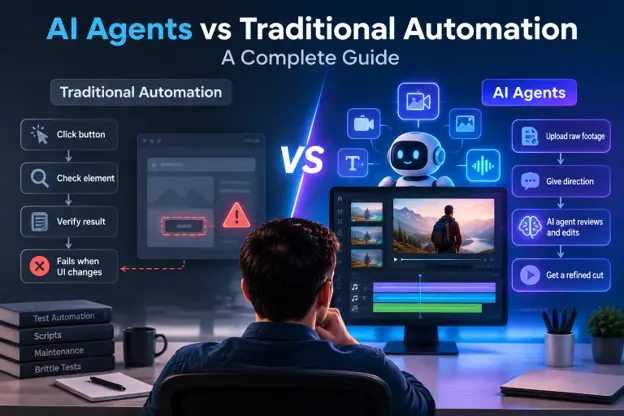
Traditional automation executes a predefined sequence. A test script clicks a specific button, checks for a specific result, and reports pass or fail based on a condition someone wrote in advance. A marketing automation flow sends email B three days after someone opens email A. None of this requires understanding; it only requires correct execution of a rule that a person already worked out.
The strength of this approach is predictability. A well-written automation script does exactly the same thing every time, which is precisely what you want for a repetitive, well-defined task. The weakness is equally direct. The moment reality deviates from what the rule anticipated, a new UI layout, an unexpected input, footage that does not match the exact format a script expects, the automation either fails outright or produces a result nobody actually wanted.
What Makes an AI Agent Different
An agent is given a goal rather than a fixed sequence of steps. Instead of "click this button, check this value," you give it a direction, "verify the checkout flow works," "assemble a cut from this raw footage," and the agent works out how to get there, adjusting its approach based on what it actually encounters.
This is not a minor technical distinction. It changes what happens when the input is messy. A traditional script breaks on the unexpected case, because it has no way to reason about anything it was not explicitly told to handle. An agent evaluates the situation in front of it and makes a judgment call, the way a person would, without needing every possible variation scripted in advance.
Example One: Software Testing
Testing is a useful place to see this play out, because the industry has been living with the limits of traditional automation for years.
A traditional test script checks for exact conditions. It clicks a button at a specific coordinate or selector, and if that element moves, gets renamed, or the page structure changes even slightly, the script fails, whether or not the underlying feature actually works. Maintaining a large automation suite often becomes a job in itself, updating scripts to keep pace with an application that keeps changing underneath them.
An AI agent approaches the same task differently. Rather than checking for one exact element, it can understand the intent behind a test, "confirm the user can complete checkout," and adapt when the page layout shifts, the way a human tester would recognize the same button even if it moved or got a new label. This does not eliminate the need for good test design or human oversight, but it removes a huge amount of the brittle, rule-by-rule maintenance that traditional automation demands.
Example Two: Video Editing
Video editing is a less obvious example, but it shows the same distinction just as clearly, arguably more so, because the "traditional automation" version of editing is something most people have already used.
A template is traditional automation applied to video. You select a preset, footage gets arranged into a fixed pattern, a transition here, a caption style there, and the template executes correctly regardless of what is actually in your footage. It has no understanding of which take was usable, which clip had a mistake in it, or which moment in an hour of raw recording is actually worth keeping. It follows the pattern; it does not review the material.
An agent-based editing workflow works the way the testing example above works. Instead of applying a fixed pattern, the agent actually reviews your raw footage, comparing takes, identifying which version of a repeated line is clean, cutting dead pauses and false starts, and assembling the usable material into a real timeline. This is the same shift from rule-following to judgement that separates an AI agent from traditional automation anywhere else.
Invideo editor is one of the tools built specifically around this distinction. It pairs a professional editing timeline with AI editing agents you can assign real work to, and it is completely free to use, running entirely in the browser. You give the agent your raw footage and your direction, by topic, story, shooting order, or transcript, and rather than executing a fixed template, it reviews the material, picks the usable takes, and hands back a working cut you can inspect, redirect, and refine. For a closer look at how this plays out specifically for video, invideo editor also offers invideo's agentic video editor, where agents watch the footage, work the timeline, and hand back a cut that stays fully yours to redirect.
The Common Shift: From Rules to Context
Software testing and video editing solve very different problems, but both highlight the same limitation of traditional automation. A system built around fixed instructions works well when every situation is predictable. The challenge appears when the input changes, whether that means a redesigned application interface or hours of raw footage with different takes and unexpected moments.AI agents introduce a different approach. Instead of only executing predefined steps, they can evaluate the information available, understand the goal they are working toward, and adjust their actions based on the situation.In software testing, this means understanding the purpose of a test rather than only checking a specific element. Invideo editing, it means analysing footage, identifying useful material, and helping create a starting timeline based on the editor's direction instead of applying a fixed template.The difference is not that AI agents remove human involvement. The value comes from handling the repetitive execution while allowing people to focus on decisions that require judgment, creativity, and context.
What This Means for Choosing Between Them
Traditional automation is still the right tool for genuinely stable, well-defined, repetitive tasks, where the conditions are not going to change and predictability matters more than flexibility. There is no reason to reach for an agent to do something a simple script already handles reliably.
Agents earn their place where the input is messy, variable, or requires judgment that cannot be fully specified in advance. Testing an application that changes shape regularly, reviewing hours of unpredictable raw footage, these are situations where a fixed rule breaks constantly, and where an agent's ability to evaluate and adapt actually saves the manual work a rigid script cannot.
The Bottom Line
The difference between AI agents and traditional automation is not a matter of degree, faster automation or smarter automation. It is a difference in kind. Automation executes; agents evaluate and decide. Testing and video editing make that distinction concrete in two very different domains, but the underlying shift is the same one: from rules that break the moment reality diverges from the script, to a system that actually looks at what it is given and works out what to do with it.
FAQs
1. What is the main difference between AI agents and traditional automation?
Traditional automation follows a fixed, predefined sequence of steps and breaks when conditions deviate from what was scripted. AI agents are given a goal and adapt their approach based on the actual input they encounter.
2. Can AI agents replace traditional automation entirely?
No. Traditional automation remains reliable and efficient for stable, well-defined, repetitive tasks. Agents are better suited to situations involving messy, variable, or unpredictable input that a fixed rule cannot anticipate.
3. How do AI agents work differently in software testing?
Instead of checking for one exact UI element or condition, an agent can understand the intent behind a test and adapt when the application's layout or structure changes, reducing the constant script maintenance traditional automation requires.
4. How is agentic video editing different from using a template?
A template applies a fixed pattern to footage you have already selected. An agent reviews your raw footage directly, identifying usable takes and removing mistakes, the same review work a human editor would otherwise have to do manually.
5. Is there a free tool that uses agents for video editing?
Yes. Invideo editor offers a free, browser-based editing timeline paired with AI agents you can direct to review footage and assemble a working cut from your raw material.


.webp)