


Software testing has evolved dramatically over the past decade. What once relied heavily on manual test execution and rigid automation scripts is now being transformed by intelligent systems capable of learning, adapting, and optimizing themselves. As software ecosystems become increasingly complex, traditional testing approaches struggle to keep pace with rapid development cycles, distributed architectures, and constantly changing user expectations.
The emergence of autonomous AI technologies presents a new opportunity for quality assurance teams. Rather than merely automating repetitive tasks, AI-powered testing solutions can analyze patterns, identify risks, prioritize test cases, and continuously improve testing strategies without extensive human intervention. This shift represents a fundamental change in how organizations approach software quality.
In today's highly competitive digital environment, businesses need testing frameworks that can scale efficiently while maintaining accuracy and reliability. Autonomous testing systems offer a promising solution by combining machine learning, analytics, and intelligent decision-making to create a more proactive quality assurance process.
The Limitations of Traditional Testing Approaches
Conventional testing methods often depend on predefined scripts and static workflows. While these approaches can be effective for predictable environments, they face significant challenges when applications undergo frequent updates.
Common limitations include:
- High maintenance costs for test scripts.
- Delayed identification of critical defects.
- Difficulty adapting to changing application behavior.
- Limited visibility into emerging quality risks.
- Increased testing bottlenecks in agile environments.
As development teams embrace continuous integration and continuous delivery (CI/CD), testing must become faster and more intelligent. Static automation alone can no longer meet the demands of modern software delivery.
The Rise of Autonomous Testing
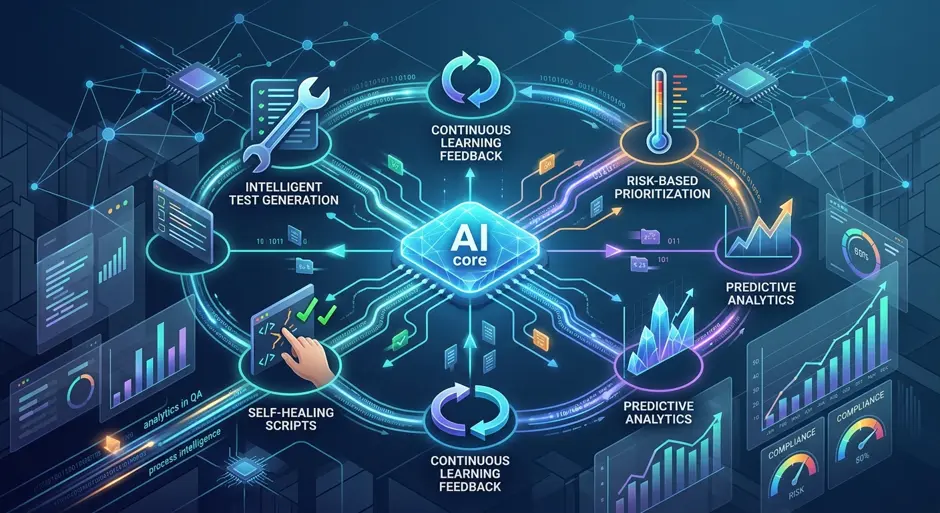
Autonomous testing leverages artificial intelligence to make testing systems more adaptive and self-sufficient. Instead of relying solely on predefined rules, these systems learn from application behavior, historical test results, production incidents, and user interactions.
Key capabilities of autonomous testing platforms include:
Intelligent Test Generation
AI can analyze application workflows and automatically generate relevant test scenarios. This reduces the time required to create test cases manually while improving overall coverage.
Self-Healing Test Scripts
One of the most valuable features of modern testing platforms is the ability to repair broken test scripts automatically. When user interface elements change, AI algorithms can identify alternative locators and continue executing tests successfully.
Risk-Based Testing
Rather than treating every component equally, AI systems evaluate risk factors and prioritize testing efforts where defects are most likely to occur. This enables teams to maximize testing efficiency while minimizing execution time.
Predictive Defect Analysis
Machine learning models can identify patterns associated with historical defects and predict areas of the application that may require additional scrutiny before release.
Creating a Scalable AI Testing Ecosystem
Organizations seeking to maximize the benefits of autonomous testing must develop a scalable technology foundation. This requires integrating testing capabilities into broader digital transformation initiatives.
An effective strategy often involves aligning testing operations with an organization's enterprise ai architecture. A unified AI framework enables testing systems to access shared data sources, machine learning models, monitoring platforms, and governance controls. This integration improves consistency, accelerates model deployment, and enhances visibility across development and operational teams.
When testing solutions operate within a larger AI ecosystem, organizations can gain deeper insights into application performance, customer behavior, and quality trends. This interconnected approach supports continuous improvement while reducing operational silos.
Leveraging Process Intelligence for Better Test Coverage
One of the most significant challenges in software testing is understanding how users actually interact with applications. Many testing teams rely on assumptions that may not reflect real-world usage patterns.
This is where process mining software becomes particularly valuable. By analyzing event logs generated by business systems, organizations can visualize actual workflows and identify bottlenecks, exceptions, and process variations.
For testing teams, process mining offers several advantages:
- Discovery of critical user journeys.
- Identification of under-tested workflows.
- Validation of business process compliance.
- Detection of unexpected system interactions.
- Improved prioritization of test scenarios.
Instead of designing tests based solely on documentation, teams can use process intelligence to align testing efforts with actual user behavior. This leads to more meaningful test coverage and a greater likelihood of identifying defects before they impact customers.
The Role of Analytics in Quality Assurance
Modern testing generates enormous amounts of data. Test execution results, defect reports, performance metrics, deployment logs, and user feedback all contribute valuable information.
However, collecting data alone is not enough. Organizations must transform raw information into actionable insights.
Advanced analytics platforms can help testing teams:
- Measure quality trends over time.
- Forecast testing requirements.
- Detect recurring defect patterns.
- Evaluate release readiness.
- Optimize resource allocation.
The integration of analytics into testing workflows creates a feedback loop that continuously enhances decision-making. As AI systems consume more operational data, their recommendations become increasingly accurate and valuable.
Extending Testing Intelligence Across Business Functions
Quality assurance does not exist in isolation. Software quality often depends on the effectiveness of interconnected business processes.
For example, procurement systems play a critical role in enterprise operations. Errors within supplier management, purchasing workflows, or financial integrations can have significant downstream consequences.
Organizations can improve testing effectiveness by leveraging insights generated through procurement analytics software. These platforms provide visibility into purchasing activities, vendor interactions, compliance metrics, and transaction flows.
By incorporating procurement intelligence into testing strategies, teams can:
- Validate complex business workflows.
- Identify high-risk transaction paths.
- Simulate real operational scenarios.
- Detect integration vulnerabilities.
- Improve compliance testing coverage.
This broader perspective enables quality assurance teams to evaluate software performance within the context of actual business operations rather than isolated technical environments.
Continuous Learning and Feedback Loops
One of the defining characteristics of autonomous testing systems is their ability to learn continuously.
Traditional automation often remains static until manually updated. AI-powered systems, however, evolve over time by analyzing:
- Production incidents.
- User behavior changes.
- Application modifications.
- Test execution outcomes.
- Infrastructure performance metrics.
These feedback loops create a dynamic testing environment capable of adapting to changing conditions automatically.
As organizations deploy more autonomous capabilities, testing frameworks become increasingly effective at identifying risks before they impact users.
Governance and Ethical Considerations
While AI-driven testing offers substantial benefits, organizations must establish appropriate governance structures.
Important considerations include:
Transparency :- Teams should understand how AI models make decisions regarding test prioritization and defect prediction.
Data Quality :- The effectiveness of machine learning models depends heavily on the quality and accuracy of training data.
Security :- Testing platforms often access sensitive application and business information. Robust security controls are essential.
Human Oversight :- AI should augment human expertise rather than replace it entirely. Quality professionals remain responsible for strategic decisions, validation, and continuous improvement initiatives.
A balanced approach ensures that organizations can leverage AI effectively while maintaining accountability and trust.
Future Trends in Autonomous Testing
The future of software testing will likely be shaped by increasingly sophisticated AI capabilities.
Emerging trends include:
- Generative AI-powered test creation
- Autonomous exploratory testing
- Real-time production validation
- AI-driven performance engineering
- Intelligent root cause analysis
- Adaptive security testing
As these technologies mature, testing will become less reactive and more predictive. Instead of simply identifying defects after they occur, autonomous systems will proactively prevent quality issues from emerging in the first place.
Organizations that invest in intelligent testing today will be better positioned to manage future software complexity while accelerating innovation and improving customer experiences.
Conclusion
Autonomous testing represents a significant advancement in software quality assurance. By combining artificial intelligence, machine learning, and advanced analytics, organizations can build testing systems that continuously learn, adapt, and improve. These capabilities enable faster releases, stronger quality outcomes, and greater operational efficiency. As software environments continue to grow in complexity, self-optimizing testing frameworks will become an essential component of modern digital transformation strategies, helping organizations deliver reliable and resilient applications at scale.

.webp)