

A marketing team we spoke with recently described their video review process the same way most teams eventually do: someone watches every clip before it goes anywhere. Checking for a bad take, a sync issue between audio and picture, an exposure problem that only shows up on a second viewing. That review step rarely gets automated, mostly because nobody thinks to ask whether it can be.
Software teams solved a version of this problem years ago. Automated testing exists precisely because manually checking every build for regressions does not scale. Video is starting to go through the same shift. AI tools can now review raw footage the same way a QA process reviews a build, catching issues before a human ever has to sit through the material themselves.
What "Quality" Actually Means in Raw Footage
Before automating a check, it helps to define what is actually being checked. In raw video, quality issues tend to fall into a few consistent categories.
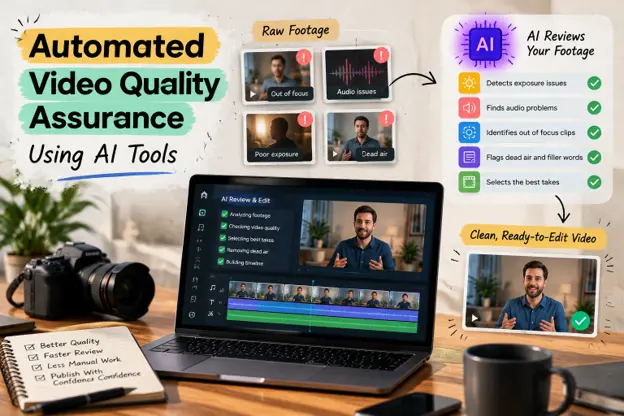
Technical issues. Exposure that drifts across a shot, audio that clips or drops out, footage that is out of focus, or a take where the audio and video have fallen out of sync.
Continuity issues. Lighting or color that shifts noticeably between takes of the same scene, or footage from different angles that does not match visually once assembled.
Content issues. A take where the speaker misspoke, restarted a sentence, or included a long pause that would read as dead air in the finished video. Technically clean footage that is still unusable because of what happened during the take.
Most manual review processes catch these the same way manual QA used to catch bugs, by watching everything and hoping nothing slips past.
Why Manual Review Does Not Scale
The problem is not that reviewing footage is hard. It is that it is repetitive, and repetitive tasks done by hand get inconsistent the more of them there are.
A reviewer who is sharp on the first hour of footage is not necessarily as sharp on the fourth. A small audio glitch buried in the middle of a long take is easy to miss once, and easy to miss again on a rewatch that is really just confirming what was already assumed. This is the same failure mode that made manual software testing unreliable at scale, a human checking the same category of thing over and over eventually starts checking it less carefully, not because they are careless, but because vigilance genuinely degrades with repetition.
How AI Tools Are Automating the Review Step
An AI-driven review works differently because it applies the same level of attention to the first minute of footage and the last. It does not get tired, and it does not start skimming after the tenth take of the same line.
In practice, this looks like an agent reviewing uploaded footage and flagging or handling categories of issues automatically. Comparing multiple takes of the same section and identifying which version is clean. Detecting dead air, filler words, and false starts. Recognizing footage types, scripted, unscripted, multicam, and applying the right kind of review logic to each rather than treating every clip identically.
This does not replace human judgment about what the footage should ultimately look or feel like. It replaces the exhausting part, the actual watching, comparing, and flagging that happens before any creative decision gets made.
Where This Fits Into an Editing Workflow
Video quality review is most useful when it happens as part of the same workflow as the edit itself, rather than as a separate check that happens before or after. Invideo editor is one of the tools built around this idea, pairing a professional editing timeline with AI editing agents you can assign real work to, and it is completely free to use, running entirely in the browser.
Instead of manually reviewing footage before you start editing, you upload the raw material and direct an agent, and the review happens as part of assembling the timeline. The agent compares takes, identifies what is usable, and catches the kind of issue a tired reviewer might miss on a fifth pass through the same recording. This is the same category of repetitive editing work invideo editor's agents are built to take on, so the review does not sit as a separate manual step before the real editing begins. You can edit videos with AI directly, describing the result you want while the agent handles the review and assembly work underneath it, and switching to the manual timeline whenever a specific decision needs a human hand.
What Automated Review Still Gets Wrong
Automated review is not infallible, and treating it as a replacement for any human check at all is its own kind of mistake, the same one teams learned to avoid with automated software testing.
Context still matters in ways an agent can misjudge. A pause that reads as dead air in one take might be a meaningful beat in another, depending on what is being said around it. A take an agent flags as technically imperfect might still be the one with the best delivery, a judgment call that requires actually understanding what the footage is for, not just what is measurably wrong with it.
The reasonable approach treats automated review as a first pass that removes the bulk of the repetitive checking, with a human doing a final pass on what the agent flagged or assembled, rather than either extreme of reviewing everything by hand or trusting an automated pass completely.
Building a Review Process That Actually Holds Up
A few principles carry over directly from how software teams built reliable QA processes, applied to video instead of code.
Define what "quality" means for the specific project before reviewing anything, since a technically perfect take with a flat delivery is not always the right take, and a rule that only checks for technical issues will miss that. Treat automated flags as a starting point, not a final verdict, the same way a failed test case gets investigated rather than assumed correct. And keep a human doing a final pass on anything customer-facing, even when the automated review has already done most of the work, because judgment about fit and feel is still something a person needs to confirm.
The Bottom Line
Manual review does not scale, in video any more than it does in software, because repetitive attention-heavy work is exactly the kind of task humans get worse at the more of it they do. Automating the review step does not remove judgment from the process. It removes the exhausting part that was making judgment harder to apply consistently in the first place, leaving the actual decisions to a person who is not several hours into watching the same category of footage.
FAQs
1. What does automated video quality assurance actually check for?
Technical issues like exposure, sync, and audio problems, continuity issues like lighting or color mismatches across takes, and content issues like restarted lines, dead air, and filler words.
2. Can AI fully replace manual video review?
No. Automated review reliably catches repetitive, well-defined issues, but judgment calls about tone, delivery, and fit for the project still benefit from a human doing a final pass.
3. Why does manual footage review become unreliable at scale?
Attention naturally degrades with repetition. A reviewer catches less on the tenth similar clip than the first, the same failure pattern that made manual software testing unreliable before automated testing became standard.
4. How does AI-driven footage review fit into an editing workflow?
Rather than reviewing footage as a separate step before editing, an AI agent can review raw material as part of building the timeline, flagging or handling issues while assembling a working cut.
5. Is there a free tool for AI-assisted video review and editing?
Yes. Invideo editor offers a free, browser-based timeline with AI agents you can direct to review footage and handle repetitive editing work, including the review step itself.


.webp)