

Every team wants faster releases. But picking the wrong testing tools can slow you down more than no automation at all flaky tests, broken selectors, and endless maintenance eating into your sprint velocity. In an AI-driven development world, your software testing workflow needs to keep pace with your deployment speed.
The problem is that nearly every tool on the market now calls itself "AI-powered." Some genuinely are. Others have slapped a chatbot on top of a five-year-old recorder and called it a day. This guide cuts through that noise.
Below, you'll find the 8 best AI Testing Tools in 2026, what each one actually does, where it falls short, and most importantly, when your team should use it. No filler. No vendor hype.
What Makes an AI Testing Tool Actually Good in 2026?
Before we get into the list, here's the filter we used to evaluate every tool across the entire software testing lifecycle.
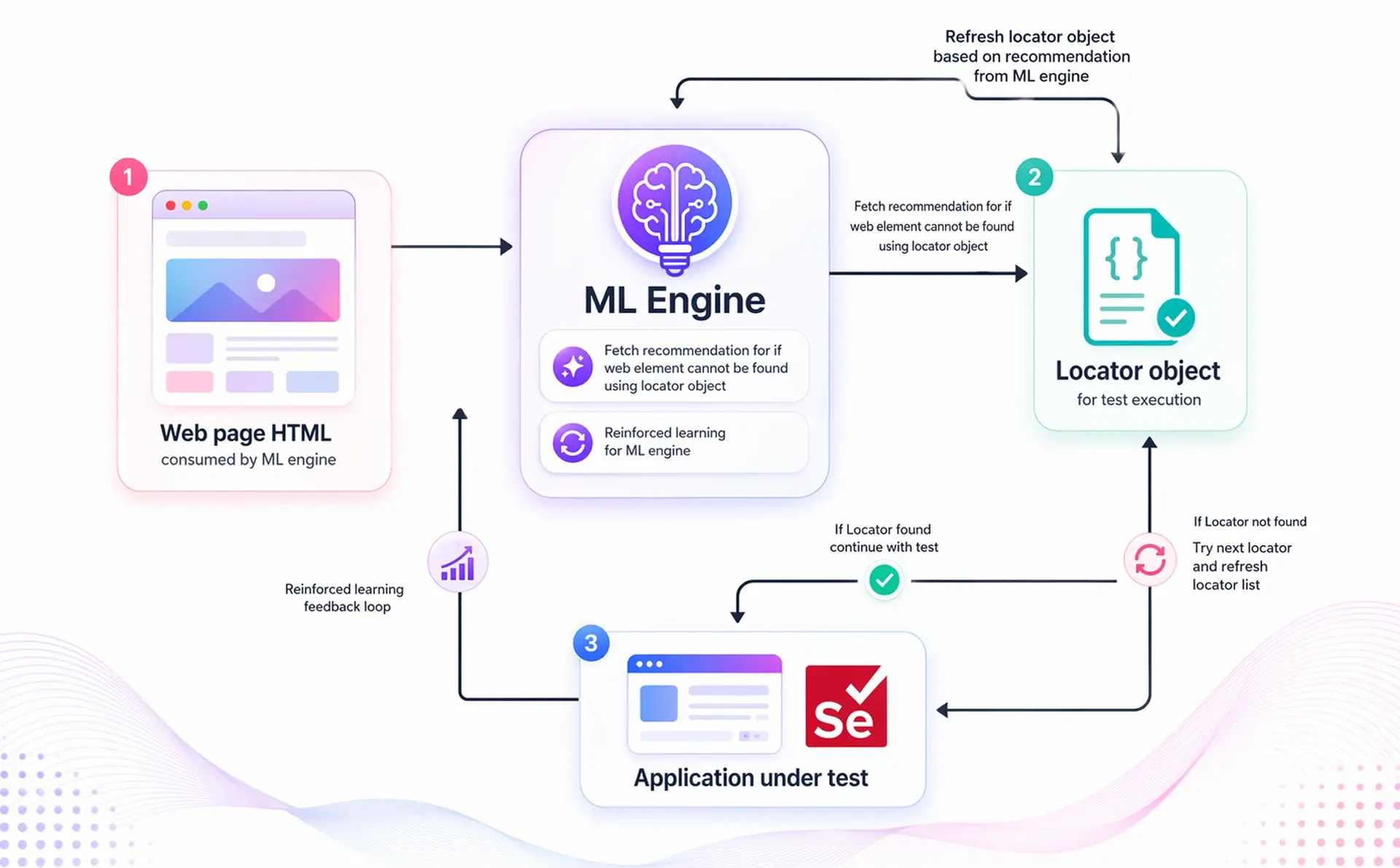
Self-healing tests When your UI changes, do tests break silently and wait for a developer to fix them? Or does the tool adapt automatically? Genuine AI-powered testing platforms heal themselves. Script wrappers don't. Real self-healing tests detect when an element has moved or changed and update their own logic without human input.
CI/CD workflows Good QA automation lives inside your pipeline. It runs on every pull request, blocks bad deployments, and fits into GitHub Actions, Jenkins, or GitLab without a custom middleware layer. Solid ci testing is what turns a QA tool into a genuine quality gate across your CI/CD workflows and CI/CD pipelines.
Maintenance burden and test coverage This is the one nobody talks about honestly. Creating tests is easy. Maintaining test coverage as your app evolves is where most teams quietly give up. The best tools in 2026 reduce that tax significantly and give you reporting and insights that make gaps visible before they become production bugs.
The 8 Best AI Testing Tools in 2026
1. QA Wolf
QA Wolf is an agentic testing platform that specialises in autonomous test generation it produces production-grade Playwright code and Appium scripts directly from natural language prompts. You describe what you want tested; it handles test case creation end-to-end, writing actual code your team can review, version, and run in CI/CD.
What makes it stand out is the managed service layer. QA Wolf doesn't just give you a tool, they give you a team that builds and maintains the tests for you. This is why enterprises with high test coverage requirements gravitate toward it.
Key AI feature: Specialised agents handle mapping, code generation, and maintenance separately each optimised for its stage of the automated testing workflow.
Limitation: Less control for teams that want to own every line of test scripts themselves.
When to use it: When test maintenance is your single biggest pain point and you'd rather outsource test case creation entirely than manage another platform in-house.
2. Mabl
Mabl is an AI-assisted low-code platform built for web application testing. It sits in the middle ground between fully autonomous and fully manual your team still defines what to test, but Mabl's AI dramatically reduces self-healing test maintenance overhead.
Its learning model accumulates execution history across every run and uses that data to predict and prevent failures before they surface in test results. For teams running hundreds of test cycles per week, this compounding intelligence is genuinely valuable. Reporting and insights are also a strong suit Mabl surfaces failure patterns across runs in a way that makes root cause analysis faster.
Key AI feature: Auto-healing that adapts to UI changes without requiring manual selector updates reducing self-healing test maintenance to near zero for stable apps.
Limitation: Teams with no existing automation in place may find the onboarding curve steeper than expected.
When to use it: When you already have some QA automation set up and want to make it more resilient without rebuilding your entire test suite from scratch.
3. BrowserStack Low-Code Automation
BrowserStack Low-Code Automation is an AI-powered low-code testing platform that lets teams create and run automated tests without writing test scripts. Testers can generate test cases from requirements or natural language prompts, convert them into low-code automated tests, and execute them across real desktop and mobile browsers in the BrowserStack cloud.
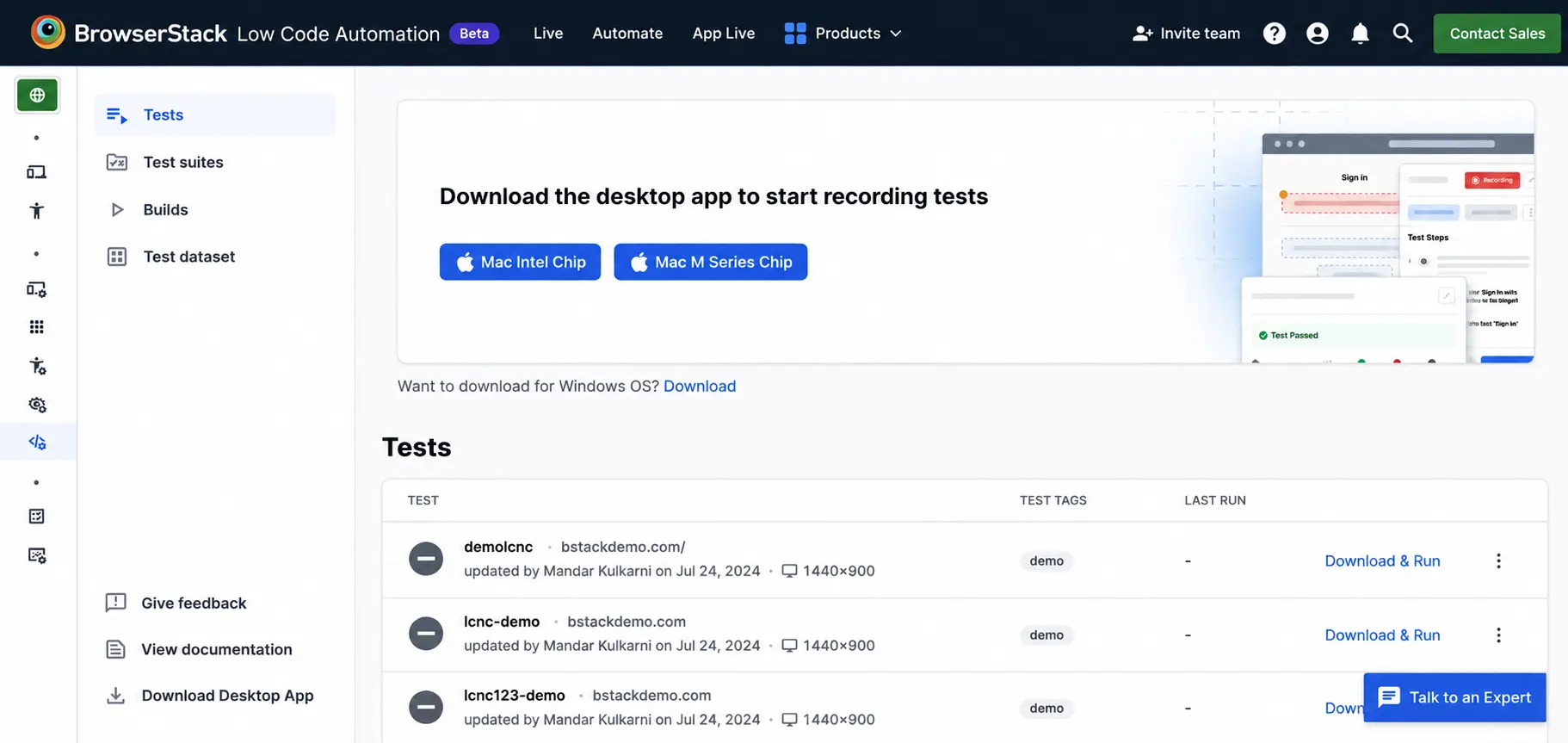
Its AI capabilities also help with the maintenance side of automation. The platform can automatically heal tests when UI or workflow changes break them, while its test failure analysis helps identify failure types and possible fixes. This makes it useful for teams that want to increase automation coverage without taking on the maintenance burden of fully coded test suites.
Key AI feature: AI-assisted test generation and authoring combined with self-healing automation and test failure analysis.
Limitation: Teams that need full framework-level control over code may prefer a code-first automation approach.
When to use it: When you want low-code browser automation with AI-assisted test creation, self-healing, and cloud-based cross-browser execution.
4. Testsigma
Testsigma is a cloud-based codeless test automation platform built around Natural Language Processing. Its AI assistant, Atto, lets testers describe test cases in plain English "click the login button, enter username, verify dashboard loads" and convert that into executable automation across test environments.
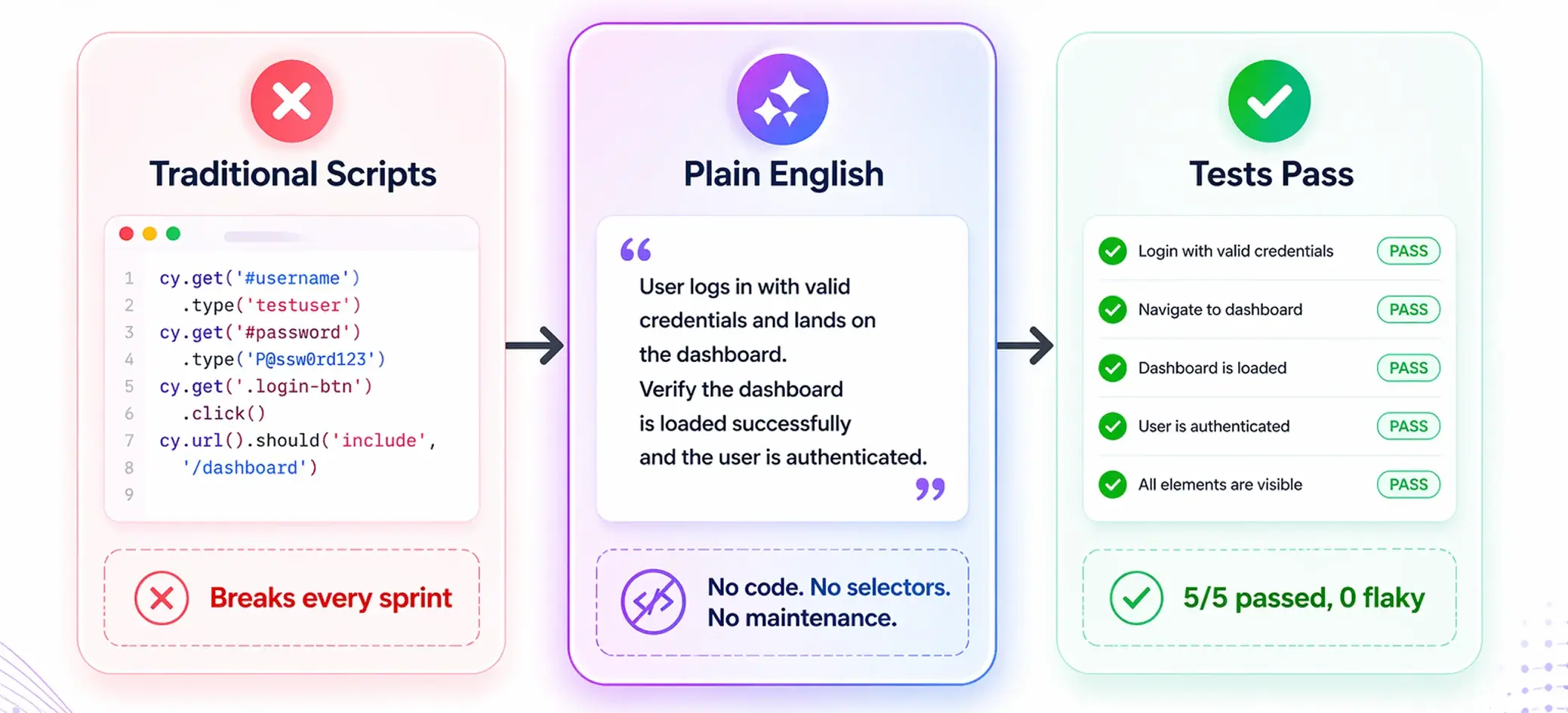
AI test case generation is where Testsigma genuinely delivers. Rather than recording clicks or writing selectors, testers describe intent and the platform handles the rest. It covers web, mobile, API, and desktop testing from a single interface, which matters for teams tired of juggling separate tools. The self-healing tests engine catches and repairs broken selectors automatically before they fail in CI.
Key AI feature: Natural Language Processing-powered test authoring that non-technical team members can actually use without any training.
Limitation: Teams needing deep customisation, custom test data injection, or framework-level control may hit the ceiling of what codeless allows.
When to use it: When your QA team doesn't have strong coding skills but needs solid functional testing and test coverage across web and mobile fast.
5. Katalon Studio
Katalon Studio is the closest thing the market has to a true all-in-one test management platform. It covers manual testing, automated web testing, mobile testing, api testing, visual testing, and performance testing with AI layered throughout for test generation, self-healing, and failure analysis.
Its StudioAssist feature uses Generative AI testing capabilities to help teams write, explain, and debug test scripts including automated test creation from requirements documents. TrueTest, its newer module, autonomously explores your web app to identify test cases your team may have missed entirely bringing genuine AI test case generation to an already mature platform.
Key AI feature: AI assistance across the full software testing lifecycle not just test creation, but also debugging, visual testing, and test coverage gap detection.
Limitation: Katalon's AI enhances what you define; it doesn't independently own your test planning or quality strategy.
When to use it: When your team needs one platform that handles every test type and skill level from no-code recording to full scripting without managing multiple QA tools.
6. Applitools
Applitools specialises in visual testing and visual regression detection catching UI regressions that functional tests miss entirely. It uses computer vision to compare screenshots across browsers and devices examining test steps at a visual level filtering out rendering noise while flagging genuine UI validation failures. This is what true visual AI testing looks like in practice.
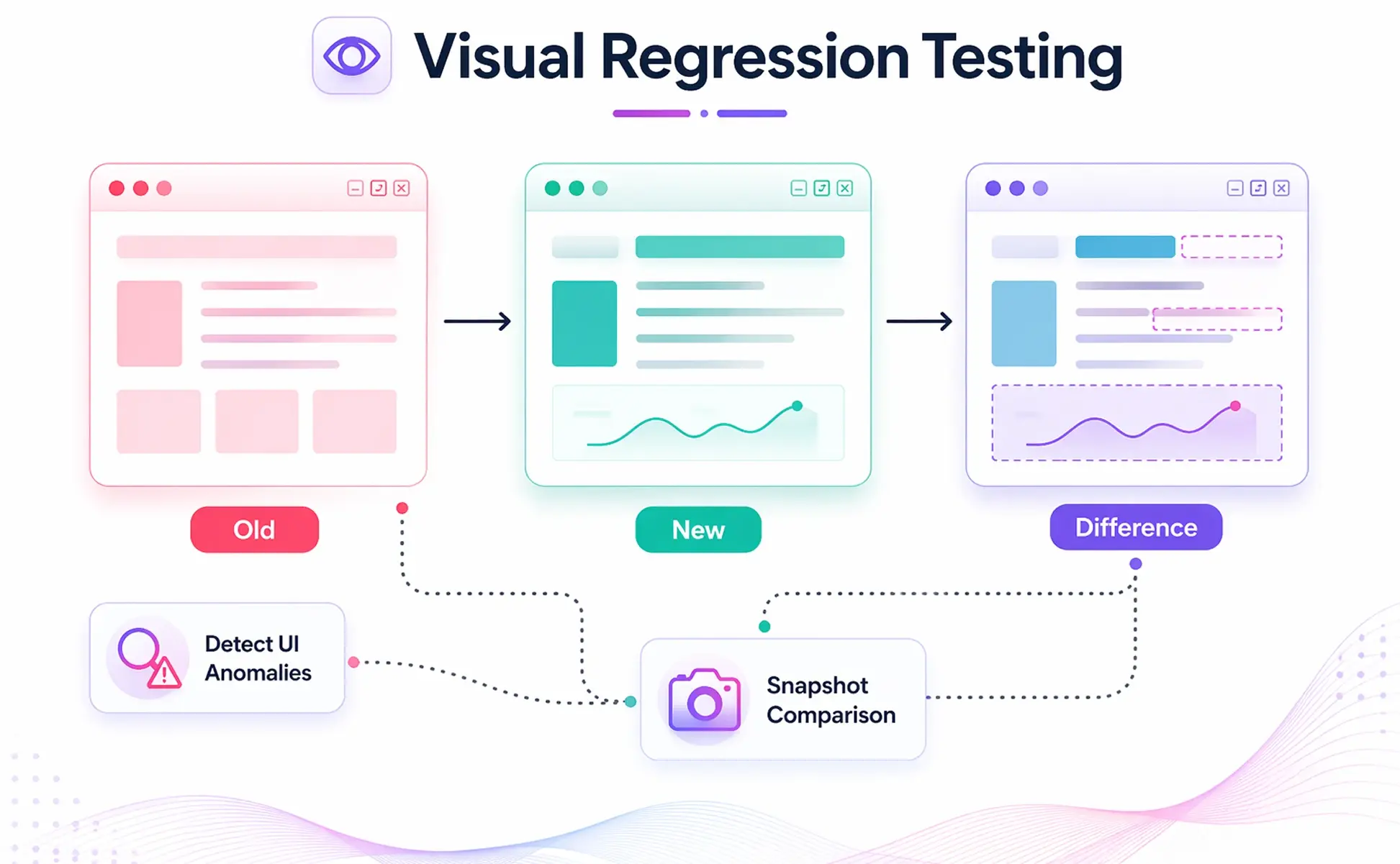
Its Ultrafast Grid runs visual testing across thousands of browser and device combinations in parallel, making it particularly powerful for teams where cross-browser consistency is a competitive differentiator. For apps going through a UI redesign, Applitools makes it possible to validate hundreds of screens in minutes rather than days of manual review.
Key AI feature: Visual AI that understands what "looks wrong" contextually rather than doing pixel-by-pixel comparison dramatically reducing false positives in visual regression detection.
Limitation: Applitools is a visual validation layer, not a full end-to-end automation platform. You'll need a separate tool for functional test coverage.
When to use it: When UI testing consistency, visual regression detection, and UI validation across browsers and devices are your primary quality assurance concern.
7. Testim
Testim uses machine learning and smart locators to stabilize web UI tests as your interface evolves. Its self-healing execution engine finds alternative element recognition strategies mid-run when the original locator stops working meaning tests adapt rather than fail. Regression validation becomes far more reliable when your test suite can handle UI changes without constant manual attention.
Its Agentic Test Automation feature builds complete tests from natural language, while the Testim Copilot generates custom code steps using generative AI. Self-Healing Automation is genuinely built into the architecture here, not bolted on as a feature.
Key AI feature: ML-powered self-healing execution that identifies alternative locator strategies when the original approach fails keeping your regression validation suite stable through UI changes.
Limitation: Runs tests in a proprietary environment, which means your broader QA process and coverage strategy still sit with your team.
When to use it: When flaky selectors are your most frequent source of test failures and Self-Healing Automation is the specific capability you need.
8. TestRigor
TestRigor takes a different architectural approach entirely. Instead of selectors, it uses plain English commands to interact with your application eliminating the selector dependency that makes traditional automation brittle. When the UI changes, there are no selectors to break.
This makes regression testing and edge-case coverage dramatically less painful. Teams report eliminating entire categories of self-healing test maintenance by removing selectors from the equation. Human validation logic is preserved tests describe what a user would do and expect, not how the DOM is structured.
Key AI feature: Goal-based test execution that navigates your app by intent making edge-case coverage accessible without deep technical knowledge of the underlying codebase.
Limitation: Less suited for teams that need to produce portable, reviewable Playwright code output they can own and version independently.
When to use it: When brittle locators and selector maintenance are consuming more engineering time than actual feature work and your QA process needs a reset.
9. Virtuoso QA
Virtuoso is built as a fully AI-augmented testing tools platform from the ground up, not a legacy tool with AI added on top. Its Natural Language Programming layer allows any team member to write tests conversationally, and its Live Authoring feature converts those into executable automation in real time. Teams exploring similar solutions can also use an AI tools directory to discover other AI-powered testing and automation platforms. For mobile-first teams, it also handles native mobile test environments alongside web.
For enterprise teams running complex applications, Virtuoso's Self-healing AI and autonomous maintenance reduce the overhead that typically makes large test suites unmanageable. It also supports open-source AI testing tools integrations for teams that want flexibility in their stack.
Key AI feature: Self-healing AI that owns the entire testing lifecycle from AI test case generation to diagnosing failures without requiring human scripting at any stage.
Limitation: Enterprise pricing and implementation complexity make it less accessible for smaller or faster-moving teams.
When to use it: When you're an enterprise team that needs full lifecycle AI-powered testing with zero scripting, strong quality assurance governance, and the budget to match.
Quick Comparison Which Tool Fits Your Situation?
Not sure which one to start with? Use this table.
Conclusion
The right AI Testing tool in 2026 isn't the one with the most features or the boldest marketing, it's the one that directly addresses where your testing workflow is breaking down today.
If your tests are brittle, pick a tool that eliminates selectors. If your team can't code, pick a tool built on Natural Language Processing. If maintenance is the tax you can't afford, pick a platform with genuine Self-healing AI. Match the tool to your bottleneck, not to a generic top-ten list. A clear test strategy before you pick any tool will save you more time than any individual platform ever will.
Start with a free trial from whichever option matches your situation in the comparison table above most offer enough access to know within a week whether it's the right fit for your automated testing workflow and team.
FAQs (People Also Ask)
Q1. Are these AI testing tools beginner-friendly?
Ans: Most of them are. Tools like Testsigma and testRigor are specifically built for testers who don't write code. BrowserStack Low-Code Automation also lets teams create automated tests without coding, while AI features help with test creation and maintenance. Tools like QA Wolf and Katalon Studio have more depth but also offer guided onboarding for new users.
Q2. How much do these AI testing tools cost?
Ans: Most tools on this list offer a free trial or a free tier to get started. Paid plans typically range from $50 to $500+ per month depending on team size and features. Enterprise tools like Virtuoso QA are custom-priced. Always start with a free trial before committing.
Q3. Can these tools test mobile apps, not just websites?
Ans: Yes, several can. QA Wolf supports Appium for mobile, Testsigma covers web, mobile, API, and desktop from one platform, and Virtuoso QA handles native mobile environments. If mobile testing is a priority, Testsigma or QA Wolf are your best starting points.
Q4. Will switching to an AI testing tool break my existing test suite?
Ans: Not necessarily. Tools like Mabl and Testim are designed to work alongside existing automation you don't have to start from scratch. If you're rebuilding entirely, tools like testRigor or QA Wolf make the transition smoother since they don't rely on your existing selectors or scripts.
Q5. How long does it take to see results after setting up an AI testing tool?
Ans: Most teams see meaningful results within 2 to 4 weeks. Simple test suites can be up and running in days. The bigger time investment is defining what to test, not the setup itself. Tools with managed services like QA Wolf can cut that timeline significantly.

.webp)
.webp)