

By 2026, it will no longer be a choice for organisations to provide dependable software to their clients. In order for them to continue providing this service to their clients on a global scale, companies are making substantial investments in quality assurance (QA) as ERP systems need to have effective and efficient releases, by protect client trust, and improve long-term client satisfaction. This quality assurance guide from Frugal Testing explores how QA fits into the software development process, as well as the many tools and methodologies available to companies to manage QA by effectively managing quality, costs, and risk.
Understanding Quality Assurance Services in Modern Software Delivery
Quality Assurance Services Confirm Software Meets Functionality, Security, Performance, and Usability Standards. QA is Embedded in the Software Development Process Throughout, which Enables Early Defect Prevention and Enhances the User Experience.
- Quality Assurance Associations Development with Quality Management Systems
- Quality Assurance Provides Structure and Processes Through Workflows, Audit Logs, and Measurement Systems
- Quality Assurance Supports Proactively Identifying and Mitigating Risks
At Frugal Testing, QA is a Continuous Process, not a Box to Check After the Product is Delivered to Market. This allows Organisations to Build Digital Products That Are Scalable and Resilient.
Definition of Quality Assurance in Software Engineering
Quality Assurance software offers a systematic framework for confirming the quality of all aspects of the software production process, as well as the end product, to meet set quality criteria. Instead of simply trying to find defects after they occur, Quality Assurance focuses on preventing defects from happening during the course of production.
- Defines and establishes the policies, standards and governance of Quality Assurance
- Defines and develops a strategy for testing software based upon the overall business objectives
- Ensures compliance with both internal and external laws/regulations
Whereas a Quality Assurance program creates predictable relationships and builds trust and confidence among team members, it also builds a foundation for increased stability of the end product over time.
Quality Assurance vs Quality Control vs Testing Explained Clearly
The difference between Quality Assurance, Quality Control, and Testing allows an organization to appropriately layout who does what within the organization in relation to quality.
- Quality Assurance includes process focus, prevention, and strategy.
- Quality Control is focused on a product in relation to inspections.
Testing is the act of executing the responsibilities assigned to a Quality Assurance Engineer.
Testing is just one component of the overall quality system called 'Quality Assurance'. Total quality includes creating and maintaining disciplined processes and implementing continuous improvement methods.
Importance of QA Services for Business Growth and Customer Trust
Customers are satisfied, return to a business based upon their experience, and establish a positive brand image via high-quality software, while poor quality can lead to churn, increased support costs and operations risk.
- QA prevents failures and rollback events in production
- QA enhances customers' usability and experience
- QA allows a company to automate processes, enabling them to scale confidently
Companies with well-established QA practices achieve greater reliability and faster time to market than their competitors.
The QA Testing Process Across the Software Lifecycle
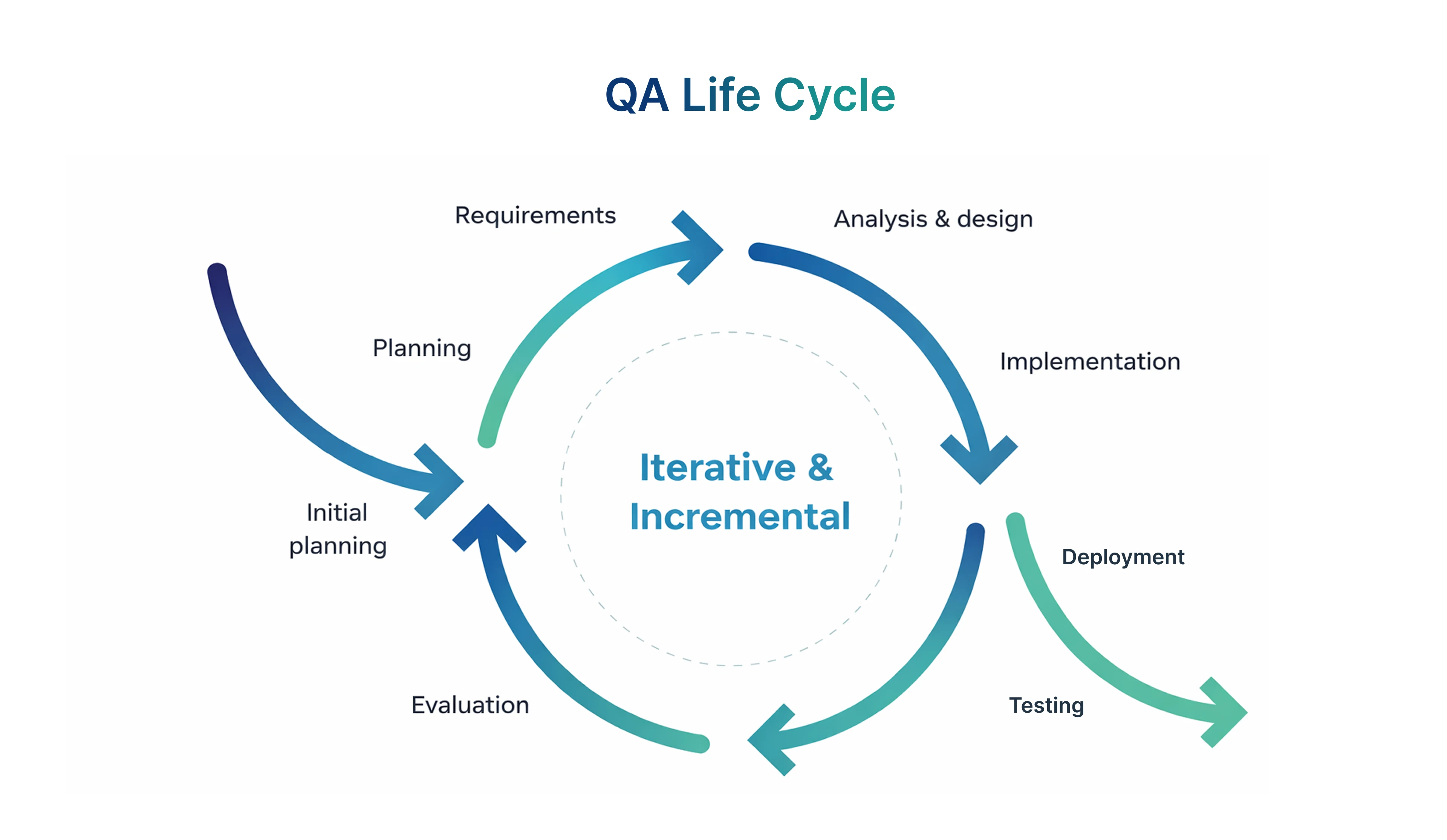
With a structured approach,Each lifecycle phase includes planning and validation, with an actionable phase of execution that supports continuous improvement throughout. These phases provide teams with the tools and techniques to eliminate risk, optimise resources, and create quality products for their customers' needs and expectations.
1. Initial Planning
Defines the overall QA goals, scope, timelines, resources, and feasibility of testing activities.
2. Requirements Analysis
Understands and reviews business and functional requirements to identify testable conditions and risks.
3. Test Planning
Creates the test strategy, selects tools, defines roles, schedules, and prepares the test plan document.
4. Analysis & Design
Designs test scenarios, test cases, test data, and traceability matrices based on requirements.
5. Implementation
Develops and organizes test cases, scripts (manual/automation), and prepares the test environment.
6. Testing (Execution)
Executes test cases, logs defects, retests fixes, and performs regression testing.
7. Deployment
Supports release validation, smoke testing, and ensures quality readiness before production.
8. Evaluation
Reviews test results, defect metrics, and process effectiveness; documents lessons learned for improvement
QA pipeline will allow an organization to achieve quality consistency, find problems as soon as possible, and maximize testing efforts. A defined process for various stages of QA, when incorporated into Agile and DevOps methodologies, will improve the overall quality of releases and provide a mechanism for ongoing enhancements based on user feedback and evaluations, resulting in an improved customer experience, increased success of products in the marketplace, and ongoing viability of the product.
Key Phases of QA Testing and Their Outcomes
The Value of Each Phase of the QA Testing Lifecycle
- Clear understanding of project requirements and quality expectations
- Well-defined test strategy, plans, and reusable test assets
- Early identification and prevention of defects
- Improved software reliability, performance, and security
- Reduced rework cost and faster release cycles
- Traceability between requirements and test coverage
- Stable and defect-free deployment to production
- Continuous process improvement through evaluation and metrics
- Increased customer satisfaction and confidence in the product
Each part of this lifecycle creates value by providing a thorough and thoughtful structure for auditing and operational consistency.
Overview of the QA Testing Process in CI/CD Environments
The integration of QA in CI/CD allows automated checks at each step of the way.
- Automated unit and API tests are run as soon as code is committed.
- Smoke and regression testing is performed during the build process.
- Performance and security testing occurs before moving into production.
Being able to incorporate QA with CI/CD provides greater confidence to developers that their releases are more stable, and it enables faster feedback cycles.
QA Methodologies and Approaches Used in 2026
Choosing the right QA methodology depends on project complexity, regulatory needs, and release frequency.
- Agile QA for rapid iteration
- Waterfall QA for compliance-heavy projects
- V-Model for traceability
- DevOps QA for continuous delivery
Most organizations adopt hybrid models that combine flexibility with governance.
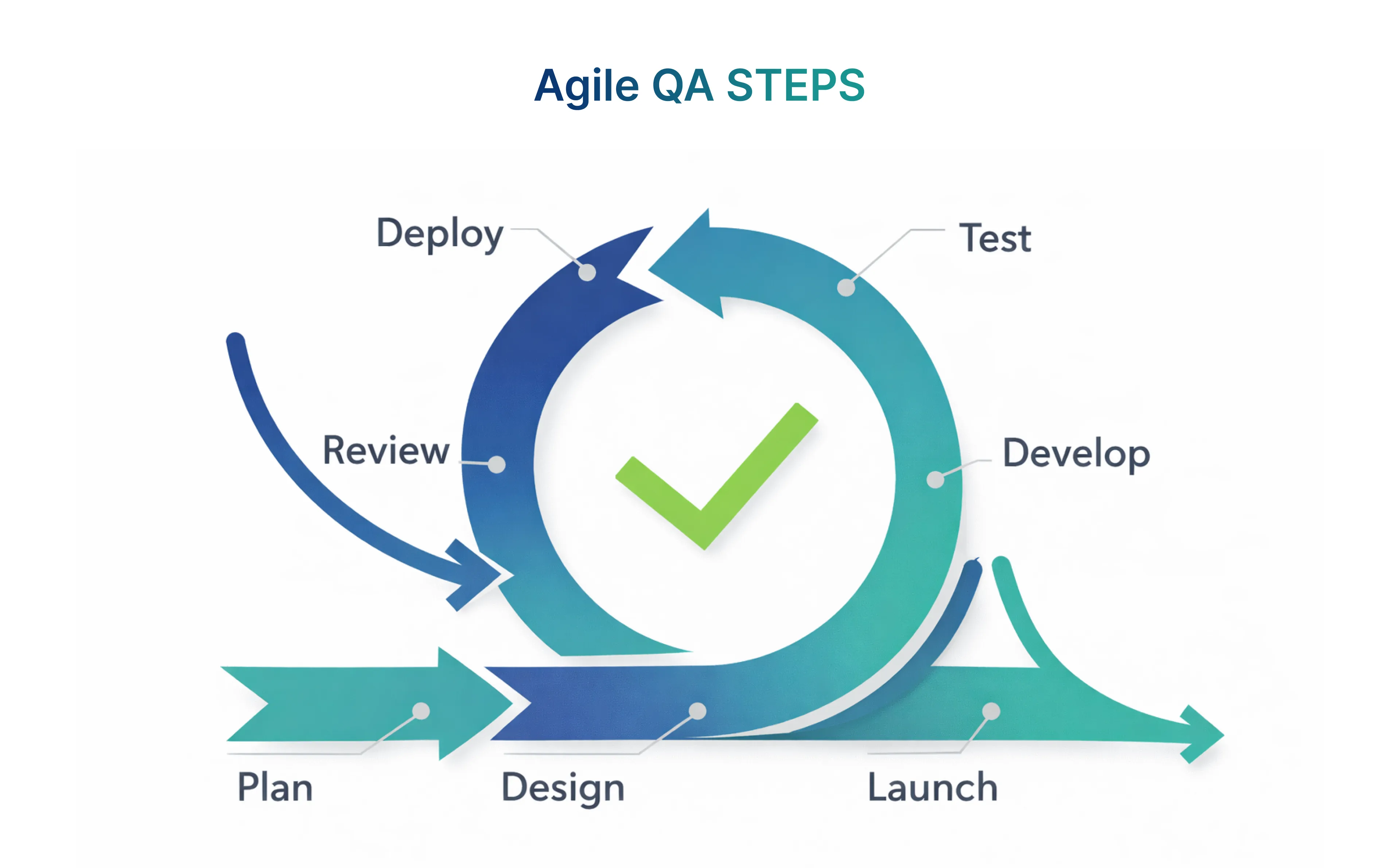
Agile QA Methodology for Continuous Improvement
Agile QA integrates QA Engineers directly into sprint teams to ensure early validation.
- QA participates in planning and backlog refinement
- Test cases are derived from user stories
- Automated acceptance tests validate sprint outcomes
This approach improves collaboration and speeds up delivery without sacrificing quality.
Waterfall QA Methodology for Structured Projects
Waterfall QA emphasizes documentation, formal reviews, and sequential testing phases.
- Ideal for regulated industries
- Strong alignment with quality management systems
- Clear traceability and approval workflows
While slower, it provides high control and predictability.

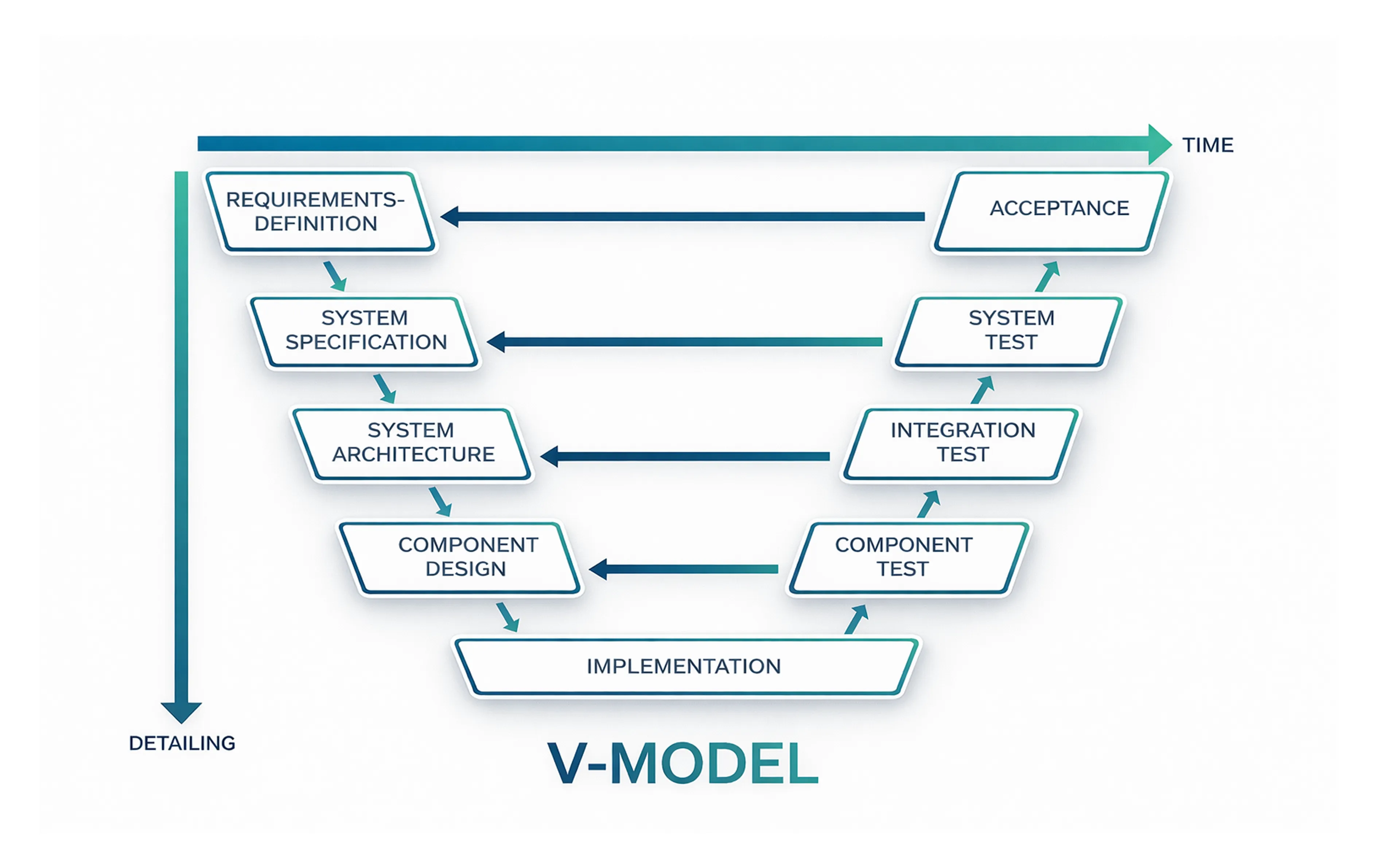
V - Model QA Methodology for Risk-Based Validation
The V-Model aligns development and testing activities to support strong Risk Management.
Early test planning reduces late-stage surprises,Strong mapping between requirements and tests,Ideal for mission-critical systems,It ensures that every requirement is validated systematically.
DevOps and Continuous Testing for Faster Releases
DevOps QA embeds testing into deployment pipelines to support Continuous Integration and continuous delivery.
Automated testing at every pipeline stage,Real-time feedback to developers,Reduced defect leakage into production.
Continuous testing is now a baseline expectation for competitive software teams.
Types of QA Testing and Their Role in User Experience
A comprehensive QA strategy includes multiple testing types, each addressing different risks.
- Functional testing validates features
- Non-functional testing ensures performance and security
- Acceptance testing validates business readiness
Together, they ensure a smooth and reliable user experience.
Manual vs Automated Testing in Modern QA Programs
Both methods when used strategically complement each other.
Manual Testing is superior in areas such as exploratory and usability testing.Automated Testing can rapidly and repeatedly verify a product's quality,Hybrid Testing Strategies will provide the highest overall return on investment,By automating as much of the testing as possible, QA Engineers can spend more time on higher-value testing activities.
Common Types of QA Testing Explained
Key testing types include:
Manual Testing
Testing is performed by a human without automation tools to validate functionality, usability, and user experience.
Automated Testing
Test cases are executed using tools or scripts to improve speed, accuracy, and repeatability of testing.
Continuous Testing
Testing is integrated into the CI/CD pipeline to provide fast feedback at every stage of development.
Functional testing:-A function of performance and compatibility for the software features to meet the requirements and business logic.
- Unit testing:-For testing purposes, unit testing is performed on each of the individual components or sections of code written for a software application to assure that each component works as specified when it is isolated from the rest of the program.
- Integration testing:-Performing integration testing checks the interaction/flow of data between one or more integrated modules or systems.
- System Testing: Validates the complete system in a production-like environment.
- •User Acceptance Testing (UAT):-User Acceptance Testing is performed to validate that a system functions as designed from the end-user's perspective and meets the overall business needs of the customer, at which point the software application will be ready for deployment.UAT ensures the software meets real user expectations before release.
Non-Functional Testing
Non-functional testing checks how well the system performs under various conditions.
- Performance testing:-Performance testing checks the responsiveness/speed, scalability, and stability of the system with regard to the volume of data processed by the system under load.
- Security testing:-Security testing discovers vulnerabilities in a software program and protects against security threats to the data, authenticating users, and ensuring that only authorized users can access the system.
- Usability Testing: Ensures the application is easy to use and user-friendly.
- Compatibility Testing: Confirms that the application works correctly on different browsers, devices, and operating systems.

Developing a Test Automation Strategy That Scales
QA in today's world relies on automation to deliver reproducible results in a timely manner. By concentrating on the best possible combinations of risk and frequency of automated testing execution, the QA department may identify high-priority defects as quickly as possible while also minimising waste of personnel resources.
An additional important aspect of this automation process is to develop an automation framework that will be both maintainable and scalable in order to maximise long-term use and minimise time spent on maintenance activities. Incorporating automated tests into the CI/CD pipeline will provide real-time feedback on automated test execution and allow for quick deployment of automated tests, which will assist QA personnel in reducing their workloads.
Benefits of Test Automation for Risk Reduction
Automation directly supports Risk Management by catching defects early.
- Faster feedback cycles
- Lower production incidents
- Improved release confidence
- It also supports business continuity and scalability.
Choosing the Right Automation Tools and Frameworks
Tool selection depends on application type and team expertise.
Tools Under Functional Testing (Web Automation)
Selenium, Playwright, Cypress
These tools are primarily used for automating functional and regression testing of web applications. They validate UI behavior, workflows, and business logic across browsers.
- Why: To ensure web application features work as expected after code changes.
- When: During development cycles, regression testing, and CI/CD pipeline execution.
- Where: Web applications across multiple browsers and operating systems.
- Who: QA Engineers, SDETs, and automation testers.
Tools Under Mobile Functional Testing
Appium
Appium is used to automate testing of native, hybrid, and mobile web applications.
- Why: To validate mobile app functionality and user flows on real devices.
- When: During functional and regression testing of mobile applications.
- Where: Android and iOS platforms using real devices and emulators.
- Who: Mobile automation testers, QA Engineers, and SDETs.
Tools Under Load & Performance Testing
JMeter (Performance Testing)
JMeter is widely used to evaluate application performance under varying loads.
- Why: To test performance, scalability, load, and stress conditions before release.
- When: Before production deployment and during performance validation phases.
- Where: Web applications, APIs, and enterprise systems.
- Who: Performance testers, QA Engineers, and DevOps teams.
Tools Under Security Testing
OWASP ZAP
OWASP ZAP helps identify security vulnerabilities in applications.
- Why: To detect security flaws such as SQL injection, XSS, and authentication issues.
- When: During security testing phases before production release.
- Where: Web applications and APIs.
- Who: Security testers, QA Engineers, and DevSecOps teams.
How to Choose the Right QA Service Provider
Selecting the right QA partner impacts long-term success.
- Look for domain expertise and automation maturity
- Evaluate reporting and communication practices
- Assess experience with Continuous Integration
Frugal Testing emphasizes outcome-driven QA partnerships rather than resource-only models.
Key Evaluation Criteria for QA Vendors
Strong vendors demonstrate:
Effectively Implemented QA Methodologies: With structured methodologies in place, organisations will have the consistency, full testing across all aspects of the product, and predictable quality levels.
Experienced Quality Assurance Engineers: The experience of the employee includes industry knowledge and technical expertise to identify and resolve any minor issues that may arise early enough to be addressed.
Defined Processes for Defect Management: With a defined structure in place for tracking and prioritising defects as well as creating a timely resolution plan, an organisation can expect to experience fewer production-related defects, as well as faster time-to-release.
Obtain Measurable Metrics Rather Than Verbal Assurances: Evaluate QA performance based on established metrics such as the number of defects per release, percentage of coverage by testing, and time between test cycles; don’t simply take what a company says at face value.
Conclusion: Creating Quality-First Software in 2026
Quality Assurance (QA) in today’s world is very much centered around Automation as a means of delivering Reliable Software swiftly with a diminished risk factor. Automation of high-risk and high-volume Test Cases allows for earlier defect detection; efficient resource utilization; and maintaining consistent levels of Quality throughout the entire Software Development Life Cycle (SDLC). Integration of Automation into Continuous Integration/Continuous Deployment (CI/CD) Pipelines allows for continuous feedback; a quicker deployment rate; and very stable Quality levels with little or no need for maintenance. Tools including: Selenium, Playwright, Cypress, Appium, JMeter and OWASP ZAP provide support for Functional Testing, Performance Testing and Security Testing across Web, Mobile and API layers.
Frugal Testing increases efficiency by utilizing economical, risk-focused Testing practices. It emphasizes Testing on Critical Features, reusing existing Test Assets, using Open Source Tools, and eliminating Tests that do not need to be performed. This methodology provides maximum Coverage with minimal Effort, and is therefore suited to the Agile and DevOps environments.
Selecting the appropriate QA Service Provider is paramount to achieving long-term success. Organizations must assess Service Providers based on relevant Domain Expertise, Automation Maturity and CI/CD Experience, as well as establishing measurable Quality Metrics, while ensuring that they understand Outsourcing Risks and Budget Constraints.
FAQ’S
1. Does developer automation remove the need for QA?
Ans: No. Developer tests validate code, while QA ensures complete end-to-end user flows and non-functional quality like performance, security, and usability.
2. How does QA work in Agile/DevOps?
Ans: QA embeds within Agile teams and CI/CD pipelines, enabling continuous testing, automation, and fast feedback without slowing releases.
3. Can QA improve performance and scalability?
Ans: Yes. QA identifies performance bottlenecks early and validates system behavior under load to support scalable growth.
4. What happens if QA is rushed or skipped?
Ans: It leads to production defects, security risks, poor user experience, and higher post-release costs.
5. How do QA services scale from MVP to Enterprise?
Ans: QA grows from basic functional testing to full automation, performance, security, and compliance testing at scale.

.webp)
.webp)