

AI-driven systems are transforming modern software development but without the right controls, they can spiral into unpredictable behaviour. A single unnoticed model drift, flawed test data set, or unstable CI/CD pipeline can silently degrade software quality, increase test failure rates, and introduce security risks into production. The promise of artificial intelligence in automation testing is powerful but only if Continuous Testing keeps it measurable, governed, and aligned with business goals.
This article is for QA leaders, DevOps engineers, software architects, and product teams integrating AI into test automation within their software development lifecycle. If you are building CI/CD pipelines, deploying machine learning models, or scaling automated tests across complex environments, this guide is designed for you.
In this blog, you will learn:
- How Continuous Testing governs AI agents and machine learning algorithms within CI/CD pipelines to ensure stability, traceability, and controlled releases.
- Proven strategies to detect and prevent model drift, minimise test flakiness, and strengthen software quality assurance practices.
- How to seamlessly integrate predictive analytics, test automation frameworks, and automated governance into your end-to-end software delivery lifecycle.
The Use Case Decision: Identifying Where Machine Learning Adds Value
Not every automation challenge requires machine learning. The real decision begins with identifying where deterministic rules fail, and adaptive intelligence creates a measurable impact. High test failure rates, unstable environments, large-scale log analysis, and unpredictable defect detection patterns are strong signals that AI-driven systems can improve operational stability. The goal is not to replace automation testing, but to enhance Continuous Testing with intelligent feedback loops.
Common Machine Learning Use Cases in IT Operations
In IT operations, machine learning is often applied to predictive testing, anomaly detection, intelligent test case generation, and root cause analysis. Teams use predictive analytics to identify risky builds inside CI/CD pipelines before release. AI agents analyse regression suites to detect flaky patterns and reduce test flakiness. Autonomous testing platforms can optimise test coverage by prioritising high-impact test cases based on historical trends in defects.
Real-world example:
A fintech company running daily CI/CD pipeline deployments used machine learning algorithms to analyse past defect data. The system flagged builds with a high probability of production failure, allowing QA teams to pause releases and add targeted automated tests reducing post-release defects by 32% in three months.
Aligning ML Systems with Business Objectives
Machine learning initiatives must connect directly to software quality, release velocity, and operational cost reduction. If an ML system cannot clearly improve Quality Assurance metrics such as test coverage, test failure rate, or defect leakage,it adds complexity without value. Every AI in a Test Automation initiative should define measurable KPIs before implementation.
Infrastructure Requirements: Cloud and Model Servers
Successful ML integration depends on scalable cloud infrastructure, containerised test environments, model servers for inference, and proper test data management. CI/CD pipelines must support automated model validation and retraining triggers to prevent drift.
Validating Model Accuracy Before Deployment
Before deployment, teams must validate model performance inside staging environments using controlled test data and benchmark scenarios.
Mini Checklist Before Go-Live:
- Confirm model accuracy against baseline metrics.
- Validate predictions across multiple test environments.
- Test integration with CI/CD pipelines.
- Monitor performance impact on deployment speed.
- Define a rollback strategy for model failure.
The Creation Decision: Designing and Training AI Models
Once a clear use case is defined, the next step is designing and training the AI model that will support Continuous Testing and automation workflows. This phase determines whether artificial intelligence strengthens software quality or introduces hidden instability. The foundation always begins with clean, reliable data because poor data leads to poor predictions.
How to Create Your Own AI Model Step by Step
Below is a simplified, practical process teams can follow:
- Define the problem clearly (e.g., predicting high-risk builds in a CI/CD pipeline).
- Collect historical data such as test results, defect logs, build metrics, and production incidents.
- Clean the data, remove duplicates, fix missing values, and standardise formats.
- Split the dataset into training and validation sets.
- Select a suitable machine learning algorithm.
- Train the model and evaluate performance using validation data.
- Tune parameters to improve accuracy.
- Document metrics before moving to staging.
Data quality is critical here. If test data is incomplete, biased, or outdated, the model will learn incorrect patterns. Simple validation checks like verifying consistent labelling and balanced datasets prevent inaccurate predictions later.
Model Architecture and Training Strategies
Model architecture depends on the problem. For classification tasks like defect detection, supervised learning models work well. For anomaly detection in logs, unsupervised approaches may be more effective. Training strategies should include cross-validation, periodic retraining, and monitoring overfitting to ensure generalisation across environments-concepts covered in depth in any structured AI course.
From Training to Initial Deployment
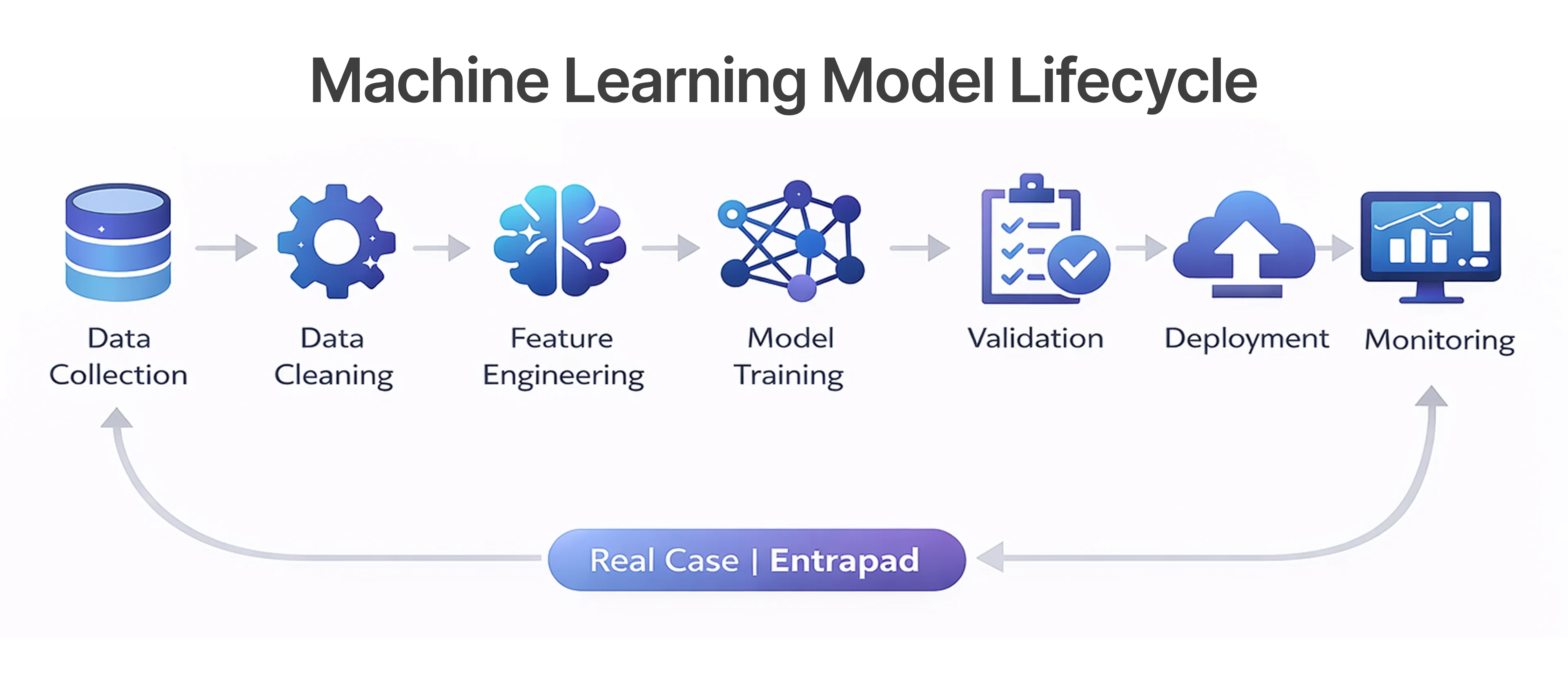
After training, deploy the model into a staging environment integrated with CI/CD pipelines. Run it alongside existing automated tests rather than replacing them immediately. Compare prediction results with real outcomes to measure reliability before full-scale rollout.
Ensuring Prediction Reliability and Bias Control
Prediction reliability depends on continuous validation. Monitor accuracy trends, false positives, and false negatives. Bias control requires checking whether the model consistently favours certain patterns due to skewed data. Regular audits, retraining cycles, and transparent metrics ensure AI in Test Automation remains controlled, measurable, and aligned with business goals.
The Automation Decision: Turning Models into Intelligent Workflows
Once AI models are validated, the next challenge is embedding them into real operational workflows. Automation is not just about generating predictions it is about converting those predictions into repeatable, governed actions inside Continuous Testing and CI/CD pipelines.
What AI Automation Really Means in Practice
In practice, AI automation means connecting model outputs to decision engines. For example, if a predictive model flags a build as high risk, the CI/CD pipeline can automatically trigger expanded regression suites, generate additional test cases, or notify QA teams. AI agents may reprioritise automated tests based on historical defect patterns.
However, workflows can fail. Imagine an AI workflow that predicts a risky deployment and automatically blocks the release. If the model was trained on incomplete test data, it may generate false positives, delaying releases unnecessarily. Without validation checkpoints and human override controls, intelligent automation can disrupt software delivery.
Automation Using AI in Enterprise Environments
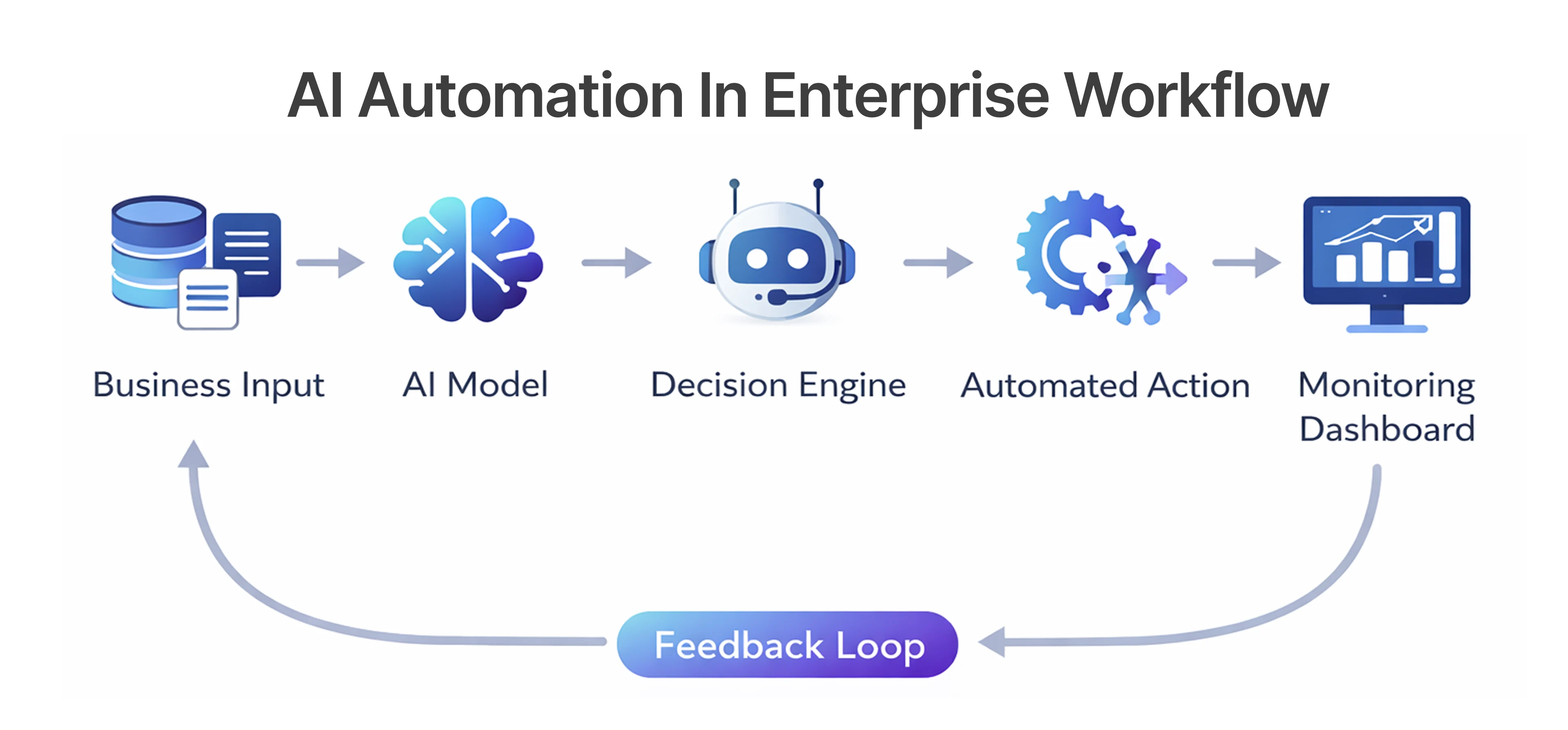
In enterprise environments, AI-driven workflows integrate seamlessly with DevOps pipelines, containerised test environments, and service virtualisation tools to create a controlled, scalable delivery ecosystem. Intelligent systems optimise test coverage, reduce test flakiness, and strengthen defect detection by analysing historical performance data and release patterns. Forward-thinking enterprises combine predictive analytics with advanced environment management to stabilise high-frequency releases and accelerate time to market without compromising software quality.
A typical AI workflow might look like this:
- Model analyses build and test metrics.
- The risk score is generated in real time.
- CI/CD pipeline dynamically adjusts regression scope.
- Automated action is triggered (block, expand tests, or approve release)
- The monitoring dashboard captures outcomes for continuous improvement.
For organisations looking to operationalise AI safely and at scale, the next step is clear: embed Continuous Testing as a governance layer across your AI and DevOps strategy. Investing in structured validation, intelligent automation frameworks, and pipeline-level controls today ensures resilient, audit-ready, enterprise-grade AI systems tomorrow.
Choosing the Right AI Automation Software
Selecting AI automation software requires evaluating scalability, integration capability, explainability, and governance controls. Platforms should support model monitoring, audit trails, and seamless CI/CD integration not just standalone intelligence.
Integrating QA Automation with Intelligent Systems
QA automation must remain structured and measurable when combined with AI systems. Test scripts, test data management, and reporting mechanisms should align with intelligent workflows. For deeper guidance on pipeline integration strategies, see Continuous Testing in CI/CD Pipelines.
The Pipeline Decision: Integrating AI into CI/CD Workflows
AI models cannot operate reliably without structured CI/CD pipelines. Unlike static code, machine learning systems evolve with data, making continuous validation essential. CI/CD ensures that model updates, test automation scripts, and infrastructure changes move through controlled stages protecting software quality and preventing silent production failures.
Why CI/CD Is Critical for AI Systems
AI systems require repeatable testing, version control, and monitoring. Every new model version must be validated against baseline accuracy, test coverage thresholds, and performance benchmarks. Without CI/CD, teams risk deploying untested models that degrade defect detection or increase false positives. Continuous Testing embedded in pipelines creates automated guardrails for intelligent workflows.
CI/CD Implementation for Model Deployment
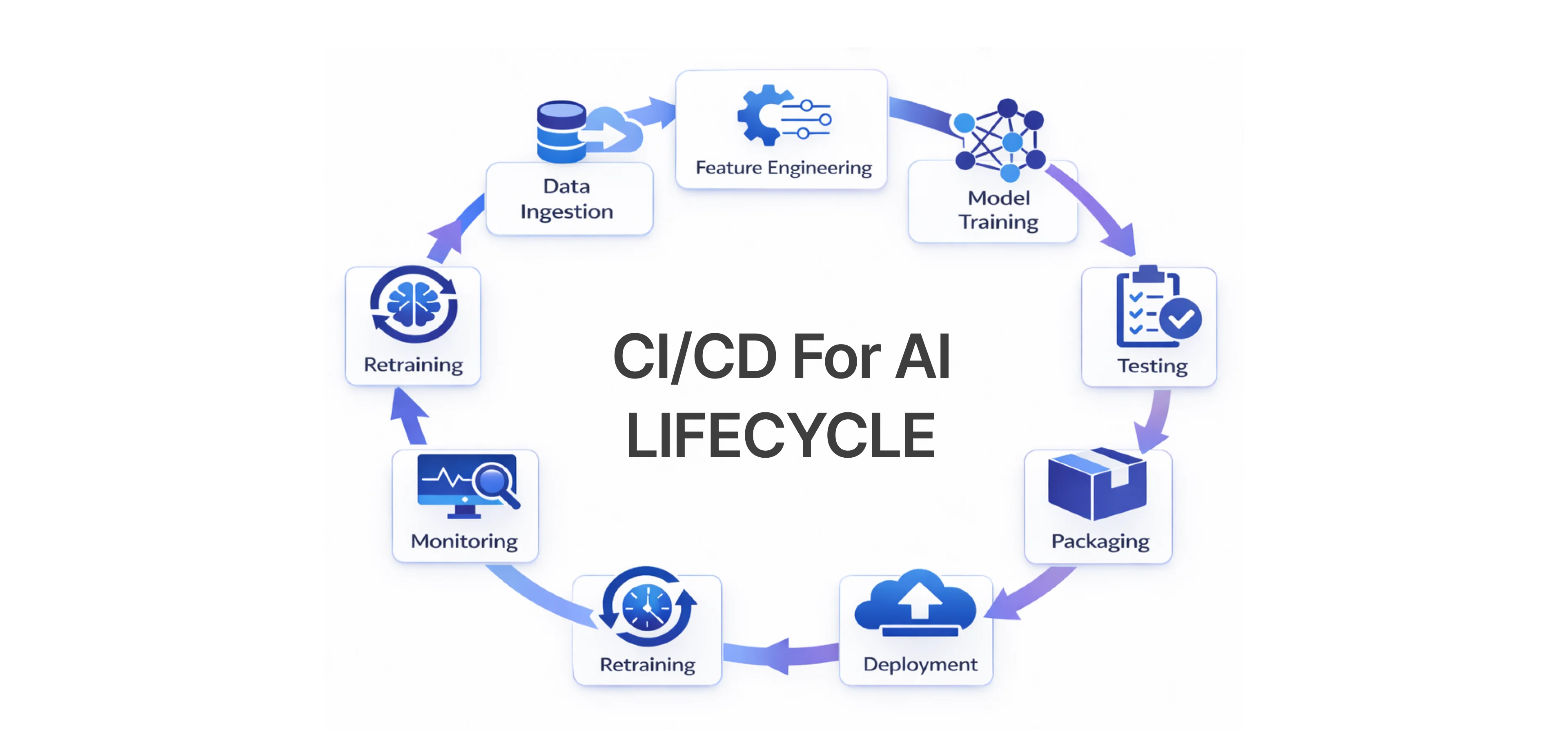
A practical AI-enabled CI/CD flow may look like this:
- The developer commits the updated model or training script to the repository.
- Pipeline triggers automated tests and data validation checks.
- The model is evaluated against predefined accuracy benchmarks.
- The container image is built and pushed to the registry.
- Staging deployment runs regression suites.
- Production release is approved based on quality gates.
This structured process ensures prediction reliability before exposure to real users.
Selecting the Right Pipeline Tools
Pipeline tools should support containerization, automated rollback, environment management, and model artifact tracking. Integration with monitoring dashboards is critical for tracking performance drift. Teams often evaluate tools based on scalability, integration flexibility, and security controls. For general CI/CD best practices, refer to Atlassian CI/CD Guide.
Automating Model Releases with GitHub Actions
GitHub Actions enables automated workflows triggered by code commits. Teams can configure workflows to validate model metrics, execute automated tests, and deploy containerised models. Built-in versioning and approval gates ensure that AI releases remain traceable, repeatable, and aligned with DevOps governance standards.
The Control Decision: Embedding Continuous Integration Testing
Even the most advanced AI automation system can become unstable without embedded controls. Continuous integration testing acts as the safety layer that ensures models, data, and automated workflows remain predictable. Unlike traditional software testing, AI systems introduce new risks such as data drift, model drift, unstable predictions, and fluctuating test coverage. Continuous Testing inside CI pipelines helps detect these issues before they impact production.
How Continuous Integration Testing Tools Prevent Model Failures
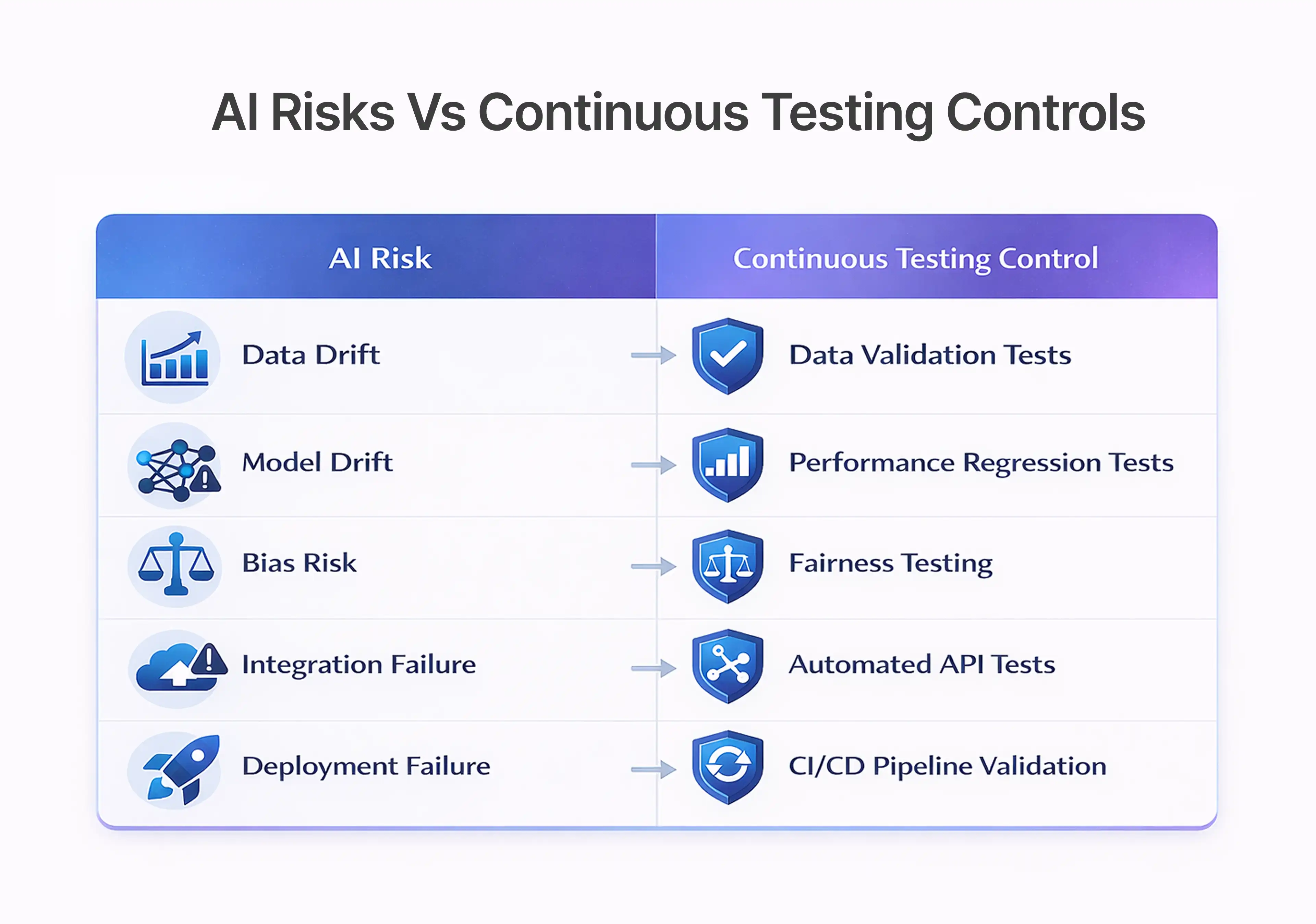
Continuous integration testing tools automatically validate both code and model behaviour after every commit. They compare model accuracy against baseline metrics, verify data consistency, and ensure test scripts execute reliably. If performance drops below a defined threshold, the pipeline fails preventing risky deployments. This structured validation reduces silent model degradation and unexpected test failure rate spikes.
Automated Testing Inside CI Pipelines
Automated tests inside CI pipelines should include model accuracy validation, regression suites, API contract tests, and performance checks. AI-enhanced automation testing can also detect flaky tests by analysing inconsistent results across builds. Maintaining stable test coverage ensures that intelligent systems do not bypass critical Quality Assurance checkpoints.
For deeper implementation guidance, see Continuous Testing in CI/CD Pipelines.
Monitoring Drift and Performance Degradation
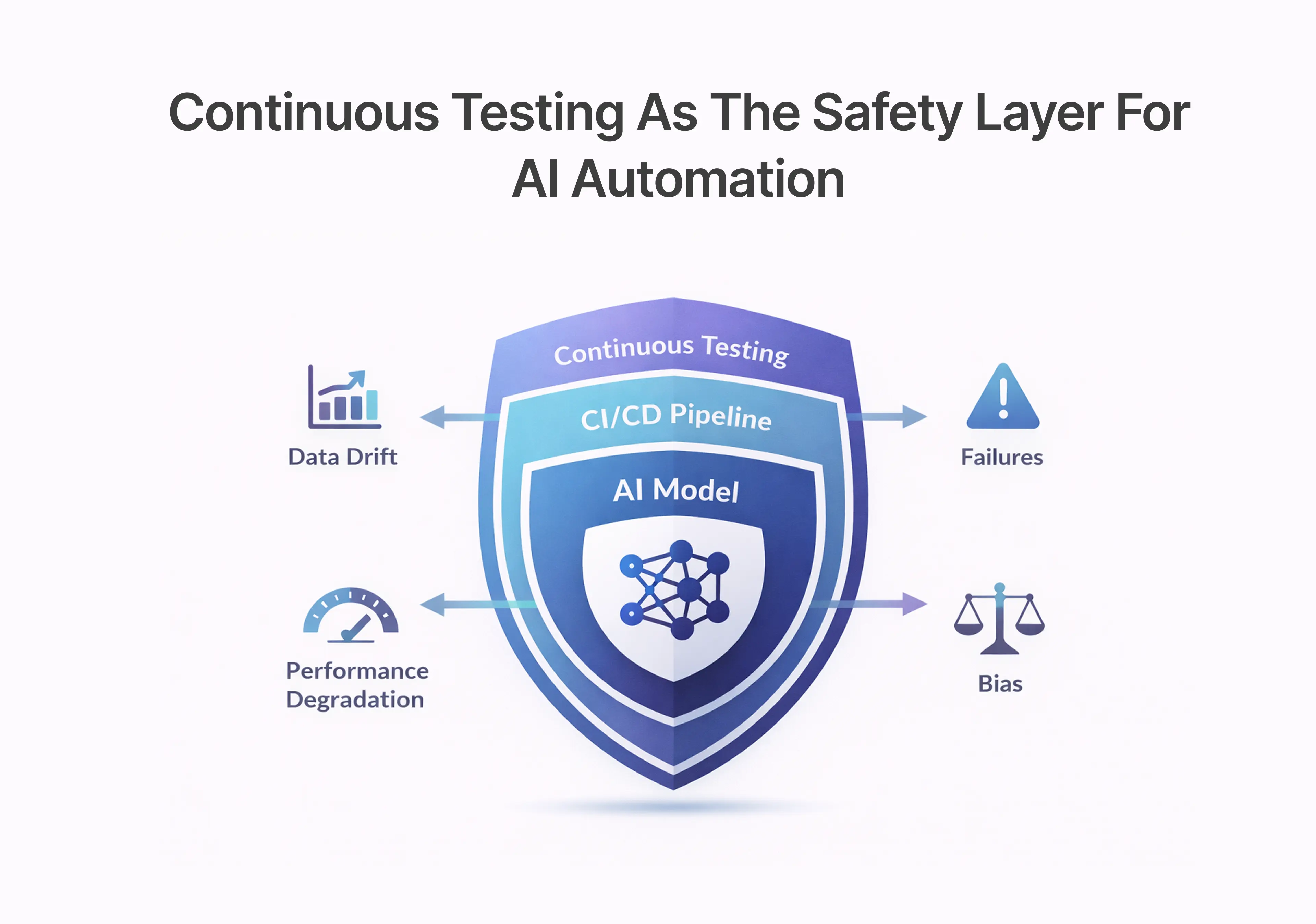
AI systems are sensitive to data drift (changes in input data patterns) and model drift (decline in predictive accuracy over time). Continuous monitoring dashboards should track accuracy, false positives, false negatives, and performance latency. When thresholds are breached, automated alerts should trigger retraining or rollback processes.
Mini Risk Control Table:
Building a Feedback Loop for Long-Term Stability
Long-term reliability depends on feedback loops. Production metrics should feed back into retraining pipelines. Defect detection trends must refine test case generation strategies. By continuously validating data, models, and automated tests, organisations maintain stable AI automation while preserving software quality over time.
The Strategic Advantage: Why Continuous Testing Is the Safety Layer for AI Automation
AI automation delivers speed, intelligence, and competitive differentiation but without Continuous Testing, it also introduces silent risks. The real strategic advantage lies not in deploying artificial intelligence faster, but in controlling it intelligently. Continuous Testing becomes the safety layer that protects software quality, stabilises CI/CD pipelines, and ensures machine learning systems remain accountable to measurable outcomes.
From Reactive Fixes to Proactive Stability
Traditional Quality Assurance often reacts to production failures. In AI-driven environments, that approach is too late. Continuous integration testing shifts organisations from reactive defect resolution to proactive stability. Instead of waiting for model drift or flaky tests to surface in production, pipelines automatically detect performance degradation, declining test coverage, and abnormal behaviour patterns before release.
From a business perspective, this reduces downtime, protects brand reputation, and lowers incident recovery costs. From an engineering standpoint, it introduces structured validation, traceable releases, and predictable deployments. Industry best practices around DevOps and AI governance emphasise this shift toward built-in control mechanisms rather than after-the-fact corrections.
Building AI Systems That Scale Without Breaking
Scalable AI systems require repeatable testing, automated validation gates, and strong feedback loops. Continuous Testing ensures that as data volumes grow, models retrain, and deployments accelerate, stability does not decline. It aligns intelligent automation with disciplined software development allowing innovation to scale without sacrificing reliability.
Conclusion:
AI automation delivers powerful capabilities but without structured controls, it can introduce instability into even the most mature software environments. Continuous Testing acts as the stabilising.
force that keeps machine learning systems reliable, measurable, and aligned with business outcomes.
Key Takeaways:
- AI models require validation just like code, including accuracy checks and drift monitoring.
- CI/CD pipelines provide structured quality gates for safe model deployment.
- Continuous integration testing prevents data drift, model drift, flaky tests, and declining test coverage.
- Intelligent workflows must combine automation with monitoring, rollback strategies, and feedback loops.
Simple Next Steps:
- Audit your current CI/CD pipeline to identify gaps in AI validation and monitoring.
- Introduce automated accuracy benchmarks and drift detection into staging environments.
- Establish a feedback loop that connects production metrics to retraining and test optimisation.
Organisations that embed Continuous Testing into every stage of AI automation don’t just move faster they scale with confidence, stability, and control.
People Also Ask (FAQs)
Q1.What is continuous testing in AI systems ?
Ans: Continuous testing in AI systems means validating both code and model behaviour throughout the CI/CD pipeline. It includes checking model accuracy, monitoring data quality, validating test coverage, and detecting drift before deployment. The goal is to prevent unstable AI releases from reaching production.
Q2.Why is CI/CD important for AI model deployment ?
Ans: CI/CD ensures that every model update goes through automated validation, regression testing, and performance checks. Unlike traditional code, AI models can degrade over time, so pipelines help enforce quality gates. This keeps deployments reliable, traceable, and aligned with defined accuracy benchmarks.
Q3.What is data drift, and why does it matter ?
Ans: Data drift happens when the input data used in production changes from the data the model was trained on. This shift can reduce prediction accuracy and increase errors. Continuous monitoring and automated validation tests help detect drift early and trigger retraining if needed.
Q4.How does test automation support AI-driven workflows ?
Ans: Test automation validates integrations, APIs, model outputs, and system performance inside CI/CD pipelines. Automated tests ensure that intelligent workflows remain stable even as models evolve. It also helps detect flaky tests and maintain consistent test coverage across releases.
Q5.How do teams monitor AI models after deployment ?
Ans: Teams use model monitoring dashboards to track accuracy, latency, false positives, and false negatives. Alerts are configured to flag performance degradation or abnormal behaviour. Continuous feedback loops allow retraining and rollback decisions before issues impact users.

.webp)