

How Do You Build a QA Partner Scorecard?
A QA partner scorecard is built by defining the testing capabilities that matter to your business, assigning each criterion a weight, rating shortlisted QA vendors on a consistent scale, and calculating a weighted final score. A strong scorecard evaluates technical expertise, automation, security, delivery, communication, scalability, reporting, and commercial fit rather than choosing a QA partner based primarily on price.
Smart Summary
A good QA partner scorecard turns vendor selection from a subjective decision into a measurable evaluation process.
- Define business-critical QA requirements first. Evaluate vendors against your actual product, risk, release cadence, technology stack, and testing needs.
- Weight criteria by importance. Technical capability and delivery performance should normally carry more weight than presentations, certifications, or the lowest hourly rate.
- Score evidence, not promises. Ask vendors to demonstrate frameworks, reporting practices, automation approaches, communication processes, and relevant testing experience.
- Evaluate long-term maintainability. The best QA partner should improve testing efficiency as your product grows rather than create additional technical debt.
- Use the scorecard as a decision tool, not an automatic winner selector. Final scores should be combined with reference checks, technical discussions, pilots, and risk assessment.
What Is a QA Partner Scorecard?
A QA partner scorecard is a structured vendor evaluation framework used to compare software testing companies against predefined criteria. Instead of selecting a QA provider through sales presentations, pricing, or intuition alone, teams assign measurable scores to capabilities such as testing expertise, automation maturity, security, delivery reliability, communication, scalability, and commercial fit.
The goal is straightforward:
Make every QA vendor compete against the same requirements. For example, suppose three software testing companies submit proposals. Without a scorecard, the decision may come down to:
- Which proposal looked strongest?
- Which vendor offered the lowest price?
- Which sales team communicated best?
- Which company had the most recognizable clients?
Those factors can influence a decision, but they do not necessarily show which QA partner can protect product quality. A scorecard forces the evaluation back toward evidence.
The result is a repeatable QA vendor selection process that engineering, procurement, QA, product, and security teams can review together.
Why Do You Need a QA Partner Scorecard in 2026?
A QA partner scorecard helps organizations compare increasingly complex testing providers on capabilities that directly affect software quality, release velocity, security, and maintainability. In 2026, evaluating only manual testing capacity or hourly rates is insufficient because QA partners may also be responsible for automation frameworks, APIs, CI/CD pipelines, cloud environments, security testing, AI-enabled applications, and continuous quality engineering.
Software quality itself is multidimensional. ISO/IEC 25010:2023, for example, defines a product-quality model containing nine quality characteristics that can be used when establishing software quality and testing objectives.
At the same time, modern test automation increasingly depends on reusable frameworks, suitable tool selection, CI/CD integration, monitoring, and continuous maintenance rather than simply creating individual automated scripts. Current test-automation guidance similarly emphasizes framework structure, reusability, scalability, and maintainability.
That changes what businesses should ask from a potential QA outsourcing partner.
A vendor may be excellent at manual functional testing but weak at automation. Another may have strong automation engineers but inadequate security processes. A third may be technically capable but unable to support your release frequency. Your QA scorecard exposes these differences before the engagement begins.
How to Build a QA Partner Scorecard Step by Step
A practical QA vendor scorecard can be created in four stages:
Each step reduces subjectivity while keeping the evaluation tied to your actual software quality requirements.
Step 1: Define What You Need From a QA Partner
Before evaluating vendors, define the outcomes you expect from the QA engagement. Document the product architecture, release cadence, required testing types, automation objectives, environments, security requirements, reporting expectations, integrations, team structure, and expected engagement duration.
Do not begin by asking:
“Who is the best software testing company?”
Begin with:
“What does the right software testing partner need to accomplish for our product?”
For example, a SaaS company releasing several times per week may prioritize:
- Regression automation
- API testing
- Cross-browser testing
- CI/CD integration
- Parallel execution
- Test environment management
- Production-quality monitoring
- Rapid defect feedback
The scorecard must reflect your risk profile, not a generic QA checklist.
Step 2: Choose Your QA Vendor Evaluation Criteria
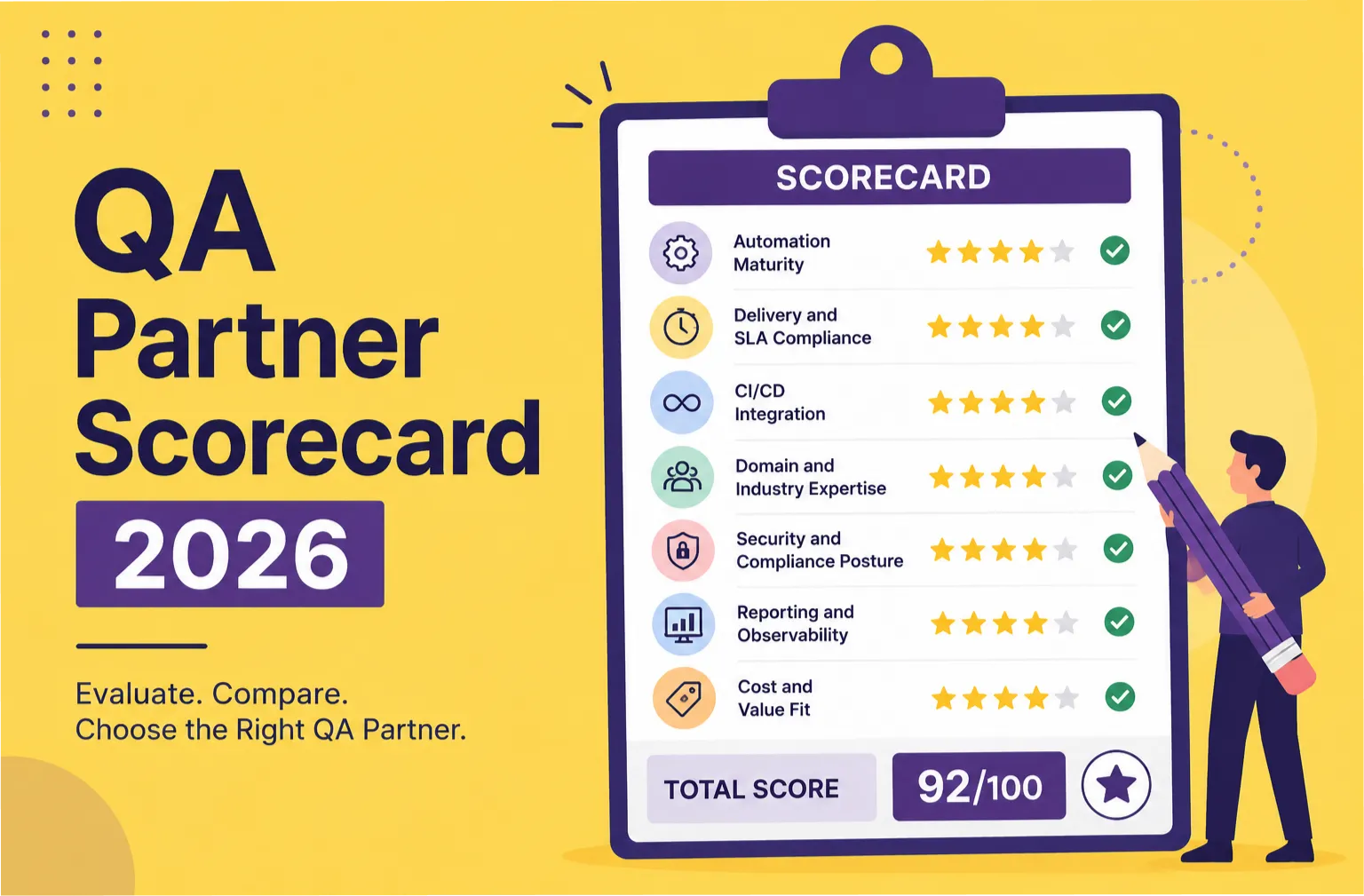
A comprehensive QA partner scorecard should evaluate eight areas:
These percentages are starting points rather than universal rules.
- A heavily regulated organization might raise security to 20%.
- A company replacing a large manual regression suite might increase automation to 25%.
- An early-stage startup could assign more importance to flexibility and scalability.
The important rule is to set the weights before reviewing final vendor proposals. Otherwise, teams can unintentionally modify the criteria to favor the vendor they already prefer.
1. How Should You Score QA and Technical Expertise?
QA and technical expertise should measure whether the vendor understands your application architecture, testing risks, relevant platforms, testing methodologies, and quality requirements. Strong QA partners should be able to explain what should be tested, why it should be tested, how coverage should be prioritized, and where testing should occur within the software delivery lifecycle.
Do not simply ask:
“Do you provide API testing?”
Ask:
“How would you test API reliability, authentication, negative scenarios, schema validation, dependencies, and failure handling in our architecture?”
The difference is important.
- A capability checklist proves that a service is offered.
- A technical discussion shows whether the team knows how to perform it.
Scoring example
2. How Should You Evaluate Test Automation Capability?
Evaluate whether the QA partner can design, implement, integrate, and maintain automation rather than simply generate automated test scripts. Look at framework architecture, tool selection, code quality, reusability, CI/CD integration, reporting, execution strategy, test-data management, debugging, and long-term maintenance.
Red flag
Be cautious when a vendor promises an extremely high automation percentage before understanding your product.
Not every scenario should be automated.
High-value automation typically focuses on tests that are repeatable, stable, business-critical, or expensive to execute manually. Current automation guidance similarly recommends prioritizing high-impact, high-risk, and frequently repeated scenarios instead of automating everything indiscriminately.
3. How Do You Evaluate a QA Partner's Delivery Process?
QA delivery should measure how reliably the partner plans testing, manages defects, integrates with development workflows, responds to releases, tracks risk, and delivers agreed testing outcomes. Evaluate the actual operating process rather than accepting labels such as Agile, DevOps, or shift-left testing without evidence.
Look for a clearly defined workflow covering:
The strongest partner should make QA part of your engineering workflow instead of becoming a testing department that only receives completed builds.
4. How Should Security Be Scored?
Security scoring should assess how the QA provider protects your source code, credentials, customer data, test environments, intellectual property, and access to internal systems. It should also evaluate whether the partner can support your application's security-testing requirements when security forms part of the engagement.
For sensitive applications, security should act as a minimum qualification criterion, not merely another weighted score.
For example:
A vendor scoring 95/100 overall but failing a mandatory security requirement should not automatically win.
Create two types of requirements:
- Weighted requirements: These contribute to the score.
- Mandatory requirements: Failure means disqualification.
Examples of mandatory requirements might include:
- Required data-protection controls
- Specific compliance requirements
- Geographic restrictions
- Source-code access policies
- Security certifications required by your organization
5. How Do You Measure Communication and Collaboration?
Communication should measure how quickly, clearly, and consistently the QA partner shares defects, blockers, quality risks, testing progress, and release concerns with your internal teams. Good communication is not the number of meetings scheduled; it is the speed and clarity with which useful testing information reaches decision-makers.
Ask a prospective vendor to show an example defect report.
A strong defect report should make it easy for developers to understand:
This is more useful than asking whether a vendor has “excellent communication.”
6. How Do You Evaluate QA Scalability?
QA scalability measures whether the testing partner can expand or adjust coverage as your product, release frequency, platforms, environments, or testing requirements change. The partner should be able to scale capabilities without forcing your organization to repeatedly rebuild testing processes from scratch.
Ask:
“What happens if our testing requirement doubles six months from now?”
The answer should cover more than additional headcount.
Look for a scalable combination of:
People + Processes + Automation + Infrastructure
7. What Reporting Should a Good QA Partner Provide?
QA reporting should help engineering and business stakeholders understand product quality, release risk, testing progress, defect patterns, automation health, and unresolved issues. Reports should support decisions instead of simply showing how many test cases were executed.
Avoid rewarding a vendor because its reports contain more charts.
Ask:
“What decision does this metric help us make?”
If nobody can answer, the metric may not belong in the executive QA dashboard.
8. How Should You Evaluate QA Pricing and Commercial Fit?
Commercial fit should evaluate whether the QA engagement model is sustainable, transparent, and aligned with your testing requirements. Price matters, but selecting the lowest-cost QA vendor can become expensive if poor automation, weak defect detection, high turnover, or inadequate testing creates additional engineering work.
Instead of asking only:
“What is your hourly rate?”
Evaluate:
“What quality outcome are we purchasing for the total cost?”
Two vendors charging different rates can produce very different total costs depending on productivity, automation, expertise, defect prevention, and management overhead.
How Does the QA Partner Scoring System Work?
Use a consistent numerical scale for every vendor. A simple 1-to-5 system works well because it provides enough differentiation without creating false precision.
Then multiply each score by the assigned weight.
What Evidence Should You Request From a QA Partner?
Do not assign high scores based only on proposal language. Request evidence that demonstrates how the QA company actually performs testing.
Useful evidence can include:
Sample Test Strategy
Review how the vendor translates requirements and product risks into testing priorities.
Sample Test Cases
Look for clarity, coverage, negative scenarios, maintainability, and traceability.
Sample Defect Reports
Evaluate whether defects contain useful reproduction details and technical evidence.
Automation Framework Walkthrough
Ask the technical team to explain framework architecture, reusable components, reporting, test data, CI/CD integration, and maintenance.
Sample QA Dashboard
Check whether reports communicate product risk rather than only testing activity.
Relevant Case Studies
Prioritize projects with similar:
- Architectures
- Product types
- Testing challenges
- Scale
- Industries
Technical Interview
Speak directly with the engineers or QA leads who may work on the project.
Do not limit the evaluation to the vendor's sales team.
What Are the Biggest QA Vendor Selection Red Flags?
Common QA partner red flags include promising unrealistic automation coverage, recommending tools before understanding the product, focusing almost entirely on headcount, providing vague reporting, lacking framework-maintenance plans, avoiding technical discussions, or being unable to explain how testing integrates with the development lifecycle.
Watch especially for these signals:
1. “We can automate everything.”
Not every test provides enough value to justify automation.
2. Tool-first recommendations
A partner should understand the testing problem before prescribing Selenium, Playwright, Cypress, Appium, or another platform.
3. No automation maintenance strategy
Automated tests require ongoing maintenance as the product changes. Sustainable automation depends on disciplined framework design and continuous improvement.
4. Testing begins only after development
Modern QA should provide feedback throughout the development lifecycle.
5. Activity-focused reporting
“2,000 tests executed” means little without context about coverage and risk.
6. No knowledge-transfer plan
Your company should not become permanently dependent on undocumented vendor knowledge.
7. Sales team cannot bring technical experts into discussions
Technical evaluation requires technical people.
QA Partner Scorecard Template for 2026
Recommended Final Classification
90–100: Excellent fit
Strong candidate with evidence across critical requirements.
80–89: Strong fit
Suitable partner with manageable gaps.
70–79: Conditional fit
Requires deeper validation or mitigation.
60–69: High-risk fit
Significant weaknesses exist.
Below 60: Poor fit
The provider is unlikely to meet critical QA requirements.
These thresholds should be adjusted according to your organization's risk tolerance.
What Should Change in a QA Scorecard for 2026?
A 2026 QA partner scorecard should evaluate more than traditional manual-testing capacity. Organizations should increasingly examine automation maintainability, CI/CD integration, API and distributed-system testing, cloud environments, security, AI-assisted testing practices, reporting quality, framework ownership, and the provider's ability to work continuously with engineering teams.
One important area is AI-assisted QA.
Do not award points simply because a vendor says it uses AI.
Ask what AI improves.
For example:
- Test-case generation?
- Test maintenance?
- Failure analysis?
- Test-data generation?
- Defect triage?
- Coverage analysis?
- Visual testing?
- Script generation?
Then evaluate:
Accuracy + Human Review + Traceability + Security + Maintainability
AI capability is valuable only when it improves the testing outcome.
People Also Ask (FAQs)
Q1. What is a QA partner scorecard?
Ans: A QA partner scorecard is a weighted evaluation framework for comparing software testing providers against consistent criteria. It typically scores areas such as technical expertise, automation, security, delivery, communication, scalability, reporting, and commercial fit so organizations can make a more objective QA vendor selection decision.
Q2. What criteria should be included in a QA vendor scorecard?
Ans: A QA vendor scorecard should typically include testing expertise, automation capability, QA processes, security, communication, scalability, reporting, and pricing. Organizations should modify the weighting based on their product architecture, risk profile, release frequency, regulatory environment, and testing objectives.
Q3. How do you score a QA company?
Ans: Score each QA company against the same criteria using a consistent scale, such as 1 to 5. Multiply each rating by the criterion's assigned weight and combine the results into a score out of 100. High scores should require evidence rather than marketing claims.
Q4. What is a good QA partner score?
Ans: A score above 80 out of 100 can indicate a strong candidate when using the sample methodology in this guide. However, organizations should define their own thresholds and mandatory requirements before evaluating vendors. A high overall score should never override a failed security, compliance, or other non-negotiable requirement.
Q5. How many QA vendors should you evaluate?
Ans: Three to five qualified QA vendors is often a manageable shortlist for detailed comparison. Evaluating too many providers can increase procurement effort, while evaluating only one or two may provide insufficient comparison. Initial screening can reduce a larger vendor list before the detailed scorecard stage.

.webp)