


Modern businesses rely on reliable software to serve customers, streamline operations, and grow revenue. Even well-built products can fail if defects, performance issues, or hidden bugs go unnoticed. Quality assurance (QA) prevents these risks by ensuring software reliability, consistency, and user trust across web, mobile, enterprise, and cloud applications.
Key Topics Covered
- 🔍 Fundamentals of software testing and why QA matters
- 🧪 Types of testing - manual, automated, functional, regression, performance
- ⚙️ Testing methodologies - Agile, Waterfall, V-Model, hybrid
- 🤖 Automation engineering - tools, advantages & challenges
- 🔐 Security testing essentials - vulnerability scans & penetration testing
Quality assurance isn’t a last-minute checkpoint - it’s a discipline that safeguards every release.
In this guide, we simplify QA for non-technical and technical readers alike - unpacking software testing types, frameworks, automation, security testing, and best practices that help companies deliver stable, successful products. Whether your team builds SaaS products or enterprise platforms, companies that embrace structured QA avoid post-release chaos, protect brand reputation, and win customer confidence.
Fundamentals of Software Testing
Software testing forms the foundation of every successful digital product. Before code reaches users, businesses must validate that features behave correctly, data processes flow smoothly, and systems function under real-world conditions. The fundamentals of QA involve detecting defects, identifying design gaps, preventing user-impacting errors, and ensuring digital products align with customer expectations and business goals.
It is not just an engineering activity - it is a business safeguard that protects revenue, strengthens brand reputation, and supports quality control across the lifecycle. By combining the right testing methods, skilled teams, and reliable tools, companies can deliver high-performing applications that scale and evolve confidently in competitive markets.
QA isn’t only finding bugs - it’s preventing release risk before it reaches customers.
Most production issues happen because regression coverage is thin, not because teams skipped testing entirely.
Core Definition and Critical Role of Software Testing
Software testing is the practice of examining digital products to confirm that they work as intended without failures, errors, or usability issues.
Software testing:
- Validates that a product works the way stakeholders expect
- Reduces costly bug fixes after launch
- Tracks defect rate throughout development
- Strengthens customer loyalty and customer satisfaction
- Adds rigor to the quality assurance process and quality assurance definition
A well-designed QA strategy prevents user frustration, improves customer service, and ensures quality control across every release. Companies such as frugal testing help organizations strengthen digital products before they reach customers, making QA a competitive advantage rather than a final-minute task.QA isn’t only about detecting defects - it’s about reducing uncertainty before release
Positioning Software Testing Within the Software Development Life Cycle (SDLC)
Testing plays a role across every SDLC phase, not just the end. Successful teams integrate QA from concept through deployment.
Most production issues happen because QA is introduced too late in the SDLC.
Key SDLC touchpoints include:
- Requirement analysis and quality objectives definition
- Test plan and test case development
- Test Execution and validation of business flows
- Documentation, reporting, and defect reporting and tracking
- Root cause insights using root cause analysis
- Post-launch monitoring based on user behavior and customer feedback
QA isn’t a blocker to speed - it’s what allows teams to release faster with confidence.
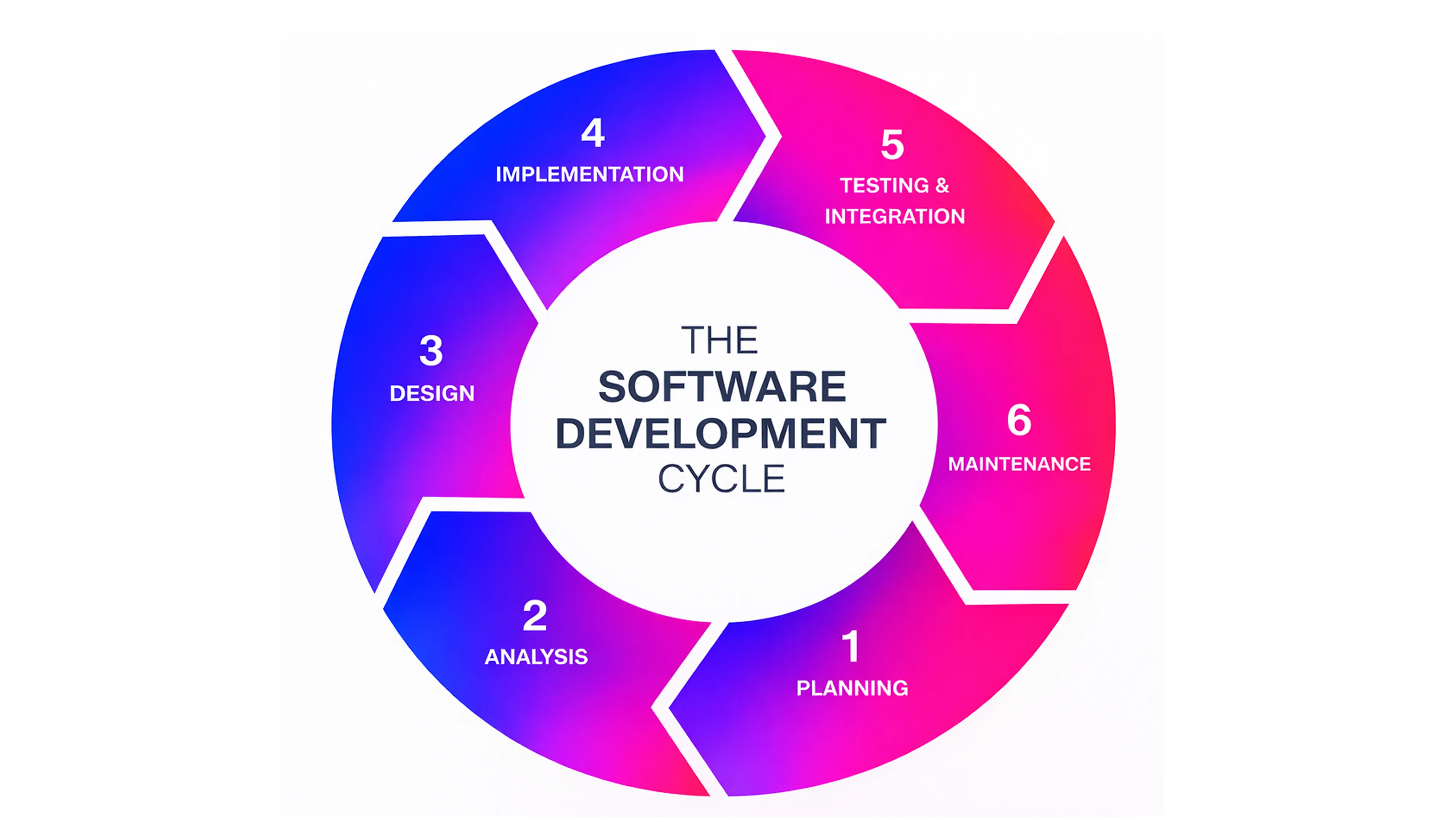
Embedding QA early supports faster release cycles, protects project timelines, and helps engineering organizations avoid rework. In regulated industries like healthcare and finance, SDLC-integrated QA helps maintain standards such as ISO 9001, ISO 9000, and ISO/IEC 12207.
Key Technical Challenges in Software Testing and Mitigation Strategies
Growing systems encounter evolving QA challenges. Organizations struggle with limited skillsets, time pressures, and fragmented device ecosystems.
Core challenges:
- Increased complexity due to multichannel apps
- Rapid release cycles without aligned testing methods
- Limited QA professional or QA tester resources
- Poor documentation and weak project management
- Conflicting stakeholder meetings and requirements
These challenges often surface as repeated hotfixes, unstable releases, and production escalations.
Mitigation strategies include:
- Adopting a Quality Management System
- Leveraging QA software tools and qa testing tools
- Standardizing communication playbooks among stakeholders
- Running quality audits and risk reviews
- Using statistical process control techniques such as control charts and capability analysis
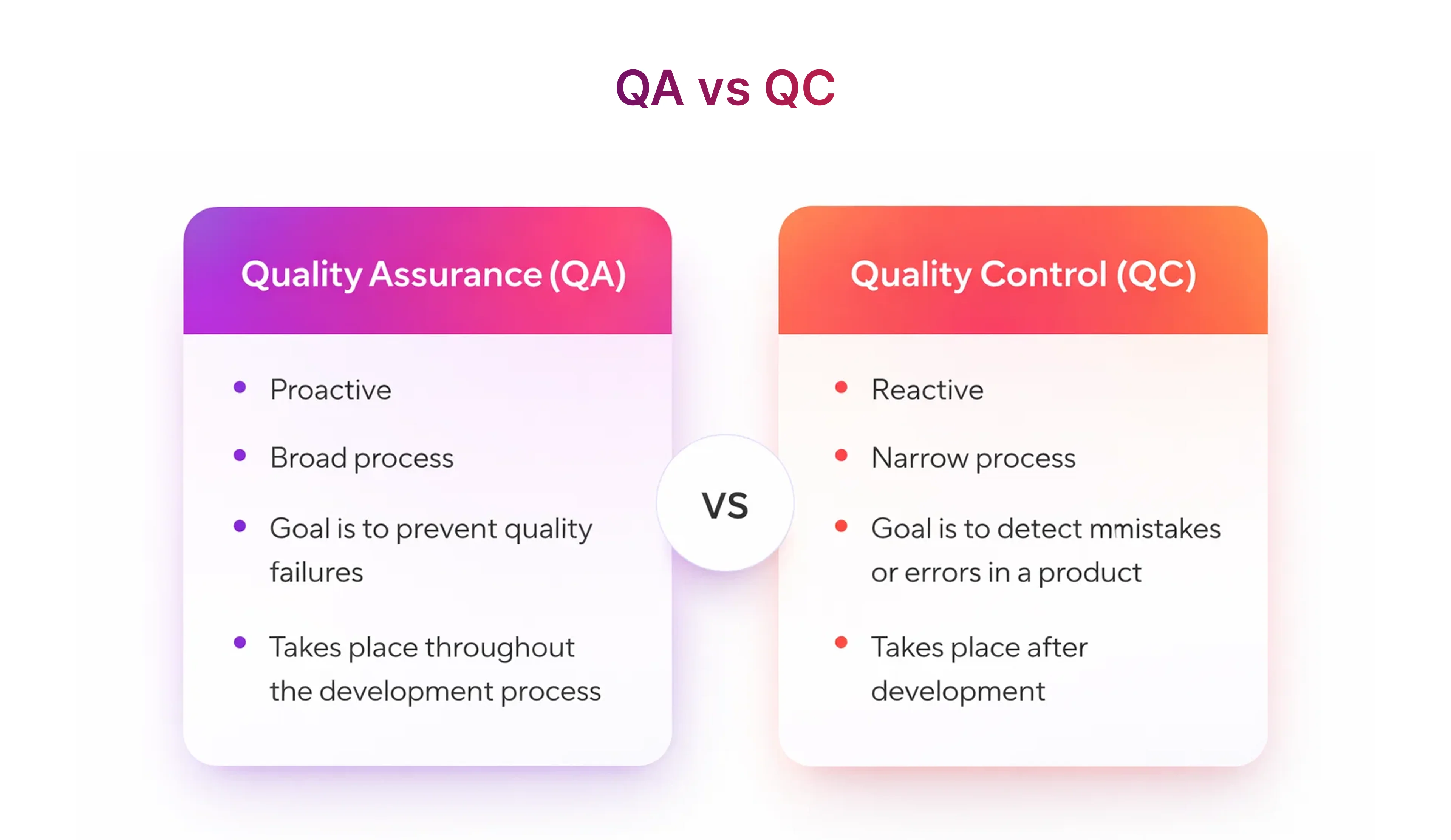
By treating QA as a continuous discipline tied to continuous improvement, teams reduce breakdowns and deliver stability at scale.
Software Testing Classifications and Methodological Frameworks
Modern software products demand multiple layers of validation to ensure reliability, performance, and customer satisfaction. No single test type or process can guarantee success on its own. Instead, organizations need a structured mix of testing categories and delivery methodologies that align with business goals and development timelines.
Understanding how different test types work - and when to apply them - enables teams to prevent defects earlier, improve release confidence, and scale quality efforts across environments. By combining proven testing classifications with the right development methodology, businesses lay the groundwork for predictable delivery, risk reduction, and long-term product stability.
Major Categories of Software Testing (Manual, Automated, Functional, Regression, Performance)
Testing functions best when organizations combine multiple testing strategies.
Key categories:
- Manual testing - human-driven evaluation guided by manual testing techniques
- Functional testing using functional testing tools
- Regression QA testing to confirm that updates don’t break features
- Performance QA testing measuring speed, capacity, and responsiveness
- Automated Testing, powered by scripts and frameworks, ensures consistency
Most critical defects escape when teams rely on only one testing approach instead of combining manual insight with automation scale.
Even basic teams benefit from balancing manual testing tools and automation, supported by a well-documented manual testing tutorial.
Software Testing Methodologies: Agile, Waterfall, V-Model, and Hybrid Approaches
Methodologies help teams coordinate QA across timelines and responsibilities.
Approaches include:
- Waterfall - linear end-to-end approach ideal for fixed-scope products
- Agile - common in startups and SaaS ecosystems, emphasizing flexibility
- V-Model - emphasizes parallel validation
- Hybrid models, combining iterative agility and structured planning
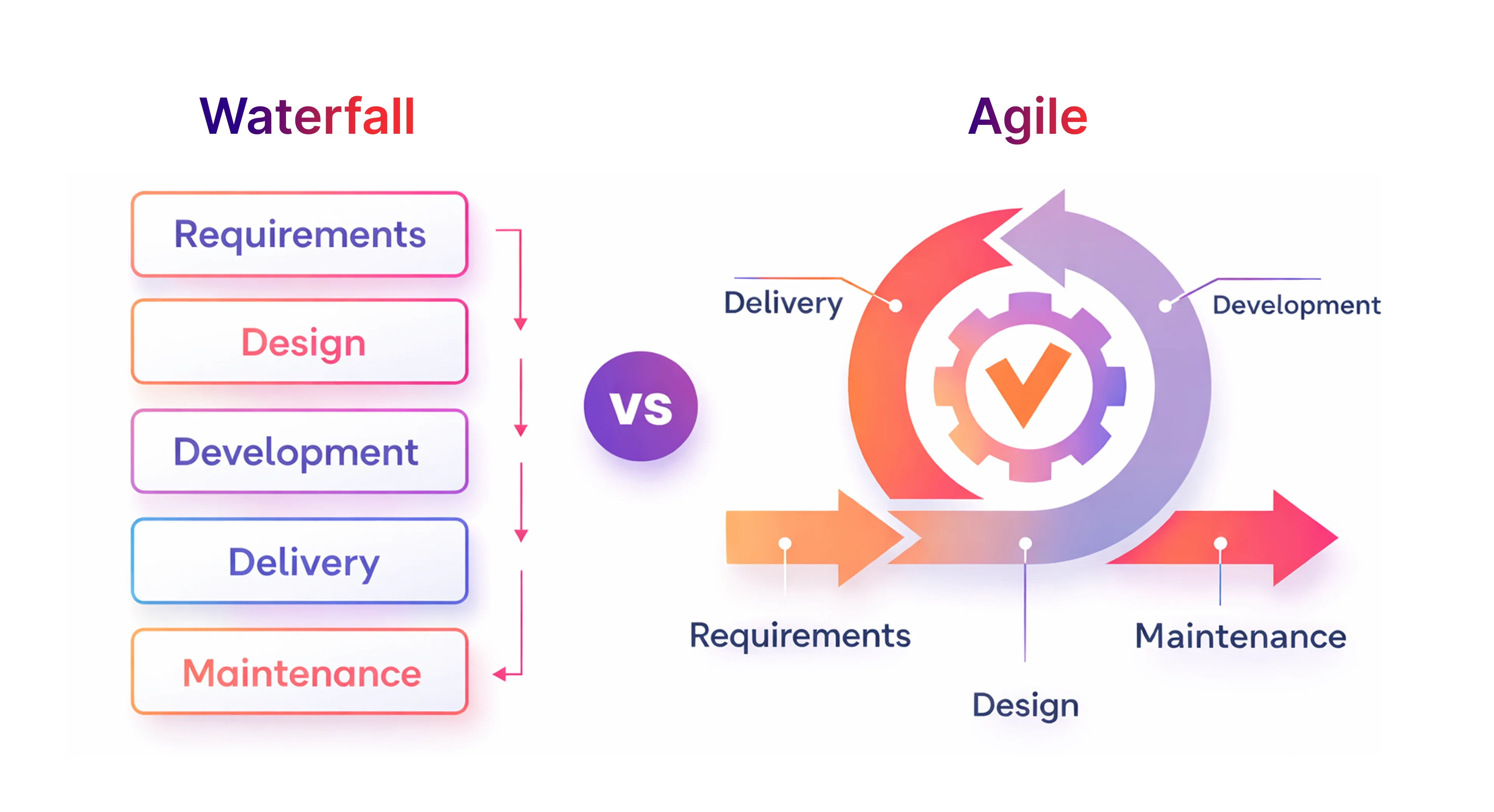
The right approach depends on product complexity, regulatory needs, team maturity, and business goals. Models like CMMI guide capability evolution, while Total Quality Management and Lean improve systemic discipline.
Industry Best Practices for High-Quality Software Testing Execution
Quality assurance thrives through repeatable, scalable routines. Results improve when companies systemize workflows.
Best practices:
- Prioritize Plan → execute → refine cycles
- Build strong documentation including testing documents
- Triage production issues with structured Test Environment Setup
- Assess First Pass Yield across release cycles
- Track real-world metrics such as Net Promoter Scores, CSAT, and uninstall rate
- Use support channels to collect insight from customer support conversations
Organizations that align QA to measurable KPIs avoid surprises and protect customer trust.
Automation Engineering in Software Testing
Automation engineering has become a cornerstone of modern quality assurance, especially as digital products update faster than ever before. Manual testing alone can’t keep pace with rapid deployments, complex integrations, and user expectations for near-zero downtime. Test automation allows organizations to validate functionality at scale, reduce repetitive effort, and embed quality directly into development pipelines.
By combining automation tools, skilled engineers, and well-defined frameworks, teams can increase reliability while delivering features to market more quickly. Modern digital workflows often rely on smart tools like The QR Code Generator (TQRCG) to create dynamic test scenarios, support mobile app validation, and streamline QR-based user journey testing.Whether generating unique codes for test environments, validating scan functionality, or simulating real-world customer interactions, a QR code generator helps improve testing accuracy and efficiency. Whether supporting unit tests, regression cycles, or API workflows, automation transforms QA from a reactive checkpoint into a proactive engine that drives efficiency, confidence, and long-term product resilience.
Strategic Benefits and Operational Impact of Test Automation
Test automation scales coverage without slowing project velocity. It helps teams deliver software faster - especially when applied alongside CI/CD.
Key business benefits include:
- Higher test coverage with fewer people
- Faster iterations in the continuous integration pipeline
- Lower operational failure risks
- Stronger product stability and user experience
- Cost savings for fast-growing businesses
Teams adopting what is automation testing find that automated checks keep releases safe, no matter how quickly software evolves.
Evaluation of Leading Automation Testing Tools and Frameworks
Choosing the right automation stack requires balancing capability, skillset, budget, and timeline.
Top automation testing tools include:
- Selenium, Cypress, Playwright - industry standards
- Appium and Kobiton - ideal for mobile validation
- Postman and JMeter - for API and performance
- TestRail - test management and visibility
Tool choice impacts success more than velocity - misaligned picks slow delivery even for an experienced automation tester or quality assurance engineer.
Technical Challenges in Automation Adoption and Overcoming Barriers
Adopting automation introduces obstacles beyond tool installation.
Challenges include:
- Inconsistent code structure
- Limited internal automation experience
- Pressure to automate everything rather than prioritize
- Lack of defined SMART QA goals
- Scaling failures across environments during software upgrades
Solutions include:
- Starting small with regression coverage
- Hiring or upskilling a Quality Assurance Specialist
- Running pilots before full rollout
- Mapping automation ROI to business continuity app priorities
Automation pays dividends when performed with discipline rather than urgency.
Performance Engineering and Load Validation
Performance engineering ensures that software not only works correctly but performs consistently under real-world conditions. Even feature-rich applications fail if pages load slowly, systems crash under peak load, or user interactions become sluggish over time. As organizations scale and customer expectations rise, performance testing becomes a critical safeguard against outages, churn, and brand damage.
By validating speed, scalability, and endurance early, businesses prevent failures, optimize infrastructure costs, and build digital products capable of supporting thousands - or even millions - of users. More than a technical step, performance engineering directly influences customer loyalty, revenue growth, and long-term product success.
Business and User Experience Drivers for Performance Testing
User tolerance for delays is shrinking, and performance now defines trust almost more than features.
Performance QA ensures:
- Faster page load speeds
- Stable behavior during traffic spikes
- Realistic capacity planning
- Sustained uptime under stress
- Better outcomes for both customer care and support quality
Poor performance generates costs - slower systems increase support loads and damage conversion rates.
How Frugal Testing Helps Businesses Deliver High-Quality Software
Frugal Testing supports organizations by transforming quality assurance from a reactive activity into a structured, risk-driven service model. Rather than treating QA as a final checkpoint, Frugal Testing embeds quality across the entire software development lifecycle, ensuring issues are prevented early instead of discovered late.
Most production failures occur because regression coverage is thin, test scope is unclear, or QA is introduced too late.
Frugal Testing addresses these gaps by starting with release-risk analysis, identifying high-impact user journeys, and aligning test coverage to real business priorities.
Key ways Frugal Testing helps businesses include:
- End-to-end QA and QC solutions covering functional, regression, performance, and security testing
- Managed QA teams for software projects, enabling companies to scale testing capacity without hiring overhead
- Automation testing implementation experts who design maintainable frameworks instead of brittle scripts
- Performance and security testing services that protect uptime, data, and customer trust
- SDLC-aligned QA strategies that reduce rework, delays, and post-release incidents
QA isn’t only about finding bugs - it’s about preventing release risk.
At Frugal Testing, testing efforts are driven by real production failure patterns, not generic checklists. This approach helps teams release faster while maintaining confidence in stability, performance, and security.
By combining experienced QA engineers, proven testing frameworks, and business-focused metrics, Frugal Testing enables organizations to ship reliable software without sacrificing speed or quality. The result is fewer production escalations, lower support costs, and stronger customer confidence - release after release.
Core Types of Performance Testing: Load, Stress, Scalability, Endurance
Performance involves multiple test dimensions.
Types include:
- Load testing simulating expected user activity
- Stress testing validating survival under extremes
- Scalability testing for horizontal/vertical growth
- Endurance testing proving stability over long cycles
These ensure software stays reliable no matter how customer bases grow.
Comparative Overview of Performance Testing Tools and Capabilities
Performance tools provide insights into system health and bottlenecks.
Common tools:
- Gatling and JMeter - load simulation
- Locust - distributed traffic generation
- New Relic, Dynatrace - observability and monitoring
Teams validate cycle time, uncover weak points early, and course-correct before new releases reach users.
Security Validation and Vulnerability Assessment
In a world where cyber threats continue to evolve faster than traditional defenses, security validation has become a core pillar of software quality assurance. Vulnerabilities can expose sensitive data, compromise brand trust, and cause regulatory penalties - making security testing essential rather than optional. Effective security QA, whether handled internally or by a specialized cybersecurity company, proactively identifies weaknesses across applications, networks, APIs, user access flows, and third-party integrations before attackers exploit them.
By combining rigorous validation, continuous scanning, and disciplined response planning, organizations strengthen resilience, support compliance frameworks, and ensure products remain safe throughout their lifecycle. Security testing protects not only systems, but customers, reputation, and long-term business continuity.
Security failures don’t just expose systems - they expose businesses to reputational and financial damage.
Security Testing Fundamentals and Risk Prevention Role
Security testing protects digital products from malicious exploitation.
Benefits include:
- Maintaining user trust
- Preventing data breaches
- Reducing compliance violations
- Enforcing quality control definition
- Supporting regulated compliance frameworks
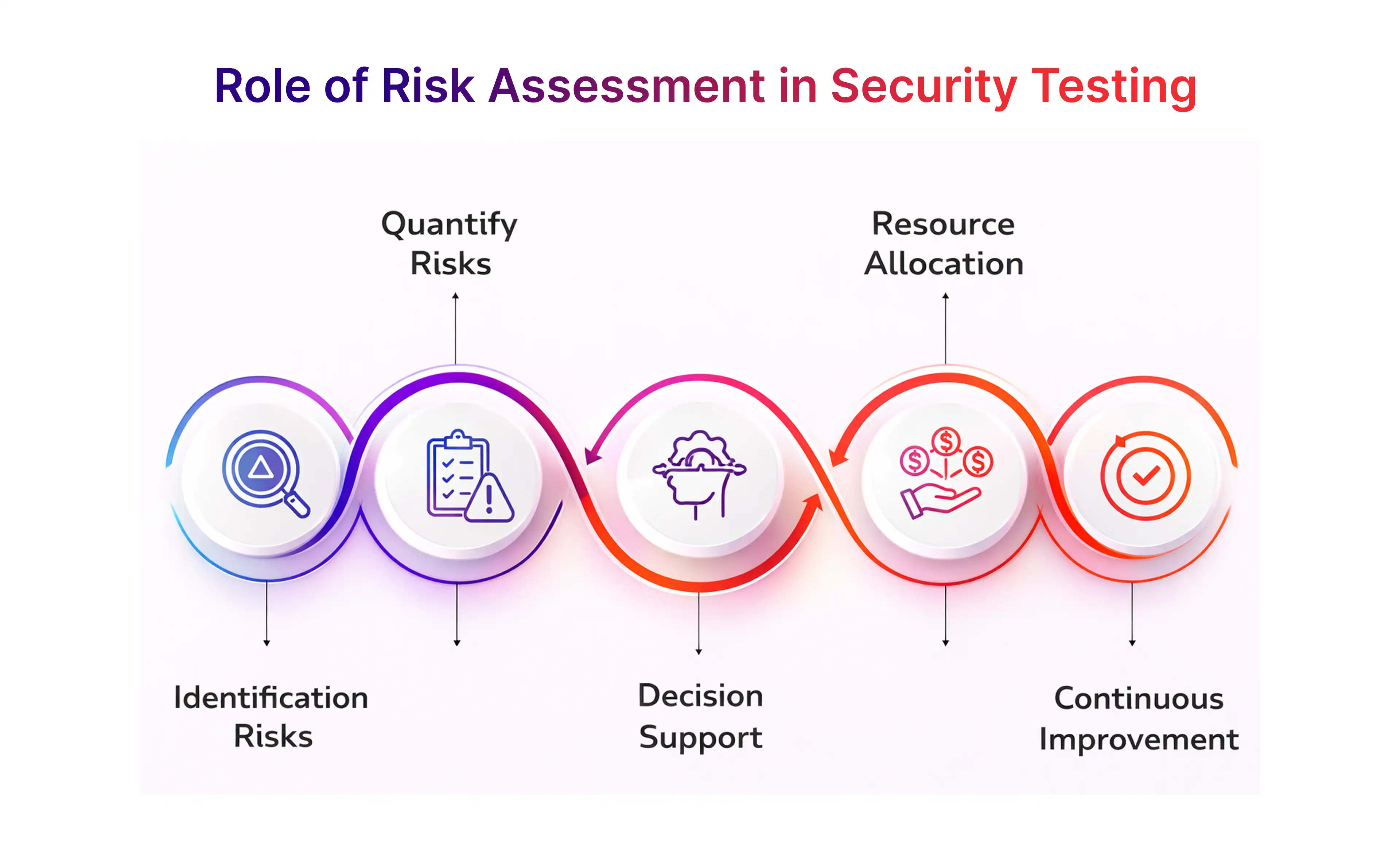
Strong security helps protect revenue and uphold brand reputation.
Critical Security Testing Approaches: Penetration, Vulnerability Scanning, Threat Modeling
Security validation covers multiple angles.
Approaches:
- Penetration testing to simulate attackers
- Automated vulnerability scanning
- Threat modeling sessions using structured frameworks
- Failure Testing and Failure Mode and Effect Analysis
- Post-event recovery built from Process Improvement
These help organizations detect weaknesses before attackers exploit them.
Selection Criteria and Evaluation of Security Testing Toolsets
Security tool selection blends cost, capability, and operational necessity.
Criteria include:
- Regulatory alignment (GDPR, HIPAA, MIIT)
- Ease of integration into DevOps
- False-positive filtering strength
- Internal skill capability and test manager oversight
- Availability of risk dashboards and Gantt charts
Security tools are effective only when teams understand how to apply them consistently.
Conclusion: Why Quality Assurance Services Matter for Every Business
Quality assurance isn’t a checkbox - it’s a disciplined process that protects teams, businesses, and end users. Every company benefits from better QA, whether developing enterprise platforms or consumer mobile applications. A reliable QA strategy reduces defects, strengthens customer expectations, and reinforces quality control throughout the product lifecycle - ultimately driving growth through trust and consistency.
Today’s businesses rely on expert partners to stay ahead. From software testing service providers who validate every feature to end-to-end QA and QC solutions designed to support complex digital ecosystems, organizations now have access to specialized support at every stage of development. Companies can also tap into managed QA teams for software projects, accelerating delivery without sacrificing rigor or performance. Meanwhile, automation testing implementation experts help businesses scale faster by introducing repeatable, efficient workflows. And as cyber threats evolve, performance and security testing services ensure products stay resilient, reliable, and user-ready.
Key takeaways from this guide include:
- QA reduces defects, errors, and post-release failures
- Testing supports every SDLC phase - not just deployment
- Manual + automated testing deliver the strongest coverage
- Performance and security testing protect user trust and uptime
- QA drives customer satisfaction, retention, and brand reputation
At Frugal Testing, we focus on reducing release risk, improving coverage, and helping teams ship with confidence - not just checking boxes.
Businesses that embrace QA early avoid costly surprises later. With expert partners like frugal testing, teams gain tools, insight, and confidence to scale - delivering software that works right the first time, every time.
Frequently Asked Questions
Q1: Can startups and small businesses benefit from QA services?
Ans: Yes - QA helps small teams catch defects early before customers notice them.
It also prevents expensive fixes later and builds user trust from day one.
Q2: Should businesses use manual testing or automation?
Ans: Both are important and work best together. Manual testing finds usability issues, while automation speeds up repetitive validation.
Q3: What tools are commonly used in QA services?
Ans: Popular tools include Selenium, Cypress, JMeter, Appium, and TestRail. Teams choose tools based on product type, platform, and project needs.
Q4: How does QA improve product reliability and customer satisfaction?
Ans: QA identifies defects before launch, reducing crashes and service issues. A smoother experience keeps users satisfied and encourages long-term loyalty.
Q5: What happens when businesses skip quality assurance?
Ans: Skipping QA leads to bugs, downtime, and unhappy customers. It also damages reputation and increases support costs over time.

.webp)
.webp)