


APIs are the backbone of modern digital systems, facilitating communication between microservices, cloud platforms, and applications through Application Programming Interfaces (APIs). A failure in an API to ensure the accuracy and integrity of all data exchanged can pose a significant risk of revenue loss, non-compliance with regulations, and a breach of trust, particularly for organisations that operate within highly regulated industries.
- APIs enable service-to-service communication in microservices architectures.
- Distributed tracing helps monitor data flow across distributed systems
- Poor validation of incoming data increases the likelihood of corrupted test data and production data
- Modern systems rely on Artificial Intelligence models that require validated and consistent inputs.
This guide will support you in understanding how API Testing Exposes Data Integrity Issues Across Services, API Automation Testing, End-to-End Testing, end-to-end validation, and Security & Data Protection strategies will provide consistent and reliable data across complex ecosystems.
API Testing Tools and Automation Techniques
APIs enable communication between microservices, cloud platforms, and applications. When they fail to maintain accurate and consistent data, organizations risk revenue loss, compliance issues, and damaged trust. Distributed systems increase data risks, and weak validation can lead to corruption. This guide explains how API Testing, API Automation Testing, End-to-End Testing, and Security & Data Protection ensure reliable and consistent data across services.

Top API Testing Tools for Modern Development Teams
Development teams need flexible, scalable, and automation-friendly tools for testing APIs across REST, GraphQL, and event-driven systems. Modern automation tools go beyond basic request-response validation.
- Postman for collaborative API development and automated testing
- Apache JMeter for Load testing and Performance testing
- Rest Assured for Java-based API testing and simplifies Unit Testing and contract tests
- SoapUI for SOAP and REST-based integration tests
- Karate for behaviour-driven end-to-end tests
These tools integrate with API Manager platforms to ensure governance, API compatibility, and version control across evolving services.
Postman API Testing and Postman Automation API Testing Guide
Postman API testing remains one of the most accessible approaches for teams starting automation. It supports test scripting, collection runners, environment variables, and monitoring.
- Create automated test scripts within Postman Collections
- Execute regression through automated Test Suite runs
- Integrate with continuous integration pipelines like Jenkins or GitHub Actions
- Validate API responses, Response time, and schema consistency
- Monitor Error rates in production environments
With Postman automation api testing, teams improve end-to-end validation and ensure stable releases across services and third-party service integrations. This reduces deployment risks in distributed architectures. For startups and enterprises alike, it offers a practical entry point into API Automation Testing without heavy infrastructure investment.
FastAPI and Advanced API Testing Automation Tools
Frameworks like FastAPI simplify API development, but robust testing must accompany rapid builds. Fast API applications often rely on asynchronous processing, making automated validation essential.
Choosing Reliable API Automation Testing Services
Not all teams have in-house testing maturity. Choosing professional api automation testing services can accelerate quality assurance efforts.
- Expertise in end-to-end tests and multi-cloud deployments
- Proven experience in end-to-end software testing
- Integration with DevOps and CI/CD
- Security-focused validation via Penetration testing and API compatibility checks
- Scalable test architecture design
Companies like Frugal Testing support enterprises in India, the US, and Europe with structured API automation frameworks. By combining technical depth with cost efficiency, organisations reduce software and data integrity failures before they impact production.
Understanding Data Integrity in API Ecosystems
Data Integrity ensures information remains accurate and consistent across its lifecycle. In API ecosystems, every request and response must preserve structure and transactional consistency through distributed tracing, proper validation rules, reliable transaction management, schema enforcement, and error-handling consistency. Without these safeguards, distributed systems risk silent corruption, inconsistent states, and increased Error rates that impact analytics and customer experience.
Data Integrity vs Data Quality – What’s the Real Difference?
The debate around data integrity vs data quality often causes confusion. While related, they address different dimensions of data management.
- Data integrity focuses on correctness and consistency across Application Programming Interfaces
- Data quality evaluates usefulness and completeness
- Integrity ensures no unauthorized modification
- Quality ensures relevance and accuracy
- Both are essential for compliance and analytics
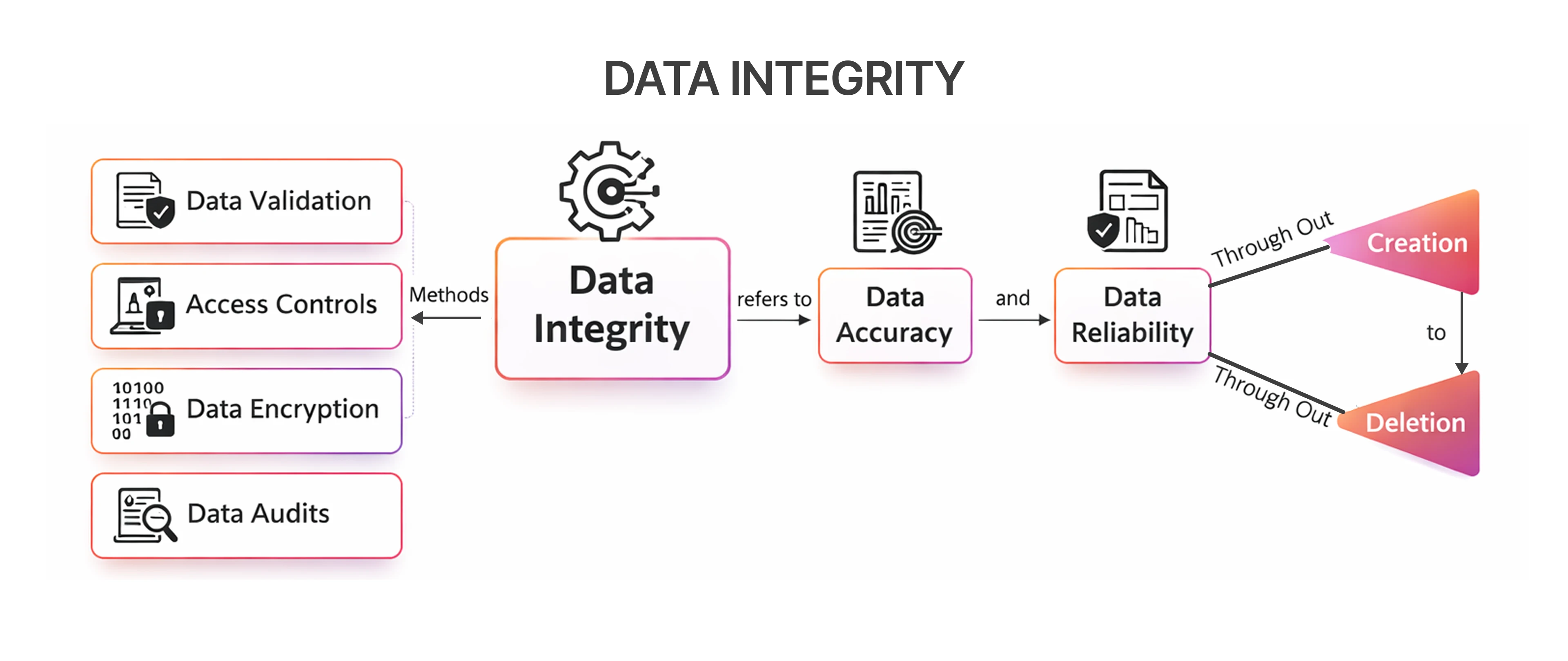

For example, an e-commerce platform in Delhi might collect accurate customer addresses (quality), but if API synchronization duplicates orders, integrity fails. Strong data integrity testing prevents such transactional mismatches across microservices.
Common Software Data Integrity Failures in Distributed Systems
Distributed systems increase complexity and introduce multiple failure points. API misconfigurations or race conditions can result in significant issues such as partial transaction commits, inconsistent caching layers, message queue delivery failures, schema version mismatches, and improper validation rules.
These software and data integrity failures often appear during peak loads. According to industry reports from cloud providers like AWS and Azure, most production outages stem from configuration or integration issues rather than code defects. Preventive API Testing reduces these risks significantly.
Practical Ways to Maintain Data Integrity Across Services
Many leaders ask: How do you maintain data integrity in interconnected systems? The answer lies in layered validation and automation.
- Enforce strict schema validation.
- Use transactional APIs with rollback mechanisms.
- Implement idempotency keys
- Monitor logs and anomalies
- Apply contract testing
Organisations in financial sectors in Mumbai or London must comply with strict audit trails. Integrating validation at the API and database levels ensures consistent cross-service synchronisation and regulatory compliance.
The Importance of Data Integrity Testing in API Validation
Data integrity testing verifies that APIs do not corrupt, lose, or alter data during transmission or processing. It goes beyond functional correctness.
- Validate request-response consistency
- Check database persistence accuracy
- Confirm cross-service synchronization
- Test boundary conditions
- Simulate concurrent requests
This layer of validation strengthens resilience. When API contracts evolve, automated tests prevent breaking dependent systems. Strong validation practices reduce operational disruptions and build long-term reliability.
End-to-End Testing for Detecting Cross-Service Data Issues
While API tests validate isolated endpoints, End-to-End Testing evaluates complete workflows across services, databases, and user interfaces. It simulates real-world user journeys, validates orchestration across service orchestration layers, ensures seamless third-party services integration, monitors performance via distributed tracing, and executes comprehensive end-to-end validation. For enterprises operating across regions like APAC and North America, this visibility ensures consistent performance across distributed infrastructure.
Why End-to-End Testing Is Essential for API Reliability
An API does not generally work by itself. The process of a single checkout could include multiple payment gateways, inventory services, and notification systems.
Some examples of ensuring cascading failures do not exist are:
- Validate interactions through Integration Testing
- Confirm database consistency via E2E tests
- Detect cascading failures early
- Simulate real-world Load testing scenarios
- Monitor production stability using logging, tracing, and monitoring
There is no guarantee that systems will be operationally ready until they are tested through a series of validations at the end of the design process. Comprehensive validations improve the reliability of APIs when they are in production environments.
Best End-to-End Testing Tools and Frameworks
Implementing End-to-End Testing Automation in CI/CD
End-to-end testing automation becomes powerful when integrated into CI/CD pipelines. Automation ensures every build passes comprehensive validation before deployment.
- Trigger tests on pull requests
- Run regression suites nightly
- Use containerised test environments
- Generate automated reports
- Fail builds on integrity breaches
Continuous validation reduces risk in cloud-native deployments. For global enterprises deploying multiple times daily, automation ensures consistent reliability across environments.
API Security and Data Protection Considerations
Security is inseparable from integrity, and Security & Data Protection strategies prevent unauthorized modifications and breaches. This includes encrypting data in transit, enforcing authentication and authorization, implementing rate limiting, validating input parameters, and monitoring suspicious behavior.
Regulatory frameworks like GDPR and India’s DPDP Act require structured security and data protection in API-driven systems.
API Security Testing for Secure Data Exchange
API security testing identifies vulnerabilities such as injection attacks, broken authentication, or excessive data exposure.
- Test for OWASP API vulnerabilities
- Validate token expiration handling
- Check encryption protocols
- Simulate penetration scenarios
- Verify role-based access control
Secure data exchange builds trust, particularly in fintech and healthcare ecosystems. Integrating security checks within API Testing workflows prevents breaches before deployment.

Best Cloud Security for Data Protection in API Systems
Cloud-native systems require scalable protection models. Choosing the best cloud security for data protection ensures compliance and resilience.
- Use managed identity services.
- Apply zero-trust architecture
- Monitor API gateways
- Enable centralized logging
- Automate compliance scans
Cloud providers offer built-in tools, but organisations must configure them correctly. Misconfiguration remains one of the leading causes of data breaches worldwide.
Endpoint Security and Data Protection Strategies
Each API endpoint acts as a potential entry point. Endpoint security and data protection measures reduce exposure.
- Implement input validation
- Use rate limiting
- Apply API throttling
- Mask sensitive data
- Monitor abnormal traffic
Strong endpoint governance ensures APIs remain reliable under high traffic conditions, especially during seasonal spikes in retail or financial trading platforms.

Building a Data Security and Protection Toolkit
A robust data security and protection toolkit combines automation, monitoring, and governance.
- Static and dynamic testing tools
- Automated vulnerability scanning
- Logging and alerting systems
- Compliance dashboards
- Incident response workflows
Security is not a one-time effort. It requires continuous monitoring aligned with evolving threats and business expansion.
Integrating API Automation Testing with End-to-End Testing
Isolated automation strategies cannot guarantee system-wide reliability, so integrating API Automation Testing with End-to-End Testing bridges gaps. This involves sharing reusable test components, aligning validation rules, integrating monitoring systems, maintaining version-controlled test cases, and centralizing reporting dashboards. Combined automation reduces duplication and enhances the detection of cross-service data integrity issues.
Aligning API Automation Testing with End-to-End Testing Frameworks
Alignment ensures cohesive validation across layers. Teams can unify API and UI tests within shared frameworks.
- Map API tests to user journeys
- Reuse authentication flows
- Synchronise test data management
- Implement parallel execution
- Centralise CI/CD triggers
This synergy enhances release confidence. By merging api testing automation tools with end-to-end testing frameworks, organisations streamline workflows and accelerate innovation.
Detecting Cross-Service Data Integrity Issues Through Combined Automation Strategies
Combined automation uncovers subtle synchronisation errors that isolated tests miss.
- Validate database consistency post-workflow
- Compare logs across services
- Simulate concurrency scenarios
- Monitor cross-region replication
- Test rollback mechanisms
Such strategies help prevent software and data integrity failures in distributed architectures. Enterprises operating across continents benefit from automated consistency validation.
Conclusion
APIs drive modern digital transformation, but without rigorous validation, they risk undermining trust and compliance. Combining API Testing, API Automation Testing, End-to-End Testing, and robust Security & Data Protection practices ensures scalable reliability. Automated validation protects Data Integrity, CI/CD integration accelerates safe deployments, security testing prevents unauthorized access, combined automation detects hidden inconsistencies, and continuous monitoring supports regulatory compliance.
How Frugal Testing can help in Building Reliable Systems Through API Testing and Data Protection
Frugal Testing has built its name by providing clients with cost-effective API automation testing services, security validation frameworks, and full-blown Automated Software Testing Approaches. The focus on providing clients with global access to their services, through offices located in India, Europe and North America, has allowed the company to combine low-cost solutions with technical know-how.
Frugal Testing enables businesses to have greater control of their Data Integrity by providing Advanced Automation, security-focused validation and Cloud-Based Encoding Architecture. This gives organisations the ability to keep their Data Safe, avoid Loss of Potential Revenue and create Robust Applications that can scale to meet future requirements.
People also Ask For (FAQ’s)
Q1.Why is API testing essential for data integrity across systems?
Ans: API testing ensures that data exchanged between services remains accurate, consistent, and reliable, preventing corruption or mismatches across systems.
Q2.What risks arise from data integrity failures in connected services?
Ans: Failures can cause revenue loss, regulatory non-compliance, operational disruptions, and damage to customer trust.
Q3.How does API testing prevent revenue, compliance, and reputation loss?
Ans: By validating requests, responses, and workflows, API testing detects errors early, ensuring consistent data and reducing financial and regulatory risks.
Q4.How does end-to-end testing improve cross-platform data reliability?
Ans: End-to-end testing verifies complete workflows across services and platforms, catching integration gaps and maintaining synchronized, accurate data.
Q5.What strategic investments ensure long-term data integrity and resilience?
Ans: Investments in automated API testing, end-to-end frameworks, CI/CD pipelines, and robust security measures maintain reliable and scalable systems.

.webp)