


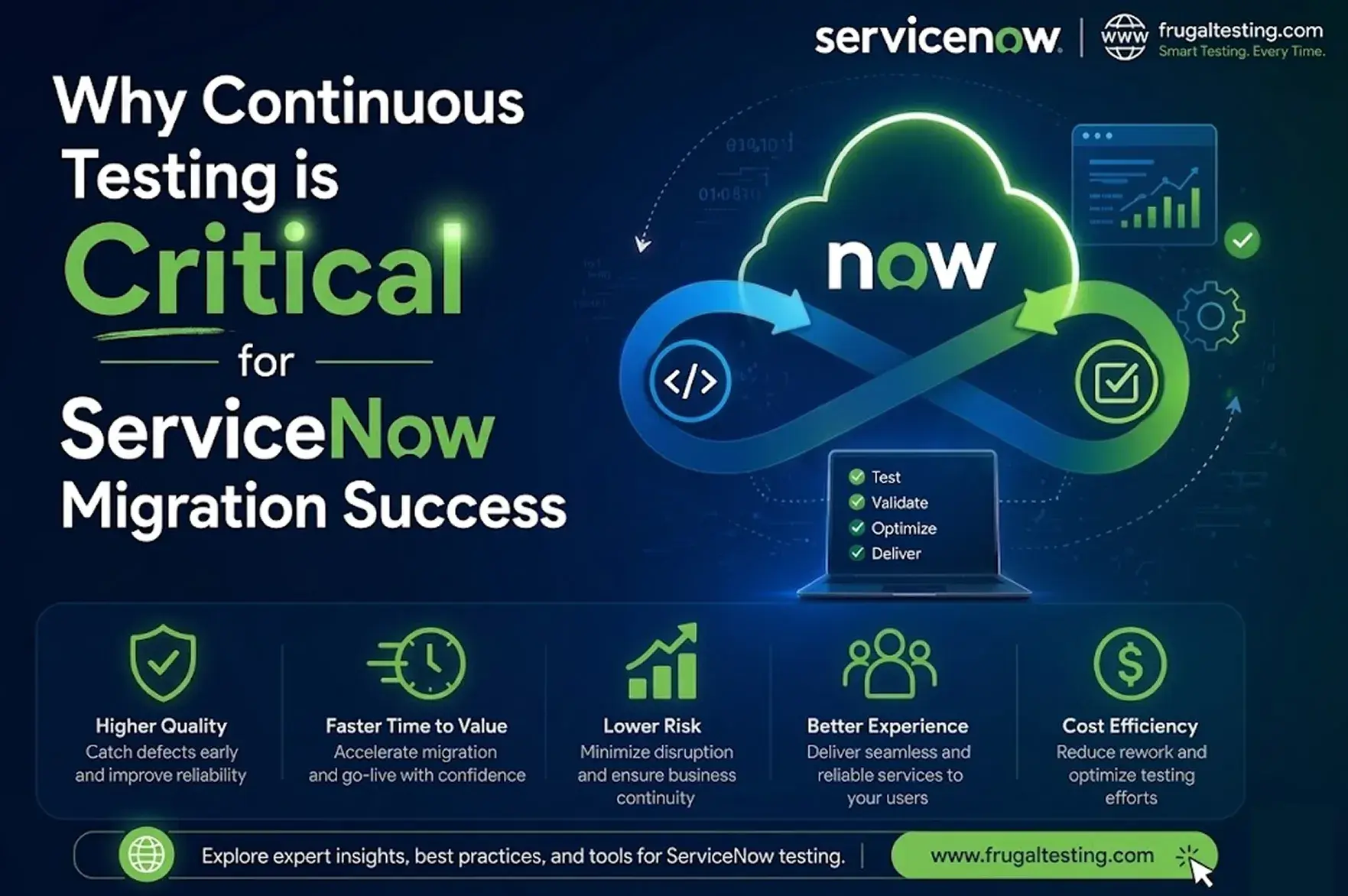
Organizations that want to streamline their workflows and enhance their service delivery and modernize their IT operations should choose to implement ServiceNow. The migration process becomes difficult because it requires organizations to move their data and rework their operational systems while connecting different software systems. The absence of a proper testing method leads to operational failures and data discrepancies plus performance problems when even the smallest mistakes happen. ServiceNow Migration Testing establishes its critical importance through its ability to test and validate as a key element which ensures successful results.
Understanding the Complexity of ServiceNow Migration
The process of migrating to ServiceNow presents organizations with complex challenges that result in difficult implementation paths. Organizations face challenges because they must manage three different types of systems which include their old systems and their specialized software and their distinct data formats. The three elements need dedicated risk management which requires special procedures to handle them. The following factors constitute standard obstacles which organizations face during their ServiceNow migration processes.
- Data loss or corruption during migration
- Compatibility issues with existing integrations
- Performance degradation post-migration
- Workflow misconfigurations
- Security vulnerabilities
The existing problems demonstrate why organizations need to implement a systematic quality assurance process QA for ServiceNow Migration testing which needs to continue throughout the entire period of migration work.
What is Continuous Testing in ServiceNow?
The continuous testing in ServiceNow uses both automated and manual testing methods to test all components during the entire migration process. Testing starts at the beginning and continues throughout all stages of development and integration and deployment until the system is complete.
The approach enables organizations to find and fix problems as they occur which leads to reduced expenses and decreased work effort needed for later defect resolution. The approach meets current DevOps requirements which need organizations to deliver products at high speed while maintaining product quality.
Why Continuous Testing is Essential
1. Early Detection of Defects
The primary benefit of continuous testing enables organizations to identify problems at their earliest stage. The migration process can lead to system-wide failures when even tiny configuration mistakes remain undetected. Teams achieve immediate issue resolution through continuous testing implementation which enables them to detect problems as they emerge.
The proactive strategy protects against potential threats while creating smoother transitions which enhance the effectiveness and dependability of ServiceNow Implementation Testing.
2. Ensuring Data Integrity
Data constitutes the essential foundation for any ServiceNow instance. The migration process requires organizations to maintain both data accuracy and data consistency. Continuous testing establishes data validation processes that verify the following data transfer process.
- Data transfer process operates accurately
- System prevents the occurrence of duplicate or missing records
- Data formats show no signs of inconsistency
The system requires this validation level to establish user confidence while preventing expensive mistakes.
3. Improved System Performance
Performance problems emerge after migration because system architecture changes lead to higher operational demands. Continuous testing enables teams to track performance data during the entire process which guarantees the system will achieve its predetermined performance targets.
The Automated Testing for ServiceNow enables organizations to duplicate actual user conditions in order to find system bottlenecks before they can disrupt user experience.
4. Faster Time-to-Market
Organizations need to achieve fast development cycles according to current business requirements. Continuous testing enables organizations to conduct simultaneous development processes together with migration testing activities. The team tests all modifications at once which results in quicker system setup.
The method benefits companies who plan to outsource ServiceNow Migration Services because it guarantees that third-party teams will produce excellent work within restricted schedules.
Role of Automated Testing in Continuous Testing
The process of continuous testing depends on automated testing as its fundamental component. The testing process for ServiceNow migrations needs more than just manual testing because of their fast-paced nature and complex requirements. The automated testing for ServiceNow System requires because it provides both fast testing results and ability to handle high volumes of recurring test procedures.
The key advantages that automation provides include:
- Test cases are executed with greater speed.
- Test results are delivered with uniformity
- and precision.
- The system minimizes mistakes that humans typically make.
- The system can conduct tests continuously throughout the entire week.
Organizations depend on dedicated testing companies which provide automated testing solutions to achieve their goals of complete testing coverage and superior testing results.
Integrating Continuous Testing into Migration Strategy
Organizations need to adopt continuous testing as part of their migration strategies to reach their full potential. The process consists of two elements which are:
Test Planning: The team needs to establish precise objectives together with defining the test boundaries and test requirements which they will assess against their migration objectives.
Test Automation: The team has to determine which processes can be automated, so that then they come up with tools of automation for the ServiceNow environment.
Continuous Integration: For conventional applications, integration adds with continuous delivery and integration pipelines so as to check every change automatically against these setups.
Monitoring and Reporting: The system allows users to track testing results throughout the entire testing process while it generates insights which help users make decisions quickly.
Addressing Common Migration Risks with Continuous Testing
Organizations use proactive risk management to achieve successful migration results. The testing process finds several important problems:
Mitigation Risk: Thorough ongoing validation helps ensure data accuracy and completeness.
Integration Risk: Continual test-run of the integration helps eliminate compatibility problems.
Performance Risk: The ongoing performance test helps in finding bottleneck problems earlier at the onset.
Security Risk: Continual security testing helps to identify and correct possible threats.
These risks can be actively managed, enabling organizations to realize essential migration objectives.
Choosing the Right Testing Approach
The successful execution of migration operations requires companies to select testing methods which guarantee both uninterrupted system performance and complete operational safety. Through its structured ServiceNow Migration Testing framework organizations can maintain system stability and their data remains correct while they proceed through their migration process. The alignment of testing methods with business objectives together with system requirements establishes the path to successful testing outcomes. Key considerations include:
- Define testing objectives which clearly connect to the migration requirements and business needs
- Identify critical modules and workflows that require priority validation
- Combine manual and automated testing for better coverage and ability
- Ensure data validation and integrity checks at every migration stage
- Testing should proceed through CI/CD pipelines which provide continuous assessment
- The team will work together with experienced QA professionals to manage the challenges which arise during complex migration processes.
Importance of Quality Assurance in Migratio
Quality assurance is not just about testing; it’s about ensuring that the entire migration process meets defined standards. The QA for ServiceNow Migration process includes the following steps:
- The system functionality needs to be confirmed through testing.
- The system needs to prove its ability to fulfill all specified requirements.
- The system needs to confirm its data records through testing.
- The system needs to test its connections and operational procedures through testing.
- The system achieves dependable and secure performance through the combination of a strong QA framework with ongoing testing methods.
Leveraging External Expertise
External expertise helps organizations manage difficult migration tasks while improving their project results. Automated testing services organizations enable them to complete testing procedures faster while maintaining testing accuracy and testing consistency. The main benefits of the system include:
- The system provides organizations with access to advanced testing equipment and experienced quality assurance experts.
- The system enables organizations to conduct their extensive testing processes at a quicker pace.
- The system decreases operational mistakes while expanding testing capabilities.
- The system provides businesses with budget-friendly testing options that can grow with their needs.
Conclusion
The successful execution of a migration process needs a testing strategy which evaluates performance and security and verifies data integrity. Organizations achieve successful system transitions while reducing risks through their implementation of active ServiceNow Migration Testing. Businesses achieve operational efficiency through continuous validation which works with automated systems and strong QA practices to deliver a dependable user experience which leads to both enduring success and complete value realization from their ServiceNow investment.
People Also Ask
1. How do you measure the effectiveness of continuous testing in ServiceNow migration?
Effectiveness is measured using KPIs like defect leakage rate, test coverage of critical workflows, data accuracy, and mean time to detect (MTTD) issues. A successful strategy ensures early defect detection, minimal post-migration issues, and stable system performance.
2. How does continuous testing reduce risks during ServiceNow migration?
Continuous testing identifies issues in real time across data migration, integrations, performance, and security. This proactive approach prevents major failures such as data corruption, integration breakdowns, and performance bottlenecks before they impact production systems.
3. What role does automation play in continuous testing for ServiceNow?
Automation enables faster execution of repetitive test cases, ensures consistent results, and supports continuous validation throughout the migration lifecycle. It is essential for handling complex and large-scale ServiceNow environments where manual testing alone is insufficient.
4. Can continuous testing be integrated into Agile and DevOps workflows?
Yes, continuous testing is a core component of Agile and DevOps. It integrates with CI/CD pipelines to validate every change automatically, enabling faster releases while maintaining system quality and reliability during migration.
5. How do you ensure data integrity during ServiceNow migration testing?
Data integrity is ensured through continuous validation checks that verify data accuracy, prevent duplication or loss, and confirm consistency across systems. Regular testing at each migration stage helps maintain trust in the system and avoids costly errors.

.webp)