

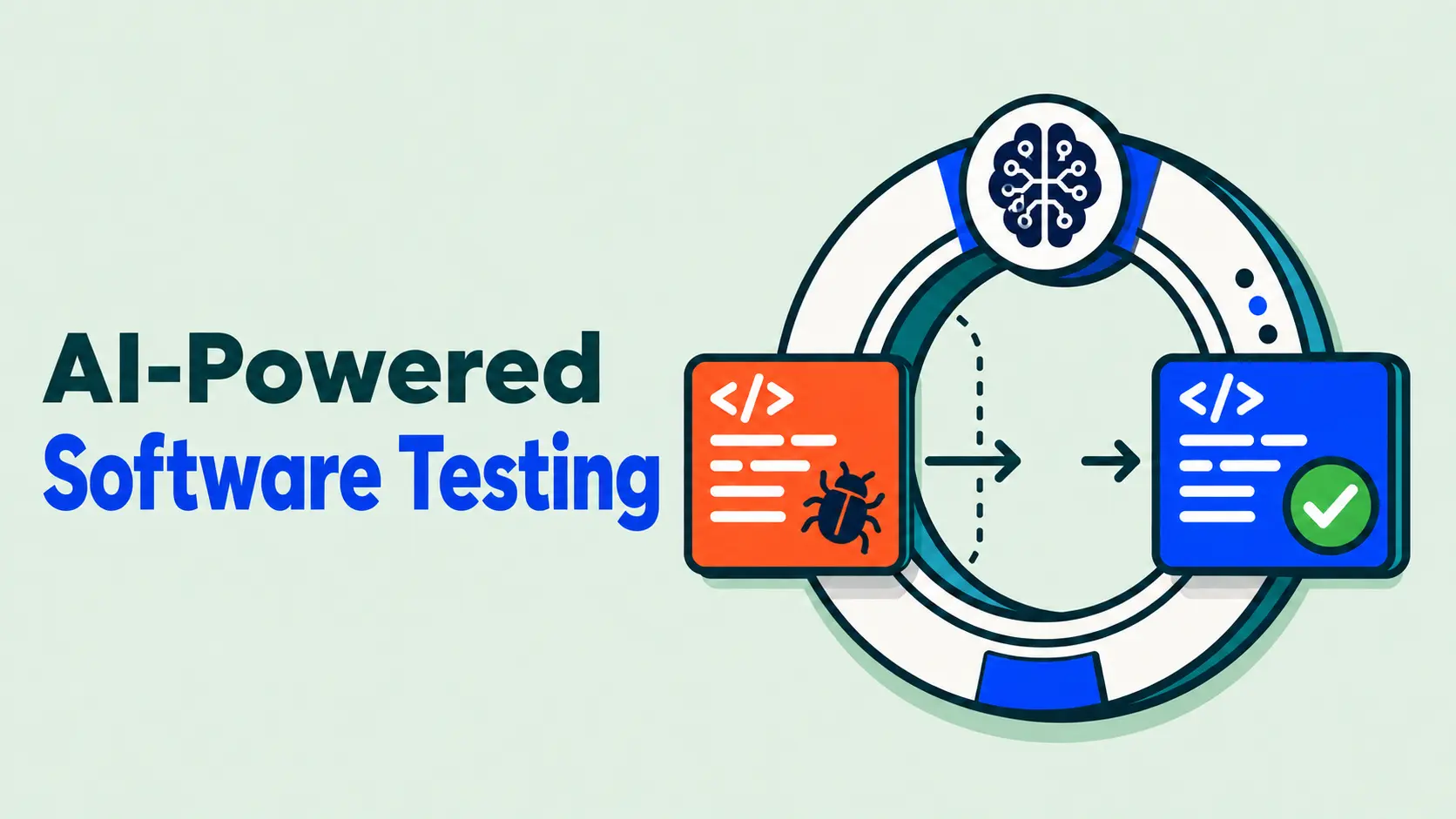
AI is no longer a side experiment in QA it's showing up inside test suites, defect trackers, and CI/CD pipelines whether teams planned for it or not. Test tools now ship with AI features by default, and engineering leaders are being asked how AI fits into their quality strategy, often before anyone has run a proper pilot. This isn't about replacing testers. It's about understanding where AI genuinely helps, where it introduces new risk, and how to bring it into a QA workflow without breaking what already works.
How AI Is Reshaping Test Automation, Defect Detection & Coverage
The most visible shift is in test automation maintenance. Traditional automated tests break the moment a UI element moves, a selector changes, or an element ID gets regenerated and someone has to manually patch the script. AI-assisted "self-healing" testing tools now detect these changes and adjust locators automatically, cutting down the maintenance overhead that has historically made large automation suites expensive to keep alive.
Defect detection is changing too. Instead of relying purely on predefined assertions, machine learning models trained on historical bug data and code-change patterns can flag areas of an application statistically more likely to contain defects letting teams prioritize testing effort where regressions are most probable, rather than testing everything with equal weight. Visual regression tools use similar pattern-recognition approaches to catch UI inconsistencies that scripted assertions would miss entirely.
Test coverage is where AI's impact compounds. Intelligent test case generation tools can analyze application flows, user paths, and existing test data to surface edge cases a human tester might not think to write manually particularly useful for large, fast-changing applications where manual test design can't keep pace with release cycles. Coverage optimization models can also identify redundant tests in a suite, helping teams trim execution time without losing meaningful coverage.
None of this eliminates the need for human-designed test strategy. It shifts effort away from repetitive script maintenance and toward the parts of testing that require judgment: what to test, why it matters, and what "correct" actually means for the user.
The Real Challenges of Bringing AI into QA Workflows
The practical difficulties tend to surface after the pilot phase, not during it.
Training data quality: AI-driven test tools are only as good as the data they learn from. If historical defect data is inconsistent, mislabeled, or too sparse, the model's predictions about "risky" areas of code will be unreliable and teams end up chasing false signals instead of real ones. For teams working with large or complex datasets, a data annotation company can help ensure training data is consistently labelled and structured for AI systems.
False positives and false negatives: AI-flagged defects and AI-generated test failures need review just like any other test result. A model that over-flags creates alert fatigue; one that under-flags creates a false sense of coverage. Teams often underestimate how much tuning is needed before AI-generated results can be trusted at face value.
Explainability: When an AI tool flags a test as high-risk or auto-heals a broken selector, testers need to understand why not just accept the output. Without a clear rationale behind AI-driven decisions, it becomes difficult to validate the tool's judgment, audit failures after the fact, or explain testing decisions to stakeholders who ask how coverage gaps were identified in the first place. This matters more in regulated or high-stakes domains, where teams increasingly need explainability and audit trails built into how AI-driven outputs are governed, rather than treated as opaque see how explainable, audit-ready AI decision-making is approached in regulated enterprise environments for a sense of what that looks like at scale.
Integration friction: Most AI testing tools weren't built with a specific CI/CD pipeline in mind. Getting them to plug into existing build systems, reporting dashboards, and ticketing workflows without creating a parallel, disconnected process takes real engineering effort it's rarely as plug-and-play as vendor demos suggest.
Skills gap: QA engineers are testing specialists, not always ML practitioners. Understanding what a model is actually optimizing for, and knowing when to distrust its output, is a new skill set that most teams are building on the fly.
Practical Approaches QA Teams Can Start With
Start with one workflow, not the whole suite: Pick a single high-friction area, flaky UI tests, or a defect-prone module and pilot AI tooling there before rolling it out broadly. This makes failures cheap to diagnose and gives the team a real basis for evaluating whether the tool is actually helping.
Keep a human review checkpoint: Treat AI-flagged defects and AI-generated test cases as recommendations, not final verdicts, at least until the team has enough history with the tool to calibrate trust. This is especially important early on, when false positive rates are still being understood, while tools like predis ai AI generated videos can support broader AI-driven workflows.
Prioritize tools with visible reasoning: When evaluating AI testing tools, ask vendors directly how the tool explains its flagged risks or generated test cases. Tools that surface their reasoning even briefly are far easier to validate, debug, and defend in a post-incident review than ones that return a verdict with no context.
Track outcomes, not adoption: The metric that matters isn't "how many AI features are we using" it's whether defect escape rate, test maintenance time, or release cycle time actually improved after adoption. The World Quality Report 2025-26 found that while nearly 90% of organizations are now piloting or deploying generative AI in quality engineering, only around a third have moved it into production a reminder that adoption and measurable value are two different milestones, and teams should track the second one deliberately rather than assume it follows automatically from the first.
Budget time for tuning: AI testing tools rarely work well out of the box. Plan for a calibration period where false positives get triaged and thresholds get adjusted, rather than expecting immediate accuracy.
AI is changing what QA teams spend their time on, not whether QA teams are needed. The teams getting real value from it aren't the ones adopting the most tools, they're the ones being deliberate about where AI actually reduces manual effort, and disciplined about keeping human judgment in the loop where it still matters most.