


Skipping API testing in a microservice architecture can lead to data inconsistencies, security vulnerabilities, cascading system failures, regression issues, broken integrations, and performance bottlenecks. Because services depend on each other through APIs, even a small failure can quickly impact the entire system.
Without proper API testing, these risks often remain hidden until they affect production, resulting in higher costs, downtime, and poor user experience.
What Is API Testing in Microservice Architecture?
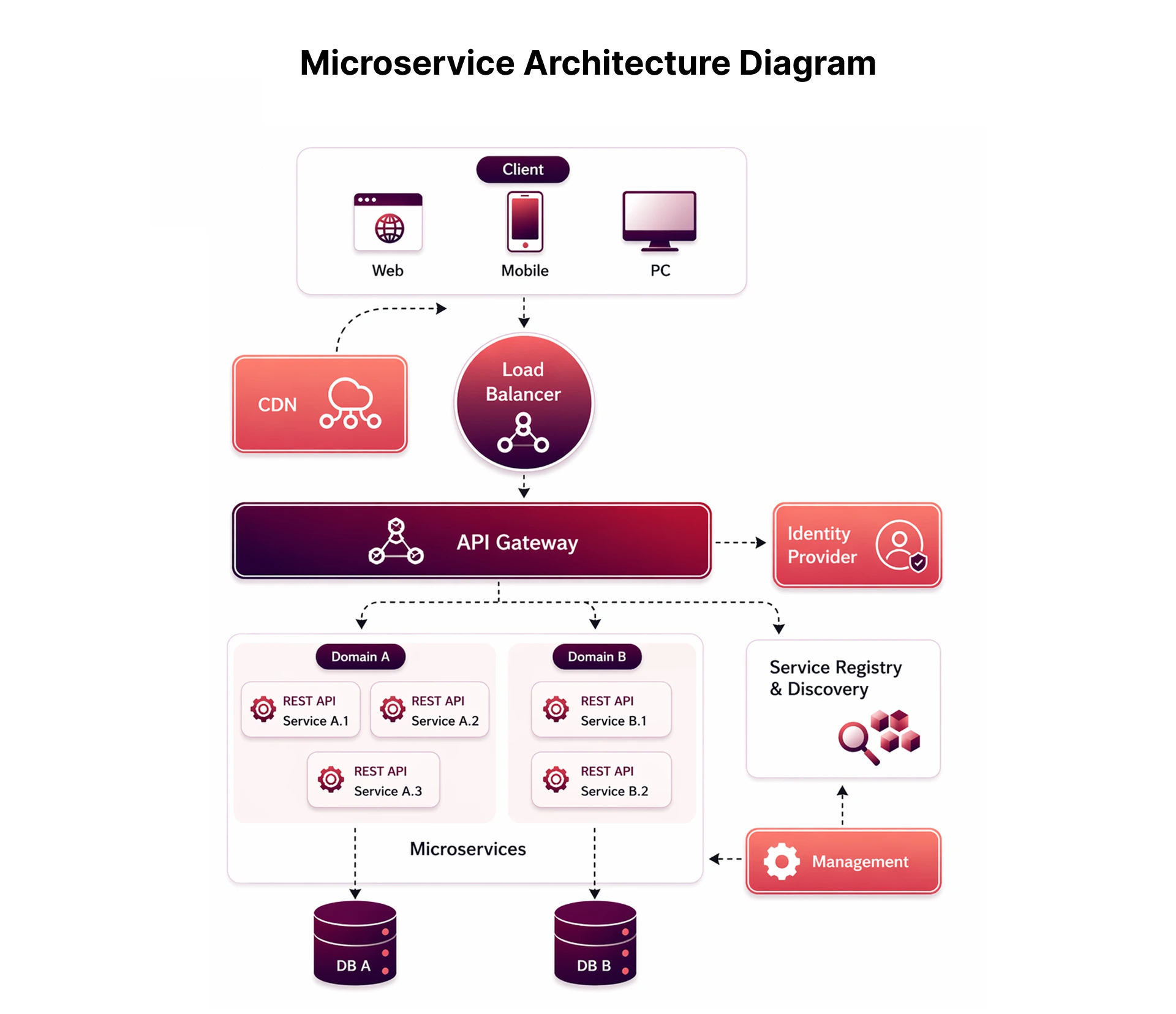
As a part of microservice architecture, the software application is divided into smaller modules known as services. Each service operates independently of the other. In this scenario, communication between these services occurs via their APIs. To take an example, suppose Service A communicates with Service B for accessing user details, and Service B calls Service C to get transactional records of the user. All these interactions have to be tested, and each one of them is a point of failure that could go undetected if not validated.
Thus, API testing in microservice best practices includes testing interactions for request/response formats, authentication flows, error-handling mechanisms, and performance under different loads. It involves testing not just individual services but also their integration. This validation also covers both unit testing and integration testing at various stages of development, including during deployment via CI/CD pipelines. Test tools that could do all this include Postman, Swagger, and JMeter, among others.
Why Skipping It Is a Risk Teams Cannot Afford
Microservices require more resources than monolithic architectures due to operational complexity alone. That cost only makes sense if your architecture is stable, and stability depends entirely on how well your API layer is tested.
When a contract breaks between two services, the failure does not stay local. It travels downstream silently, corrupting data for hours before anyone notices. A missed schema validation today becomes a cascading production failure next month. The right api testing tools, qa and software testing services, and performance testing best practices exist to prevent exactly this.
The 6 Critical Risks of Skipping API Testing
Schema Failures and Data Inconsistency Risks
In a microservices architecture, there’s no shared database keeping everything aligned behind the scenes. Consistency mostly depends on API contracts and how well those contracts are actually tested.
These issues don’t usually show up immediately. A contract change might pass initial checks, but once other services interact with it, small mismatches start to surface.
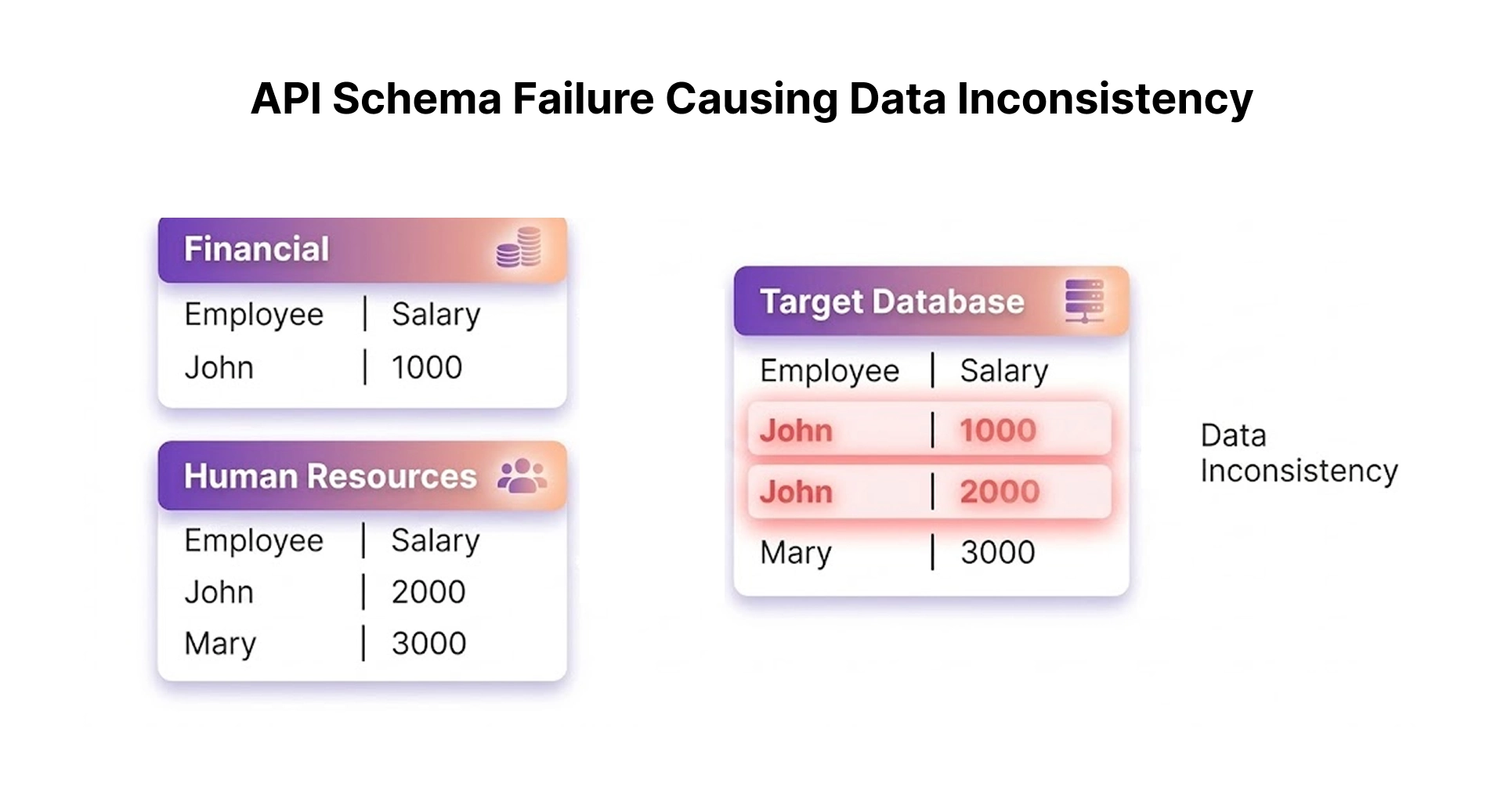
A few patterns tend to show up here:
- API contract updates go live without verifying dependent services.
- Schema validation isn’t part of the CI/CD pipeline, so testing stays limited to tools like Postman API testing during development.
- OpenAPI specs exist, but are treated more like static documentation than something that evolves with the code.
Moving contract testing earlier in the workflow helps. Tools like PactFlow can catch structural mismatches during pull requests, before they spread across services.
It’s not a complete safeguard, but it does reduce the chances of issues slipping into later stages where they’re harder to diagnose. Running API automation tests alongside deployments adds another layer, not perfect, but useful for catching problems early.
API Security Gaps That Expose Vulnerabilities
Most teams spend time checking whether APIs return the correct response. What often gets less attention is whether those APIs should return that response in the first place.
In microservice architectures, this becomes harder to manage because authentication isn’t centralized. Each service handles its own logic, so a small gap in one place can quietly expose access across others.
Reports from organizations like IBM have consistently pointed out that a large share of API breaches comes from gaps like these, not from complex attacks, but from missed validations.
Some patterns tend to come up repeatedly:
- Mutual TLS is enforced at the edge, but not between internal services.
- Object-level authorization isn’t fully tested, so restricted data is returned incorrectly.
- JWT tokens are accepted without proper validation; privilege escalation may occur without triggering failed login attempts.
- Secrets management isn’t integrated (for example, missing HashiCorp Vault), leading to sensitive data appearing in API responses.
Many teams rely on API testing services to continuously validate authentication and authorization layers across deployments. Bringing security checks into the CI/CD pipeline makes a noticeable difference. Tools like Nmap, Trivy, and SonarQube help catch misconfigurations early, especially when they’re run automatically with each deployment.
Cascading System Failures That Lead to Service Downtime
A single failing service in a microservice architecture does not fail in isolation. It pulls everything connected to it, one timeout, one backed-up queue, one exhausted connection pool at a time, until a localized issue becomes a system-wide outage nobody can untangle quickly.
Root Causes:
- No End-to-end testing covering real service dependencies before deployment.
- Circuit breaker patterns have never been tested or validated under failure conditions.
- Timeout thresholds were never validated under concurrent load in the staging environment.
- Fault tolerance testing was skipped entirely across dependent service interactions.

In a high-traffic scenario, when Service B goes down, all 600+ concurrent requests can cascade onto Service A alone, overwhelming its connection pools and potentially triggering a system-wide failure. At this stage, teams often bring in a software testing service provider to stabilize failing integrations.
Regression Testing Gaps That Slow Down CI/CD and Increase Costs
These issues rarely show up all at once. They build over time, one deployment at a time, until debugging starts taking longer than actual development. In microservices, this tends to happen sooner than expected.
A few things usually contribute to it:
- Independent deployments affecting shared API contracts without clear visibility.
- No validated baseline before releases.
- Staging environments missing full regression coverage.
- Developers are spending more time fixing issues than building features.
In practice, this isn’t just theoretical. In Frugal Testing work with mid-sized SaaS teams, regression gaps in CI/CD pipelines often show up as a major cause of production issues. In some cases, they’ve contributed to over half of post-deployment rollbacks during early scaling.
It often comes down to a simple pattern: changes pass local checks, but their impact on dependent services isn’t fully tested.
Broken Service Integration That Impacts Business Workflows
Most business workflows don’t stay within a single service; they move across several. That’s where integration issues tend to show up.
The problem isn’t always obvious during development. Things may work fine in isolation, but once services interact, small mismatches start affecting the flow.
Some common causes include:
- Request payloads are changing between versions without proper versioning.
- Authentication tokens not being passed correctly across services.
- Message formats (Kafka or MQTT) are drifting between producers and consumers.
- Lack of service virtualization, so issues only appear with live dependencies.
In practice, documentation tools like Postman or Swagger help define expected behavior, but they don’t catch everything on their own.
What tends to work better is validating integrations continuously. Using API automation testing tools in the deployment pipeline helps catch mismatches early, before they start breaking real workflows.
Performance Bottlenecks That Degrade User Experience at Scale
An API that handles Monday traffic fine can completely fall apart on a product launch day. Not because the code changed, but because nobody tested what happens when ten times the normal number of users hit the same endpoint simultaneously.

- Database queries are running fine in isolation, but grinding under fifty concurrent service calls.
- No connection pooling between services, every request opens a fresh connection, adding hundreds of milliseconds under load.
- Synchronous REST calls handling workflows that should have been asynchronous from the start.
- Kubernetes autoscaling thresholds are set too high, and pods are spinning up after users have already experienced degradation.
JMeter performance testing simulates realistic traffic patterns before release, exposing bottlenecks under controlled conditions. Load testing techniques, including spike, soak, and stress testing, each expose a different failure mode before a real traffic surge does.
The Modern API Toolkit: Observability and Automation
API testing shows how your system behaves in controlled conditions. Good observability shows what actually happens in production. The strongest teams treat both as non-negotiable; automation catches failures before deployment, and observability catches what slips through after.
Playwright & REST-assured: Frameworks for Robust Automation
In microservice projects, teams usually don’t stick to just one of the many API testing tools available. Playwright and REST-Assured are two that come up often, but mostly for different reasons.
Playwright is useful when testing isn’t limited to APIs alone. For example, if a UI action triggers an API call, it helps to see both sides together instead of testing them separately. You can intercept requests, mock responses when something isn’t ready yet, and quickly check how the UI behaves. It’s not the best choice for deep backend validation, but for end-to-end flows, it saves time.
REST-Assured is a bit more straightforward. It’s mainly used in Java and Spring Boot environments where the focus is on API correctness. If you need to validate JSON responses or chain multiple API calls, it tends to be easier to manage here than trying to do the same in a UI-heavy tool.
The table below compares Playwright and REST-Assured across some practical factors for API testing in microservices.
Prometheus & Datadog: Real-Time Microservice Observability
Once your services are live, testing alone doesn’t tell you much about how things behave under real traffic. That’s where observability tools start to matter.
Prometheus is often used to keep track of system metrics: request rates, error counts, latency, and so on. It gives you a steady view of how services are performing and alerts you when something crosses a threshold.
Datadog, on the other hand, helps when you need to dig deeper. Instead of just metrics, it traces requests across services. So if something slows down, you can follow the request path and see exactly where the delay is coming from.
The table below compares Prometheus and Datadog across key observability factors in microservice environments.
Case Study: The $440 Million "Dead Code" Glitch at Knight Capital
Among the most famous instances of a malfunctioning trading system, Knight Capital Group's problem is widely regarded not as a result of a cyber attack, but rather of a combination of release and misconfiguration.
On August 1, 2012, while implementing new software, new trade instructions were deployed to several servers. Unfortunately, the new software was not deployed on one of the servers, which remained using the old version (SMARS-related).
Upon setting certain flags, the obsolete code was run by mistake, and the system issued excessive trades on a massive scale. In less than an hour, Knight had already lost around $440 million, based on the reports and investigation of the US Securities and Exchange Commission.
It can be seen that the problem did not only lie in the missing deployment, but also in the lack of proper release tests, environment similarity, and comprehensive testing of the system as a whole.
The Bottom Line: API Testing Is Not Optional in Microservice Architecture
Scaling Smarter: Achieving Cost-Efficiency with Frugal Testing
Looking at all these risks together, the problem usually isn’t that teams aren’t testing. It’s more about what gets tested and when. A lot of issues in microservices come from small things, API contract changes, dependencies between services, or behavior that only shows up under real traffic.
The fix is not broader coverage; it’s targeting the high-risk API interactions that are most likely to fail in production. That’s where most of the real issues tend to come from anyway.
Frugal Testing leans into this idea. Instead of trying to test everything, it focuses on the parts that actually matter, critical paths, service dependencies, and the areas where failures are more likely. It’s a bit more practical than just increasing test volume.
In most teams, this ends up being a mix of api testing services, qa and testing services, and test automation services working together. It’s not always perfectly structured, but when these are aligned, they cover the gaps that usually slip into production.
And as systems grow, having a software testing service provider involved can make this easier to manage over time, especially when different teams are working on different services.
Read the Frugal Testing Case Study →
FAQs (People Also Ask)
Q1.What are the common challenges teams face when scaling API testing in microservices?
Ans: API testing at the microservice scale is difficult because of service dependencies, frequent API updates, and inconsistent environments. As microservices grow, maintaining test coverage becomes complex. Without strong test automation and CI/CD integration, teams struggle to keep tests reliable and fast.
Q2.How can teams ensure test data consistency across multiple microservices?
Ans: Test data consistency across microservices requires centralized test data management and service virtualization. Controlled environments like staging help simulate real interactions, while reusable datasets and isolated test cases ensure reliable validation across services.
Q3.What role does versioning play in maintaining API test stability?
Ans: API versioning helps maintain test stability by ensuring backward compatibility when APIs change. It allows services to evolve without breaking existing integrations, keeping test suites reliable across different service versions.
Q4.How do you maintain API test suites as microservices evolve?
Ans: Maintaining API test suites in microservices requires regular updates to reflect service changes. Outdated tests should be removed, and new scenarios added, while test automation in CI/CD ensures continuous validation as services evolve.
Q5.What are the most important metrics to track in API testing?
Ans: API testing metrics that matter most include response time, error rates, and test coverage. Teams should also track latency under load and defect leakage into production to identify performance issues early and improve system reliability.


%201.png)