


Organizations use artificial intelligence to create better software testing processes which they implement and improve through testing. Businesses that implement AI-based automation systems discover that their existing manual testing methods struggle to handle the demands of complex AI-driven systems which include AI Agents and large language models and machine learning models.
Key Topics Covered in This Blog
- Core principles of AI-driven test case redesign and intelligent test case design
- Framework architecture for AI-based test automation and execution pipelines
- Machine learning integration for test optimization, defect prediction, and test case generation
- Validation, refactoring, and performance optimization strategies for automated testing
Organizations like Frugal Testing, serving global clients including India, the US, and Europe, specialize in implementing AI-native testing frameworks that combine quality assurance and intelligent automation. By integrating AI-powered testing strategies, companies can achieve faster release cycles, stronger quality control examples, and improved reliability in automated testing frameworks.
Core Principles of AI-Driven Test Case Redesign
Software testing now uses AI-based test case redesigns to create adaptive learning systems for their testing process because traditional test scripts need human monitoring throughout the testing process.
Here are the core principles of AI-driven test case redesign:
1. Autonomous Test Generation (Model-Based Testing)
The AI system uses its best practice testing method to create testing scenarios, which include standard business processes that cover login and checkout and CRUD operations.
2. Self-Healing Test Automation
AI tools use computer vision technology to identify elements because this technology enables them to track multiple attributes while detecting elements that have experienced UI modifications.
3. Intelligent Test Case Optimization
Test Suite Pruning: The process identifies testing scenarios that remain unused or exist as duplicates or show no relevance.
Gap Analysis: The process measures present testing coverage against essential requirements that come from user stories to develop new test cases for functions that remain untested.
4. Data-Driven & Predictive Risk Prioritization
Risk-Based Testing establishes the testing sequence for software modules that need evaluation because these modules face the greatest risk of failure after developers make code changes.
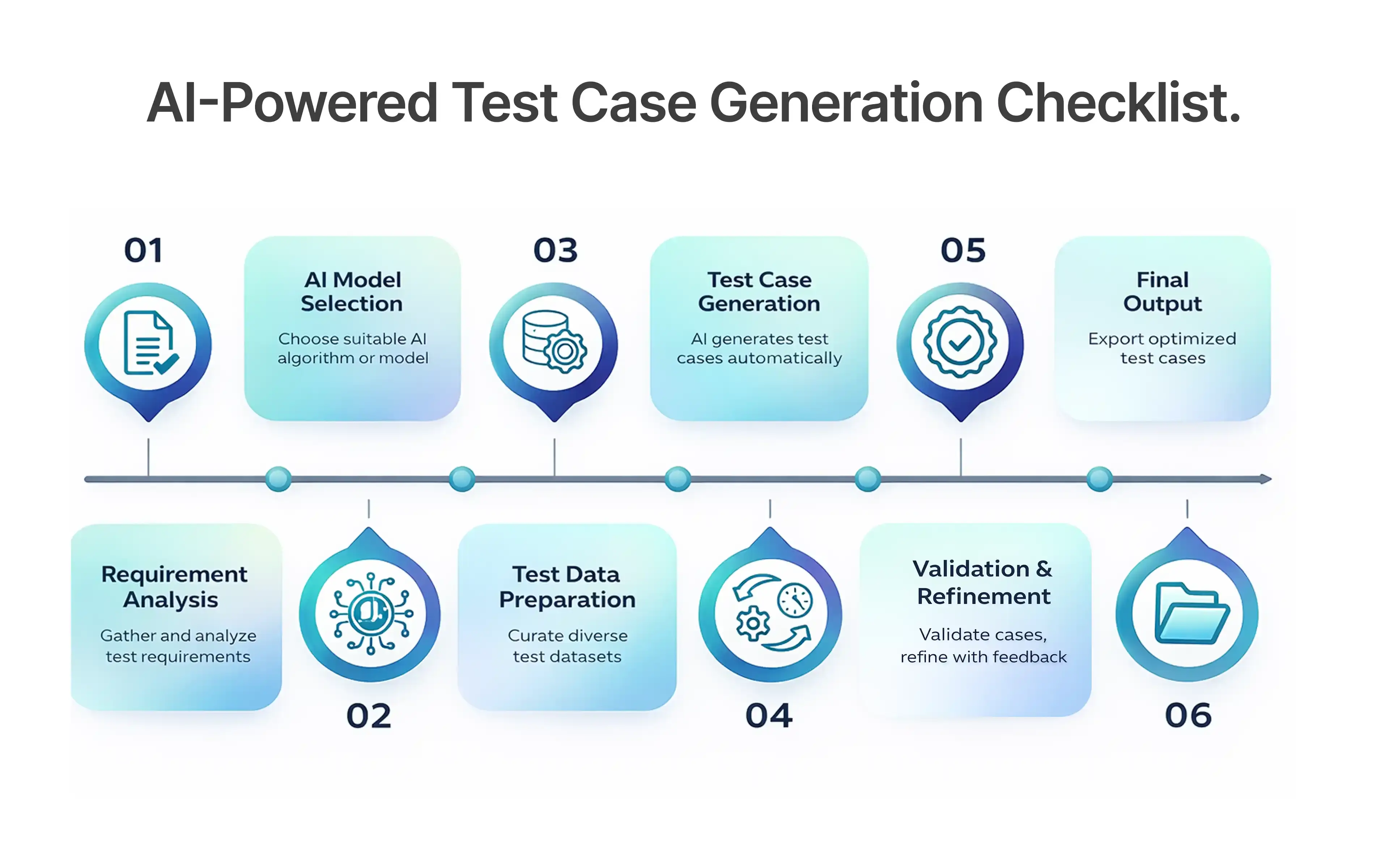
Structural Foundations of AI-Based Testing Architectures
The test architectures that exist today require support for testing environments that use artificial intelligence to operate dynamically.
The system architecture consists of these essential components.
- The test automation framework uses Page Object Model together with architectural design methods to create a modular testing framework system.
- The system allows users to perform tests continuously while validating software deployments through its integration with CI/CD pipelines.
- The system enables testing through APIs, user interfaces, and visual elements on multiple platforms.
The testing frameworks maintain their ability to grow and their strength through these basic elements.
Efficient Test Scenario Design for Automated Validation
The process of creating efficient test scenarios enables organizations to achieve maximum automation results while reducing their need for manual testing. A well-designed sample of test cases improves test coverage, execution speed, and defect detection capabilities.
Essential Components of a Test Scenario
- Unique ID: For tracking and organization.
- Description: Clear, concise goal of the test.
- Preconditions: Setup required before execution.
- Steps & Expected Results: Measurable, actionable steps, and expected outcomes.
Developers can use pytest or Python unittest to create test cases that automatically verify system functionality through their scalable testing framework.
Quality Assurance Frameworks for AI-Enabled Test Improvement
Understanding quality assurance definition and quality control definition is essential when implementing AI-enabled testing systems. While quality control focuses on defect detection, quality assurance ensures the overall testing process improves continuously.
AI-enabled quality frameworks include:
- Automated defect detection using Neural Networks and machine learning models
- Self-healing tests that adapt to UI testing framework changes
- Continuous test management using intelligent Test Manager systems
Quality control vs quality assurance becomes clearer when AI tools automate both validation and process improvement.
Machine Learning Integration in Automated Test Optimization
The testing process achieves improved operational efficiency, testing efficiency, and testing adaptability through the implementation of Machine Learning (ML), which enables intelligent testing process management.
Key Areas of Integration and Optimization
ML techniques are applied across several key testing activities:
Test Case Generation: ML algorithms use supervised and generative models to examine requirements together with user behavior logs and historical test data for the creation of complete test cases, which include edge cases that human testers would overlook.
Test Suite Optimization: The ML system does automatic testing and test suite performance enhancement, because it finds and eliminates tests that do not contribute to testing value.
Test Prioritization and Selection: The ML system tests new code modifications, previous failure records, and code difficulty assessment to determine which tests should be run first to accelerate CI/CD pipeline results and to allocate testing efforts to critical test components
Machine Learning Applications in Test Effectiveness Enhancement
Machine learning enhances testing effectiveness by analyzing historical test data and identifying patterns. These capabilities allow testing frameworks to predict failures before they occur.
Key applications include:
- Defect prediction using historical test coverage and execution data
- Automated Root Cause Analysis for faster debugging
- Intelligent regression tests prioritization based on risk analysis
- Adaptive test case generation using Reinforcement Learning
For example, generative AI models can analyze business requirements and automatically generate software test case examples. This reduces manual testing effort and accelerates release cycles.
Adaptive Execution Frameworks for AI-Optimized Testing
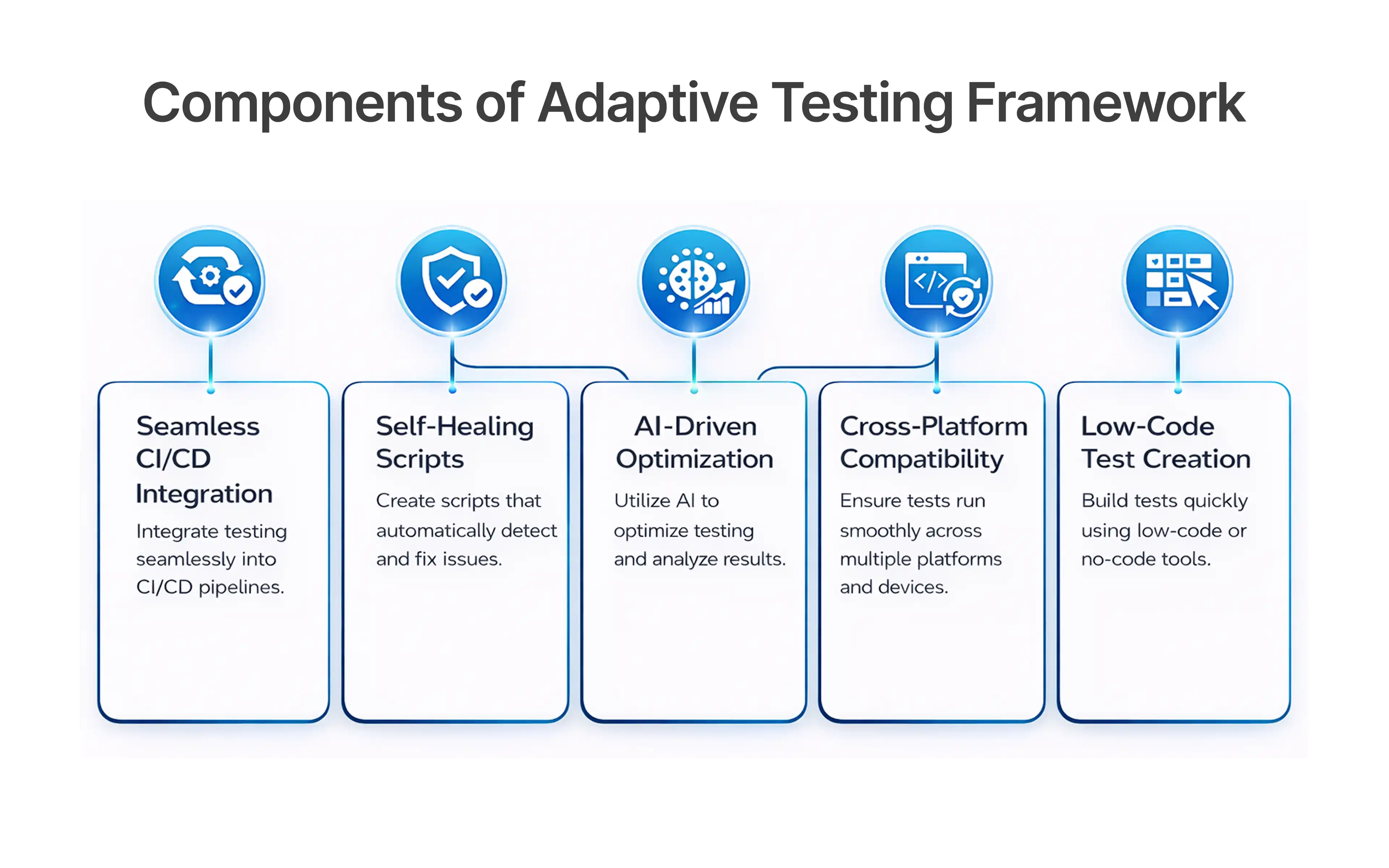
Adaptive execution frameworks enable testing systems to automatically adjust based on application changes. These frameworks support continuous integration and scalable automation.
Core features include:
- Autonomous test execution using AI Agents
- Parallel Execution Support for faster test execution
- Self-healing tests that update automatically when UI layouts change
- Intelligent test management using automated testing frameworks
Tools like Cypress testing, jest testing, and react testing library provide scalable UI testing solutions. When combined with AI-powered testing tools, these frameworks enhance automation reliability and efficiency.
Scalable Test Processes for Autonomous Automation Systems
Scalable test processes allow organizations to handle large-scale automation environments. Autonomous testing agents continuously monitor and optimize test performance.
Scalable test processes include:
- Automated test case generation using large language models
- Synthetic test data generation for realistic testing scenarios
- Continuous regression testing for system stability validation
Organizations adopting scalable automation frameworks improve deployment reliability and system performance. AI-native platforms also reduce operational costs while increasing automation efficiency.
Framework Architecture for AI-Based Test Automation
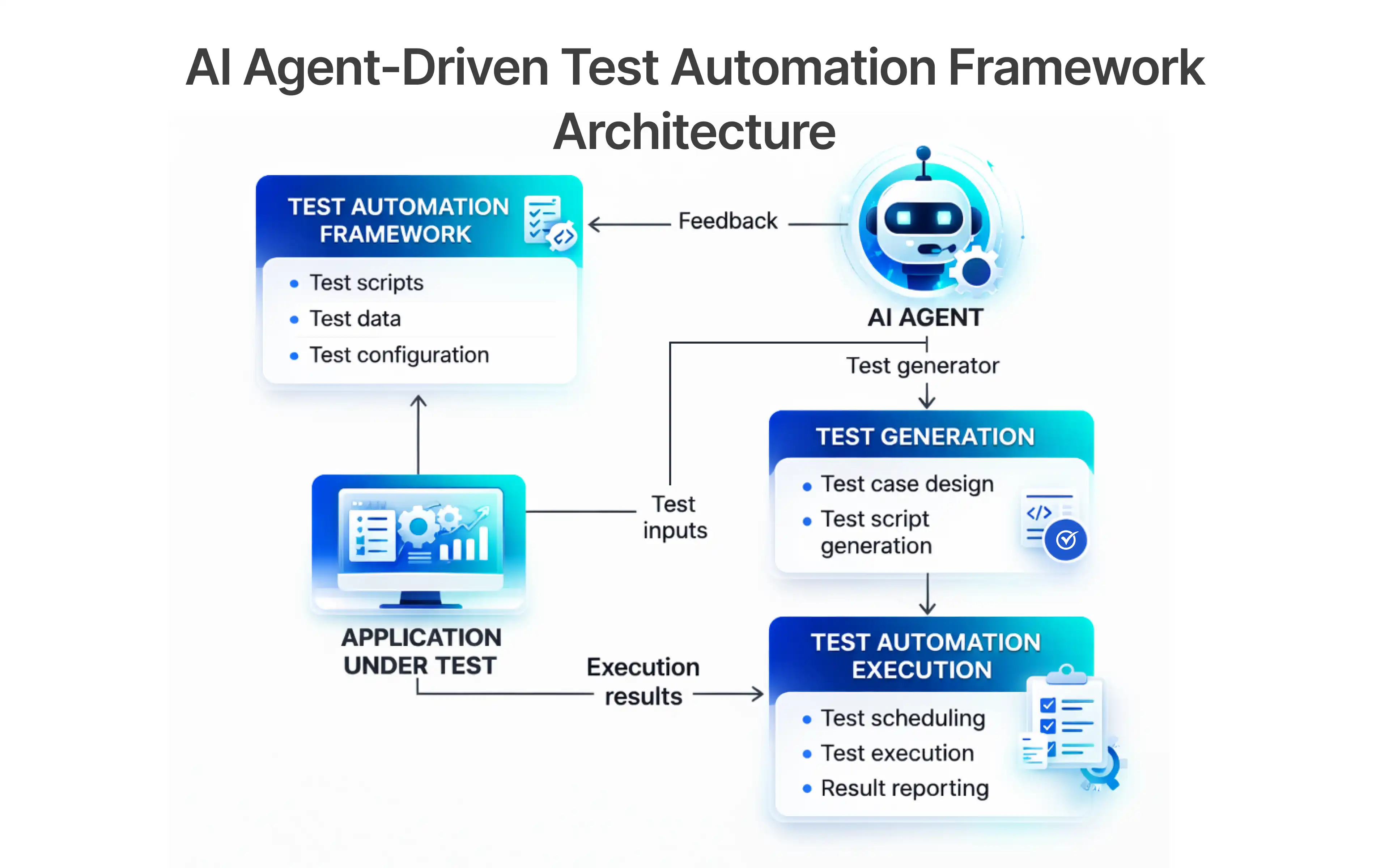
The AI test automation framework architecture establishes the interaction pattern between intelligent elements, which build testing mechanisms that conduct tests and assess results while they improve testing methods through their ongoing development.
- Intelligent Test Design Layer: The system employs generative AI together with Natural Language Processing and AI Test Case Generator tools to create test cases from testing requirements, acceptance criteria, and business logic.
- Automation Execution Layer: The system executes test scripts through several testing automation tools, which include Selenium WebDriver, Cypress testing, pytest, Python unittest, and Katalon Studio to enable UI testing, API testing, and regression testing.
- AI Decision and Optimization Layer: The system uses machine learning models together with Reinforcement Learning and Neural Networks to enhance test execution processes, to forecast defects, and to create self-healing tests for UI layout changes and workflow modifications.
Core Components of AI Testing Infrastructure
AI-driven testing infrastructure consists of several core components that enable automated testing operations.
Essential components include:
- Test automation tools such as Katalon Studio, Selenium WebDriver, and Cypress testing.
- Automated test suite management systems.
- AI-powered test case generation tools.
- Reporting and Logging systems for defect tracking.
- CI/CD pipelines integration for continuous testing.
These components ensure automated testing frameworks operate efficiently and provide accurate validation results.
Design Patterns for Intelligent Test Structure Implementation
Design patterns improve automation framework scalability and maintainability. Using structured patterns ensures efficient automation development.
Common design patterns include:
- Page Object Model for UI testing automation
- Modular test automation framework architecture
- Test Data Handling strategies for scalable automation
- Self-healing tests for adaptive automation
- Automated test management frameworks
Organizations implementing structured automation frameworks experience faster deployment cycles and improved software testing efficiency.
Automation Engine and Execution Pipeline Architecture
The automation engine is responsible for executing test cases and validating application behavior.
Key pipeline components include:
- Test execution engines using pytest and python unittest
- Automated regression tests and validation pipelines
- AI-powered defect detection and analysis
- Continuous monitoring using automated testing frameworks
- Intelligent reporting systems
Automation pipelines enable faster software validation and improved deployment reliability.
Validation and Refactoring Strategies for Automated Testing
The development process benefits from effective testing solutions, which require developers to validate their work throughout the entire development process and use automated tools for safety testing to maintain code quality and test accuracy.
Validation Strategies:
Automated testing requires validation to verify that the software fulfills both user requirements and business needs. Key strategies include:
- Implement the Testing Pyramid: The Testing Pyramid requires implementation through which testing teams should conduct their testing operations by executing numerous fast-paced Unit Tests.
- Integrate with CI/CD Pipelines: The system should connect with continuous integration and continuous delivery pipelines to initiate testing procedures whenever developers submit code changes or create pull requests, which will produce immediate testing results.
- Prioritize Tests Based on Risk: The most important user pathways, history tests, and dangerous areas should receive automated testing as the main testing focus.
Refactoring Techniques for AI-Compatible Test Scenarios
The process of refactoring automated testing frameworks for their transformation into AI-native testing systems requires complete testing systems that can handle ongoing application updates.
The primary refactoring methods that enable AI testing for specialized test scenarios include
- The process of creating adaptive AI-powered test scripts replaces traditional static testing scripts, which require manual alterations.
- The development of AI-based test case generation systems needs implementation of AI-based test case generation systems.
- Intelligent prioritization combined with dynamic validation processes enhances test coverage.
Performance Optimization Methods for Automated Execution
The automated testing frameworks require another testing method to achieve efficient performance testing while their existing speed, scalability, and reliability capabilities remain intact.
Automated test execution involves several key performance optimization techniques, which include:
- Parallel execution support for faster and scalable validation: Automated testing frameworks use Parallel Execution Support to conduct multiple test suites across different locations at the same time.
- AI-powered defect prediction and proactive failure prevention: Machine learning models and Neural Networks use test coverage data along with execution logs and historical defects to forecast potential failures before they occur.
Quality Engineering Frameworks for Continuous Test Improvement
Quality engineering frameworks focus on continuously improving automated testing efficiency, reliability, and scalability. Unlike traditional quality control examples that focus only on defect detection, AI-powered quality engineering integrates quality assurance definition principles with intelligent automation.
Framework components include:
- Continuous test management systems
- Automated regression testing pipelines
- AI-powered defect detection systems
- Automated reporting and analytics
These frameworks improve overall testing efficiency and reliability.
Tools and Platforms for AI-Based Test Redesign
The process of software quality assurance undergoes a fundamental change because AI-based test redesign platforms, which industry experts call intelligent test automation (ITA) or autonomous testing platforms, use AI/ML technology to handle all aspects of test development and upkeep, and test execution, which results in decreased need for manual test scripting.
Here is a breakdown of the top tools and platforms for AI-based test redesign as of 2026:
Top AI-Powered Testing Platforms
- TestRigor: A top-rated tool that uses Generative AI to create and execute end-to-end tests in plain English across web, mobile, and desktop.
- Mabl: An agentic AI platform designed for low-code, continuous testing in Agile environments.
- Applitools: A pioneer in visual AI, it uses computer vision to detect UI changes and bugs, reducing visual regressions.
- ACCELQ: A cloud-native, codeless, AI-driven platform. The system enables users to conduct complete testing across various platforms, which include Web and Mobile, API, and Desktop environments, while using AI technology to create test cases that derive from user stories.
- Functionize: The system combines AI technology with natural language processing to design and execute tests while maintaining a cloud-based system that minimizes test upkeep through self-healing capabilities.
- LambdaTest KaneAI: A newer, LLM-powered tool that lets users create, debug, and evolve tests using conversational, plain-English commands.
Open-Source Platforms for AI-Powered Testing
The open-source platforms enable budget-constrained organizations to conduct extensive AI testing, which can be utilized by both small and large organizations.
The following open-source platforms serve as popular solutions for AI-powered testing:
- pytest and Python unittest for scalable backend and API testing: The Python-based frameworks offer test script modularity, automated test suite management, and machine learning model integration capabilities.
- Cypress testing and Jest testing for modern frontend automation: Cypress testing provides fast and reliable UI testing for modern web applications, while Jest testing delivers efficient unit and integration testing for JavaScript applications.
Comparative Analysis of AI Testing Tools
AI testing tools provide different levels of automation, intelligence, and scalability. The table below shows a quick comparison of popular AI automation tools used in modern test automation frameworks.
Emerging Technologies in AI-Driven Test Automation
Emerging technologies are rapidly transforming the future of automated testing by enabling intelligent, adaptive, and autonomous testing environments.
Key emerging technologies in AI-driven test automation include:
- Generative AI for automated test case generation and intelligent test design: Generative AI systems create software test case examples through their analysis of requirements, user stories, and business workflows.
- Neural Networks and machine learning models for defect prediction and intelligent analysis: Neural Networks use historical test execution data together with defect trends and system behavior information to forecast system failures.
- AI-powered Test Case Generator systems using Natural Language Processing: The systems transform natural language requirements into automated test scripts.
Conclusion: Scalable AI Test Case Redesign Through Frugal Testing Strategies
AI-driven test case redesign has become a strategic necessity for organizations building modern, scalable, and reliable software systems. As applications increasingly rely on artificial intelligence, machine learning models, and dynamic user interfaces, traditional manual testing and static automation frameworks can no longer ensure consistent quality.
Key benefits of AI-powered test redesign include:
- Faster and more accurate test case generation using generative AI and Natural Language Processing
- Improved defect detection, Root Cause Analysis, and regression testing accuracy using machine learning
- Reduced test maintenance overhead through self-healing tests and autonomous testing agents
- Enhanced test coverage, test execution efficiency, and automation scalability across enterprise systems
Frugal Testing plays a critical role in helping organizations successfully adopt AI-powered testing and intelligent automation frameworks. With expertise in building AI-native testing solutions, Frugal Testing helps businesses design scalable automation framework architectures, implement advanced test automation tools such as Selenium WebDriver, Cypress testing, pytest, and Katalon Studio, and integrate machine learning-driven test optimization strategies.
People also ask for (FAQ’S)
Q1.How does artificial intelligence improve automated test case execution?
Ans: AI enables self-healing tests, faster test execution, and automatic defect detection, reducing manual effort and improving accuracy.
Q2.How can machine learning be used for test case prioritization and selection?
Ans: Machine learning prioritizes critical test cases based on past failures, risk, and code changes, improving test efficiency.
Q3.What challenges arise when redesigning test cases for AI-based automation?
Ans: Challenges include integrating AI with existing frameworks, managing test data, and adapting to frequent UI and system changes.
Q4.Which frameworks support scalable AI-driven test automation and test case management?
Ans: Frameworks like Selenium, Cypress, pytest, and Katalon Studio support scalable AI-driven test automation and test management.
Q5.What benefits does AI bring to modern test automation frameworks?
Ans: AI improves test speed, accuracy, scalability, and defect detection while reducing manual testing effort.