

What is a 1xx Response Code?
The 1xx response typically consists of an HTTP status line, response headers, and is terminated by an empty line. HTTP/1.0 did not define 1xx status codes, so web servers should not send a 1xx response to an HTTP/1.0 client unless there is a specific compatibility reason.
A 1xx response code is not a final response. It works as an interim response between the client and the server. In simple terms, when a browser, API client, or software system sends an HTTP request, the server may send a 1xx status code to confirm that the request has been received and processing is still continuing. The final result of that request will usually come later as a 2xx response code, 3xx response code, 4xx response code, or 5xx response code.
This is why 1xx HTTP response codes are mostly seen in technical environments like APIs, server logs, browser developer tools, WebSocket connections, and performance debugging rather than on normal website screens.
As 1xx HTTP codes are meant for informational purposes, browsers and user agents usually do not show these response codes as the final output on the front-end screen. Instead, they process them in the background and continue waiting for the final HTTP response.
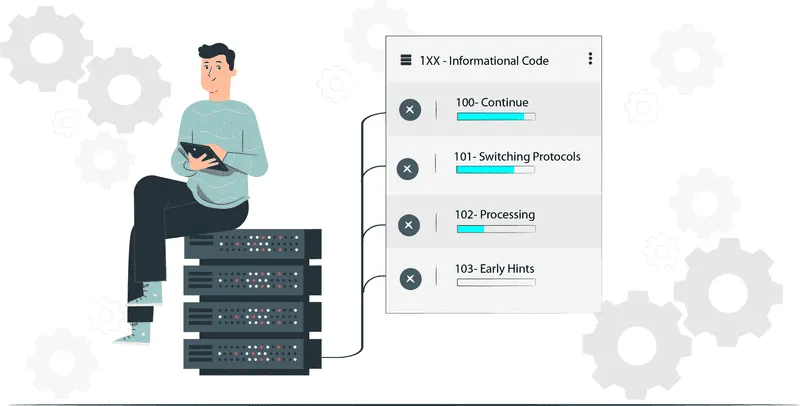
Some of the most commonly used 1xx status codes are:
- 100 – Continue
- 101 – Switching Protocols
- 102 – Processing
- 103 – Early Hints
What does a 1xx response code look like?
A 1xx HTTP response usually appears before the final server response. It confirms that the request has reached the server and that the communication is still in progress. For example, a server may send 100 Continue after receiving the request headers, allowing the client to continue sending the request body.
In most cases, normal users do not see these informational response codes on the browser screen. Developers usually notice them in API testing tools, server logs, network monitoring tools, or browser developer tools.
Guide to 1xx Response Codes
The most commonly used HTTP 1xx response codes are listed below:
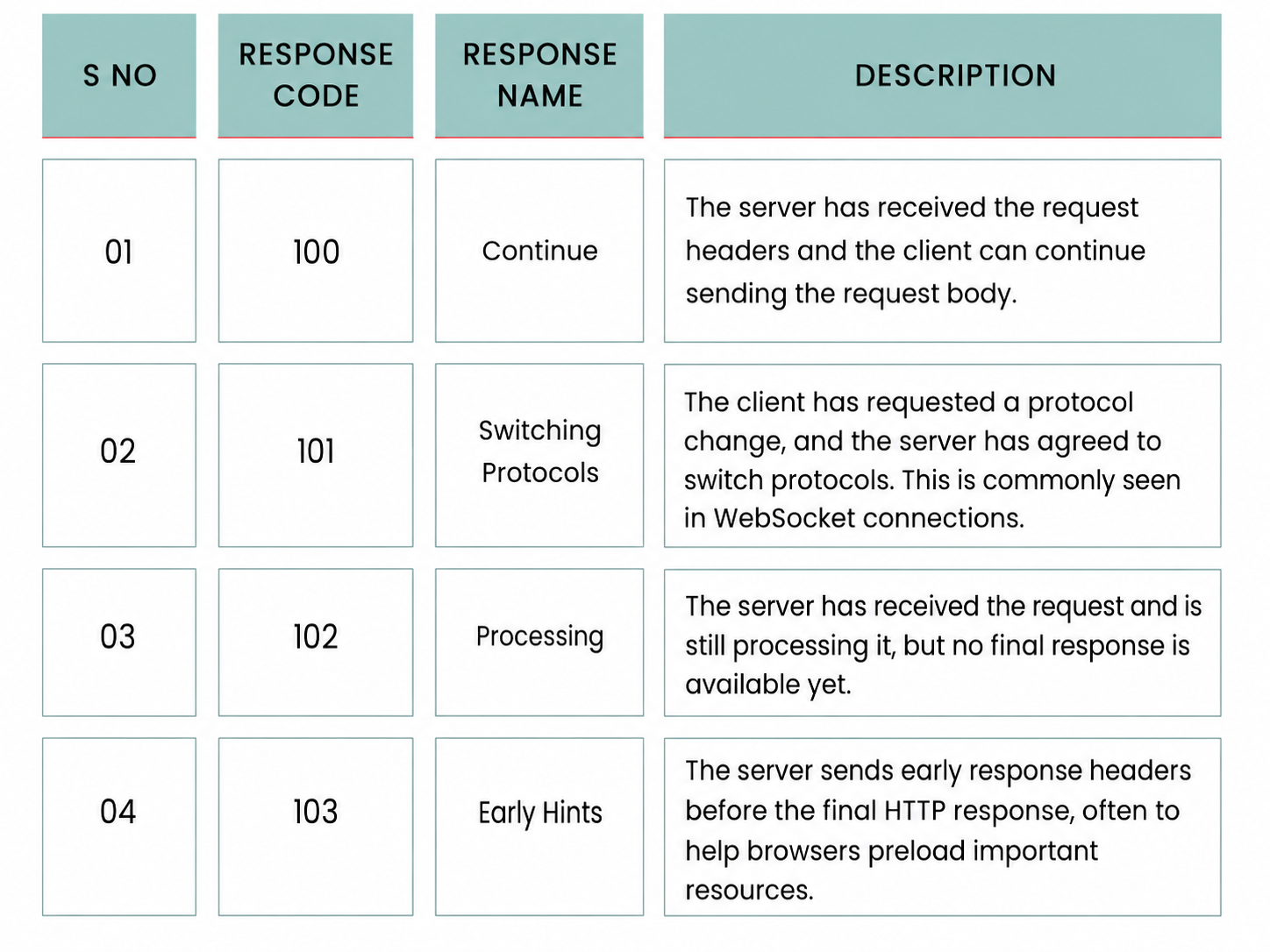
Where 1xx Response Codes Fit in an HTTP Request
To understand 1xx response codes, it helps to first understand what an HTTP request is.
An HTTP request is a message sent by a client, such as a browser, mobile app, or REST API testing tool, to a server. The request tells the server what action the client wants to perform.
A basic HTTP request usually includes:
How do HTTP requests work?
HTTP requests work through a simple client-server process.
First, the client sends a request to the server. Then, the server reads the request method, URL, headers, and body. After processing the request, the server sends back an HTTP response.
In most cases, users only notice the final response code, such as 200 OK, 404 Not Found, or 500 Internal Server Error. However, in some situations, the server may first send a 1xx informational response before sending the final response.
This is where 1xx response codes are useful. They help the client understand whether it should:
- Continue sending data
- Switch protocols
- Wait while the server processes the request
- Preload resources before the final response is ready
1xx Response Codes and HTTP Headers
HTTP headers are an important part of how 1xx response codes work. Headers carry extra information about the request or response.
For example, headers can tell the server or browser about:
- Content type
- Accepted file formats
- Connection details
- Caching rules
- Authentication details
Response headers vs request headers
When comparing response headers vs request headers, the difference is simple.
In the case of 1xx response codes, the server may send response headers before the final HTTP response is completed. This is common in situations like 100 Continue or 103 Early Hints.
Are HTTP headers case sensitive?
A common question is whether HTTP headers are case sensitive.
In modern HTTP usage, header field names are generally treated as case-insensitive. For example:
- Content-Type
- content-type
- CONTENT-TYPE
All usually refer to the same header field.
This header exchange is important in HTTP/1.1 and HTTP/2 communication, especially when informational responses are involved.
Are There Unofficial 1xx Response Codes?
The 1xx series has very limited practical usage compared to 2xx, 3xx, 4xx, and 5xx response codes. For most developers, testers, and API teams, the most important 1xx codes to understand are 100 Continue, 101 Switching Protocols, 102 Processing, and 103 Early Hints.
Since 1xx responses are informational and temporary, they are usually handled by browsers, APIs, servers, and debugging tools in the background.
Conclusion
1xx response codes are informational HTTP status codes that help the client and server communicate before the final response is sent. They are not errors and are usually not visible to normal users on a browser screen.
However, they are important for developers, testers, API teams, and performance engineers because they explain what is happening during the early stage of an HTTP request. By understanding 100 Continue, 101 Switching Protocols, 102 Processing, and 103 Early Hints, teams can better analyze HTTP response codes, debug API behavior, and understand how modern web communication works.Folding these checks into a broader API testing strategy ensures interim responses like 100 Continue are actively validated against your critical endpoints, not just spotted later in server logs.
People Also Ask (FAQs)
Q1.Are 1xx response codes errors?
Ans: No, 1xx response codes are not errors. They are informational HTTP status codes used during communication between the client and server.
Q2.What is HTTP 101 error code?
Ans: HTTP 101 is often searched as an error code, but it is not actually an error. It means Switching Protocols and is commonly used when a connection is upgraded, such as during a WebSocket handshake.
Q3.Do browsers show 1xx response codes?
Ans: Browsers usually do not show 1xx response codes on the front-end screen. They process these responses in the background and wait for the final HTTP response.
Q4.Is HTTP TCP or UDP?
Ans: HTTP commonly runs over TCP because TCP provides reliable communication between the client and server.
Q5.What port does HTTP use?
Ans: HTTP commonly uses port 80, while HTTPS commonly uses port 443.