

A founder we spoke to last year shipped a vibe-coded checkout flow on a Friday afternoon. By Monday, a penetration tester on their enterprise client's side had found a hardcoded Stripe secret key baked into the frontend bundle. The AI had seen key examples in the training context and helpfully included one. The feature worked perfectly. The security posture was a disaster.
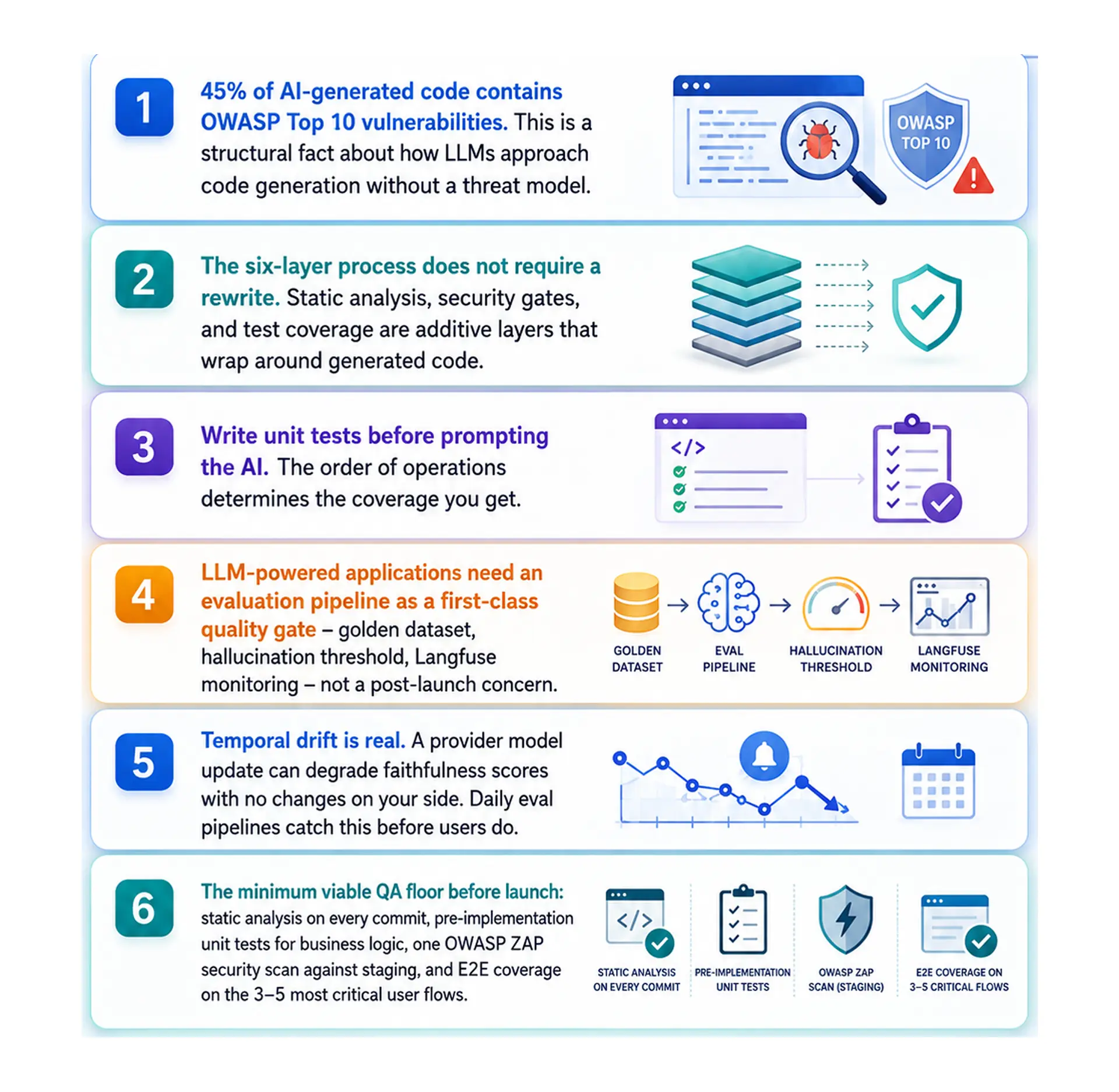
That gap - between "the code runs" and "the code is safe" - is exactly what vibe coding teams are falling into at scale. According to Veracode's 2025 GenAI Code Security Report, 45% of AI-generated code contains OWASP Top 10 security vulnerabilities. That figure isn't a warning sign. At that density, it's a production incident waiting for a date on the calendar.
Cursor, Lovable, Bolt, Claude Code (running on Sonnet 4), GitHub Copilot, and Gemini 3-powered IDEs - these tools are genuinely fast. Teams shipping with them generate 3–5× more code per sprint. The problem is that volume without coverage infrastructure compounds risk at the same rate. Research cited by ContextQA's 2026 AI testing checklist found that teams without QA guardrails on AI-generated code see 35–40% higher bug density within six months, with AI-generated PRs carrying 1.7× more major issues than human-written ones.
This guide gives you a six-layer QA process that closes the production gap without killing the speed advantage. No rewrites. No slowing down the workflow.

Why Vibe-Coded Software Fails Differently in Production
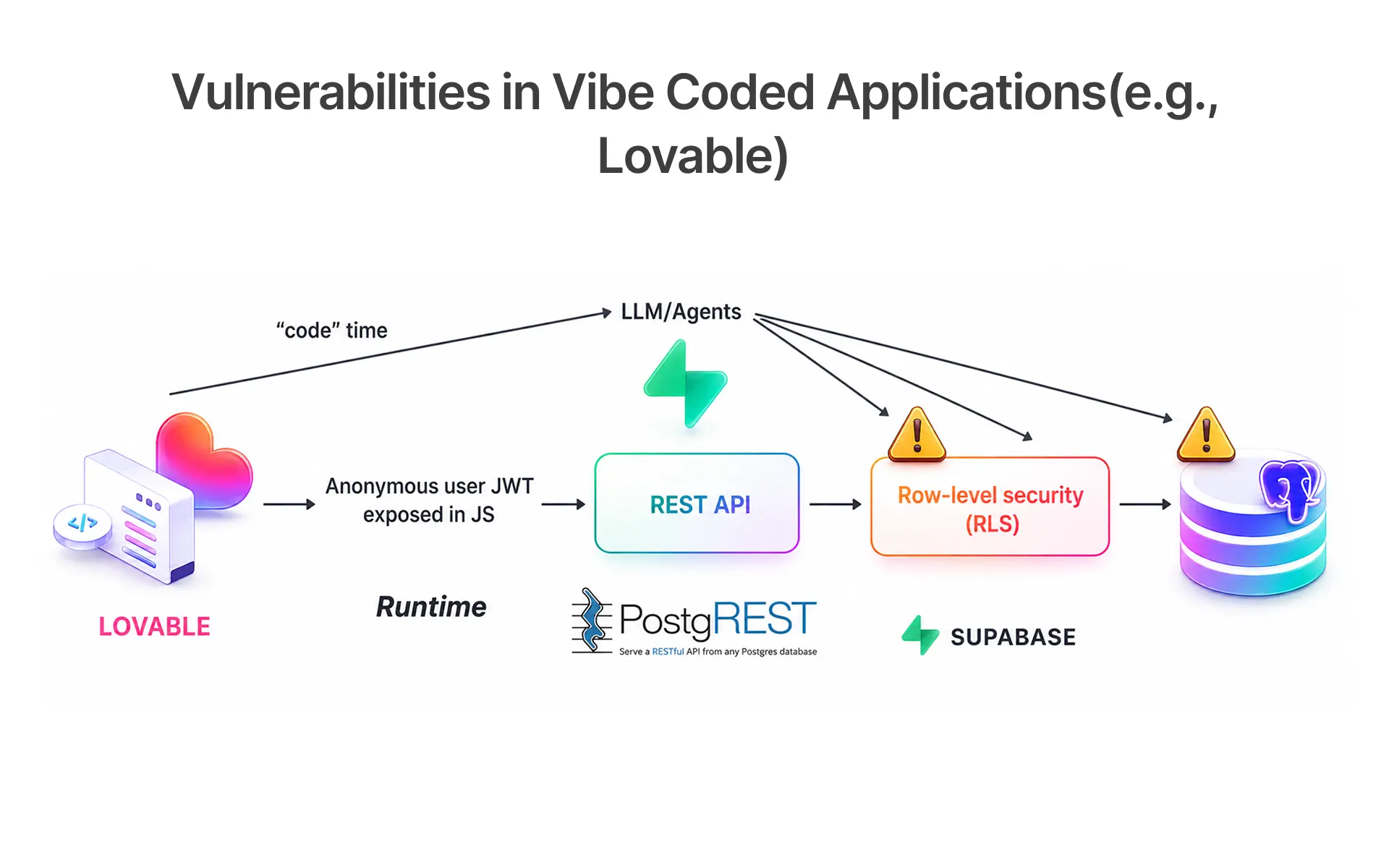
A QA lead at a 90-person B2B SaaS company came to us after a post-launch incident. Their team had shipped a vibe-coded permissions system using Lovable. The code passed all existing tests. Three weeks in, a support ticket revealed that read-only users could write to endpoints the AI had left wide open. The AI had been given a permissions spec. It built what was asked. It had no idea what wasn't asked.
That's the pattern. AI-generated code doesn't fail randomly, it fails in specific, predictable ways that traditional QA checklists miss, which is exactly what makes vibe coding security a distinct problem from standard software security.
Three failure modes show up consistently:
- Security misconfigurations - hardcoded secrets, missing .env scaffolding, plain-text credentials. The model doesn't have a threat model; it has a task.
- Overly broad permission scopes - 41% of AI-generated backend code carries admin-level access by default, per the Cloud Security Alliance's 2026 enterprise study. The model grants what works, not what's appropriate.
- Missing edge case handling - user flows that weren't explicitly prompted are implicitly untested. The AI covers the happy path. Everything else is your problem.
The ICSE 2026 systematic review of 101 sources on AI-assisted coding quality found that QA is the most frequently overlooked dimension of AI coding workflows.
The Production Gap Between "Working" and "Safe"
To an LLM, "working" means the code runs without errors against the prompt it received. To an engineering team, "production-ready" means secure, observable, and resilient under real user behaviour - including behaviour the AI was never told about.
Stanford researchers found developers using AI coding assistants were 41% more likely to introduce security vulnerabilities when they trusted generated code without structured verification. The verification habit changes when the code arrives already written. That's the real risk.
How AI-Generated Code Introduces Security Debt by Default
The OWASP categories surfacing most often in AI-generated codebases are not exotic: SQL injection (CWE-89), cross-site scripting (CWE-80), insecure cryptographic algorithms (CWE-327), overly broad IAM roles, and remote code execution vectors in auto-generated file handlers. Georgia Tech's Vibe Security Radar tracked 35 CVEs in March 2026 directly attributable to AI coding tools - including multiple Zero-click RCE exposures in web applications built with popular Vibe coding platforms.
The mechanism is straightforward: LLMs optimise for functional completeness given the prompt. They don't know your threat model, which routes require authentication, or that an admin role was granted solely to make the demo easier. The same applies to software engineering tooling that automates code changes - when a tool touches your codebase without human review on every Pull Request, the risk compounds.
The Six-Layer QA Process for Vibe-Coded Software
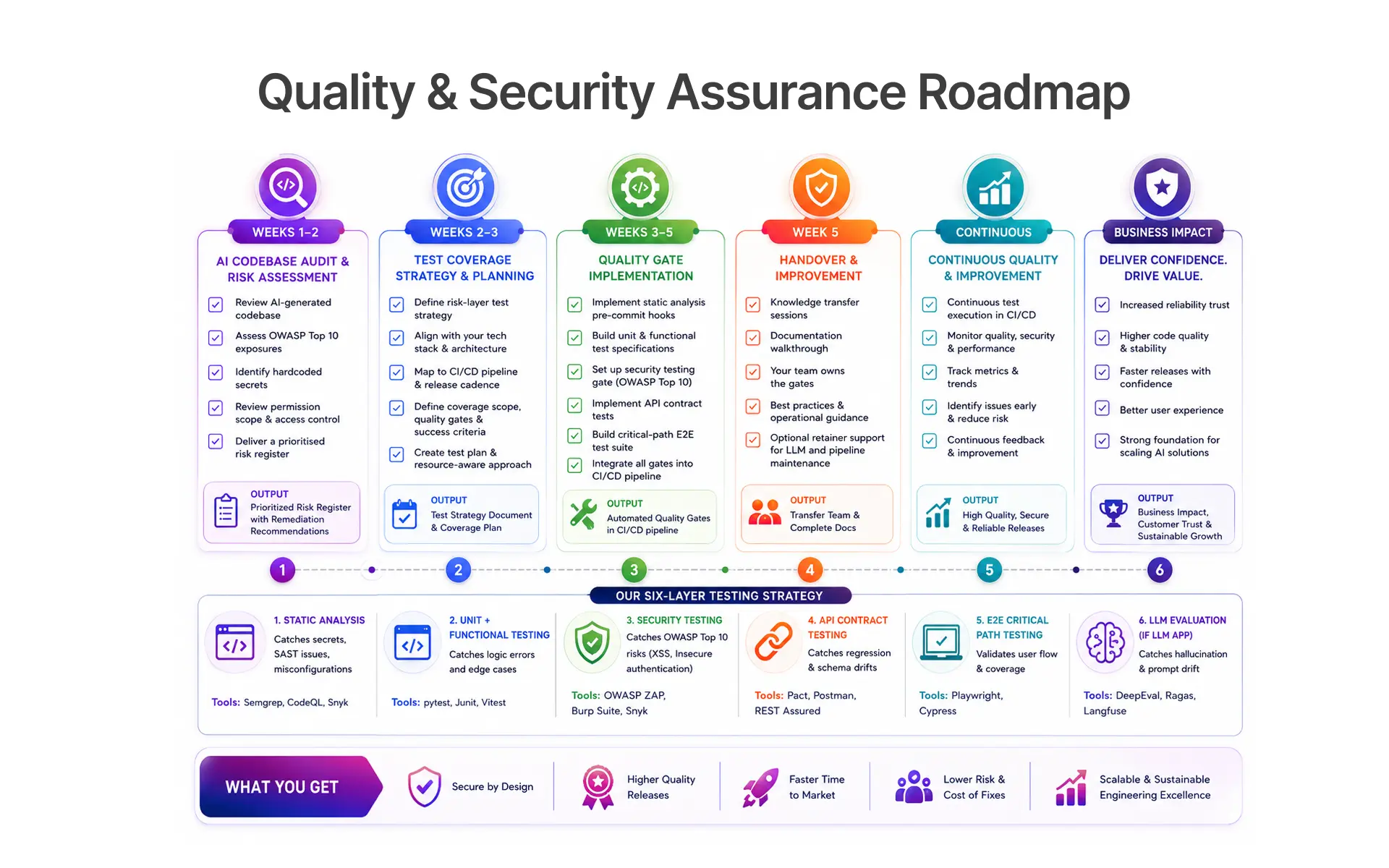
Each layer maps to a specific failure mode from the previous section. Engineering managers: scan the table first, then go into the details that are relevant to your stack.
Layer 1 - Static Analysis Before the First Merge
Static analysis must run at the commit level. AI-generated code introduces misconfigurations silently and at volume. By the time a build completes, the secret is already in version history. Static code analysis isn't optional here - it's the first line of defence against the most predictable failure modes in AI-generated output.
What this layer covers in practice:
- Static Application Security Testing (SAST) - Semgrep for custom rule sets tuned to your patterns, CodeQL for deep vulnerability detection across the dependency graph
- Secrets detection - blocking commits that contain hardcoded API keys, authentication tokens, or database credentials before they reach version control
- Dependency Scanning - Snyk for CVE scanning across third-party packages, triggered on all Pull Requests before merge.
- Misconfig checks - flagging overly permissive IAM roles, exposed admin panel routes, and unscoped API gateway configurations at the point of commit
Wire this into GitHub Actions so every Pull Request triggers the full scan automatically. No manual steps. No exceptions based on how urgent the release feels.
Layer 2 - Unit Testing the Logic the LLM Didn't Cover
LLMs write against the happy path of the prompt. Edge cases and error branches are systematically under-covered because they weren't asked for.
Write unit tests before passing the requirement to the AI coding tool - not after. This forces the model to generate code against a test specification rather than an open-ended description. The model produces code that passes the tests. The tests define the edge cases. You control the coverage specification.
Pair this with automated behavioral testing for any flows that cross service boundaries - particularly database operations, third-party integrations, and anything involving role-based access. These are the areas where AI-generated code routinely assumes permissions it shouldn't have.
Layer 3 - Security Testing as a Production Gate
Set up a security gate in the CI/CD pipeline that runs Dynamic Application Security Testing (DAST) against a staging environment before every production deploy. Not a quarterly pen test - an automated gate that blocks deploys on specific vulnerability categories using automated tools that don't require manual triggering.
The specific checks for vibe-coded applications:
- Authentication boundary testing - can unauthenticated API requests reach protected routes? Are authentication tokens being validated correctly, or did the AI leave verification gaps on certain endpoints?
- Privilege escalation - can a standard user reach admin panel functionality? AI-generated RBAC logic frequently misses the boundary between read and write operations.
- Input validation - testing against CWE-89 (SQL injection via database operations) and CWE-80 (XSS), which together account for the majority of OWASP findings in AI-generated codebases
- Remote code execution vectors - checking for Zero-click RCE exposure in file upload handlers and serialisation endpoints, which AI tools commonly generate without adequate sandboxing
Tool stack: OWASP ZAP for automated scanning, Burp Suite for manual review on authentication flows, and Snyk for runtime dependency monitoring.
Layer 4 - API Contract Testing to Catch Schema Drift
AI coding tools regenerate and refactor API responses across sessions without respecting prior contracts. A response schema that worked last Tuesday may have changed silently when the model restructured a service - and neither the developer nor the reviewer necessarily noticed, because the change didn't break any existing tests.
Consumer-driven contract testing with Pact addresses this. Consumers define expectations for each API request they depend on. Providers contract tests in CI. Schema drift fails the build before it reaches integrated environments. API gateway configurations - rate limits, auth scopes, response formats - should be included in the contract definition, not treated as out-of-scope for testing.
For teams managing API contract testing at scale, this layer catches silent breaking changes that never appear in unit tests because unit tests test the producer, not consumer assumptions.
Layer 5 - E2E Testing on Critical User Flows
E2E tests for vibe-coded applications must be written against user intent, not code selectors. The code will be regenerated. The selectors will change. Tests tied to the DOM structure become a maintenance liability within weeks.
Playwright's role-based locator model survives the component restructuring that happens when an AI tool refactors a UI. Cypress remains a strong option for teams already invested in it.
Scope the suite deliberately. Identify the 5 -10 critical user flows: authentication, checkout, data submission, and permission gates. Cover those and only those.
Which flows to prioritise first?
- Does the flow handle money or sensitive data? Cover it in week one.
- Is it a permission or an authentication boundary? Cover it before the first production deploy.
- Is it a core conversion flow? Cover it before external users touch it.
How to Test LLM Applications Built With Vibe Coding
Vibe-coded applications with an LLM component - RAG systems, AI chatbots, agentic workflows - need an evaluation layer that doesn't exist in traditional QA tooling. This is the section most guides skip, and it's the one that shows up as user-visible quality failures after launch.
LLM testing is a pre-deployment evaluation. LLM observability is post-deployment monitoring. Teams need both. Conflating them leaves gaps in each.
Defining an LLM Evaluation Pipeline Before Deployment
The mechanism is a golden dataset: a curated set of prompts with expected responses that functions as the LLM equivalent of a regression suite. Any increase in hallucination rate or drop in faithfulness score fails the build.
Core metrics: hallucination rate, faithfulness, answer relevancy, contextual recall (for RAG systems), and output safety. For testing LLM applications, DeepEval integrated with pytest is the most practical CI/CD entry point - its pytest convention means most SDETs ramp in under a week. Ragas covers RAG-specific evaluation. Langfuse handles production observability.
For agentic workflows specifically - where a security agent or Remote Agent is making autonomous decisions, triggering database operations, or calling third-party integrations - agent transcripts become a primary testing artefact. Log every tool call, decision branch, and output from your agentic system. Run those transcripts through your eval pipeline the same way you'd run unit tests through pytest. Any unexpected tool invocation pattern or out-of-scope action surfaces as a test failure, not a production incident.
If your agentic workflows involve code execution, Kata Containers provide the isolation layer that prevents a misbehaving agent from affecting host systems - worth implementing before any autonomous software engineering tooling goes near a production environment.
Setup time: 3–5 days for a team with existing pytest infrastructure.
Catching Prompt Drift and Model Update Regressions
A prompt scoring 0.85 faithfulness in January may score 0.70 in March after the LLM provider updates their base model, with no code changes on your side. Schedule evaluation pipelines to run daily in production using Langfuse continuous evaluation, with alerts when scores drop below thresholds. Don't only run evals on deploy.
There's a cost angle here that rarely gets flagged early enough: a prompt change that increases average token consumption by 30% is a cost regression. Catch it in CI before it appears as an unexpected API bill.
How Frugal Testing Validates Vibe-Coded Software Before It Ships
The six-layer process is well-defined. Building it from scratch while shipping features with a vibe coding tool is the sequencing constraint most teams run into. That's the gap we fill.
We embed QA engineers alongside teams shipping vibe-coded software. We audit the generated codebase, scope the six-layer coverage stack against your CI/CD pipeline, and own the implementation of the quality gates. Our team already knows the failure patterns of Cursor, Lovable, Bolt, and Claude Code output - there's no ramp-up period.
Across engagements with US engineering teams, we've helped reduce AI-code defect rates from the 35–40% elevated density range to baseline human-code levels within six weeks. As part of our QA services for AI development, we focus specifically on gaps that traditional QA processes don't cover for generated code.
What Our Engagement Looks Like
Weeks 1–2: AI code audit. We review the generated codebase for OWASP Top 10 exposure, hardcoded secrets, and permission scope. You receive a prioritised risk register.
Weeks 2–3: Coverage scoping. We define the six-layer test strategy against your stack, pipeline, and release cadence.
Weeks 3–5: Gate implementation. We build the static analysis pre-commit hooks, unit test specifications, security gate, contract tests, and critical-path E2E suite - all living in your CI/CD pipeline.
Week 5+: Handover. Your team owns the gates. Full documentation and optional retained support for LLM eval pipeline maintenance.
Who This Is For
Engineering teams of 5–50 using Vibe coding tools to ship production software, without a dedicated QA function or with a QA function that hasn't adapted to AI-generated code review at volume. Three situations that signal it's time to talk:
- You shipped a vibe-coded feature and found a security issue in production. You need to close the gap before the next release.
- Your team is generating 3–5× more code with AI tools, but your QA process hasn't scaled with it.
- You have an LLM-powered feature going live and no evaluation pipeline.
If that's your situation, a conversation with our AI testing services team is the right next step.
Key Takeaways
"The teams shipping vibe-coded software reliably are not the ones writing better prompts - they're the ones who built the quality infrastructure around them."
Conclusion
Vibe coding is a speed multiplier. Not a quality guarantee. The two are independent, and treating them as the same thing is the most common mistake we see in teams adopting AI coding tools.
The failure modes are predictable. The fixes are known. Layered testing - static code analysis at commit, unit tests pre-implementation, DAST before deploy, contract tests on every schema change, E2E on critical paths, and LLM eval for any agentic or AI-powered features - addresses each failure mode directly without touching the generated code or slowing the workflow down.
The teams that struggle are not the ones using vibe coding - they're the ones using it without the infrastructure to validate what it produces. That gap compounds quietly. Then it doesn't.
Most teams don't have the bandwidth to build this from scratch while shipping features. That's the sequencing constraint our managed testing service is built to solve. The question isn't whether your vibe-coded codebase needs a quality gate. It's whether you find out before or after a production incident.
People Also Ask (FAQs)
Q1.Is vibe-coded software safe to ship to production?
Ans: Yes, with the right coverage infrastructure. Vibe-coded software with static analysis, security gates, and E2E coverage on critical paths is production-viable. Without those layers, the 45% OWASP vulnerability rate represents unacceptable risk for any application handling user data or financial transactions.
Q2.What percentage of AI-generated code contains bugs or security issues?
Ans: 45% of AI-generated code samples fail security tests (Veracode 2025). AI-generated PRs carry 1.7× more major issues than human-written ones, and teams without QA guardrails see 35–40% higher bug density within six months.
Q3.Do we need to rewrite vibe-coded code before it's production-ready?
Ans: No. Static analysis, security gates, and test coverage are additive layers that wrap around existing generated code. Rewrites introduce new risk. The goal is coverage infrastructure, not replacement.
Q4.How do we test an LLM application built with Vibe coding?
Ans: Two layers: testing the wrapper (API contract tests, E2E on user flows) and testing the LLM outputs (eval pipeline with DeepEval golden dataset, hallucination rate threshold, Langfuse production monitoring). Both are required.
Q5.What's the minimum QA process for a vibe-coded app before launch?
Ans: Static analysis on every commit using Semgrep and Snyk, unit tests written pre-implementation for business logic, one security gate run against staging using OWASP ZAP, and E2E tests on the 3–5 most critical user flows. A 1–2 sprint implementation that closes the highest-risk exposure.



.webp)