



Disney+ isn’t just a streaming platform—it’s the invisible magic behind every frame that moves us. Every pixel of color, every whisper of sound, and every breathtaking 4K moment is engineered with precision.
From transcoding that preserves storytelling beauty to ABR systems that protect every scene from buffering, the tech feels almost alive. Akamai’s global CDN becomes the heartbeat—delivering stories faster than we can feel them.
Behind the screen, technology disappears so emotion can take center stage—letting Disney+ make every moment unforgettable.
5 Key Points to be Discussed:
- Video Transcoding & Encoding: The way Disney + can encode videos to run on various tools and offer different resolutions and formats without compromising quality.
- Adaptive Bitrate (ABR) Streaming: Disney+ techniques of dynamically changing the quality of video according to the internet speed of a user.
- Akamai Content Delivery Network (CDN): How Akamai global network can deliver content faster, reliably, and with low latency.
- Scalability & Traffic Management: How Disney+ will deal with millions of simultaneous users on peak hours or blockbusters.
- Security and DRM Integration: An effort to block the piracy of premium content and also to allow the subscribers to play seamlessly.
How Disney Powers High-Quality Streaming at Global Scale
Disney+ and the broader Disney streaming ecosystem - including the Disney Plus app, Disney+ Hotstar, and the Disney Plus bundle - run on one of the world’s most sophisticated cloud infrastructure stacks. Much like the high-performance architectures built by a modern social media app development company, Disney’s platform delivers smooth frames, crisp 4K HDR scenes, and ultra-low-latency playback through an end-to-end streaming pipeline engineered for global scale.
With billions of playback requests, diverse device compatibility (from smart TVs to Apple TV 4K), and a rapidly growing content library, Disney+ depends on advanced adaptive bitrate streaming, intelligent video transcoding software, a multi-layer CDN architecture, and a secure cloud infrastructure built for resilience.
This blog goes deep inside that engineering stack: the ingest-to-playback workflow, ABR logic, multi-bitrate packaging, Akamai CDN routing, caching layers, transcoding engines, and the DRM foundation that protects premium content.
End-to-End Streaming Workflow - From Content Ingest to Playback
Disney+ follows a cloud-native architecture built on scalable cloud computing infrastructure, hybrid cloud infrastructure deployments, and distributed CI/CD pipelines. The workflow begins when Disney ingests raw studio masters—4K HDR, Dolby Vision, or high-resolution mezzanine files—into cloud infrastructure services.
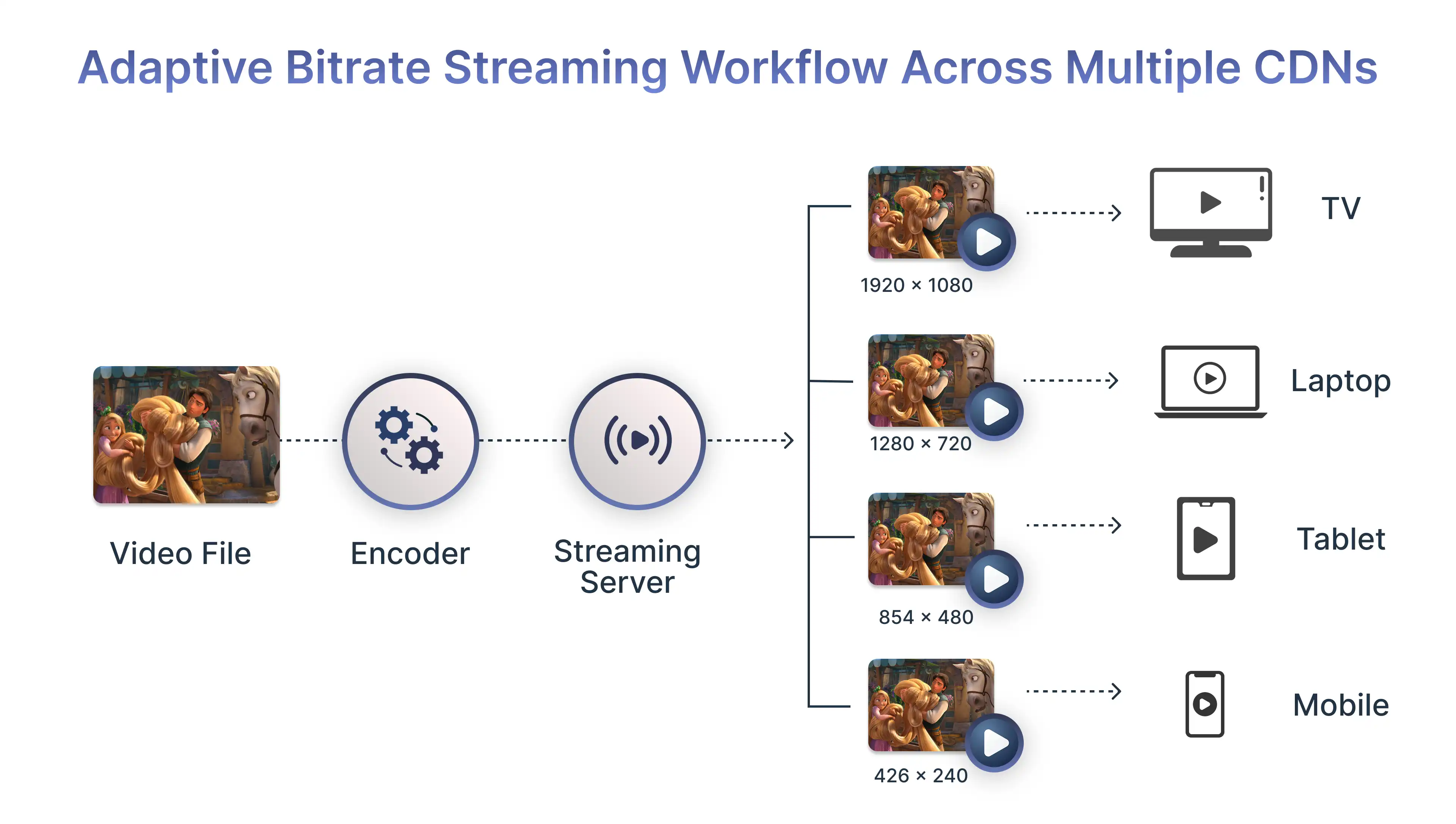
From there, the streaming pipeline handles:
- Content acquisition & licensing validations
- Video processing using enterprise transcoding software
- Multi-bitrate packaging via HTTP Live Streaming (HLS) and MPEG-DASH
- Common Encryption (CENC) and multi-DRM protection
- Distribution through global content delivery networks (CDNs)
By the time video reaches a user, complex routing, caching, and compression technology have already optimised the stream for the user’s internet connection, device capabilities, and video quality settings.
Adaptive Bitrate Streaming Engine for Seamless Playback
The Disney+ streaming video is based on Adaptive Bitrate Streaming (ABR). The ABR logic is a dynamic approach to choose the optimal selection of bitrate to be used to stream according to the network bandwidth, low-latency thresholds and real-time video quality indicators. Using the features of a modern cloud resembling those of the AWS cloud services and business platforms such as Dynamics 365 Business Central Premium, the ABR engine can be adaptive to the network conditions. The ABR system modulates the video bitrate streaming profiles to maintain a consistent visual quality regardless of whether the viewer is on the low-latency network or is on a mobile data plan or on high-speed home Wi-Fi. This means that users hardly undergo buffering, even when there is a peak traffic or live TV and live sporting events.
Intelligent Bitrate Ladder Tuning and Real-Time QoE Decisions
Disney+ employs an intelligent bitrate ladder tuned per title using predictive analytics and frame-level analysis. Instead of fixed presets, encoding ladders consider:
- Scene complexity
- Prediction blocks efficiency
- Motion intensity
- HDR mode or Dolby Vision requirements
- Recommended bitrate for streaming per device profile
This enables Disney+ to deliver optimal video quality with the best bitrate for streaming—especially critical for 4K HDR streaming titles, where video streaming bitrate can reach extremely high densities.
The ABR engine continuously evaluates real-time conditions such as:
- Internet connection fluctuations
- Device buffer performance
- CDN edge availability
- Low latency thresholds
Whether a user is watching on a smart TV, mobile phone, or browser, Disney+ ensures uninterrupted playback driven by adaptive bitrate decisions powered by user experience analytics and dynamic QoE scoring models.
Next-Gen Video Transcoding Pipeline
At the heart of Disney+ streaming lies a fully automated, next-generation video transcoding pipeline engineered for efficiency, speed, and high fidelity. Disney relies on cloud-distributed encoding built on secure cloud infrastructure, serverless computing, and massive parallelism.
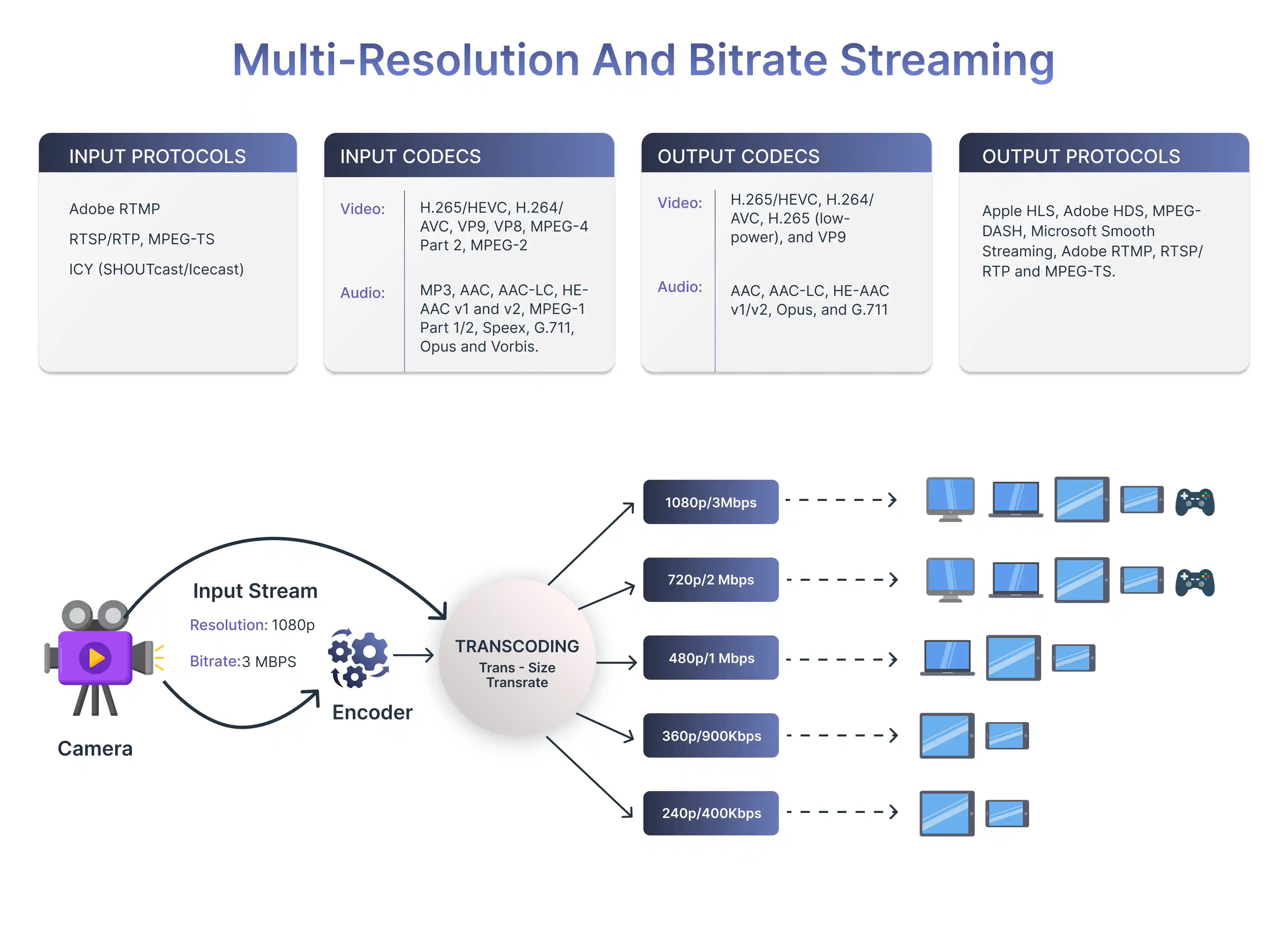
The pipeline ingests source masters and produces dozens of output renditions across different video resolutions, frame rates, and video codecs. These renditions feed the ABR playlist that users ultimately stream.
Cloud-Distributed Transcoding With HDR, Dolby Vision & Multi-Bitrate Packaging
Disney+ delivers high-quality videos to millions of viewers worldwide. To make this happen, it uses cloud-distributed transcoding, which is basically a way to process videos efficiently and make sure they look and sound great on every device. Here’s what each part means:
1. Cloud-Distributed Transcoding
What it is: Disney accesses numerous computers in cloud (online servers) to process videos, as opposed to one computer.
Why it is important: This will enable Disney to process a large number of videos simultaneously and will provide a quick and efficient processing.
Comparison: It is similar to having 50 cooks preparing 1,000 dishes simultaneously rather than one cook doing one.
2. HDR Content Mastering
HDR (High Dynamic Range): Makes the videos appear more real with the brightest highlights and darkest shadows.
Mastering Content: Disney makes sure that the colors are perfect, the brightness of the video is perfect, and the contrast is perfect too.
Example: A scene of a sunrise will appear bright and natural instead of flat and dull.
3. 4K HDR and Dolby Vision Format Support.
4K: The ultra-high-definition (UHD) video is four times sharper than normal HD.
Dolby Vision: A form of HDR used to adjust the colors and brightness per scene dynamically, and make every scene appear cinematic.
Format Handling: Disney makes sure that any video is compatible with any format, such as the 4K HDR or Dolby Vision.
Exception: Dark scenes in a film are clear without having lost their contrast even in the dark.
4. Dolby Atmos Audio Encoding
Dolby Atmos: This is a high-quality sound system that enables it to sound as though it is surrounding you on either side instead of left or right.
Audio Encoding: Disney encodes the audio of the video in Dolby Atmos format to enable you to have extensive sound on the devices that support it.
An example is that you can hear a helicopter flying over or that the footsteps are moving behind you in a movie scene.
5. Multi-Bitrate Packaging through HLS and DASH.
Multi-Bitrate Video: Disney produces one video in various levels of quality.
HLS and DASH: Streaming technologies: these use an automatic selection of the superior version dependent on the internet speed.
Why it is important: it avoids buffering and allows all to play smoothly.
Scenario: When using a slow internet connection, Disney+ will automatically downgrade to a lower-quality version so that the video does not have to stop playing.
6. Optimized x264 Encoding in Older Devices.
x264 Encoding: This is a method of compressing videos which are then encodable to utilize less space and can be easily streamed.
Older devices: The phones, tablets, or even TVs that do not have the ability to run 4K or HDR still receive some of the video which is compatible.
Case in point: You can enjoy the newest movies on Disney + even on an outdated device.
The distributed architecture allows Disney+ to process large volumes of content in parallel using AWS Elemental, Amazon Web Services instances, and cloud infrastructure as a service platforms.
Once processed, files are prepared with byte-range addressing for efficient delivery and stored using storage caching and web caching mechanisms across regional datacenters.
Advanced Codecs (AV1 / HEVC) for Efficient High-Quality Delivery
Disney+ wants videos to look amazing while also streaming smoothly without using too much internet. To do this, they use advanced video codecs, which are tools that compress videos efficiently while keeping quality high. Here’s what each one does:
1. HEVC (H.265)
- What it is: A modern video compression technology.
- Why it matters: It makes video files smaller without losing quality, which helps stream 4K and HDR content smoothly.
- Example: A 4K movie that would normally be huge in size becomes much smaller and easier to stream.
2. AV1
- What it is: A next-generation codec designed for ultra-high-quality video, especially 4K HDR.
- Why it matters: AV1 can compress videos even more efficiently than HEVC, which saves bandwidth while keeping the image crystal clear.
- Example: Streaming a high-end Disney+ animated movie in 4K HDR without buffering.
3. Enhanced H.264
- What it is: An older, widely supported codec.
- Why it matters: Ensures compatibility with older devices that may not support HEVC or AV1.
- Example: If you have an older tablet or phone, Disney+ still delivers a smooth, watchable video.
These codecs help reduce data consumption while delivering crystal-clear streaming video—even on slower internet plans. With more devices supporting AV1 hardware acceleration, Disney+ continues optimizing its codec ladder for higher efficiency and smoother playback.
Akamai CDN Acceleration and Global Edge Distribution
A robust CDN strategy is fundamental to Disney Plus performance. Akamai CDN remains one of Disney’s primary content delivery networks, supported by multi-CDN redundancy with Cloudflare CDN, AWS CDN, and other video CDN providers.
CDNs distribute content across thousands of edge servers, reducing physical distance between users and content—resulting in fast startup times, stable streaming bitrate, and low latency performance.
Edge Caching, Smart Request Routing & Ultra-Low-Latency Delivery
Disney+ uses Akamai, a global content delivery network (CDN), to make sure videos play quickly and smoothly wherever you are. Akamai has smart technology that reduces delays and buffering. Here’s what each part does:
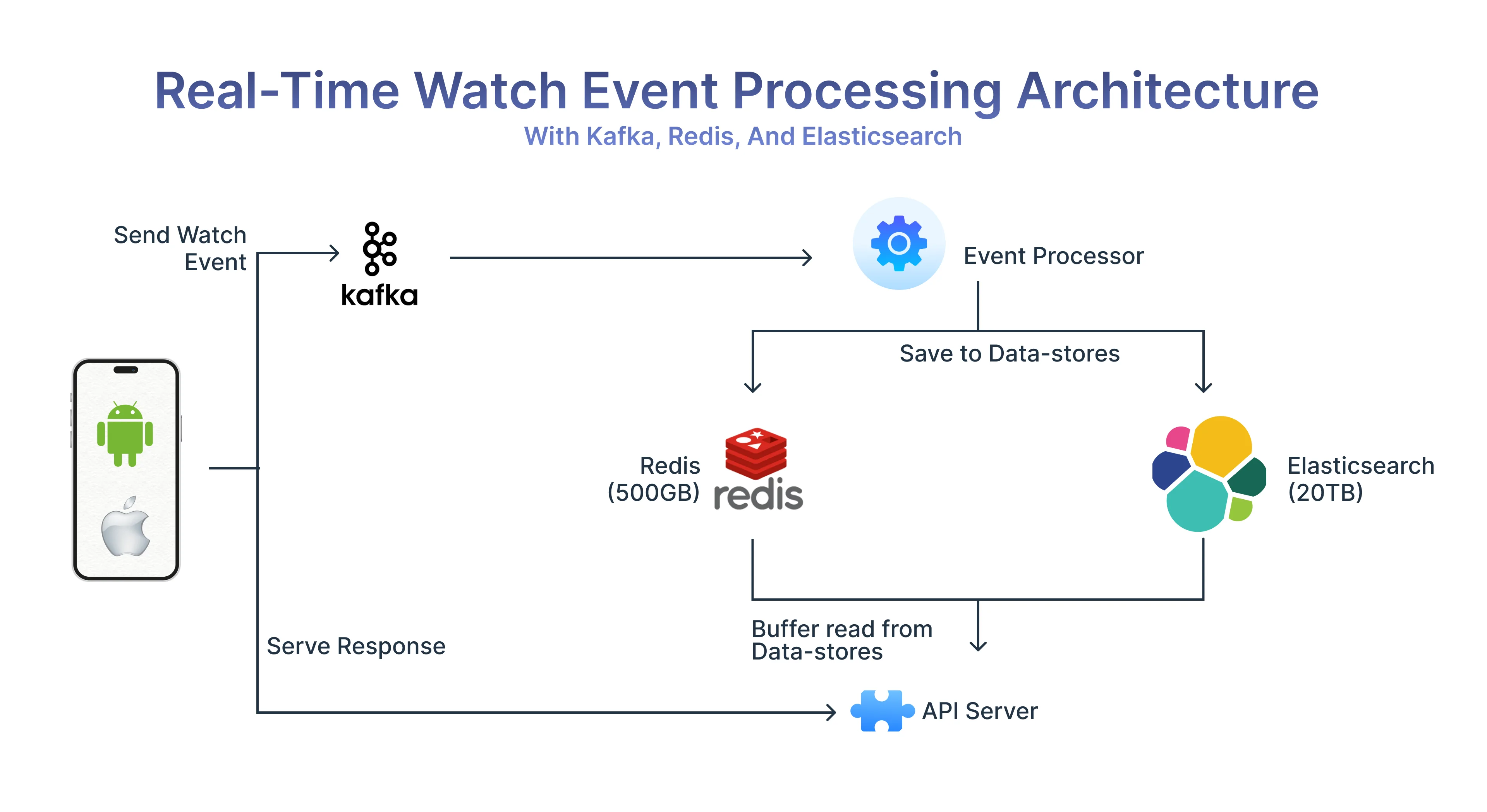
1. Edge Caching and Redis Caching
- What it is: Disney+ stores copies of popular videos on servers closer to viewers.
- Why it matters: The video doesn’t have to travel from a distant central server, which reduces loading time.
- Example: Watching a hit Disney+ show in your city starts instantly because it’s already stored nearby.
2. Smart Request Routing
- What it is: Akamai decides the fastest path for video data to reach your device.
- Why it matters: Avoids internet congestion or slow routes.
- Example: If one route is busy, your video automatically takes a faster path so playback isn’t interrupted.
3. Real-Time Path Optimization
- What it is: Continuously monitors the network to find the best route for data.
- Why it matters: Adjusts in real time if there’s a problem in the network.
- Example: If there’s heavy traffic on one part of the internet, your video switches to a clearer route instantly.
4. Data Caching Algorithms for Frequent Titles
- What it is: Popular videos (like new releases) are cached or stored more frequently on Akamai servers.
- Why it matters: Makes streaming faster for the videos people watch most.
- Example: The latest Disney+ blockbuster is ready to stream without buffering because it’s already on many servers worldwide.
5. Ultra-Low Latency Video Delivery
- What it is: Video starts playing almost instantly with minimal delay.
- Why it matters: Gives a smooth, responsive viewing experience, even for live events or new releases.
- Example: You press “play” and the video begins immediately, with no spinning loading icon.
This helps Disney+ deliver massive live events, global premieres, and heavy-demand original programming across millions of concurrent viewers without degrading user experience.
For regions served via Disney+ Hotstar, optimised caching and localized content delivery networks ensure faster access to regional languages, content metadata systems, and content localization workflows.
Multi-Layer Security, DRM, and Anti-Piracy Infrastructure
Disney handles premium studio masters, high-value series, original programming, and exclusive theatrical releases—making strong digital rights management an essential part of its streaming platform architecture.
Disney ensures content protection through a multi-layer security foundation built on secure cloud infrastructure, encryption standards, and real-time authentication checks.

Unified Multi-DRM Framework With Tokenised & Encrypted Playback
Disney+ uses DRM (Digital Rights Management) to make sure videos are secure and protected from piracy. DRM controls who can watch the content and on which devices. Disney+ supports multiple DRM systems to cover all devices. Here’s how:
1. Google Widevine
- What it is: DRM technology used mostly on Android devices and Chrome browsers.
- Why it matters: Ensures that Disney+ videos can play securely on phones, tablets, and computers running Android.
2. Microsoft PlayReady
- What it is: DRM used mainly for Windows devices and some smart TVs.
- Why it matters: Protects content while allowing secure playback on PCs, Xbox, and supported TVs.
3. Apple FairPlay
- What it is: DRM technology for Apple devices, including iPhones, iPads, and Safari browsers.
- Why it matters: Keeps Disney+ videos safe on Apple devices while letting users watch seamlessly
Through Common Encryption (CENC) and Protection System Specific Headers (PSSH), Disney+ ensures that streams remain secure across all devices. Tokenised playback sessions validate user entitlements, subscription tiers, parental controls, and content licensing agreements.
The DRM layer works seamlessly with the streaming pipeline to maintain compliance, preserve user experience, and deliver encrypted playback without latency additions.
Conclusion: The Evolving Future of Disney+ Streaming Technology
Disney+ continues evolving as a next-generation OTT platform with innovations across adaptive bitrate logic, cloud-native transcoding infrastructure, distributed CDN routing, and ultra-secure DRM systems. Backed by engineering practices similar to those used by top software development company, these advancements enable Disney+ to deliver world-class streaming performance to millions of viewers as content consumption expands across devices and regions.
As HDR vs Dolby Vision workflows advance, AV1 adoption increases, and cloud infrastructure services expand toward serverless and edge-native architectures, Disney+ is positioned to push the limits of video quality, low latency, and user experience. The combination of scalable compute, intelligent caching, and optimised streaming bitrate ensures exceptional playback for every viewer.
Disney has built more than a streaming service—it has engineered a global streaming platform designed for the future of high-fidelity storytelling. Drawing on innovations similar to those driving modern AI development company solutions, Disney+ continues to advance compression technology, strengthen content delivery networks, and refine real-time ABR intelligence. As a result, it remains one of the most technically advanced streaming services in the world.
People Also Asked - (FAQ’s)
01: Why is Disney+ streaming technology unlike other platforms?
Disney+ combines adaptive bitrate streaming, next-gen transcoding, multi-CDN delivery, and robust DRM, ensuring high-quality playback, fast start times, and stable performance across millions of devices.
02: What is the advantage of Adaptive Bitrate Streaming (ABR)?
ABR adjusts video quality in real time based on network conditions, reducing buffering and providing smooth, high-quality playback.
03: Why does Disney+ support AV1, HEVC, and H.264?
Supporting multiple codecs ensures compatibility across devices, efficient bandwidth use, and high-quality 4K HDR streaming.
04: How does Akamai CDN enhance Disney+ performance?
Akamai stores content on edge servers worldwide, reducing latency, speeding playback start, and maintaining streaming during high traffic.
05: How scalable is Disney+ cloud infrastructure?
Cloud-native architecture automatically scales with demand, offering elastic computing, shared storage, auto-coding, and load balancing to prevent downtime.

.webp)



.webp)