


A Quick Overview
Much like development, the software testing realm seems to have undergone lots and lots of enhancements; anyone can vouch for this fact, especially after witnessing the shift from manual testing to automation. So what’s next? Have you ever come across Agnetic AI-driven testing?
Understand the Significance of Enterprise Application Testing
Businesses across the globe have been going gaga over enterprise applications these days. Once considered as mere software tools, these kinds of applications have evolved into a full-fledged or sophisticated ecosystem that assists an organisation to conduct several types of operations, including customer interactions via customer relationship management (CRM) systems or enterprise resource planning (ERP) systems, and other departmental procedures such as HR, recruiting software and analytics. In a way, it is rightly said that thesec enterprise applications are deeply woven into the operational fabric of enterprises. So, yes, in almost every manner, enterprise applications play a very significant role, be it reducing downtime, eliminating performance bottlenecks, or taking care of security vulnerabilities. Basically, an enterprise application can assist in delivering a unified customer experience while lessening unwanted losses and brand reputation damage.
As enterprise systems become more intelligent and automated, many organizations collaborate with an AI agent development company to build autonomous solutions that streamline operations, enhance decision-making, and improve overall software quality.
An ideal enterprise application is said to be thoroughly tested when comprehensive testing is done, which means all the systems, not just simply functions, but also end up maintaining robustness in case of peak loads or increased security threats. So let’s get to what exactly enterprise application testing is all about.
Though the term features a broad spectrum of methodologies functional testing to verify core features, performance testing to assess scalability and speed, security testing to protect against cyber threats, and integration testing, basically, it includes everything that is required to guarantee seamless operability. Unlike any other consumer app, enterprise applications are meant to handle complex support, mission-critical procedures, manage lots of confidential data, ensure compliance standards, optimise performance, deal with complicated workflows and diverse systems, enhance user experience, support updates without compromising on stability and even process lots and lots of data in no time, especially in systems like an HRMS System. So this is something which shouldn’t be ignored at any rate.
However, testing an enterprise application isn’t easy, especially when there are lots of challenges to face, such as:
- Integration complexity - Enterprise application testing incorporates multiple interconnected systems, modules, and third-party integrations; executing a seamless procedure can be quite bothersome.
- Scalability - Since all these involve large volumes of data, it can be hard to determine the data-carrying capacities. It is difficult to determine whether the testing procedures can handle load conditions and real-world scaling requirements or not.
- Data Privacy - Another challenge is that this type of testing involves dealing with sensitive information, such as financial records, so testers must ensure safety and privacy by conducting detailed checks, vulnerability assessments and audits.
- Regulatory compliance - It is very important for enterprise testing systems to comply with the ongoing industry-specific regulations and standards regarding quality, data protection, and accessibility.
- Complex system architecture - Gone are the days when enterprise applications were completely monolithic; in the present times, they comprise several interconnected microservices, APIs, middleware, and multiple data layers. So testing them can be highly daunting and exhausting.
In order to address these challenges, you need to opt for smarter approaches, and this is where Agnetic AI testing comes into the picture. After all, no one wants a minor defect to turn into a snowball and hit hard.
What is Agnetic AI testing?
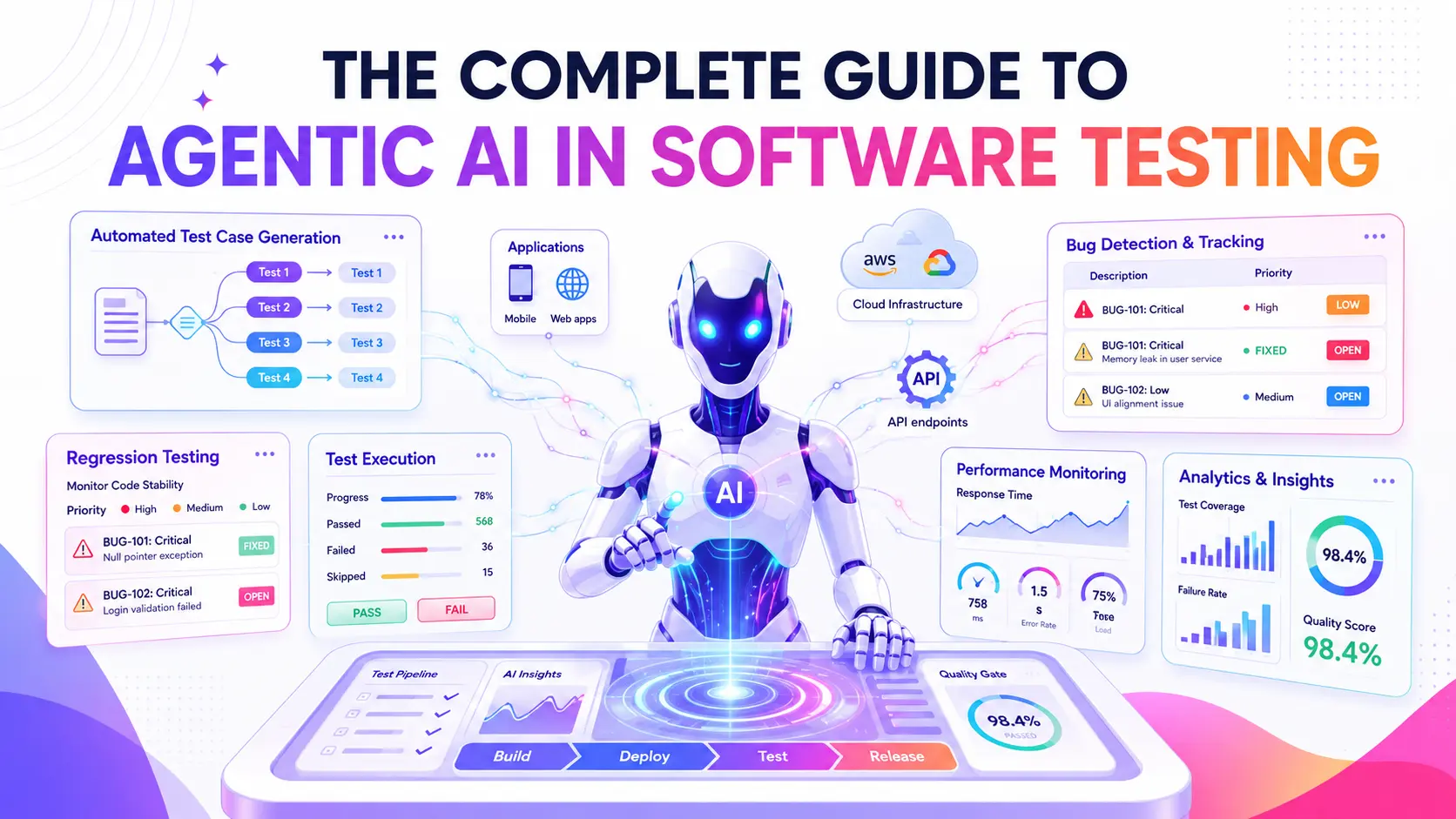
Agnetic AI testing is an unusual concept or next-generation software testing approach which is backed by Artificial Intelligence. The tech uses autonomous Ecosmob AI agents, which are meant to successfully execute and optimize testing procedures and even take care of complex tasks such as generating test scripts, and for that, they do not require any human supervision. And do you know what the best part about these agents is? They tend to learn and adapt to real-world conditions, which means the software testing process is more resilient and accurate, no two ways about it. Building these intelligent agents requires deep AI expertise in building ai agents and keeping them secure, which is why businesses typically rely on an experienced AI agent development company to design and deploy testing agents tailored to their specific workflows.
Earlier, the scenario was pretty different; traditional frameworks used to depend on predefined scripts and manual oversight, which did lead to several errors and issues. Technically speaking, Agnetic AI testing leverages modern Machine Learning (ML) algorithms and Large Language Models (LLMs) for autonomous decision-making, and can easily adapt to evolving testing environments. This shift is part of a broader movement toward agentic AI, where systems move beyond simple automation to act as goal-oriented partners capable of reasoning through complex workflows.
- Generates test cases dynamically - This works based on code analysis, historical bugs, and real-world user interactions. Agents, with the help of deep learning models, do assist in analysing the overall architecture of the software and predict failure points, which means maximum coverage is guaranteed.
- Execute tests autonomously - This aspect is about making software changes right away in real time. The app’s behaviour is monitored on a continuous basis, and test scenarios are modified accordingly. So no manual script needs to be updated.
- Analyse results and optimise relevant QA strategies - This type of testing certainly works wonders when it comes to improving overall accuracy and test coverage. These agents are set to prioritise critical issues and refine testing strategies over time, all thanks to intelligent defect clustering.
- Self-learn from previous tests - Before agnetic AI, the scope of false positives and negatives has increased over a span of time. Agnetic AI testing is a sure-shot way to test reliability and precision by successfully leveraging pattern recognition and anomaly detection.
After combining disruptive technologies such as Machine Learning (ML), Natural Language Processing (NLP), and Reinforcement Learning, professionals can successfully challenge all the traditional testing methodologies. As a result, it is possible to accelerate software releases, lessen testing costs, and even enhance overall product quality.
In a way, it is safe to say that AI agents are autonomous programs that can successfully plan, execute, and adapt a wide range of test cases based on goals, code changes, or system behavior. With advanced AI agent development services, businesses can build intelligent agents capable of automating testing workflows, improving software quality, accelerating release cycles, and continuously learning from real-world scenarios to enhance performance over time.
How it works:
- Test Execution Automation - AI agents can seamlessly execute test cases and successfully interact with the application in the same way as a human tester would.
- Data analysis - The next step is to successfully analyse test results, which is usually done to identify different patterns, trends, and potential issues, and even suggestions are made in the context of improvements or what kind of next steps should be taken.
- Self-learning - Agnetic AI agents tend to learn from previous tests and manage to successfully adapt test strategies. This is usually on the basis of outcomes, and in the end, it is all about improving the testing approach.
- Decision-making - It is possible to make real-time decisions, and you have a better perspective on which tests to run, when to pause, or which areas to focus on and all this happens on the basis of considering previous analysis.
- Error Detection and reporting - This type of testing identifies and reports bugs, defects, and inconsistencies. Here, developers get actionable insights like never before
Benefits of Agnetic AI in Software Testing
Agnetic AI offers a wide range of benefits in the software testing realm, and at the same time, it addresses the limitations of both manual and scripted automation.

- Faster test creation :- AI agents have the potential to generate test cases from requirements, user stories, and even source code. As a result, the scope for manual scripting automatically lessens, which means more chances of coverage, and no matter how many latest features are added, they can be tested from pretty early stages.
- Adaptive execution :- The next benefit of agnetic AI in the software testing realm is that it has the potential to adapt in a dynamic manner; this is generally the case even if there is a slight change in UI elements, APIs, or workflows. Not to mention, everyone can adapt to changes on the fly, as a result, common test failures can be prevented,d and the downtime is automatically lessened here.
- Reduced maintenance :- Earlier, with traditional methodologies, test suites required heavy upkeep; however, this is no longer the case. Another benefit offered by Agentic AI is that it features self-healing techniques, ensuring test functionality remains intact and reducing the ongoing agentic AI development cost associated with test maintenance, updates, and manual intervention.
- Continuous Learning :- No matter how many tests you run, each one of them successfully adds to the system's knowledge. Now agents can refine strategies, prioritise high-risk areas and even optimise regression cycles. Better outcomes are guaranteed.
- End-to-end coverage :- Here, entire user journeys are validated, especially in the context of sign-ups and checkouts. So everything is supposed to work here seamlessly, even with the evolving application.
Use cases of Agnetic AI Testing
- Agentic AI in Point-of-Sale (POS) :- Agnetic AI is highly recommended to test in the retail environment, mainly because of the way it perceives live retail data, humans cannot. Here, agents tend to take over tasks without human approval and validate hard-coded limits in POS systems, so that the agent doesn’t make unauthorised decisions. For example, setting prices below cost margins or even exceeding budget limits.
- Synthetic Data Generation :- Generative AI models tend to adapt lots and lots of synthetic data, which is more like a replica of real-world data. This works wonders when privacy is more important, or you are lacking in terms of data.
- Performance Benchmarking :- Another amazing use case of agnetic AI is that it has the potential to stimulate different load conditions, so no matter how stressful the situation is, software performance can be taken care of, and the solution is absolutely robust and scalable.
Challenges and Risks in Agentic AI Testing
- Initial setup complexities :- Agnetic AI testing mainly requires high-performance compute infrastructure, such as high-performing GPUs, TPUs, and scalable cloud services,s to operate seamlessly, which is pretty challenging. So before you even proceed, make sure you have checked all the compatibility issues, data silos and computational limitations.
- Security threats and data breaches :- AI agents are supposed to interact with multiple databases and systems, which means there are times when active user information is taken into account. As a solution, it is advisable to enforce rigorous controls to prevent data breaches using solutions like Veltar, including regular monitoring, encryption, and access management.
- Transparency and reliability :- Lastly, since human involvement is equivalent to none, the reliability of the testing procedure is often questioned. What if agnetic AI agents use fabricated data, the scope of false positives increases, here bugs will be reported even if they don’t exist.
So, as a solution, AI agents must be continuously tested, keeping human testers in the loop.
Conclusion
The future of software testing and quality assurance is pretty rosy, all thanks to agnetic AI. Now it is possible for enterprises across the globe to change the definition of quality assurance and come up with products that are more efficient than ever before.
So what are you waiting for? Time to future-proof testing strategies, reduce maintenance overhead and above all, you are bound to receive high-quality software solutions. I hope you did find the following post worth the read, in case you have further queries, reach out to us in the comment section below.


.webp)

.webp)