


Flaky tests are automated tests that pass and fail inconsistently without any changes to the underlying code. They are usually caused by timing issues, shared state, unstable environments, or unreliable external dependencies, and can be fixed through better test isolation, explicit waits, environment standardization, and continuous flakiness monitoring.
Seeing a CI pipeline fail only to discover nothing is actually broken is one of the most frustrating experiences in automated testing. Your application code is fine. The build is healthy. You rerun the tests, they pass, and everything appears normal until the same failure happens again days later.
According to Martin Fowler, flaky tests are those "tests that both pass and fail without any changes to the code."
Flaky Tests in Automated Testing What They Are and Why They Happen
A flaky test produces inconsistent results without any change to the software being tested. It passes sometimes, fails sometimes, and offers no obvious pattern which is exactly what makes it corrosive. You can't trust a test you can't predict.
This isn't the same as a broken test. A broken test fails consistently for a clear reason and shows a predictable stack trace every time. A flaky test is harder to deal with because it sometimes works. The error message shifts between runs, and pattern recognition becomes nearly impossible without proper test failure analytics.
According to Google’s research on large-scale test infrastructure, roughly 16% of test failures were attributed to flaky tests, highlighting how common test instability becomes at enterprise scale.
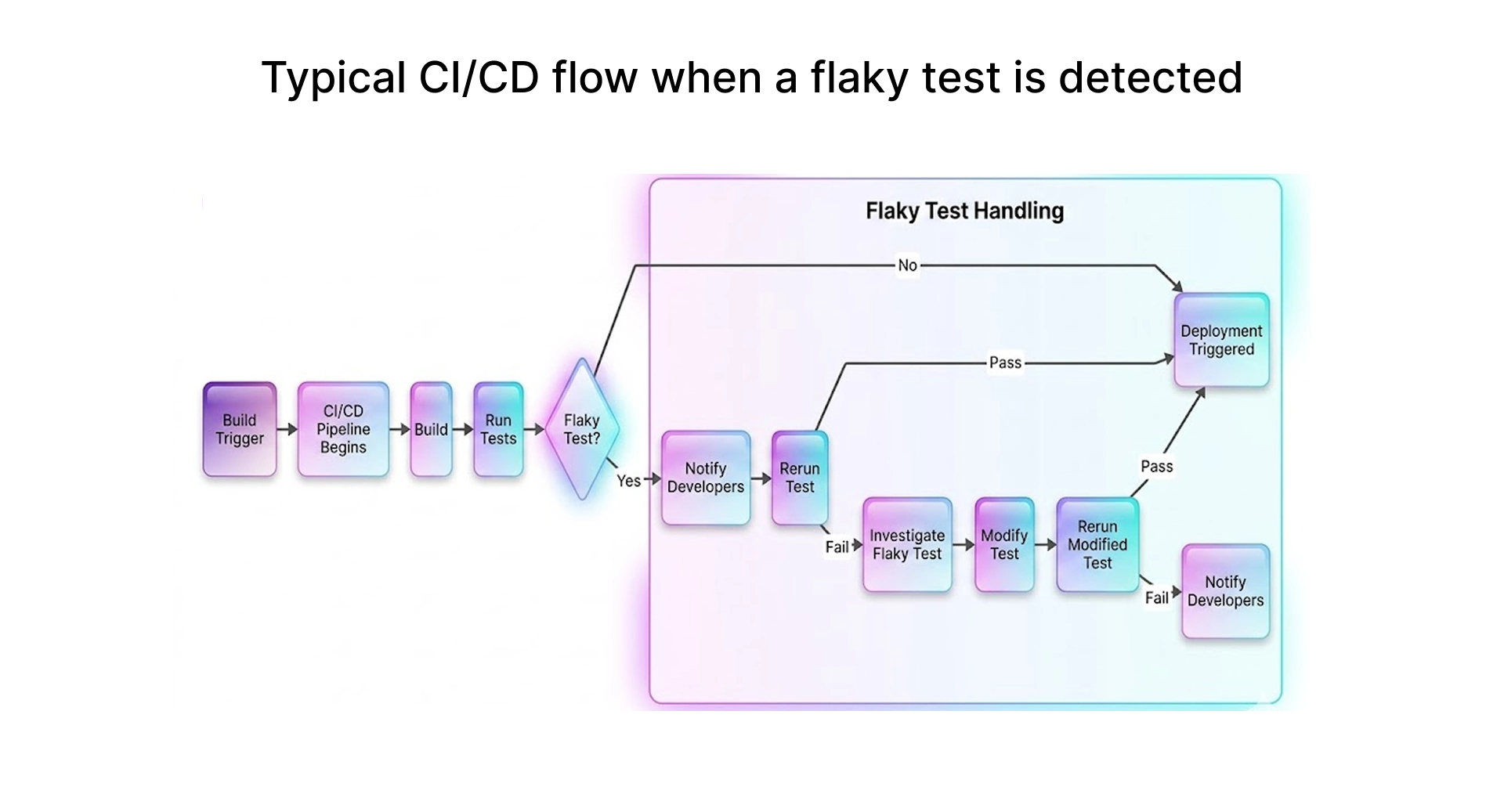
Common Causes of Flaky Tests in CI Environments
Most flaky tests trace back to a handful of root causes. Understanding which category a test falls into determines how you fix it:
- Timing issues and async wait problems: Test scripts using sleep statements or hardcoded delays instead of explicit waits fail whenever the system is slower than expected, common in CI/CD pipelines where virtual machines spin up with variable performance.
- Shared state and test order dependency: If one test modifies a shared resource and the next assumes a clean slate, failures depend entirely on test order. Parallel tests make this worse through resource contention.
- External dependencies and third-party services: Tests that call real third-party APIs inherit their reliability. A network issue or slow external API response causes a test failure even when production code is completely fine, invisible until you check HTTP logs or HAR files.
- Environment instability: Timezone assumptions, CSS/font/resolution issues, and file permission differences across virtual machines produce environment-specific failures that pass locally and fail in CI.
- Resource leaks and memory leaks: Tests that don't clean up database connections or browser sessions slowly degrade the test environment, causing later tests to fail due to exhausted shared resources.
- Concurrency issues in parallel tests: Tests not written with concurrency in mind collide over shared resources two tests writing to the same config file or hitting the same rate-limited external API simultaneously.
- Test interdependencies: When tests implicitly rely on side effects from other tests a record created earlier, a session left open reordering any test in the chain breaks downstream ones.
How Flaky Tests Erode Trust in QA Processes
Teams relying on qa testing services often treat flaky test remediation as a core reliability metric because pipeline trust directly affects release velocity.
The trust problem is cumulative and quiet. The first time a test fails intermittently, someone re-runs it and assumes it was a one-off. The fifth time, people start ignoring that test. By the tenth, they've mentally written off the entire CI/CD workflow.
Once developers stop believing CI results, intermittent failures get dismissed as "probably flaky" without investigation. Real product bugs slip through alongside the noise. The automation suite stops functioning as a bug detector and starts producing noise instead of signal.
This is the real cost not the fifteen minutes spent re-running a pipeline, but the gradual collapse of confidence in automated test coverage as a whole.
How to Identify and Analyze Flaky Tests
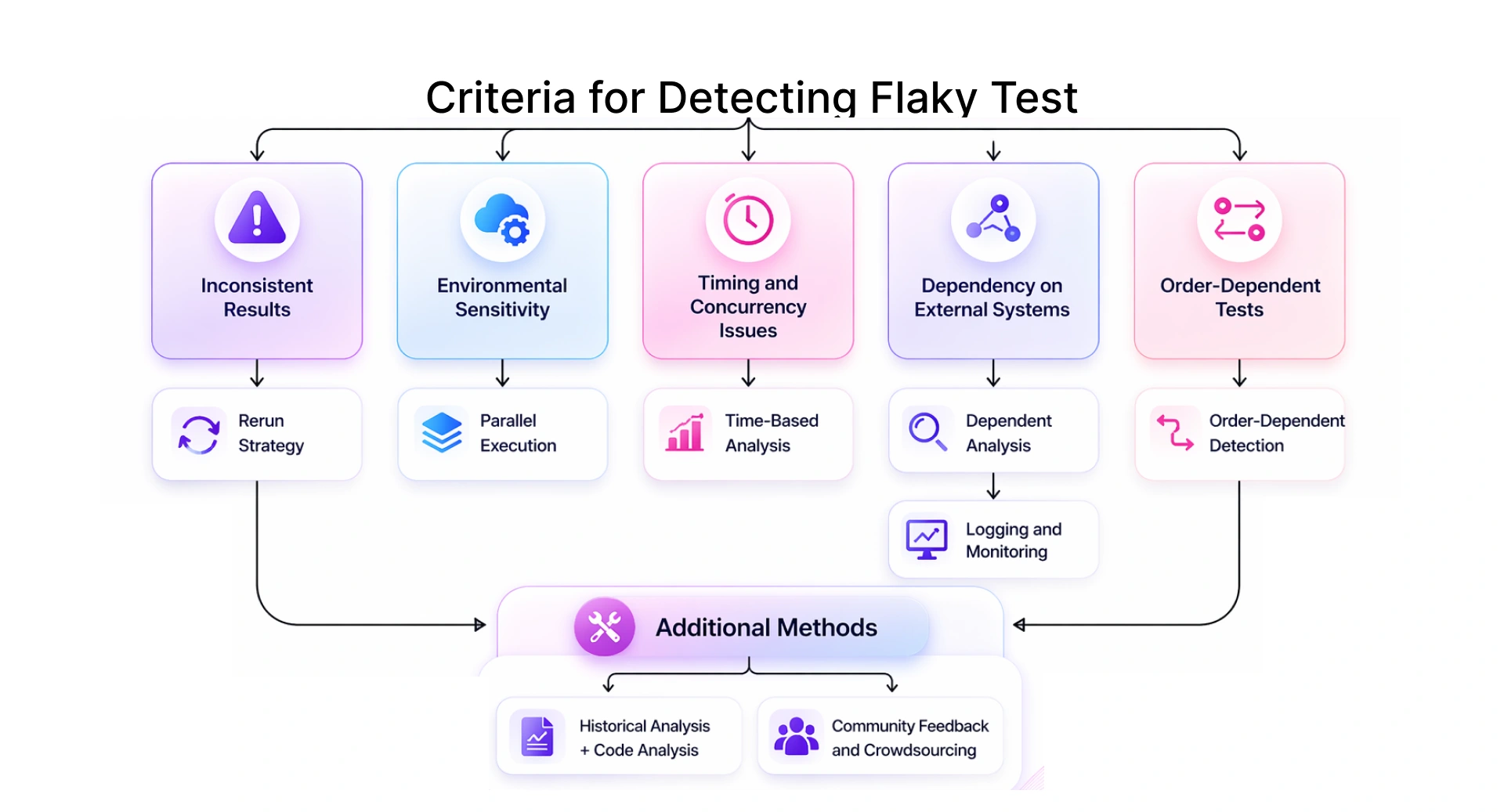
The first step is measuring flakiness systematically by tracking pass/fail history per test over a rolling window rather than relying on ad hoc developer reports.
Detecting Flaky Tests in Your Test Suite
The most straightforward method is running tests multiple times under identical conditions and recording inconsistent results. Most CI platforms GitHub Actions, CircleCI, Jenkins, GitLab CI/CD log pass/fail history per test over time. A non-zero failure rate without accompanying application code changes is the signal to look for.
Some teams maintain a flakiness rate per test: failures divided by total runs over a rolling window. A test at 30% failure rate is obviously a priority. One at 2% can look fine until it fails during a release window.
Test quarantine is a practical middle step to mark a known-flaky test, move it to a quarantine suite, and assign a test owner responsible for resolution. The risk is that quarantine becomes a graveyard without explicit ownership and timelines. For larger automation suites, test failure analytics solutions like BuildPulse surface flakiness patterns automatically by analyzing CI/CD pipeline results and categorizing failure signatures without requiring changes to existing test scripts.
Categorizing Root Causes of Flakiness
Group candidates by root cause rather than fixing each in isolation. If fifteen tests fail because they all interact with the same shared resource without cleanup, fixing the underlying isolation issue resolves all fifteen at once.
The six most common root causes of flaky tests in CI environments are:
- Timing issues and async wait problems (sleep statements, missing explicit waits)
- Shared state and test order dependency (setup/teardown gaps, test interdependencies)
- External service and third-party API dependency
- Environment instability (virtual machine variance, CSS/font/resolution issues)
- Concurrency issues and resource contention in parallel tests
- Memory leaks and resource leaks causing environment degradation
In Frugal Testing’s automation audit engagements across SaaS and enterprise QA teams, timing issues and shared-state dependencies consistently account for the majority of flaky test failures observed during CI/CD pipeline reviews.
Prioritizing Which Flaky Tests to Fix First
The most effective prioritization framework for flaky test remediation crosses flakiness rate against the business criticality of the feature being tested:
- Fix immediately: High frequency + high criticality (core auth, checkout, critical business logic)
- Quarantine temporarily: High frequency + low criticality until remediation capacity is available
- Schedule for backlog remediation: Low frequency + moderate impact scenarios
- Assign a test owner: Ensure accountability and timeline for every flaky test category
Prioritizing the highest-frequency, highest-impact flaky tests first delivers the fastest measurable improvement in CI/CD pipeline reliability.
Impact of Flaky Tests on CI/CD Pipelines and Delivery
The pipeline effects are concrete. Flaky tests add time, create noise, and make it harder for QA engineers and developers to maintain a fast, reliable feedback loop.
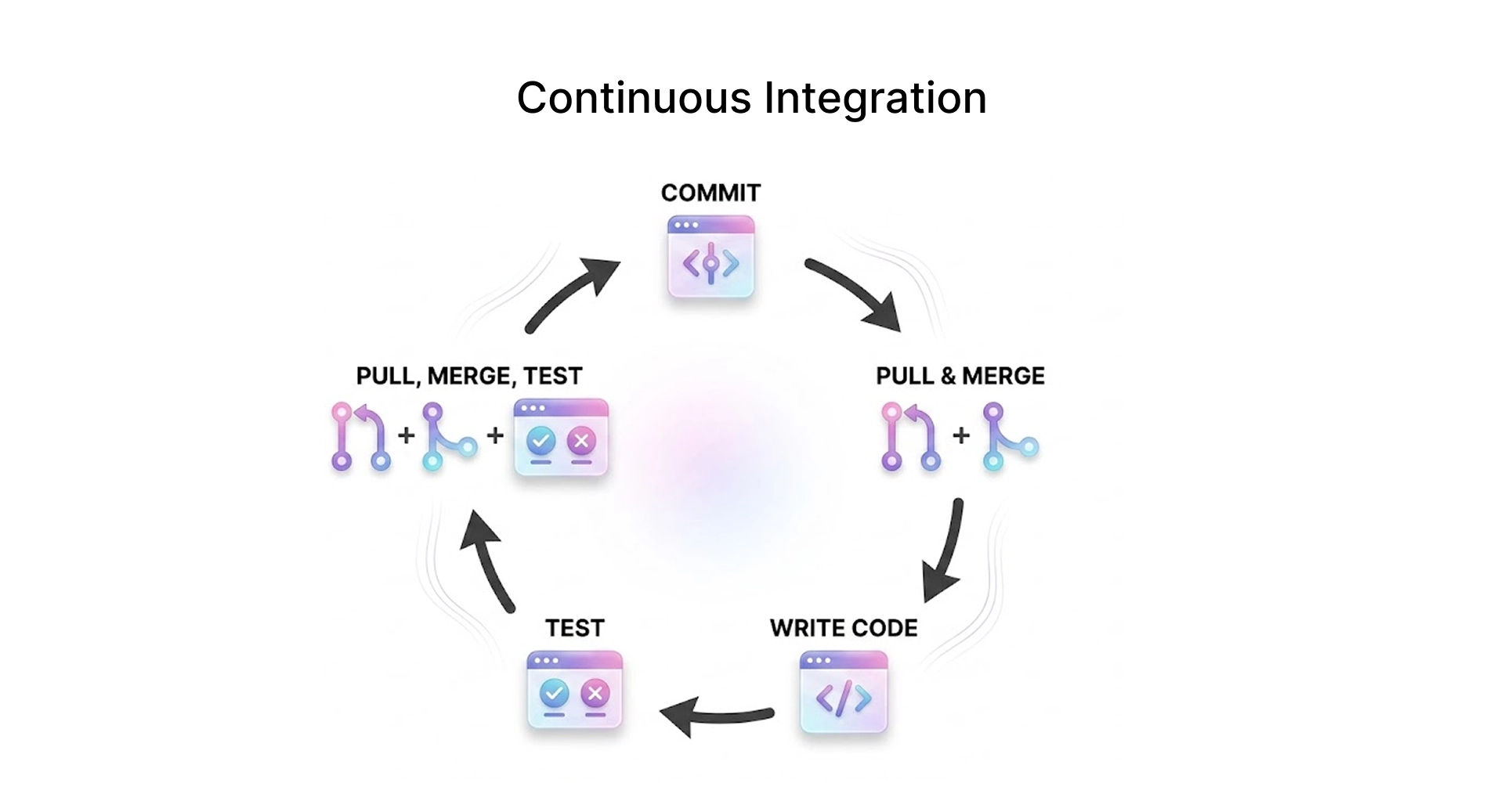
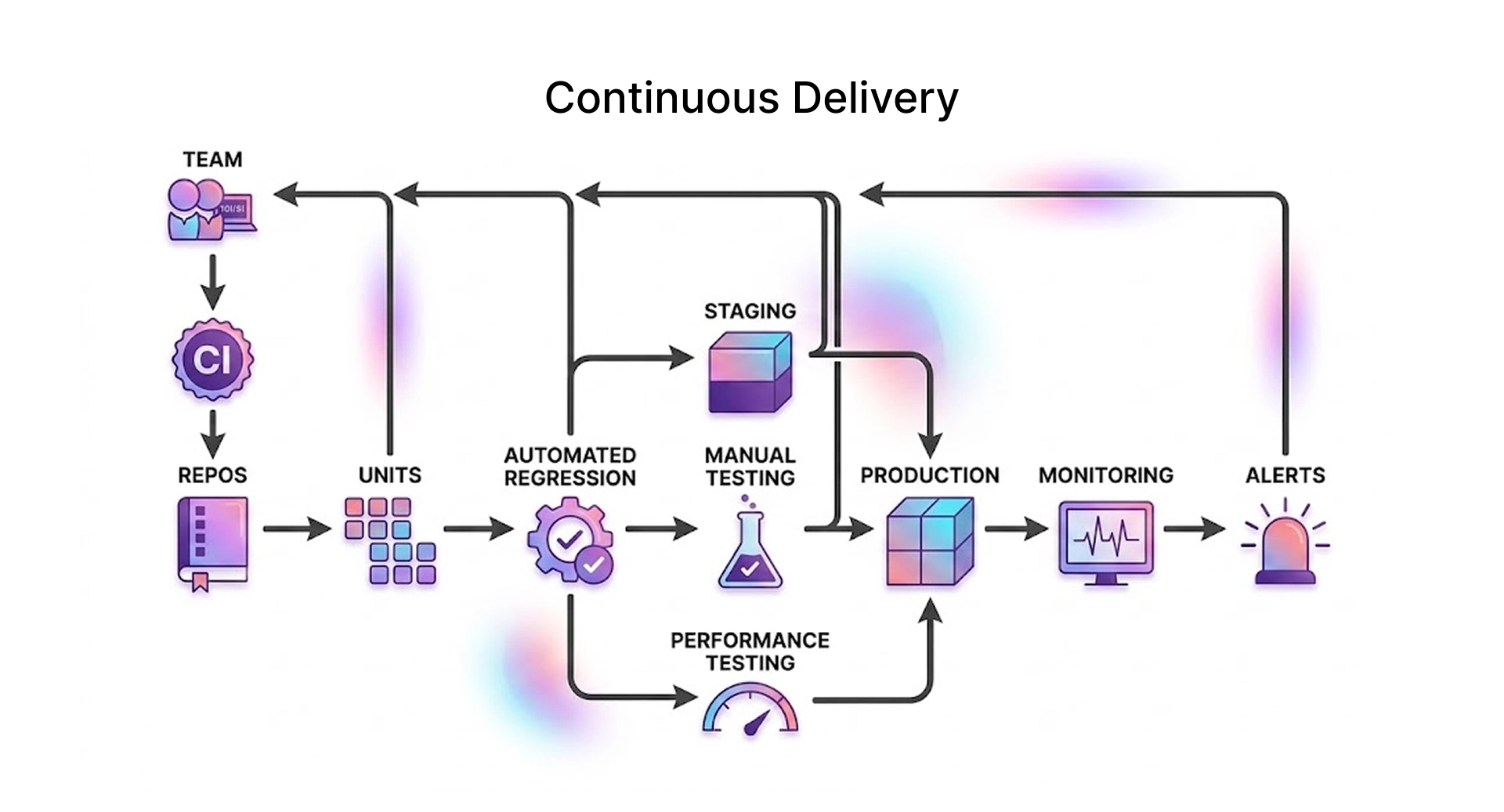
How Test Flakiness Slows Down Software Delivery
Every spurious failure that triggers test retries adds minutes to the build. On a team running twenty deployments a day, that compounds fast. Test retries can mask flakiness temporarily the pipeline eventually goes green but they hide the underlying problem and inflate build times without resolving anything.
Failed pipelines also create merge bottlenecks. Developers wait, context-switch, come back later, or start bypassing CI checks altogether. CI/CD workflows that can't be trusted stop being the safety net they're supposed to be.
Effects on Team Productivity and Release Confidence
Release confidence drops when teams can't distinguish "something is actually broken" from "that UI test is being flaky again." It surfaces as:
- Delayed releases: waiting to see if failures clear on their own.
- Rushed releases: test failures waved through without real investigation.
- Increased manual QA efforts to compensate for pipeline distrust.
- QA engineers spend most of their week on stack trace analysis instead of finding real product bugs.
Both delayed and rushed releases are bad outcomes. One blocks delivery. The other ships bugs. And the morale cost to QA engineers stuck in this loop is real.
How to Fix Flaky Tests in Automation Testing
The fixes vary by root cause, but several approaches apply broadly across automation suites.
Writing Stable Tests with Proper Isolation
Each automated test should own its test data, create what it needs, use it, clean up after itself. Key practices:
- Use setup and teardown hooks to reset state to a known baseline before and after each test
- Replace sleep statements with explicit waits tied to specific UI element states or conditions
- Use stable test selectors (data-testid, aria labels) rather than brittle CSS or positional selectors
- Mock external services to remove third-party API variability entirely from test results
- Isolate test data per test in parallel test runs to prevent resource contention
Ensuring Environment Consistency
Containerization is the most reliable approach. Identical Docker containers with pinned dependency versions eliminate most environment instability. Additional practices:
- Seed a fresh database state for each test run rather than relying on accumulated fixtures.
- Pin browser and OS versions in CI/CD workflows to prevent CSS rendering differences, font availability issues, and screen resolution inconsistencies.
- Audit CI/CD workflow configuration periodically against local dev environments to catch configuration drift.
- Capture test artifacts (logs, screenshots, video replays, HAR files) on failure so investigation doesn't require manual reproduction.
Using AI-Powered QA Testing Tools to Detect and Prioritize Flaky Tests
AI-driven test orchestration tools analyze test run history to flag flaky tests automatically, identify root cause categories based on failure signatures, and apply predictive test selection to prioritize which tests to run based on what changed. Tools worth knowing:
- Launchable: uses machine learning and pattern recognition to prioritize tests most likely to catch a defect based on historical data
- BuildPulse: surfaces test failure analytics directly from CI/CD pipeline data without requiring test script changes
- Ranorex Studio: GUI-based test management with built-in video replays and test failure analytics for automated UI testing
- Pytest plugins: flag flaky tests automatically in Python projects and generate structured test reports with flakiness metadata
For tests with external API dependencies, HTTP logs and HAR files often reveal whether a failure originated in application code or an external system, a distinction that changes the fix entirely.
Preventing Flaky Tests in Long-Term Automation Strategy
Fixing existing flaky tests is necessary but insufficient. Without a prevention strategy, you'll be back in the same position in six months.
Regression Testing Strategy for High-Velocity CI/CD Teams
A three-tier regression strategy is the most practical framework for high-velocity CI/CD teams each tier has a different tolerance for flakiness and a different execution trigger:
- Smoke suite: small, very fast, runs on every commit. Zero tolerance for flakiness.
- Integration suite: broader, runs on every pull request. Needs isolation and environment consistency.
- Full regression testing: runs nightly or before major releases.
Flaky test management strategies should be a regular part of sprint retrospectives specific reviews of which tests are in quarantine, what the root cause is, who the test owner is, and when resolution is expected. Treating flakiness the same way teams treat technical debt prevents accumulation.
Top Automated Regression Testing Tools
Many organizations adopt automated software testing services to continuously monitor and reduce flaky tests across large automation suites.
- Selenium/Playwright: Automated browser-based user interface testing. Playwright’s built-in auto-waiting reduces timing-related flakiness by automatically waiting for elements and network conditions, whereas Selenium typically requires manual wait configuration.
- Appium: Mobile automation testing for both Android and iOS platforms. Proper session management is necessary during concurrent tests.
- Pytest/Pytest plugins: Unit, integration, and end-to-end testing frameworks for Python code, incorporating flakiness mitigation strategies.
- JUnit/TestNG: Java testing frameworks offering setup/teardown hooks, retry annotations, and parallel execution controls to support better test isolation.
- Allure: Test reporting platform for managing screenshots, logs, and execution artifacts.
- ReportPortal: Test intelligence platform for analyzing failure trends and flakiness patterns across CI/CD runs.
None of the tools mentioned above can mitigate flakiness by themselves. More critical is the test design itself, encompassing test isolation, consistent testing environments, and external dependency management.
Continuous Monitoring to Prevent Flaky Tests from Returning
A fixed test can become flaky again after a dependency update or infrastructure change. One-time fixes aren't enough:
- Set a flakiness alert threshold of 5% over a rolling two-week window for each test, then track flakiness rate per test across CI/CD pipeline runs.
- Assign flakiness ownership like technical debt a specific test owner responsible for their module's flakiness budget
- Integrate test failure analytics into developer experience tooling (Slack, Microsoft Teams, build dashboards) so flakiness stays visible at the team level
Many teams working with specialized ci/cd services and software testing & qa services incorporate flakiness monitoring directly into release engineering workflows to maintain deployment velocity at scale.
Conclusion
Key Takeaways What Flaky Tests Are Really Costing Your Team
Unreliable tests undermine faith in the CI/CD pipeline, delay software release times, create merge bottlenecks, and make it harder to distinguish real product defects from noise in the system.
The most effective ways to fix flaky tests include improving test isolation, replacing hard waits with explicit waits, containerizing environments for consistency, and continuously monitoring flakiness trends over time.
How Frugal Testing Helps You Build a Reliable Automated Testing Pipeline
Frugal Testing partners with your team to detect, diagnose, and fix flaky tests in both web and mobile automation environments including root cause analysis, test isolation, environment stability checks, and monitoring solutions to ensure these issues don’t recur.
If flaky tests are slowing your releases, Frugal Testing can help audit your automation suite, isolate root causes, stabilize CI/CD pipelines, and implement long-term flakiness monitoring across your QA workflow.
FAQs (People Also Ask)
Q1.How do you identify which tests in your suite are flaky versus genuinely failing?
Ans: To identify flaky tests, re-run the failing test without any code changes if it passes on the second or third attempt, flakiness is the likely cause. For systematic detection, track pass/fail history per test across CI/CD pipeline runs; inconsistent results without correlated application code changes indicate flakiness rather than genuine defects.
Q2.Should flaky tests be deleted or fixed?
Ans: Fix them if they cover a critical path; delete them only if they duplicate coverage that other automated tests already provide and the root cause isn't worth the investigation. Deleting a flaky test removes coverage without resolving the underlying issue, which tends to resurface elsewhere.
Q3.How many flaky tests is "too many" before it becomes a pipeline problem?
Ans: A flakiness rate above 1–2% per test warrants investigation, and if more than 10% of your test suite is regularly flaky, it is a systemic pipeline problem. If developers routinely retry tests without investigation, the threshold has effectively already been crossed.
Q4.Can flaky tests exist in a well-written, well-maintained test suite?
Ans: Yes, even well-isolated automated tests can become flaky after an infrastructure change, a third-party API update, or virtual machine configuration drift. Flakiness prevention is ongoing, not a one-time cleanup.
Q5.What is the difference between test flakiness and test fragility?
Ans: Flaky tests fail intermittently without code changes typically due to environment, timing, or shared state issues. Fragile tests fail predictably when code changes because test scripts are too tightly coupled to implementation details. Flakiness is an environment or execution stability problem; fragility is a test design and coupling problem.



.webp)

.webp)