


It’s no secret that traffic volume alone isn’t enough – as an affiliate network, you need qualified leads and sales, depending on whether you’re in a pay per lead or pay per sale business. So if your earnings don’t match the traffic volume, you surely need tracking and analytics software to reveal and bridge the gaps.
Tracking pixels, postback logic, ping-post routing, CRM integrations, and reporting dashboards allow you to see whether your publisher generates quality leads. On the other hand, if the affiliate network software stack you’re using is unreliable, you’ll likely overlook problems with traffic and won’t be able to realize your full marketing potential.
That is why choosing affiliate network software matters so much. Some networks only have basic tracking, while others provide advanced features. Even from an affiliate standpoint, they will look closely at what's actually included versus what needs to be added separately – and that will likely be a major consideration in or against choosing your affiliate network.
In this article, you’ll learn what features affiliate network software should have and how to evaluate the quality of a network's software before you commit to it.
Define What Kind of Software You Need
Many networks today run on affiliate & referral marketing software, which manages both affiliate programs and customer referral programs from one dashboard. Affiliate and referral tools used to be separate products, but that line has blurred, and many affiliate networks now run both through the same system.
- Referral programs historically needed less granular tracking: a referral program is built around existing customers sharing a link to earn a reward, a relatively low-stakes, low-volume mechanic.
- On the other hand, affiliate marketing needs lead-level tracking that spans the entire customer journey. In fact, affiliate marketing is a different kind of relationship – one that may generate dozens of thousands of dollars for your network over time from a single affiliate or traffic source.
Anyway, the line between affiliate and referral marketing software has blurred over time, and today both referral and affiliate programs tend to run on the same kind of tracking software to measure how each of these marketing avenues is actually performing.
Look for Tracking & Attribution Accuracy
Tracking accuracy means two things: capturing as much funnel data as possible and reporting it correctly every time. The affiliate has no visibility into what happens on the advertiser's end. They only see what comes back through their own dashboard or API, whatever status the advertiser's system decides to send.
This is true regardless of the setup: whether a publisher becomes part of an affiliate program or network, the attribution logic sits on the advertiser's side. So, a publisher sees only what buyers allow them to see.
If the affiliate network software has bugs in its attribution logic, the affiliate suffers just as much as they would from problems in their own tracking stack, just without any control over the cause. That's why many bigger affiliates go for an independent setup that tracks as much as possible: every click, form submission, and postback response is data that can help catch a gap before it costs money.
Here’s how affiliate tracking works in pay per sale and pay per lead:
- Pay-per-sale, common in ecommerce. When a user clicks an affiliate link, the browser stores a cookie. The advertiser's site remembers this for a set “cookie window,” typically 30 to 90 days. If the person buys within that window, the publisher earns commission. But if the browser blocks or clears the cookie, or the purchase happens after the window, the affiliate gets no credit for the lead.
- Pay-per-lead (common in insurance, lending, and home services). Here, each lead gets a unique ID the moment someone submits a form. That ID travels with the lead. An affiliate will know whether a lead was counted as qualified only after an advertiser marks it. If the ID gets mismatched, or the postback arrives late or never arrives, the publisher's dashboard shows the lead as unconverted even if everything went fine.
Reporting Dashboards & KPI Visibility
Both advertisers and publishers base most decisions on what they see on the dashboard. If the numbers are inaccurate or outdated, they end up working with information that doesn’t match reality.
Make sure to check whether your affiliate network software has:
- Real-time vs. batch reporting. Conversions and reject/return events need to show up almost immediately after they happen, or the publisher keeps spending on a channel that doesn’t work as expected.
- Granular breakdown by traffic source. You need to see each metric by the source and the campaign. Otherwise, you may spend time and money on unprofitable traffic channels.
- Consistent metric definitions. Mislabeled or aggregated metrics may be confusing to both affiliates and advertisers: the former doesn’t know much about the customer journey beyond the submission, whereas the latter doesn’t know much about the lead or call channel and the lead or call itself.
- Historical data retention and trend view. Without a view of trends over time, publishers and advertisers may miss important trends and changes.
- Export and API access to raw data. Reporting allows publishers to check the advertiser’s math against their own calculations, while advertisers can calculate risks and expected profitability of their campaign or specific publisher or traffic source. Many publishers run the exported numbers through a separate affiliate marketing calculator to confirm EPC, ROI, and payout figures independently, rather than trusting the dashboard's summary at face value.
A dashboard doesn't have to look impressive. It has to be accurate enough that a "scale up" or "shut off" call is based on what's happening right now, not on a stale or mislabeled version of it.
Check Lead Routing Speed
One of the major functions of any affiliate network software is to decide which advertiser gets which leads and make sure they get this lead as fast as possible. Exact lead distribution mechanics vary by network and platform, but the underlying logic is the same: the slower the system is to decide and deliver, the lower the odds the advertiser accepts the lead.
- Ping-post is the most common example of real-time lead distribution. With ping-post lead distribution, your software asks several advertisers at once whether they want a given lead and at what price. They have seconds to respond, and the lead goes to the highest bidder.
The ping stage only passes non-identifying information needed to evaluate and bid on the lead. Contact data (name, phone, email, address) isn’t shared at this stage. The ping-post model protects the person’s PII (Personally Identifiable Information) until an advertiser has committed to the lead. Only the advertiser who wins the bid receives the full “post” with contact details.
If, however, the affiliate network software lags at any point, an advertiser simply doesn’t get the chance to respond in time, and the auction closes without them. Speaking of lagging, the research on online sales leads from Harvard Business Review found that companies contacting a lead within an hour qualified it roughly 7x times more often than competitors that waited even one additional hour, and more than 60x more often than companies that waited a full day.
Look for Advanced Duplicate & Fraud Detection Measures
Reject rate and return rate show a publisher how much of their traffic simply never gets paid. The cause splits two ways: the traffic itself is bad, or the software mishandled it, either missing fraud it should have caught or blocking legitimate people through overly strict filters. Publishers often can't tell which one it is without digging, and either mistake costs money.
This matters at the affiliate network software level because even a publisher who isn't running any fraud themselves can get hit by fraud they had nothing to do with. Junk traffic can end up mixed into a legitimate campaign: a bot hitting the landing page, someone filling out a form just to claim an incentive, a click farm buried somewhere upstream in a traffic source.
Catching it is exactly what fraud detection software is supposed to do. When it doesn't get caught in time, the advertiser's side eventually flags it and rejects the lead. So, the publisher is left having paid to acquire a lead that was never going to earn them anything, through no fault of their own.
In lead-gen verticals (insurance, lending, home services), this usually shows up as duplicate submissions or bot-generated forms. In ecommerce, it looks more like cookie stuffing or click flooding.
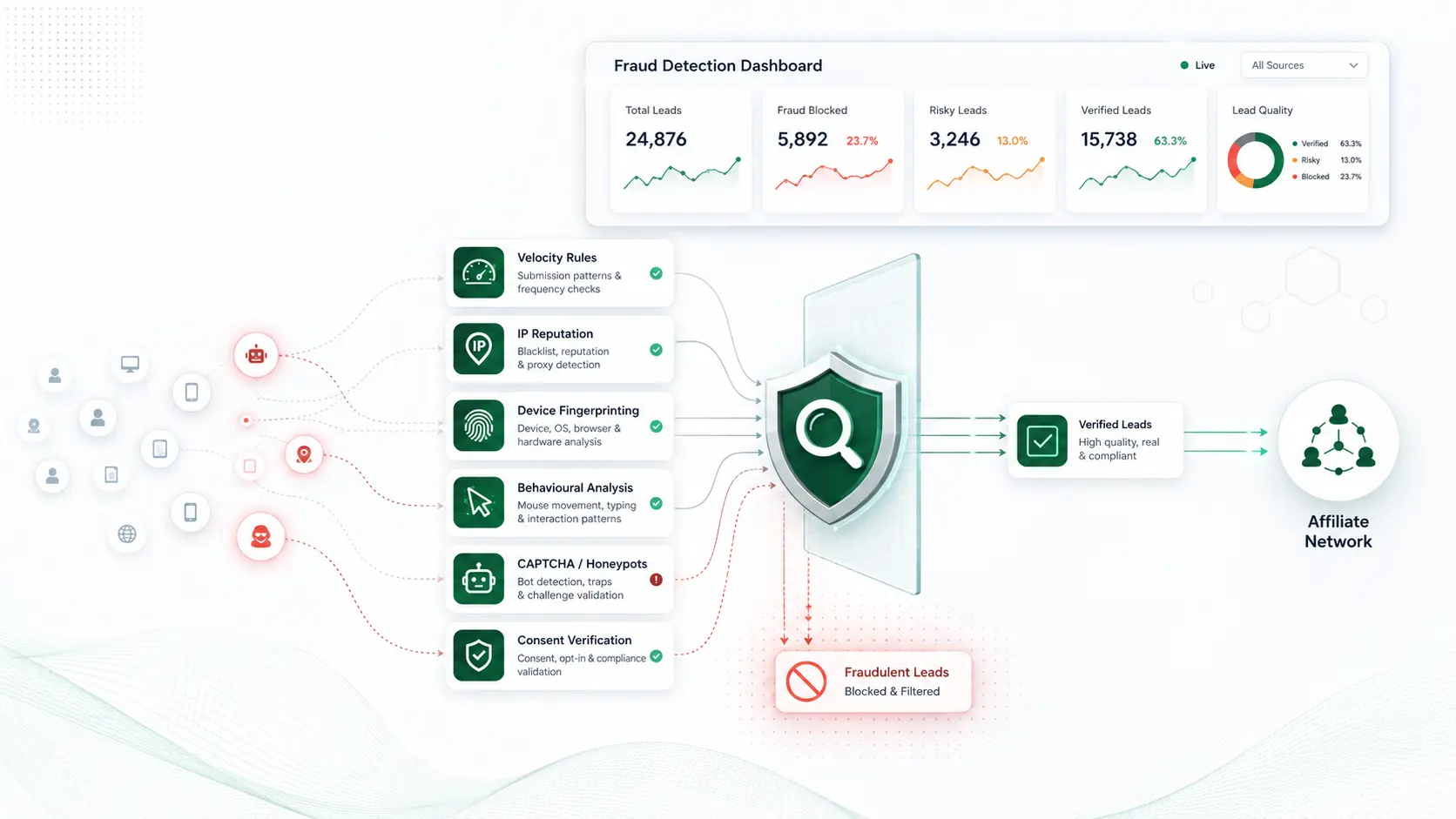
Advanced affiliate network software combines several fraud detection methods:
Checking reviews is the easiest way to see whether an affiliate network software actually hits that balance, since over-aggressive filtering catches legitimate leads too: a shared corporate IP, a VPN used for privacy, and an outdated browser are all it takes to get flagged.
Check API & Integration Reliability
Most affiliates run several affiliate programs or networks at once, each with its own API, advertisers, and payout logic. Underneath that setup sits lead distribution logic, which decides which advertiser gets which lead, in what order, and what happens if the first one doesn't respond. That means parallel integrations with many advertisers, and each one is a separate API connection that can fail independently.
This kind of failure is rarely obvious right away. The lead itself generates fine, the person is real, and the traffic is good quality, but somewhere along the way to the advertiser, the handoff gets lost to a technical glitch.
The affiliate finds out long after the fact, only once traffic has shifted enough that the dashboard numbers look suspicious and catch the team's attention. By that point, there's no way to know how many successful leads went uncounted in the meantime. On the surface, this looks identical to low-quality traffic in the affiliate network software. The cause is completely different, and without proper logging, there's no way to tell one from the other.
Platform resilience to this kind of failure comes down to a specific set of mechanisms:
- Automatic retry. If the first API call fails, the platform should retry automatically. Without this, one failed attempt means the lead is gone for good, even if the advertiser is reachable again a few seconds later.
- Duplicate protection on retry. The system can accidentally count the same lead as two separate entities. A reliable platform assigns each request a unique identifier.
- Postback delivery confirmation. When an advertiser qualifies a lead, that confirmation has to make it back to the publisher's system. If the response gets lost along the way, the publisher sees the conversion as never having happened.
- Failover routing. If one advertiser endpoint goes down, the platform should automatically redirect the lead to the next one in line.
- Load handling under spikes. During a sudden traffic surge, a platform with limited capacity can drop requests over that limit without any warning. That means losing leads when their value is highest.
- Error logging and alerting. Even the best retry logic doesn't help if the platform doesn't log the failure and flag it in time. A publisher who finds out about a problem days late loses that entire window of traffic with no chance to step in.
The same principles apply beyond the advertiser-facing API. If these systems aren't synced in the affiliate network software, the dashboard shows a stale picture, and decisions like pausing a traffic campaign end up based on data that doesn’t reflect reality.
Ensure Highest Data Security & Compliance
The type of data publishers and affiliates handle, and the scale of compliance risk that comes with it, depends on the vertical. At all times, though, you must comply with FTC disclosure rules, TCPA consent requirements, and data privacy laws.
On top of that, from the standpoint of both affiliates and advertisers, using an affiliate network with unreliable software puts them at risk of mishandling consent – for example, through issues with consent record transfers – or payment data:
Here are the possible consequences of compliance and data privacy violations:
- Phone-based lead-gen (insurance, lending, home services, legal). The TCPA governs this space. Damages run $500 per violation, up to $1,500 for willful or knowing violations, with no cap on the total. Every non-compliant call or text counts as a separate violation. The platform needs to log consent, its timestamp, the method, and any later revocation requests.
- Ecommerce and finance, where payment data passes through the affiliate link. Payment data processing itself is the merchant's responsibility, not the affiliate's: actual card data goes straight to the buyer's checkout, never through the affiliate's own systems. That doesn't mean it's irrelevant to the affiliate, though. A buyer with weak security or no real PCI-DSS compliance is a liability by association: a breach on their end can damage the affiliate’s reputation.
- FTC Endorsement Guides (16 CFR Part 255). These require clear disclosure of the affiliate relationship. Publishers must place the disclosure near the actual recommendation and phrase it in plain language.
Weak compliance creates legal risks. If consent records or transaction logs aren’t stored correctly or aren’t stored properly, a publisher has nothing to defend themselves during an audit.
Check for Scalability When Demand Spikes
The stakes behind affiliate marketing are high. By 2027, the size of the worldwide affiliate marketing market is anticipated to reach $27.78 billion. Worldwide, affiliate marketing produced 5 billion clicks, accounting for 16% of all eCommerce transactions in North America. At that scale, even a short outage during a demand spike can mean a meaningful chunk of lost, unrecoverable traffic.
Most spikes have a predictable time window. Finance sees one around tax season, ecommerce around back-to-school or Black Friday, roofing around hail season.
A handful of technical decisions determine whether a platform holds up during spikes:
- Auto-scaling infrastructure adds compute resources automatically as load grows.
- Load testing and capacity planning show what the system can actually handle before the actual spike.
- CDNs and static content caching pull some of that load off the core servers by serving requests closer to the user.
- Database connection pooling prevents too many web servers from queuing up behind the same limited set of database connections.
- Queue-based architecture holds requests during overload and works through them with a short delay. A spike slows the system down rather than losing leads.
- Redundancy and multi-region failover mean that if a data center goes down, the load shifts to another available one.
Well-built affiliate marketing platforms temporarily limit non-critical features, but never fully fail. A poorly built one just stops responding, and requests that arrive during that window get dropped.
Evaluating Vendors: How to Become Attractive to Publishers
Everything covered above comes down to one practical question: how does a publisher evaluate your affiliate network software? A demo call typically scratches the surface and doesn’t show how a platform works under load.
Here’s what publishers may also look for:
- Uptime history – a status page with an incident history and the average speed of resolving those incidents.
- API documentation and retry logic – support for webhooks, automatic retries, and idempotency keys.
- Fraud detection signals – specific fraud detection and prevention methods and strategies and proven track record
- Compliance – compliance certifications tied to the vertical and recent compliance audits.
Conclusion
Software quality means everything for an affiliate network, from whether publishers trust you to tracking accuracy to speed and scalability. Whether the system holds up during peak load is also crucial, along with ironclad fraud detection and FCC and TCPA compliance.
And then you can take it from there. The right affiliate network software creates a foundation you can build on and expand with confidence, onboarding more affiliates and ramping up lead and call volumes.

.webp)

.webp)