

You adopted an AI testing tool 18 months ago. Test authoring got faster. The team was briefly optimistic. Then the regression suite kept breaking every sprint, someone spent two days before each release manually triaging failures, and the CI/CD pipelines that were supposed to get smarter quietly became background noise that engineers had learned to distrust.
This is not an unusual story. It is the most common one we hear.
The problem is not the tool. AI testing tools optimise individual test-writing tasks; they do not own the test lifecycle. When the bottleneck is the pipeline itself, faster test authoring is not the fix. The World Quality Report 2024 found 57 per cent of organisations cite test maintenance and flakiness in CI pipelines as their top QA scaling challenge. The tooling exists. The architecture does not yet exist in most teams.
This post gives you a precise architectural breakdown of agentic QA versus AI-assisted testing: what each model does, where each stops, and a decision framework for which approach your team needs right now.
The Architectural Difference Between Agentic QA and AI-Assisted Testing
Most vendor content treats this as a product tier question. It is not. It is an execution model question.
AI-assisted testing is a human-in-the-loop tool. It accelerates discrete tasks: generating test code, suggesting a step, and repairing a broken CSS selector after a UI change. The engineer opens an IDE or test recorder, the AI suggests, the engineer accepts or rejects, and the test gets committed. Every state transition requires a human decision.
Agentic QA is a different architecture. The agent perceives application state, generates AI-generated tests based on what changed, executes them, evaluates results, and adapts the suite without a human triggering each step. Generative AI sits at the core of this loop, not as a code suggestion layer but as the test execution engine itself.
Worth noting: this is not always a product boundary. Virtuoso QA and Mabl both offer browser automation at the assisted layer, but require explicit agentic framework configuration to operate autonomously in CI pipelines. Buying an agentic-capable product and running it in assisted mode is more common than vendors admit.
How AI-Assisted Testing Works in Practice
Self-healing tests powered by accessibility attributes prevent the manual rework that consumes SDET time after every design system update. Rather than relying on brittle CSS selector logic tied to class names, modern tools use accessibility attribute signals to locate elements stably across UI changes. Teams consistently report 30 to 50 per cent faster test creation for new features, with LLM-generated test cases covering edge cases that engineers would not write manually.
The ceiling is structural. AI-assisted testing still requires a QA engineer to own the pipeline, interpret failure modes, and decide what to test next. The intelligence stops at the task boundary. It never crosses into pipeline ownership.
How Agentic QA Operates Inside a CI/CD Pipeline
The agentic execution loop: the agent monitors the codebase for changes, generates targeted test flows based on risk signals, performs root cause analysis on failure modes, and logs structured outcomes. All within the CI/CD pipeline testing gate. Without human intervention per run.
The enabling stack behind 2026-era agentic QA: LLM-generated test cases from GPT-4-class models fine-tuned on test corpora, self-healing tests that operate across UI, API, and test logic layers, ML-driven triage that separates product defects from environment noise, and tool-use agents with full API access to browsers, databases, and third-party APIs as part of a single orchestrated run.
One dependency most vendor conversations skip: agentic QA requires a defined observation surface. Without API access to the application state, the agent cannot perceive what changed. Teams without CI/CD instrumentation cannot extract value from agentic loops regardless of which tool they buy.

What AI-Assisted Testing Delivers, and Where It Stops
A 40-person engineering team with two SDETs does not have a pipeline problem. It has a coverage gap. The team ships faster than two people can write tests for, CSS selectors break after every design sprint, and the test suite is perpetually six features behind. AI-assisted testing was built for this situation.
It consistently outperforms unassisted QA on test code authoring from user stories, CSS selectors, and accessibility attribute self-repair after UI changes, and parameterised test data generation. That is where it stops. AI-assisted testing does not own the test strategy, does not decide what to test when the roadmap shifts, and does not perform autonomous failure triage. Calling it "AI-powered testing" obscures those gaps rather than closing them.
The Hidden Cost of Stopping at AI Assistance
Teams that adopt AI-assisted testing often plateau within two quarters. Coverage improves fast in the first sprint. Then the bottleneck shifts. Test authoring is no longer the constraint; test maintenance and pipeline orchestration are. The team keeps doing manual triage. The plateau is invisible until someone pulls the sprint triage numbers.
According to Gartner's 2025 analysis of AI in software testing, elite engineering teams spend less than 15 per cent of cycle time on manual test triage. Teams relying solely on AI-assisted tooling without autonomous orchestration typically sit at 30 to 45 per cent. That gap does not close by adding more AI assistance. It closes by changing the architecture.
What Agentic QA Delivers, and What It Actually Requires
Agentic QA compresses the time between a code change and a validated, triaged result. The agent generates AI-generated tests scoped to what changed, executes them, and returns a structured failure report. The engineer receives a signal: this commit introduced a defect in the checkout flow. Not a queue of 47 failures to sort through before a release.
Three capabilities that define 2026-era agentic QA maturity:
- Change-aware test generation: AI-generated tests scoped to what changed, not re-run from a fixed suite. This is what keeps agentic CI pipelines fast as the application scales.
- Autonomous failure triage: the agent separates product defects from flaky selectors from environment noise without human classification. Tools like Launchable use ML-based test selection to identify genuine defects versus infrastructure noise.
- Continuous QA regression testing management: the agent prunes and evolves the suite as the application changes, removing tests that no longer map to live behaviour and flagging new coverage gaps.
One point worth stating: agentic QA is not a replacement for QA strategy. An agent without a coverage policy generates noise. Strategy is set by humans; execution is delegated to the agent.
The Infrastructure Prerequisites Before Agentic QA Delivers ROI
Four conditions determine whether a team is genuinely ready:
- An observable CI/CD pipeline: the agent needs an event stream or API access to application state. Without it, the agent cannot perceive what changed.
- A stable test environment with reset capability: agents running against an unstable environment generate false failures faster than any team can manage.
- A baseline coverage floor: agentic systems extend an existing suite far more effectively than building from zero. Under 30 per cent coverage means build the foundation first.
- A structured failure feedback loop: triage output must flow into Jira, PagerDuty, or Slack. An agentic signal landing in a dashboard nobody opens is not a signal at all.
The most common failure mode in premature rollouts: high test volume against an unstable environment, signal-to-noise collapse within four to six weeks, agent disabled, tooling investment written off. The infrastructure scoping work that prevents this is not glamorous. It is not optional.
Agentic QA vs AI-Assisted Testing: 8-Dimension Comparison
These are not competing options at the same stack level. AI-assisted testing is a developer productivity tool. Agentic QA is a pipeline ownership model. The question is not "which is better" but "which bottleneck is the team actually solving right now."
Our Take: Most teams evaluating agentic frameworks are sitting at bottleneck type two without having recognised it. They adopted an AI-native testing platform, saw authoring speed improve, and assumed the job was done. The test execution engine they needed was autonomous, not assisted. That distinction does not show up in vendor demos.
How Frugal Testing Moves Teams from AI-Assisted to Agentic QA
Our delivery starts where most failed rollouts started: the data model. Before writing a single test, we map the application's observable state, define the business logic boundaries the agent must respect, and establish what a valid test signal looks like. Teams that skip this step end up with agents generating test flows that do not reflect how the application actually behaves.
We have helped more than 50 US engineering teams migrate from manual-heavy QA to autonomous pipeline-gated testing. That includes teams migrating Selenium scripts, legacy test scripts, and Page Object Model architectures into agentic pipelines, assessing whether Playwright MCP wrappers or open-source orchestration frameworks can be reused, and instrumenting environments using Claude Code to generate baseline coverage. The scoping work is done by engineers who understand your system.
Teams reach stable agentic runs within eight to ten weeks. What they own at close: a running Agentic QE Fleet embedded in the CI/CD pipeline, a triage classification playbook, and engineers who can extend the suite independently. Engineering velocity improves because engineers stop managing failure queues and start responding to structured defect signals.
How to Decide Which Model Your Team Needs Right Now
The decision comes down to which bottleneck your team actually has.
If the bottleneck is test authoring speed, AI-assisted tooling closes that gap immediately. The shift-left testing investment pays off in the first sprint. LLM-generated test cases scale coverage to match delivery velocity without proportionally scaling headcount.
If the bottleneck is pipeline throughput and triage overhead, where failure modes pile up faster than the team can evaluate them, agentic QA addresses the systemic root cause. This is where Quantum Quality Engineering principles apply: delegating test execution and triage to autonomous agents, so engineers spend time on engineering velocity, not failure queue management. When third-party APIs or integrations being tested have grown faster than the suite covering them, the assisted model is no longer sufficient.
Teams with neither a coverage baseline nor a stable pipeline need neither model first. They need a QA strategy foundation. Tooling investments fail on top of an unstable base. That is a sequencing problem, not a product one.
Adopt AI-assisted testing first if: fewer than 30 per cent of user stories have automated tests, the SDET-to-engineer ratio is 1:20 or worse, or no CI/CD instrumentation exists on the roadmap within six months.
Move to agentic QA when: test maintenance consumes more than 20 per cent of sprint capacity, release velocity is blocked at the QA gate by triage time rather than actual defects, or an Agentic QE Fleet or equivalent automation layer is absent from an otherwise observable pipeline.
Moving from assisted to agentic is not a tool swap. It is a shift in who owns the test lifecycle end-to-end. That requires infrastructure readiness and a coverage policy before it delivers returns.
Key Takeaways
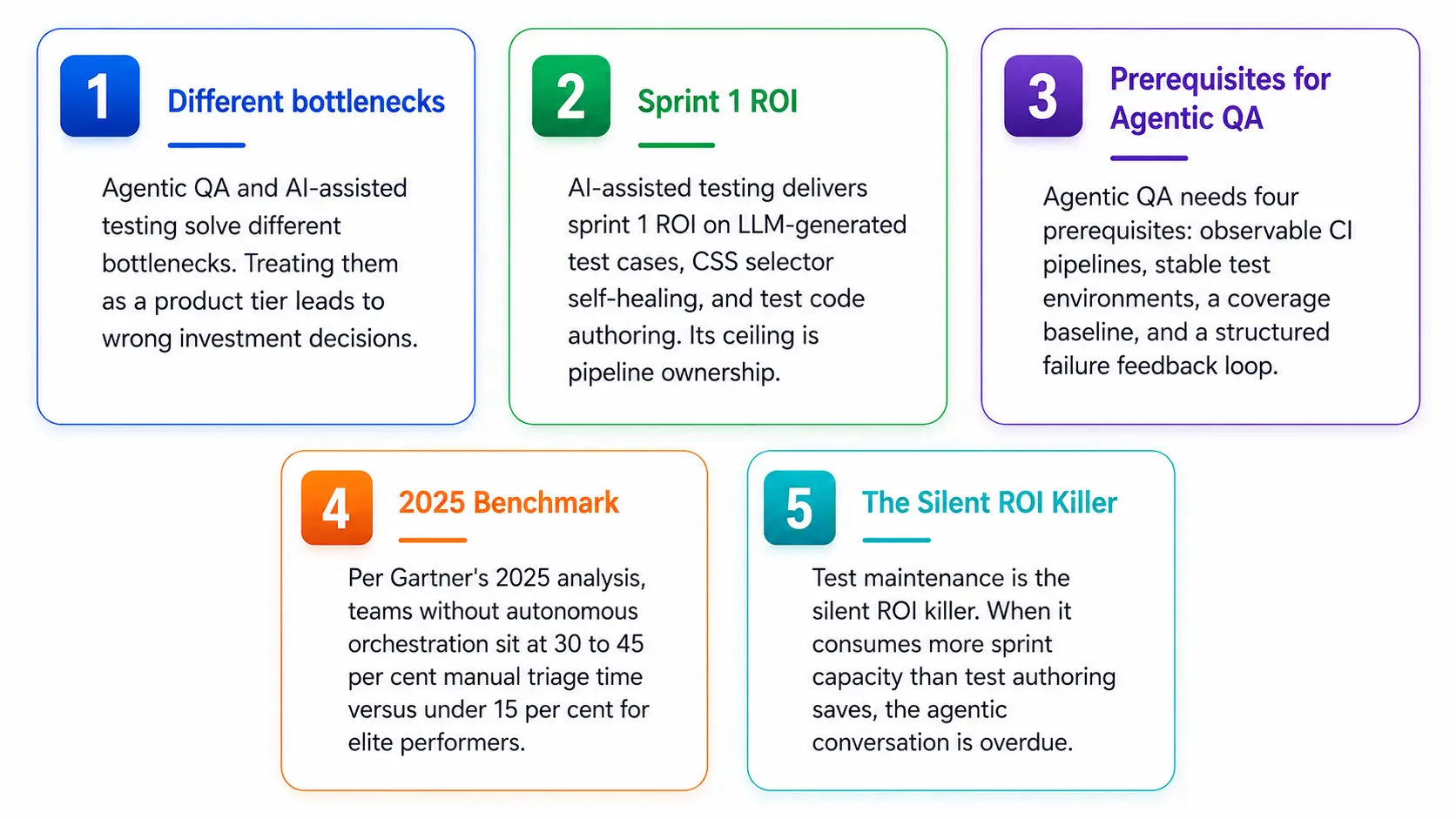
Conclusion
Agentic QA is not a rebrand. It is a different execution model, built on generative AI and agentic frameworks, solving a different class of problem with different infrastructure requirements. The engineering teams that get it right in 2026 are the ones who diagnosed their actual bottleneck first, not the ones who chased the trend.
If test maintenance and failure mode triage are still consuming days of sprint capacity despite AI tool adoption, the ceiling of the assisted model has been reached. The fix is architectural. It starts with a clear software testing automation strategy before any vendor gets involved. The teams that sort this out now will ship with fewer escaped defects and a QA gate that engineering trusts. The ones that wait will spend 2027 building the foundation they should have built now.
People Also Ask (FAQs)
Q1.Is agentic QA just a marketing rebrand of AI-assisted testing?
Ans: No. AI-assisted testing augments individual tasks with a human at every decision point; agentic QA owns the full test lifecycle autonomously using agentic frameworks and a dedicated test execution engine. They solve different bottlenecks and are not interchangeable.
Q2.Which AI testing tools qualify as genuine agentic QA in 2026?
Ans: Mabl with autonomous modes, Launchable, Virtuoso QA with agentic configuration, and Applitools with AI-driven execution qualify. GitHub Copilot, basic Testim configurations, and Selenium scripts with AI selector plugins remain in the assisted category.
Q3.How long does it take to see ROI from agentic QA compared to AI-assisted testing?
Ans: AI-assisted tooling delivers ROI in sprint 1; agentic QA requires 60 to 90 days to reach stable autonomous runs. Teams that skip infrastructure readiness and API access prerequisites never get past week eight.
Q4.Can our team run AI-assisted testing and agentic QA simultaneously?
Ans: Yes. They operate at different layers: assisted tools handle individual test code authoring and test maintenance, while the agentic layer runs and orchestrates full test flows in the pipeline. They are composable by design.
Q5.What CI/CD infrastructure does a team need before agentic QA makes sense?
Ans: Four prerequisites: an observable CI/CD pipeline with API access to application state, a stable test environment with reset capability, a baseline coverage floor, and a structured failure feedback loop into existing team tooling such as Jira or Slack.

.webp)