

What is API testing in software? It sends requests to API endpoints and checks that responses come back correct, fast, and safe, without touching a UI. Application Programming Interfaces sit at the centre of modern software development, and understanding what is API testing makes picking the right tool far less confusing.
TL;DR
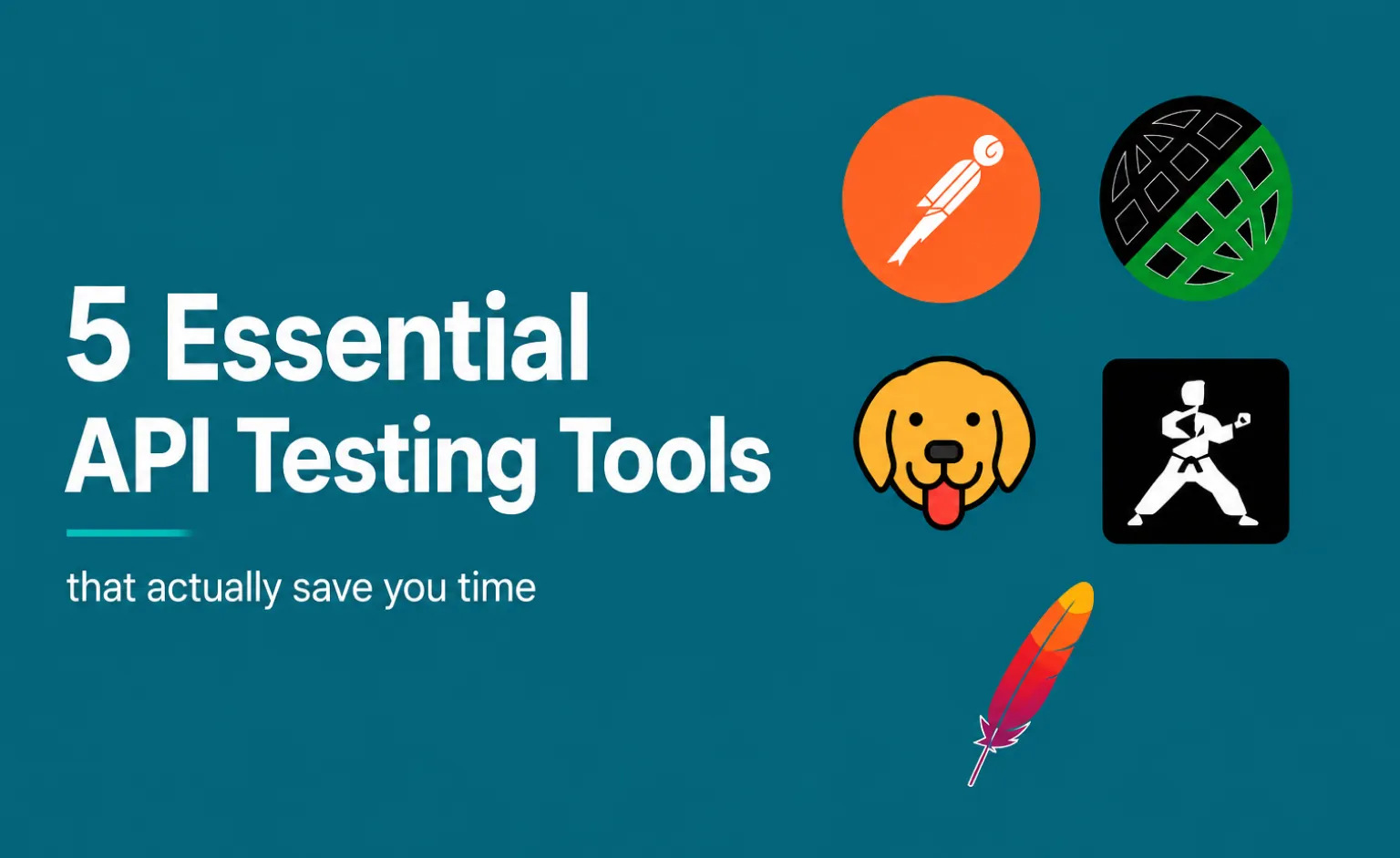
- Five tools cover most needs: Postman, REST Assured, Bruno, Karate DSL, and Apache JMeter.
- A comparison table maps each to protocol, CI/CD fit, and skill floor.
- Security testing and contract testing are the two gaps most "best tools" lists skip.
A QA lead once summed up her stack in one line: Five tools duct-taped together, and only she knew how they connected. This guide covers the five worth knowing.
What to Look for in an API Testing Tool Before You Commit
API testing splits into several distinct types, and most teams only notice this after picking a tool that covers just one:
- Functional testing: Does the endpoint return the right data?
- Security testing: Can it be broken into?
- Performance testing (load testing): Does it survive real traffic?
- Contract testing: Do two services still agree on what they send each other?
- Automated API testing: These checks run on a schedule, not by hand.
Understanding the types of automated testing available is step one. Four criteria decide whether a tool survives a real pipeline:
- Protocol support: RESTful APIs, GraphQL API traffic, gRPC, SOAP API.
- CI/CD pipelines integration: Headless in Continuous Integration, or clicking through a UI each release?
- Maintenance burden: Brittle scripts versus self-healing assertions.
- Team skill floor: Java, JavaScript, and BDD each need a different engineer.
Teams that skip this default to Postman because it's the name everyone knows, ignoring API design principles, then find two sprints later it doesn't fit their protocol mix.
Five tools cover most needs, each for a different reason: Postman for collaboration, REST Assured for JVM teams already on Java, Bruno for Git-native storage, Karate DSL for functional plus mocking plus load, and JMeter for load and performance testing. The sections below cover what each does, and where it runs out of road.
Postman: Functional Testing and Team Collaboration in One Workspace
Postman is usually the first tool a team reaches for: it turns API testing into something a whole team can edit together, not one engineer's local script.
Postman is an api testing platform, an API platform, and an API client built around Collections, JavaScript assertions against bodies and status codes, plus Newman, its CLI for running Collections headless in CI/CD pipelines.
- Postman Import pulls in an existing Swagger UI or OpenAPI spec, and Postman Enterprise adds workspace governance for larger teams.
- Shared Collections keep test automation work visible across the team.
It fits multi-person teams needing a shared workspace, and remains one of the best-known api test tools, though not a security scanner or load tester.
newman run api-collection.json \
  --environment staging.postman_environment.json \
  --reporters cli,junit \
  --reporter-junit-export results/newman-report.xml
Postman vs Insomnia: Which to Pick for Your Team
The Insomnia vs Postman question, sometimes framed as Postman vs Insomnia or Postman or insomnia, comes down to team size:
- Solo or small team: Insomnia's lighter footprint wins. How to use Insomnia to test api takes an afternoon.
- Multiple engineers sharing Collections in CI: Postman and Newman win instead.
- Neither fits? Bruno (Git-native storage) and Hoppscotch (open-source, browser-first, strong community support) are solid Insomnia alternatives, and either works as an Insomnia Postman alternative.
REST Assured: Code-First REST API Testing for Java Teams
For teams that would rather keep everything in code than click through a UI, REST Assured is the obvious stop: It treats API checks as ordinary Java tests.
REST Assured is a fluent Java library built for rest api testing: Test code lives in the same Maven or Gradle project as the service under test. As a REST test tool, it lands in the same JUnit report as unit tests, which is why Java-heavy teams reach for it.
given()
    .header("Authorization", "Bearer " + token)
    .contentType(ContentType.JSON)
.when()
    .get("/api/users/42")
.then()
    .statusCode(200)
    .body("email", equalTo("qa@example.com"));
Given/when/then structure, JSON path assertions, and OAuth2 headers are first-class here, making it dependable among rest api testing tools for JVM teams. Non-Java teams without a JUnit pipeline get further with Karate DSL, covered next.
Bruno: Git-Native API Client for Teams Who Want Collections in Version Control
Bruno showed up to answer a common Postman complaint: Why trust someone else's cloud with the Collection? Bruno keeps everything local and versioned instead.
Bruno's pitch: Collections live as plain .bru files locally instead of a cloud workspace, committed to Git alongside the endpoint code, so branching and rollback work as expected.
get {
  url: {{base_url}}/api/users/42
  body: none
}

headers {
  Authorization: Bearer {{token}}
}

assert {
  res.status: eq 200
}
A CLI runner executes Collections in CI with JUnit-compatible output. Bruno remains an API client and functional runner for web services and RESTful APIs, nothing more. Among web api testing and web service testing tools, and rest api tools generally, it's the pick for teams leaving Postman over cloud lock-in.
Karate DSL: API Testing, Mocking, and Load Testing Without Multiple Frameworks
Karate exists to fix a specific frustration: Functional tests, mocks, and load tests usually live in three separate tools. Karate puts all three under one readable DSL.
Karate uses BDD-style syntax, given/when/then, needing no step definitions, so QA engineers read and write cases without touching real Java:
Feature: User API

Scenario: Get user by ID
  Given url 'https://api.example.com/users/42'
  When method GET
  Then status 200
  And match response.email == 'qa@example.com'
The same suite feeds Gatling for load testing without a rewrite, giving end-to-end coverage from one codebase and replacing three separate tools. Its DSL sits on Java, so JavaScript-first teams may get further with Playwright api testing instead.
Apache JMeter: Load and Performance Testing for APIs Under Real Traffic
JMeter has been around since before most current QA engineers started their careers, and it's still the tool teams reach for once a functional suite passes, but nobody knows how the API behaves under load.
JMeter simulates concurrent users hitting API endpoints, making it one of the standard api load testing tools for measuring p50, p95, and p99 latency. Thread Groups define users, Samplers define requests, Listeners capture results as CSV or HTML.
jmeter -n -t api_load_test.jmx -l results.csv -e -o report/Pairing output with APM integrations, or a data pipeline for historical trends, gives a fuller picture. JMeter is open source and free, and remains solid api test software on a fixed budget.
API Testing Tools Side by Side: Which One Fits Your Scenario
Searching for software for api or general api tools? There's no single best tool for api testing, only the best fit for a stack.
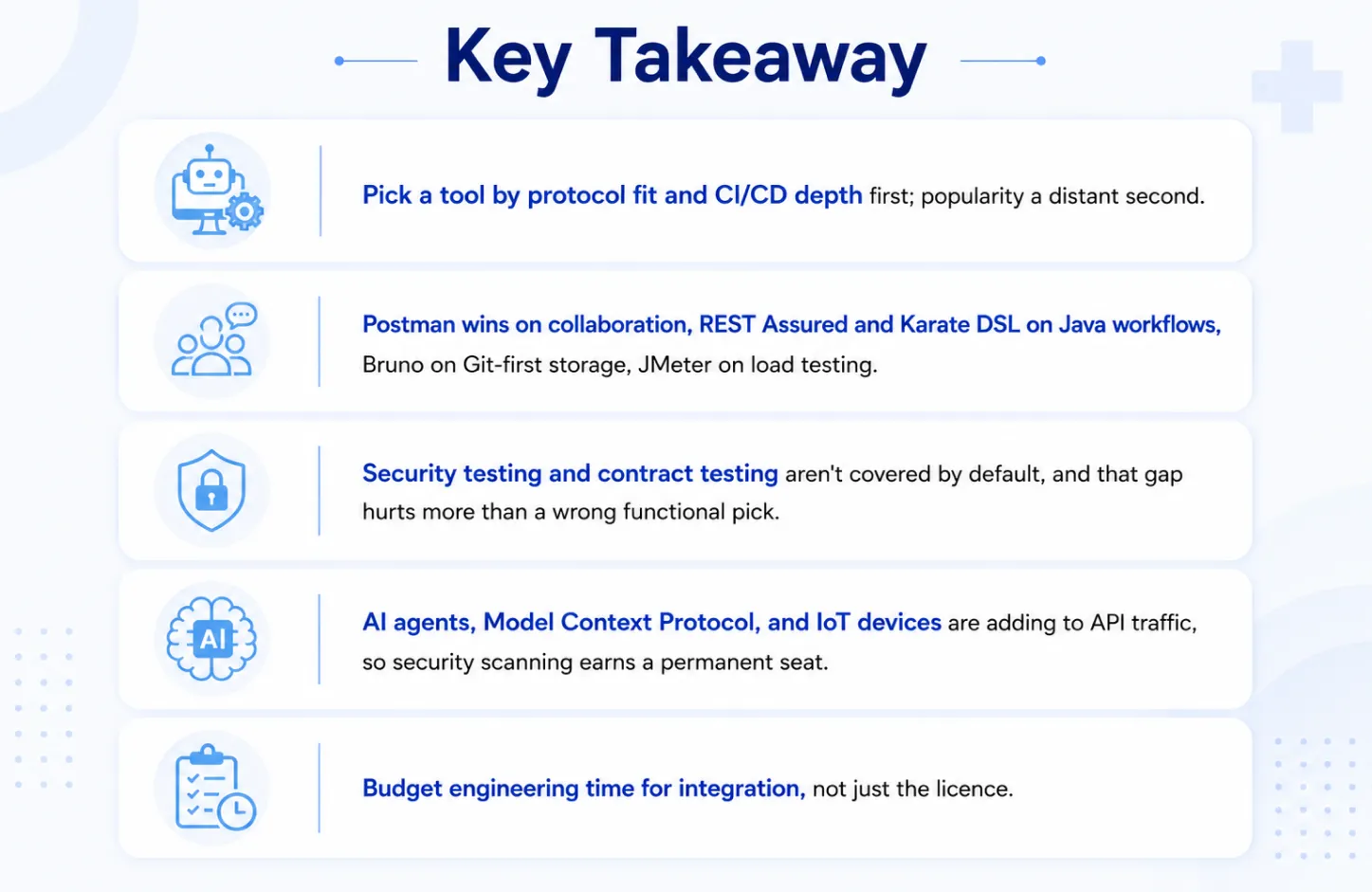
Which one fits your team? Postman for a shared workspace, REST Assured for Java/Maven, Bruno for Git, Karate DSL for functional plus mocking plus load, JMeter for traffic behaviour alone.
These five tools to test api behaviour cover most scenarios. Other automation testing tools worth a glance: Katalon Studio, Tricentis Tosca, Parasoft SOAtest, Swagger Inspector, Rapid API (RapidAPI, an online api testing tool), API Fortress, Virtuoso QA, and OpenText Functional Testing.
What Most API Testing Tool Lists Miss and Why It Slows Teams Down
Nearly every top-ranking page lists Postman, JMeter, and a handful of others, none security scanners. Confidence builds, then an audit reveals API security testing was never in scope. More tests isn't always better: A smaller suite with a genuine security layer beats a larger one without it.
The security testing gap: No OWASP API Top 10 coverage, no CI scanning for security vulnerabilities, no runtime discovery of shadow endpoints, often the entry point for security threats functional suites never simulate. OWASP ZAP closes most of it:
Manual pentests once a year don't replace checks on every deploy. Teams also skip spec linting on OpenAPI definitions, so API keys and secure transactions slip through, and an API Gateway won't catch that.
The contract testing gap is subtler: Pact and Specmatic catch consumer-provider breakage across microservices, something none of the five main tools do by default.
Our Take: Contract testing causes the costliest incidents past ten interdependent services, yet teams rarely search for it separately. The decision isn't finished until it joins the five tools above.
How Frugal Testing Helps You Build an API Testing Stack That Actually Runs in CI
Choosing between five tools is the easy part. The real friction is integration, lifecycle management for the first two hundred test cases, and getting CI to pass reliably, which stalls continuous API testing for months. Few software testing companies treat integration as the actual product.
As a software testing company, our automation testing services scope functional and performance suites and wire them into CI/CD pipelines (GitHub Actions, GitLab CI, Jenkins, CircleCI), using the tools above or a third-party tool, extending into api security testing services too.
What Our API Test Automation Engagement Looks Like
- API surface audit mapping endpoints and coverage gaps.
- Tool selection matched to the client's stack, then a real suite built against live endpoints.
- CI/CD integration into the same build report as unit tests.
Picking one api test automation tool is easy; wiring several api test automation tools into one pipeline takes two to four weeks.
Who This API Testing Engagement Is For
Teams of five to fifty engineers get the most value from qa automation services and an api testing company here: no automated coverage, or manual Postman Collections never wired into CI. Common triggers: a QA hire left, or a move to microservices.
People Also Ask (FAQs)
Q1. What are the different types of API testing?
Ans: API testing types include functional checks, security testing, load testing, contract testing, and exploratory testing. Most teams cover only one or two.
Q2. How do I use Swagger UI to test an API?
Ans: How to use Swagger UI: import an OpenAPI or Swagger spec, then use the built-in "Try it out" button to send a live request and inspect the real response; no test code required.
Q3. What are the best Insomnia alternatives if I want to switch?
Ans: Bruno offers Git-native storage for Collections, while Hoppscotch is a fully open-source, browser-first option with strong community support.
Q4. What is automated API testing and how is it different from manual testing?
Ans: Automated API testing runs pre-written assertions on a schedule or pipeline, catching regressions on every deploy; manual testing means clicking through requests by hand.
Q5. What is API security testing, and why isn't it covered by functional tools?
Ans: API security testing checks for exploitable flaws like broken authentication, injection, and data exposure. Functional tools like Postman and REST Assured verify correct behaviour, not resistance to attack.


%201.png)