

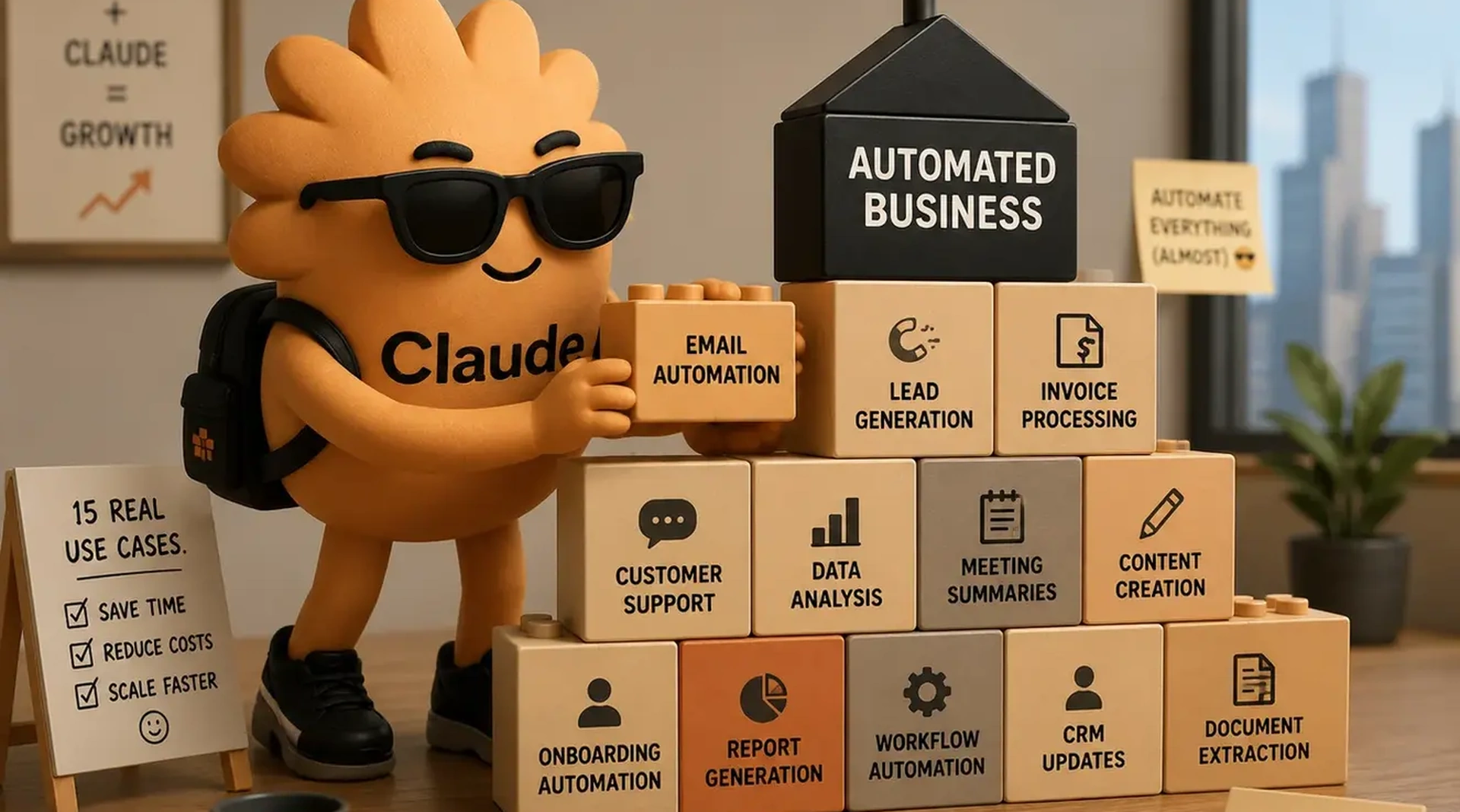
Most enterprise teams have a shortlist of manual processes flagged as automation candidates, along with a leadership mandate to move faster with AI. What they rarely have is a clear picture of which specific workflows artificial intelligence handles well and which use case to actually start with.
This post maps 15 proven use cases for AI for business automation across IT, operations, customer service, document workflows, finance, legal, and engineering. Whether you run a recruitment agency, a SaaS product team, or an enterprise ops function, there is a viable starting point here.
Why the Business Automation Landscape Shifted From RPA to AI
A mid-size logistics company spent 14 months implementing an RPA solution for invoice processing. It worked until the vendor updated their portal layout. Three scripts broke. That is not an edge case. That is the baseline experience for most RPA deployments at scale.
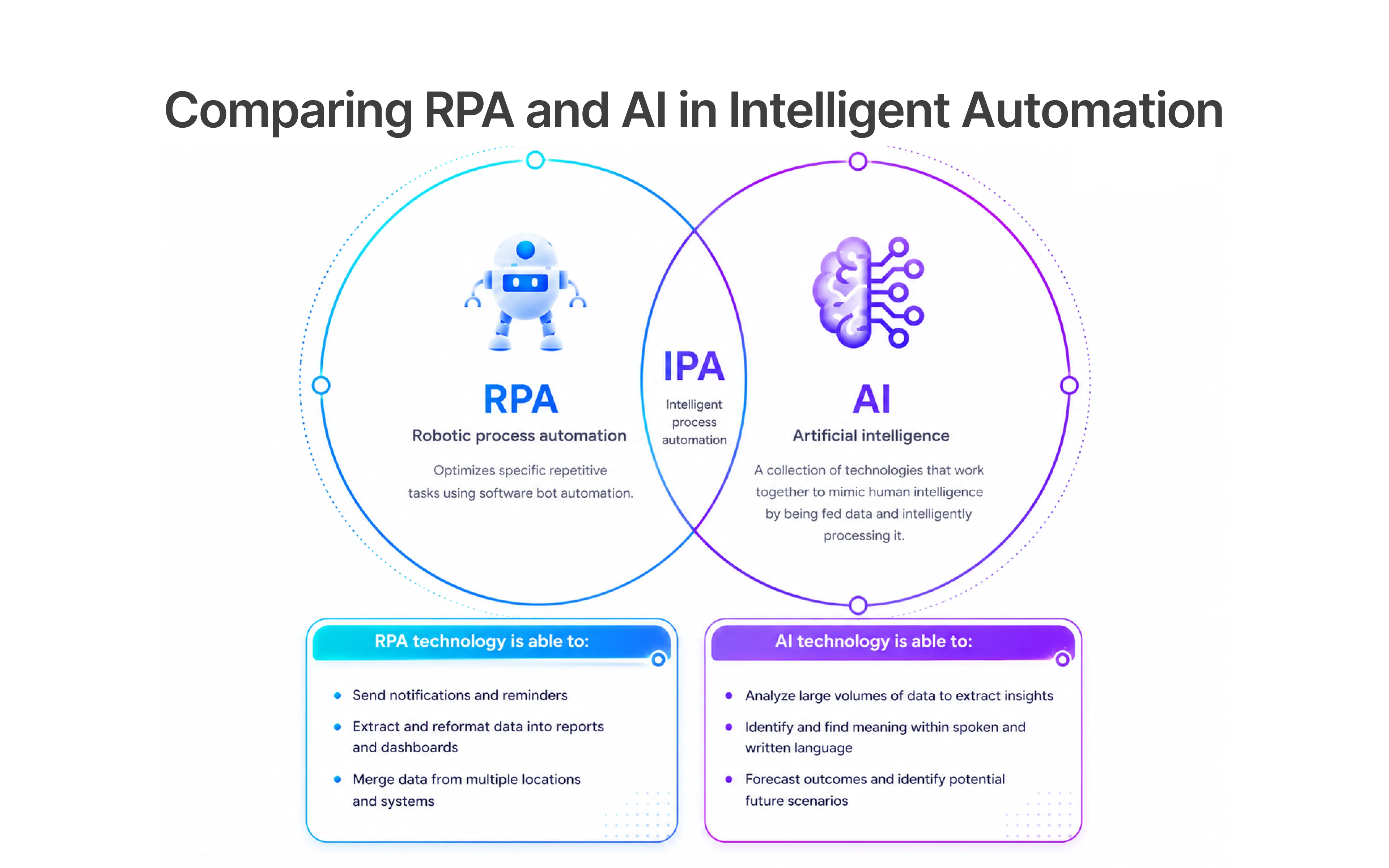
What RPA Gets Right and Where It Hits a Ceiling
Rules-based RPA works for high-volume, structured workflows: copying data between systems, generating routine reports, and processing fixed-format documents. Gartner has documented that the majority of RPA implementations require significant rework within 18 months because underlying applications change faster than automation scripts can be maintained. RPA cannot reason about context, handle unstructured inputs, or adapt when an edge case arrives.
How AI Agents Change the Automation Calculus
Where RPA executes a fixed sequence of steps, an AI agent workflow reasons about what needs to happen, selects the appropriate tools, and adapts when the situation changes mid-task. Modern agentic AI process automation is built on large language models orchestrated through frameworks like LangChain, n8n, or direct API integration via Claude or Google Gemini. Claude's 200K context window and Notion MCP integrations extend its reach into Google Drive and enterprise platforms without custom connectors. Teams evaluating the Claude Max subscription get access to agentic work capabilities that connect to existing tool stacks via API keys with no custom middleware required. Communities like the Practical AI Builder Program and Vibe Coding Builders publish templates and Builder Showcase resources that teams can adapt rather than build from scratch.
The 15 AI Business Automation Use Cases (Mapped by Function)
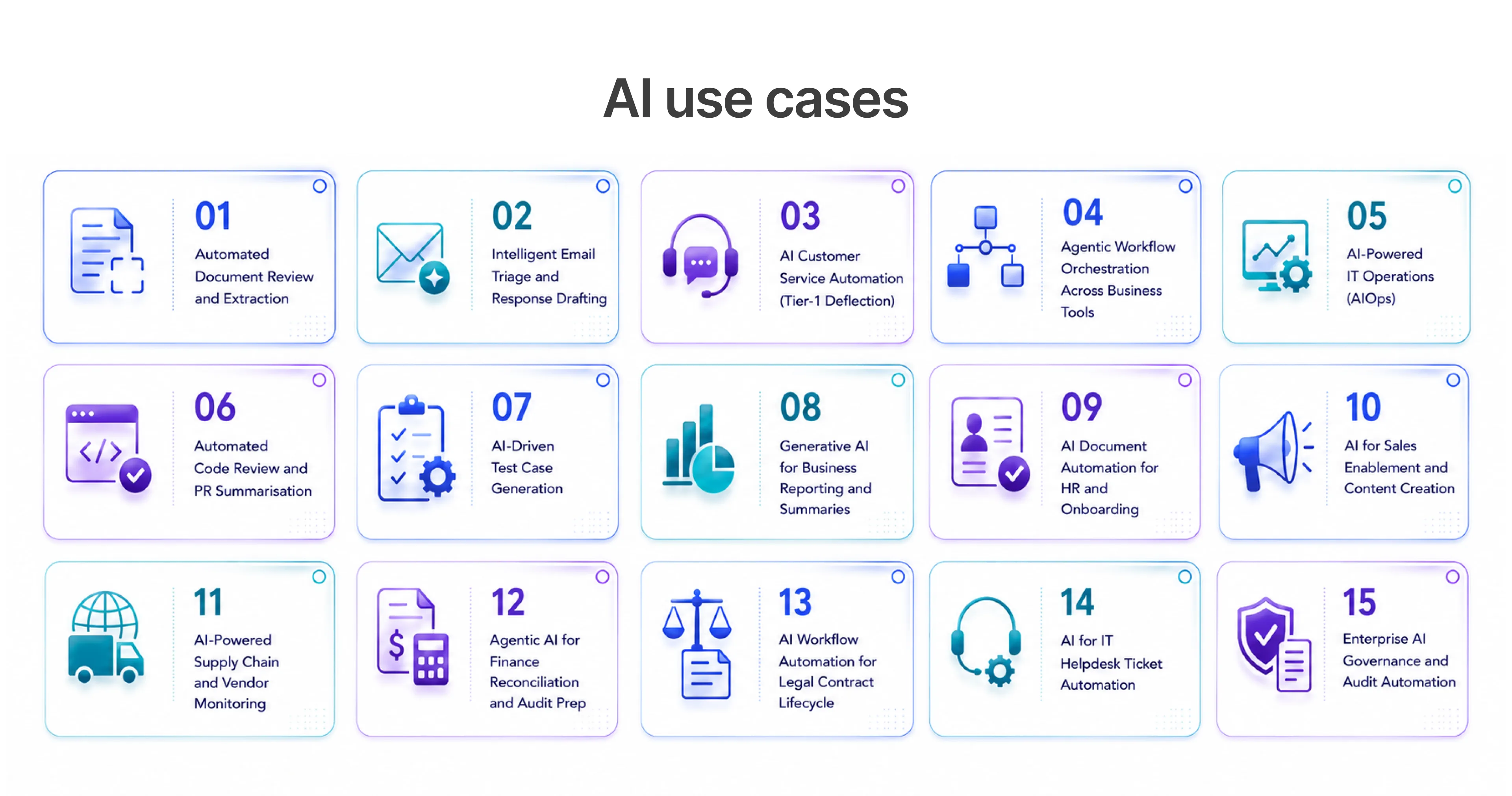
Use Case 1 - Automated Document Review and Extraction
AI tools like Claude API extract structured fields from contracts, invoices, SOWs, and compliance docs with the help of document parsing api without using OCR templates
Use Case 2 - Intelligent Email Triage and Response Drafting
AI classifies inbound emails by intent and directs each to the right owner or queue. For pattern-matching responses, the AI generates a draft reply pre-populated with relevant context, ready for human review. Meeting recordings from client calls are automatically summarised and attached to the relevant CRM record. Teams handling 3x the inbound volume without adding headcount is a consistently documented outcome.
Use Case 3 - AI Customer Service Automation (Tier-1 Deflection)
The LLM reads the full customer query, retrieves relevant context from the knowledge system, generates a natural-language response, and escalates only when the query genuinely requires human judgment. Across SaaS and e-commerce deployments, a 40-60% reduction in support ticket volume reaching a human agent is consistently documented. Voice AI and voice agents are replacing interactive voice response systems on inbound phone support lines. A virtual assistant or voice assistant layer handles routine customer conversations end to end. AI voice generation now extends to branded audio content, including sound effects and music generation for on-hold and IVR experiences. YouTube videos of product walkthroughs are automatically transcribed and indexed into the knowledge base to improve response accuracy.
Use Case 4 - Agentic Workflow Orchestration Across Business Tools
A sales operations team reduced inbound lead response time from 48-72 hours to under five minutes. The agent scores the lead, creates the CRM record, books the discovery call, sends a confirmation, and posts the summary to Slack - zero human handoffs until the AE joins. The orchestration layer: Make.com, n8n workflow configurations, or Zapier AI, with Claude API or Google Gemini API handling the reasoning steps. Platforms like Shapes Cowork and Radiant Data Hub provide pre-built agent templates for common sales and ops workflows, reducing setup time from weeks to days.
Use Case 5 - AI-Powered IT Operations (AIOps)
AI systems monitor logs, correlate anomaly patterns, generate plain-language incident summaries, and draft runbook steps for common failure modes. Alert noise suppression reduces on-call fatigue materially. Claude Code integrations allow engineering teams to automate runbook generation directly from incident data inside their existing development environment.
Use Case 6 - Automated Code Review and PR Summarisation
AI code review checks pull requests for logic errors, style guide violations, security anti-patterns, and missing test cases, then generates a human-readable summary for the reviewer. VS Code and GitHub repos webhooks are the most common entry points. Claude Code sits directly inside the developer's editor and flags issues before the PR is raised. PR cycle time drops of 30-40% are consistently documented. Read more about how this connects to CI/CD testing patterns.
Use Case 7 - AI-Driven Test Case Generation
Given a user story or acceptance criteria, the AI generates a complete test case set ready for the QA engineer to review. The authoring step that used to take days has been compressed to hours. Teams report test case generation time dropping by 40-70% after deploying this workflow. This connects into the broader AI-driven test automation pipeline and feeds back into the regression cycle.
Use Case 8 - Generative AI for Business Reporting and Summaries
The AI ingests raw data exports from CRM, analytics platforms, and finance tools, runs data analysis across sources, and drafts the executive summary.Dedicated platforms for AI for business intelligence such as WisdomAI take this further by enabling business teams to query these same datasets in plain language and receive instant, context-aware answers without requiring SQL expertise or dedicated data analysts to build reports manually. Content pipelines built on the Claude API deliver structured reports via Google Sheet dashboards, Slack, or email on a scheduled trigger. Content creation for weekly and monthly reports shifts from a four-hour manual task to a 20-minute review of an AI-generated draft.
Use Case 9 - AI Document Automation for HR and Onboarding
AI generates, personalises, and routes offer letters, onboarding packets, and compliance documents for e-signature without HR touching a template manually. Microsoft 365 and Google Workspace integrations are the most common entry points. GDPR compliance and HIPAA-aligned document handling need to be scoped from the outset for regulated deployments. Job description generation is a natural extension, with the AI drafting role-specific JDs from a standardised template and skills taxonomy.
Use Case 10 - AI for Sales Enablement and Content Creation
The AI reads the prospect's CRM record and website, then drafts a tailored proposal in the company's approved voice. Proposal drafting drops from three to four hours to under 20 minutes per deal. For teams handling formal RFPs, AI RFP Software can help streamline response creation by using existing company knowledge to prepare accurate drafts for review and collaboration. Content creation for social media platforms, case studies, and nurture sequences runs through the same research pipeline. Content analysis of prior campaign performance and engagement metrics informs what angles the AI prioritises in new drafts, tightening relevance without extra human effort.
Use Case 11 - AI-Powered Supply Chain and Vendor Monitoring
The AI integrates with ERP systems (SAP, Oracle, NetSuite) to monitor vendor delivery data, flag SLA breaches, and draft escalation communications automatically. Early flagging of supply disruptions has reduced reactive procurement costs by 15-25% in documented US manufacturing deployments.
Use Case 12 - Agentic AI for Finance Reconciliation and Audit Prep
AI agents reconcile transactions across systems, flag discrepancies with context, generate variance explanations, and pre-populate audit work papers. Big 4 audit preparation that used to require two to three weeks has been compressed to days. Intuit QuickBooks users on smaller finance teams see the same pattern via API integration. SOC 2 Type II and PCI DSS requirements need to be scoped into the system architecture from the start.
Use Case 13 - AI Workflow Automation for Legal Contract Lifecycle
The AI drafts NDAs and MSAs from approved templates, reviews incoming contracts against a defined red-flag playbook, tracks obligation milestones, and alerts the legal team when renewal windows approach. Enterprise CLM platforms (Ironclad, Agiloft, Conga) manage the lifecycle workflow; Claude API functions as the review layer.
Use Case 14 - AI for IT Helpdesk Ticket Automation
AI classifies inbound tickets, enriches them with context from the knowledge system, and either auto-resolves Tier-0 cases or drafts a proposed resolution for Tier-1 cases that a human agent can approve in under two minutes. First-contact resolution rates improve 30-50% when AI handles Tier-0 and Tier-1 volume. ATS platforms in HR and recruiting follow the same deflection pattern: candidate relationships are maintained through automated touchpoints, with a recruitment agency running 200-plus active roles managing candidate communications at scale without proportionally growing the coordination team.
Use Case 15 - Enterprise AI Governance and Audit Automation
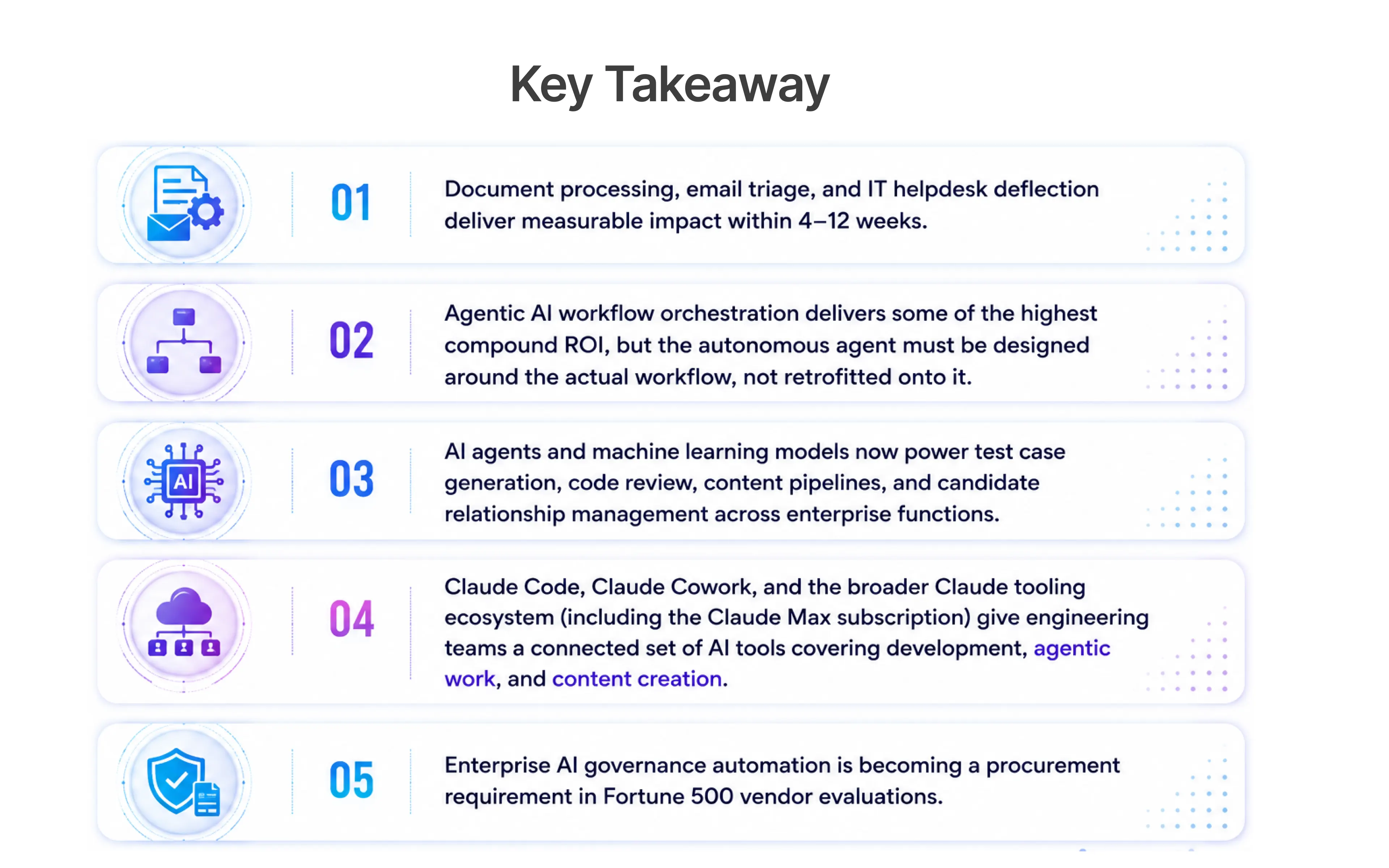
Enterprise AI governance automation uses AI to monitor AI outputs for policy compliance, flag off-policy responses, generate structured audit trails, and produce governance reports for board or regulatory review. US standards in scope: NIST AI RMF, emerging SEC disclosure requirements, and SOC 2 AI controls increasingly appearing in vendor questionnaires. For Fortune 500 procurement teams, AI governance documentation is now a supplier requirement, not a differentiator.
Comparison Table - Use Cases by Function and Complexity
Which use case fits your team first?
- Is the biggest pain document volume or manual data entry? Start with Use Case 1 or 9.
- Senior engineering time going to pattern-matching work? Start with Use Case 6 or 7.
- Customer support or candidate communications are the bottleneck? Start with Use Case 3 or 14.
How Frugal Testing Automates Your AI-Powered QA and Test Workflows
Use cases 6, 7, and 14 are where our AI automation work concentrates. Our AI Fluency for Small Business programme supports smaller engineering teams building AI automation capability without hiring a dedicated AI engineer.
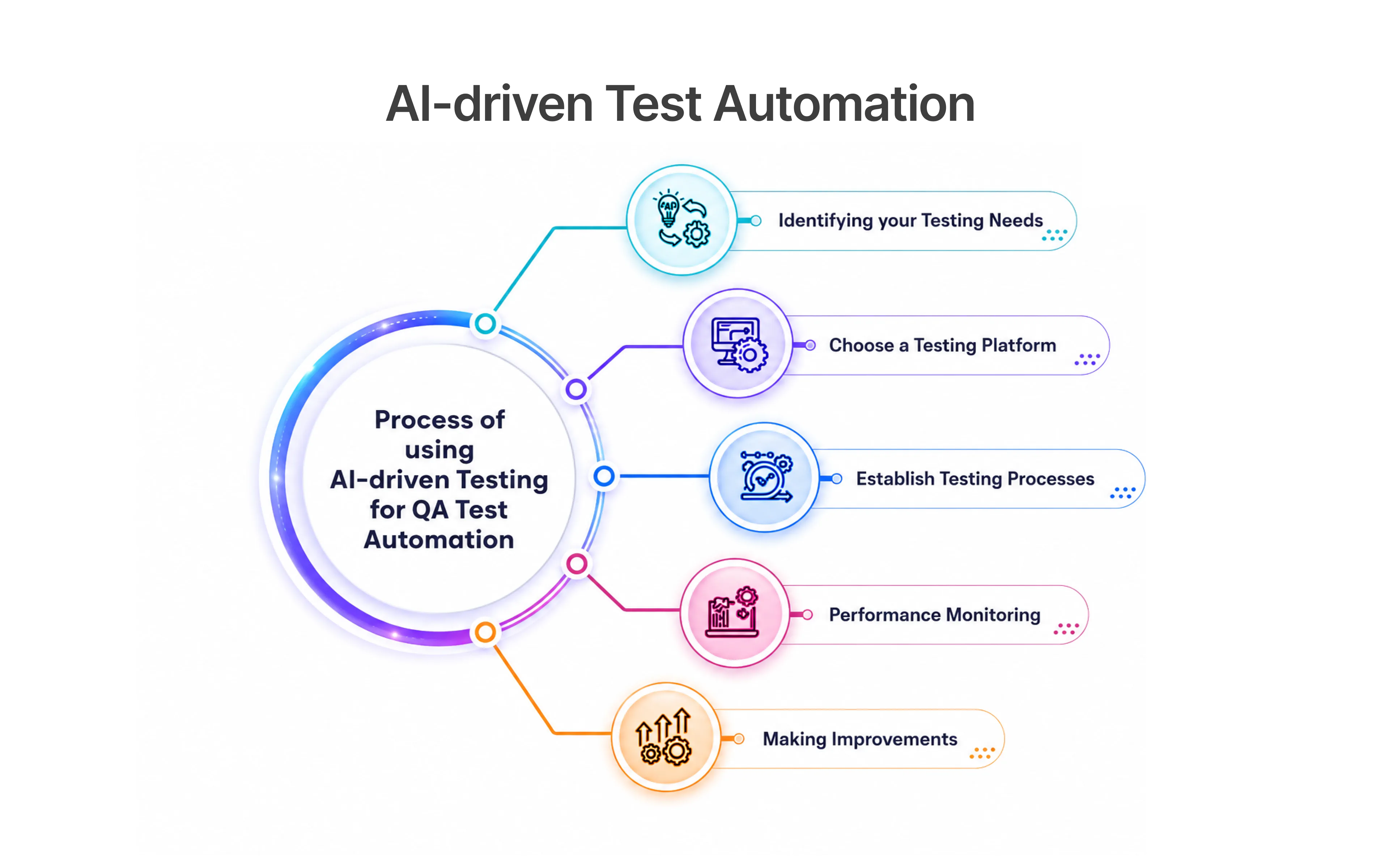
Weeks 1-2: Audit test coverage, identify the highest-value automation candidates, and scope the AI workflow layer.
Weeks 3-4: Build the AI-powered test generation pipeline: requirements in, test cases out, reviewed by the client's QA lead before entering the suite.
Week 5 onwards: Integrate into CI/CD, set up the agent workflow for ongoing test maintenance, and hand over the suite with a knowledge system for ongoing updates. The same patterns scale down to a 15-person product team with the right scoping.
"Automation without judgement is fragile. The teams that scale AI QA workflows successfully are the ones that keep a QA engineer in the loop at the review step."
Conclusion
The 15 use cases above cover every major business function, supported by AI business management software to streamline operations and decision-making. Document-heavy teams start with Use Case 1. Engineering organisations with QA bottlenecks start with Use Cases 6 and 7. Recruitment agency teams start with Use Case 14.
The teams that move fastest with AI for business automation scoped a bounded workflow, built automation around their existing process, and shipped something real within eight weeks. AI governance automation may be invisible on most roadmaps today. By 2026, it will be the first thing enterprise buyers ask about before signing a contract.
People Also Ask (FAQs)
Q1. What is the difference between RPA and AI automation for business processes?
Ans: RPA follows fixed, rule-based scripts on structured data and fails when inputs change. AI automation uses LLM-driven agents that reason over unstructured data, adapt mid-task, and handle document review, intent classification, and multi-step decisions RPA can't manage.
Q2. Which AI business automation use cases deliver ROI fastest?
Ans: Document processing, email triage, and IT helpdesk ticket deflection consistently deliver measurable impact within 4-12 weeks. All three share bounded scope, existing data, and a clear baseline metric to improve against.
Q3. Do I need to build custom AI models to automate business processes?
Ans: No. The vast majority of enterprise AI business process automation use cases are solved with API integration to foundation models like Claude or GPT-4o. Fine-tuning adds value only for highly specialised domain vocabulary or proprietary output formats.
Q4. How do US enterprises govern AI automation deployments for compliance?
Ans: US enterprises typically govern AI deployments using the NIST AI RMF, organized around map, measure, manage, and govern functions. SOC 2 Type II and PCI DSS impose data handling requirements for finance and payments, while GDPR applies in parallel for European personal data.
Q5. What AI workflow automation tools do enterprise teams use in 2025?
Ans: Enterprise AI workflow stacks span four layers: orchestration (Make.com, n8n, Zapier AI), an AI reasoning backbone (Claude API, Gemini API), an RPA bridge for legacy systems (UiPath, Automation Anywhere), and vertical tools, plus developer-facing layers like Claude Code for code review and testing.