

TLDR: AI agents fail in production not because the model is bad, but because the QA approach treated them like traditional software. This guide covers the four evaluation layers, CI/CD pipeline harness setup, observability signals, compliance requirements, and the QA vs ML ownership question.
A support ticket triage agent passed every pre-production test at a 90-person SaaS company. In production, it correctly classified tickets 94% of the time and silently routed the rest to the wrong queue. No unit tests caught it. No CI/CD pipeline flagged it. It surfaced only as a pattern across thousands of live sessions.
So, how to test an AI agent? You stop treating it like traditional software. AI agents are non-deterministic; the same input can produce different outputs on consecutive runs. Testing them requires threshold-based scoring across distributions, not binary pass/fail assertions. You need four evaluation layers covering prompt quality, tool execution, reasoning path integrity, and end-to-end application behaviour, all wired into a CI/CD pipeline that catches drift before production.
That is the framework this guide walks through.
Why AI Agents Fail Differently from Traditional Software
AI agents introduce failure modes that traditional testing was never designed to catch: non-deterministic output variance and silent regressions that accumulate across agent workflows before anyone notices.
The Non-Determinism Problem in LLM-Powered Systems
Run the same input through an AI agent twice, and you will get two different outputs. Temperature sampling, retrieval variation in RAG pipelines, context window state, and model upgrades all shift agent behavior between runs. That QA approach, built for deterministic systems,s does not transfer to the LLM layer.
A 6% misclassification rate across thousands of runs is invisible to binary pass/fail unit tests. It only surfaces when you measure output quality across a distribution, which most test suites are not built to do.
According to Gartner, over 80% of enterprises will deploy generative AI by 2026. Furthermore, 40% will embed autonomous agents, driving an urgent need for structured governance.
Why "The Agent Passed Tests But Failed in Production" Is a Structural Problem
Most teams test the LLM layer in isolation and skip the full agent workflow: tool selection, parameter passing, memory reads, and how the chain behaves when a tool returns an unexpected response. Production LLM failures trace most commonly to trajectory errors and tool execution side effects, not core model capability. Testing only the terminal output misses silent regressions that compound across agent workflows.
The Four Layers of AI Agent Testing You Need Before Go-Live
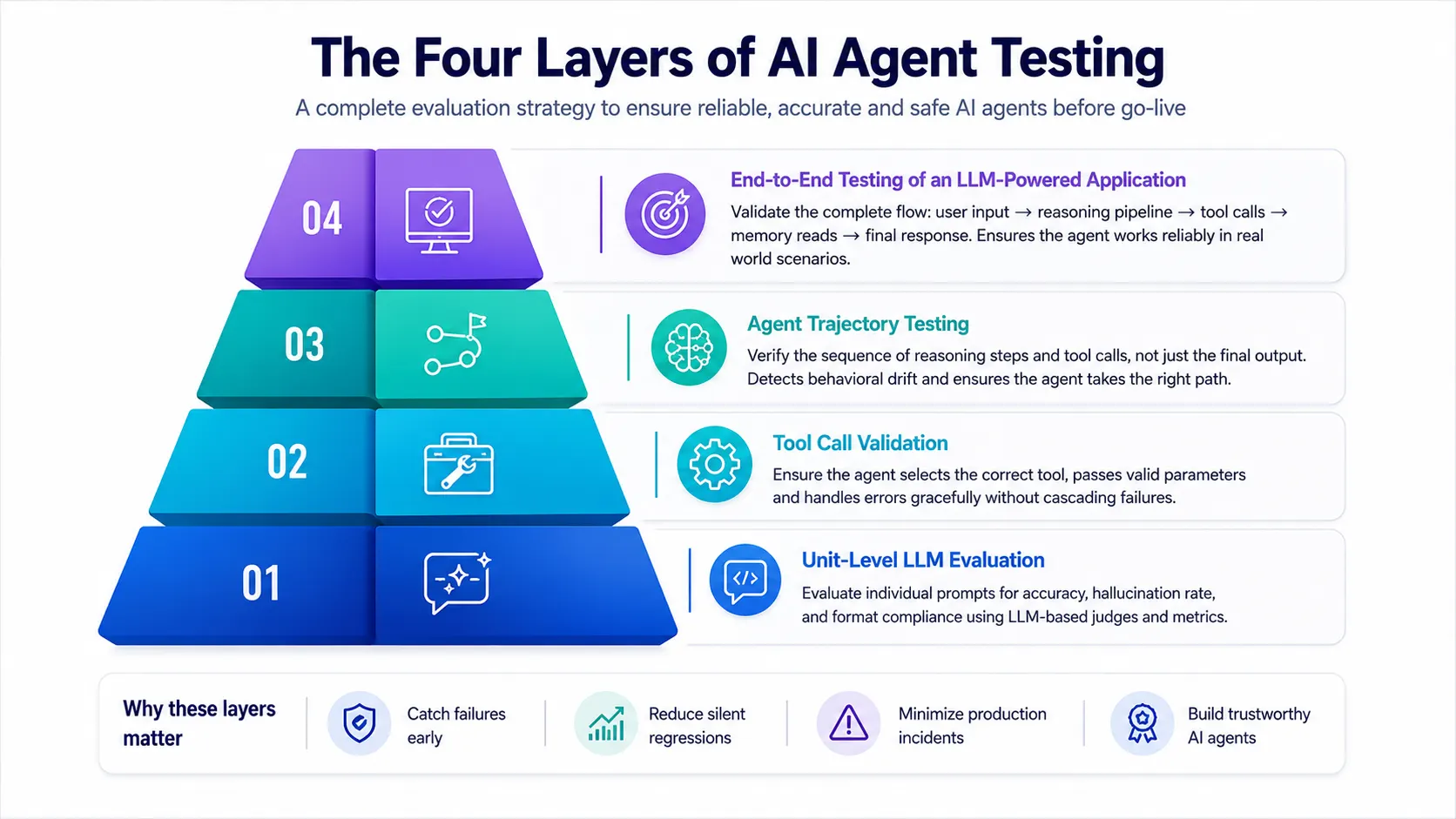
No single test type covers an AI agent end-to-end. A reliable QA approach requires four evaluation layers, each targeting a different failure surface. Miss anyone, and you have a gap the other three cannot fill. As AI agents become increasingly capable of handling complex tasks and interacting with business systems, professionals need to understand how agentic technologies are designed, evaluated, and deployed. Those looking to build practical knowledge of autonomous AI systems and their real-world applications can consider an ai agents course to develop a stronger foundation in agentic AI, generative AI, and intelligent automation.
Layer 1: Unit-Level LLM Evaluation
Unit-level LLM evaluation tests individual prompts for accuracy, hallucination rate, and format compliance using frameworks like PromptFoo or LangSmith. Three metrics matter: faithfulness, answer relevance, and groundedness. LLM-based judges, where a second model scores outputs against rubrics across large evaluation sets, handle test execution at scale where manual review is not tractable.
Layer 2: Tool Call Validation
Tool call validation verifies that the agent selects the correct tool, passes valid parameters, and handles errors without cascading failure. The test harness uses mock tool stubs, parameter schema validation, negative tests for malformed responses, and tool execution logging. For agents writing to an external state, a failed tool call is not a wrong answer. It is a destructive action.
Layer 3: Agent Trajectory Testing
Agent trajectory testing validates the sequence of reasoning steps and tool calls taken, not just the terminal output. Record golden trajectories from verified production sessions and use them as regression testing baselines. After any prompt management update, system prompt change, or model upgrade, the trajectory suite detects behavioral drift before it reaches users. This separates a reliable test suite from a flaky suite.
Layer 4: End-to-End Testing of an LLM-Powered Application
End-to-end testing covers the complete flow: user input, reasoning pipeline, tool calls, memory reads, and final response, all tested in a sandboxed environment with production-equivalent tool mocks. The E2E test suite needs evaluation sets across 5 to 7 intent categories, automated scoring via LLM-based judges, and triggers on every prompt change or model upgrade, not just release branches.
How to Set Up an AI Agent Eval Harness in CI/CD
Building the evaluation layers is only half the work. An agent harness that lives outside your CI/CD pipeline goes stale the moment the model, prompt, or tool schema changes. This section covers how to structure it and wire it in correctly.
Structuring the Eval Harness for Agentic Systems
An agent harness has three components:
- Test dataset: Input seeds plus expected output criteria per intent category
- Eval runner: PromptFoo, LangSmith evals, or a custom pipeline
- Scoring function: LLM-based judges or deterministic metric checks
For multi-agent orchestration, the harness must capture intermediate states: tool calls made, data layer writes, memory updates, and reasoning step count. Capturing only the final answer leaves trajectory errors and silent regressions undetected.
Integrating the Eval Harness with GitHub Actions or CI Pipelines
Trigger the eval suite on PR merge to staging, with results posted as a PR check against a defined pass threshold (faithfulness score of 0.85 or above, hallucination rate of 3% or below). Four CI failure gates for reliable test execution:
- Tool call error rate per tool type.
- Trajectory deviation rate from the golden set.
- Latency p95 per reasoning step.
- Output format compliance against the expected schema.
Run the agent harness against a frozen golden dataset on every model upgrade. Score drops from silent regressions surface in CI before reaching production users.

AI Observability: What to Monitor After Deployment
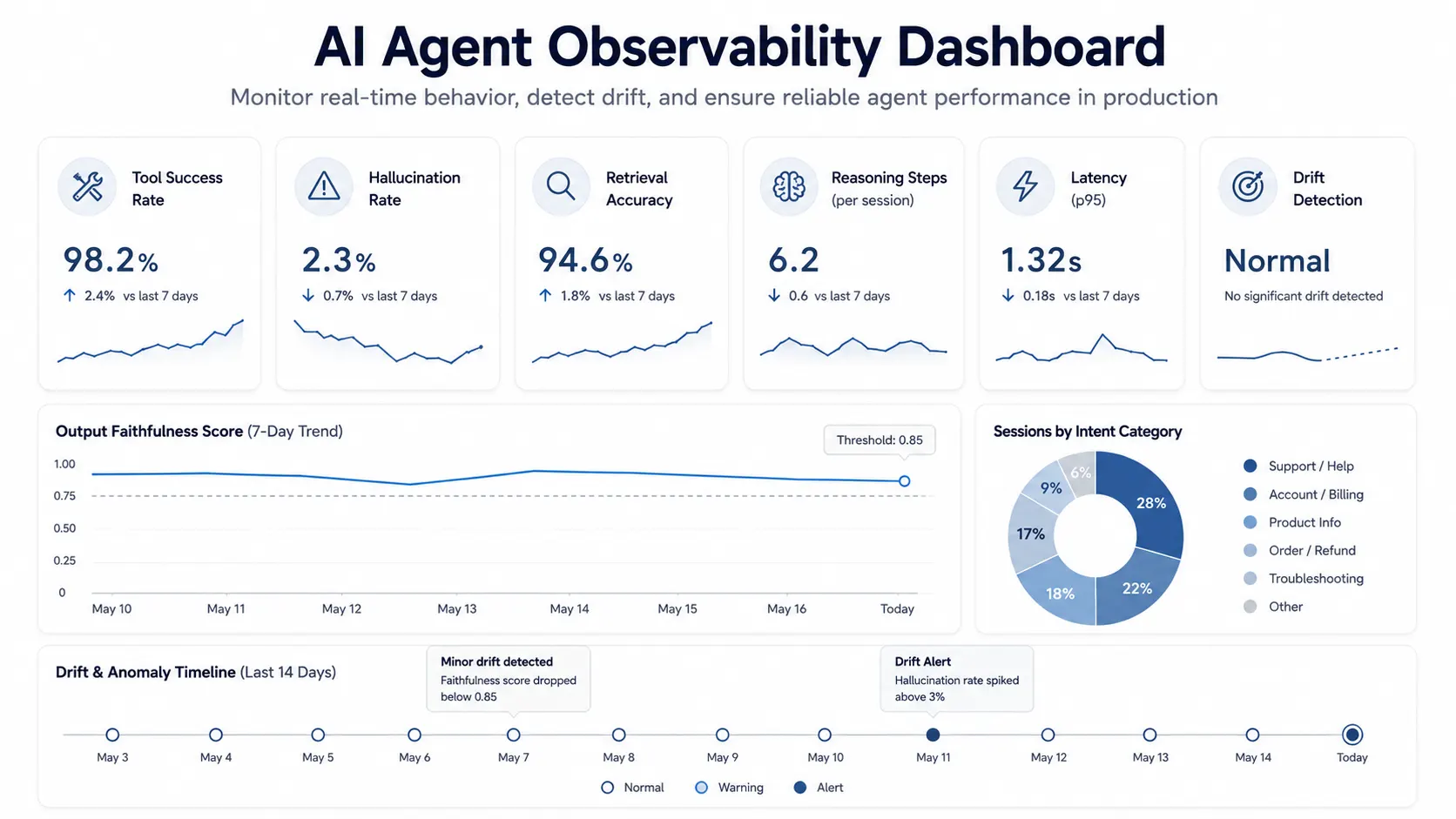
Passing your eval harness pre-release does not mean the agent stays reliable. Model upgrades, real user input distribution, and context drift all shift agent behavior after go-live. AI agent observability is what tells you when that shift is happening.
The Signals That Matter for AI Agent Observability
AI agent observability means inspecting every step of the reasoning chain: tool calls, retrieved chunks, intermediate outputs, and behavioral signals across sessions. Standard APM covers latency and error rate. That is not enough for agentic systems using natural language processing at the reasoning layer. Six signals to instrument from day one:
- Tool call success rate per tool type.
- Reasoning step count per session.
- Retrieval relevance score for RAG-backed agents.
- Output faithfulness drift over rolling 7-day windows.
- Error loop rate.
- Latency per reasoning step, not just end-to-end.
Choosing an AI Observability Platform for Production
LangChain/LangGraph stacks go to LangSmith. Teams needing AI observability platform-level drift alerts go to Arize AI. Teams that need something running fast go to Helicone.
AI Agent Testing in Regulated Industries
Functional correctness is the floor in regulated sectors. Banking, healthcare, and fintech add mandatory compliance and security evaluation layers that most standard QA frameworks do not cover.
What Compliance Requires From AI Agent QA in Banking and Healthcare
Agentic AI testing compliance in regulated environments adds two mandatory layers:
- Model risk governance: Federal Reserve SR 11-7 guidance, extended to LLM-powered decisioning, requires documented evaluation methodology, independent model validation, and audit trails for every agent decision.
- Data governance: HIPAA-compliant handling in RAG pipelines and SOC 2 Type II audit trails for every tool call.
Agentic AI testing banking compliance also requires bias and fairness evaluation and explainability documentation for every consequential tool call. Teams shipping without these layers are creating model risk exposure, not just technical debt.
LLM Security Testing for Production AI Agents
The four test categories from OWASP LLM Top 10:
- Prompt injection: Red-team prompt sets targeting system prompt manipulation.
- Data exfiltration via tool calls: Tool call parameter inspection for exfiltration vectors.
- Insecure output handling: Output sanitisation checks for downstream injection.
- Training data poisoning detection: Input provenance logging.
In regulated environments, LLM security testing is a mandatory CI gate, not a quarterly penetration test.
Who Should Own AI Agent Testing: QA Team or ML Team?
Most teams discover this problem the hard way: they hand the whole problem to one team, hit a production incident, and spend two weeks arguing about whose responsibility it was. AI agent testing spans QA and ML domains simultaneously. The ownership model must reflect that from the start.
The operating model that works: a shared agent harness owned jointly, QA leads test execution, ML leads metric design.
How Frugal Testing Builds Your AI Agent Testing Strategy: End-to-End
Most engineering teams shipping AI agents have the model, the product, and a deadline. What they lack is a structured eval framework and a CI-gated agent harness. That is the gap our AI agent testing services close.
A QA lead at a US fintech came to us after two provider-side model upgrades triggered a compliance review. They had functional testing but no trajectory regression set, no agent harness gating model version changes, and no behavioral signals in production. That is the most common gap we see: teams that tested the LLM layer but have no CI-gated trajectory baseline. Our AI-based testing service delivery includes curated evaluation sets, an evaluation harness integrated into your CI/CD pipeline, a LangSmith or Arize AI observability setup, and a tool called a validation suite.
What Our AI Agent Testing Engagement Looks Like
- Week 1: Agent architecture review, tool call mapping, eval metric design. We scope the evaluation layers and define scoring rubrics per intent category.
- Week 2: Eval harness build. Evaluation set curation, LLM-based judges setup, tool call stubs, trajectory golden set, system prompt regression baseline.
- Week 3: CI/CD pipeline integration, observability instrumentation, LLM security testing run, and handover documentation.
Who This Is For
- Engineering teams are shipping an AI agent in the next 60 to 90 days with no structured eval framework.
- QA leads whose test suite was built for traditional testing and deterministic systems.
- Engineering managers in banking or fintech where AI agent testing compliance adds mandatory evaluation layers.
If your AI agent is heading to production without a structured eval layer, that is exactly where we start.

Conclusion
The teams that catch AI agent failures before production are not the ones with better models. They are the ones with structured evaluation layers, a CI-integrated agent harness, and observability that surfaces behavioral signals and trajectory drift before users do.
AI agent testing in 2025 is where test automation was in 2015: most teams know they need it; few have built it properly. The four-layer methodology in this guide comes from real engagements with engineering teams shipping AI testing agents into environments where failure has consequences. The eval harness is the thing. Build it before you ship.
People Also Ask (FAQs)
Q1. What is the difference between LLM evaluation and AI agent testing?
Ans: LLM evaluation tests model output quality at the function level. AI agent testing covers tool calls, agent workflows, multi-step trajectories, and E2E behaviour. Both evaluation layers are required.
Q2. How do you test an AI agent that behaves non-deterministically?
Ans: Use threshold-based scoring across a distribution of runs with LLM-based judges. Statistical pass thresholds replace binary pass/fail logic, making non-deterministic agent behavior measurable and CI-gateable at scale.
Q3. What is agent trajectory testing and why does it matter?
Ans: Trajectory testing validates the reasoning steps and tool execution sequence an agent takes. A correct final output via a brittle path still produces silent regressions after model upgrades.
Q4. Which tools are used for AI agent observability in production?
Ans: LangSmith for LangChain-native tracing, Arize AI for drift detection and eval integration, Helicone for lightweight proxy logging. Platform selection depends on the stack and whether semantic drift alerting is needed.
Q5. What does AI agent testing look like in banking or regulated industries?
Ans: SR 11-7 model risk management requires a documented evaluation methodology and full audit trails. OWASP LLM Top 10 adds a second mandatory evaluation layer on top of functional testing.

.webp)

.webp)