

TLDR: RAG systems don't crash. They give wrong answers confidently, and standard QA misses it. This guide covers five test layers, compares RAGAS vs DeepEval, and shows how to stop bad answers before they reach users.
A team ships an AI assistant built on retrieval-augmented generation. The large language models are solid. Week two in production: users file tickets about answers that are confidently wrong. Engineering investigates. The LLM system is fine. The vector store returned the wrong chunks. Nobody built a test for that.
According to the 2025 Gartner AI Risk Management Report, over 60% of AI application failures trace back to data pipeline issues. Most teams ship AI applications without an automated check on retrieval. RAG testing isn't optional when AI features face real users.
Why Standard QA Misses RAG Failures
Most testing tools were built for a world where software either works or throws an error. RAG systems don't work that way.
When something goes wrong, there are no HTTP status codes or crash logs. The system returns a confident-sounding answer pulled from the wrong chunk, wrong document, or something updated months ago.
Standard QA confirms the pipeline ran. It doesn't check whether the answer was right. That's the gap.
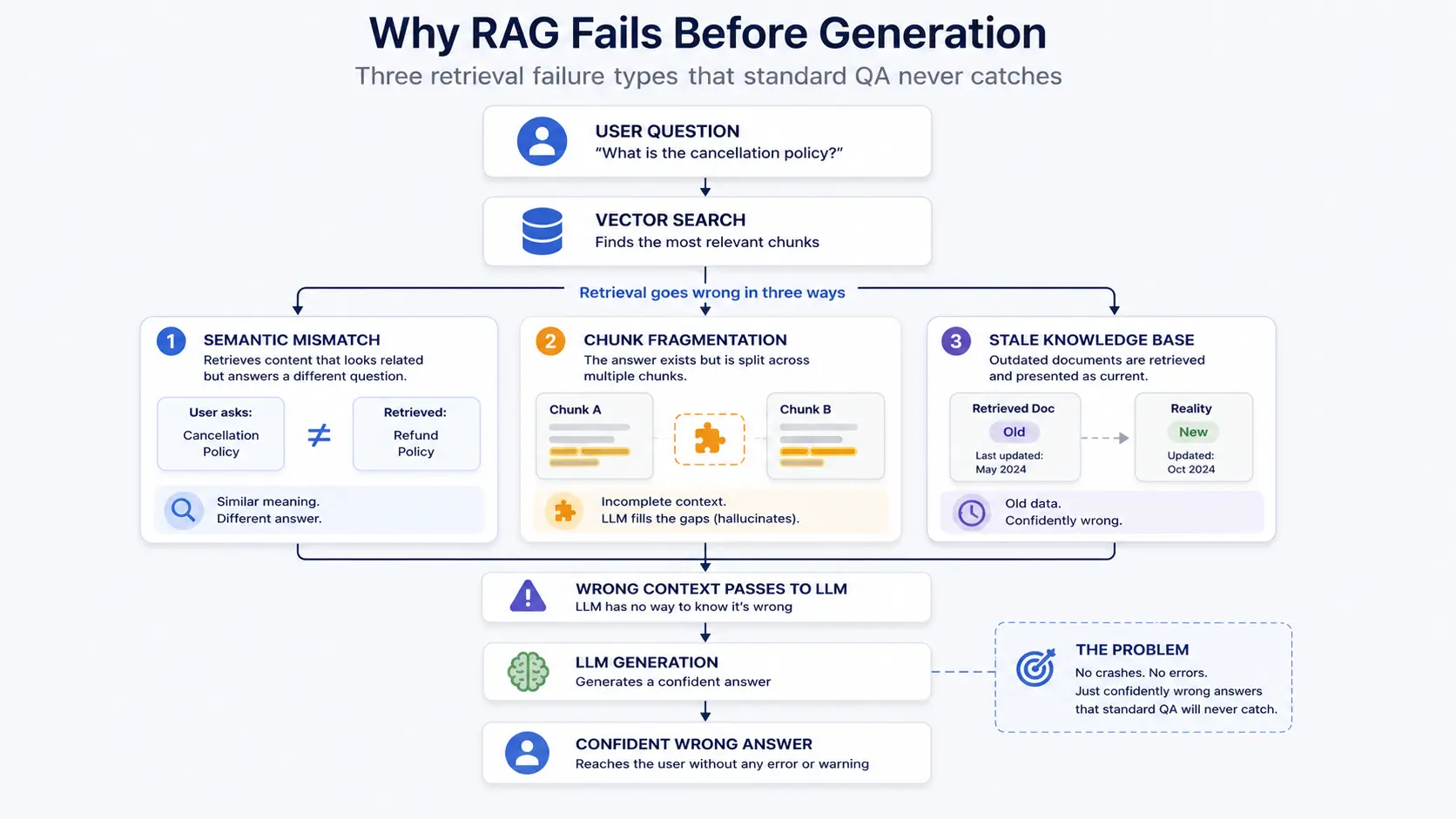
The Three Retrieval Failure Types QA Teams Miss
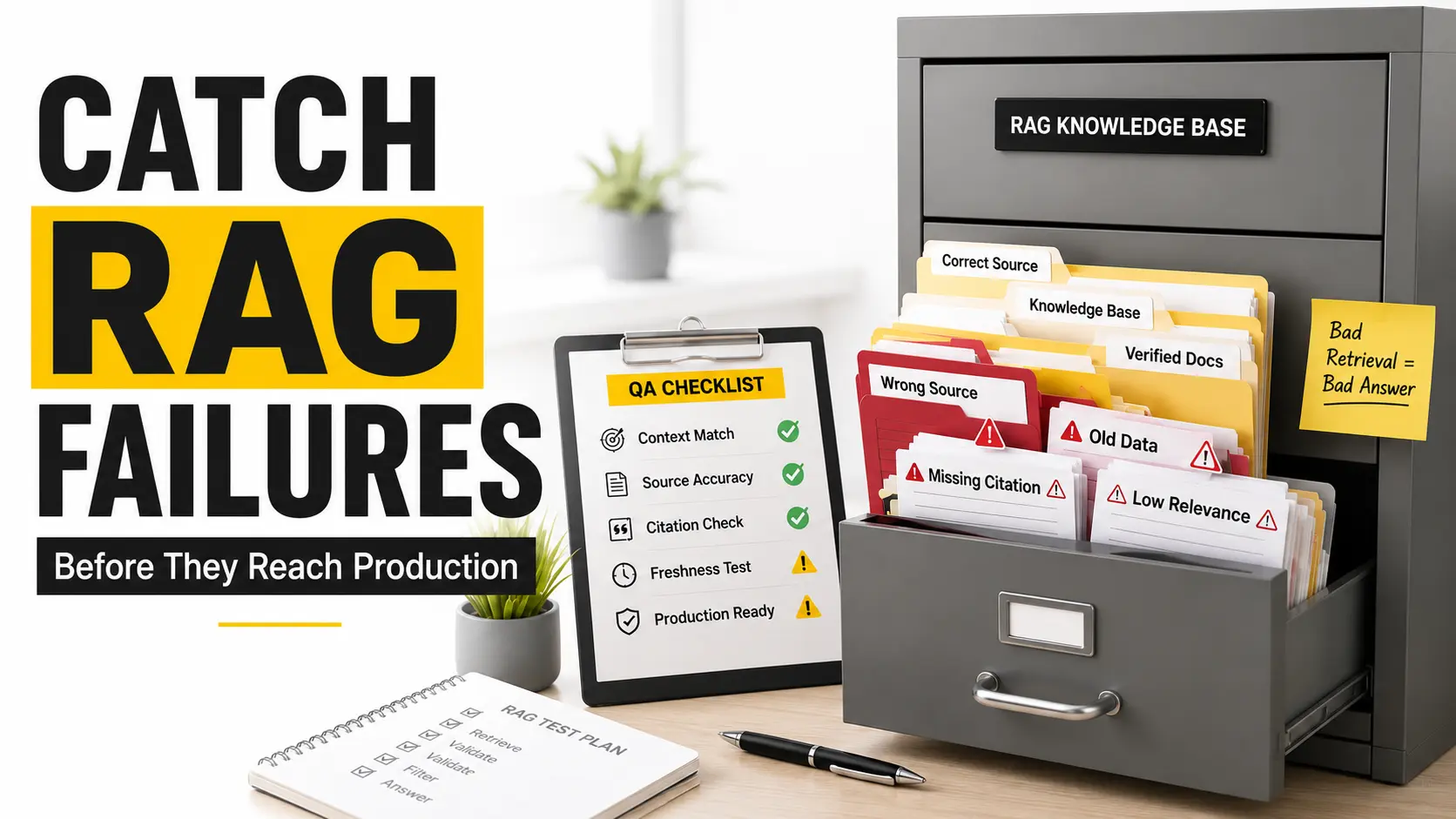
Think of a RAG system like a research assistant searching a filing cabinet. You ask a question, the assistant pulls the most relevant pages and hands them to a writer (the LLM). Three ways this breaks before the writer even starts:
- Semantic mismatch: The assistant pulls pages that look related but answer a different question. Ask about cancellation policy, and it retrieves refund policy. Vector search uses semantic similarity scores, but similar-sounding isn't always correct.
- Chunk fragmentation: The answer exists but is split across two separate pages. Neither is complete alone, so the LLM patches the gaps with its best guess. That's where hallucination creeps in.
- Stale knowledge base: The filing cabinet hasn't been updated. The LLM pulls governed data from months ago and presents it as current. No warning, just wrong.
None show up as test failures. All three reach users.
The RAG Testing Framework: Five Test Layers You Need
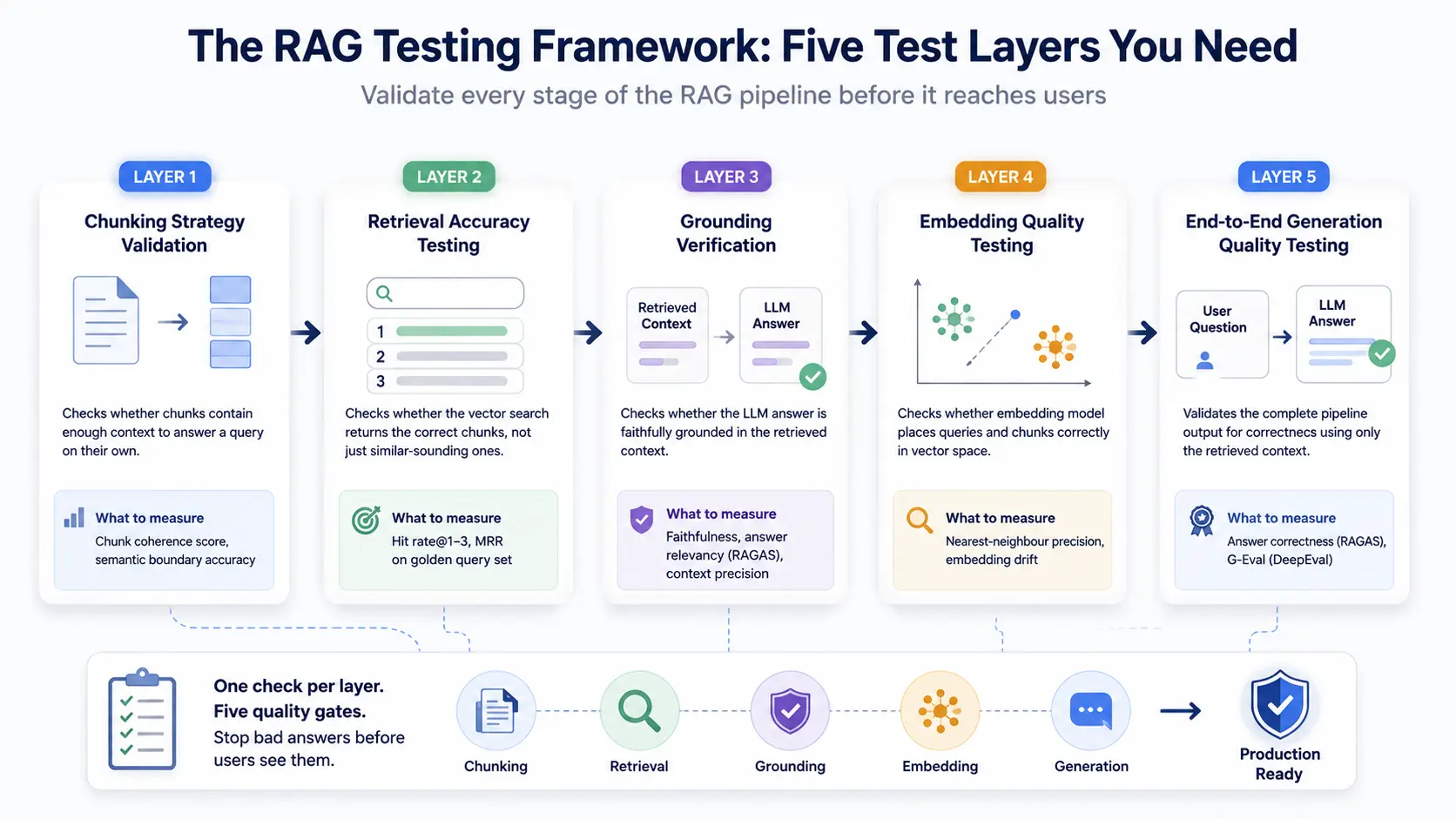
Think of your RAG pipeline as a five-stage factory: chunking, embedding, retrieval, grounding, and generation. Each stage can fail silently. One check per stage closes the gaps.
RAGAS and DeepEval are the two most widely used open-source frameworks for running these checks in CI/CD, both working with prompt/response pairs as the evaluation unit.
Layer 1: Chunking Strategy Validation
Your documents get cut into smaller pieces called chunks before your AI can search them. This layer checks whether each chunk contains enough context to answer a query on its own, without needing adjacent chunks. Semantic chunking, which splits at semantic boundaries rather than fixed word counts, produces better results. Embedding models like bge-m3 also behave differently across chunk sizes, so benchmark before locking a strategy.
Layer 2: Retrieval Accuracy Testing
This layer checks whether your vector search is returning the correct chunks, not just similar-sounding ones. Build a golden dataset of query-to-chunk pairs and measure what percentage of retrievals land the right chunk in positions 1 to 3. Note that cosine similarity scores from semantic search testing are not a pass/fail signal on their own. A chunk can score highly and still be wrong for the query.
Layer 3: Grounding Verification
Even with the right chunk retrieved, the LLM can still pull facts from outside the context. Grounding verification checks whether the generated answer is traceable back to what was retrieved. The RAGAS framework's answer relevancy score and DeepEval's faithfulness metric both test this. Grounding failures are the hardest to catch in staging, and most teams only detect them through production monitoring.
Layer 4: Embedding Quality Testing
This layer checks whether your embedding model is placing queries and chunks correctly in vector space. A miscalibrated embedding model causes retrieval failures before the vector store is even involved. Measure nearest-neighbour precision: are semantically similar queries landing near the correct chunks? Also watch for embedding drift: when the model is swapped or fine-tuned, the entire vector index needs re-validation against your golden query set.
Layer 5: End-to-End Generation Quality Testing
This is the final gate before production. It tests the complete pipeline output: given a query, does the LLM's response accurately answer it using only the retrieved context? The metric here is RAGAS's answer correctness score or DeepEval's G-Eval, run against the golden Q&A dataset. If layers 1 to 4 pass but layer 5 fails, the issue is in the prompt template or LLM configuration, not the retrieval pipeline.
Evaluation Frameworks Compared: RAGAS vs DeepEval for RAG QA
Both frameworks run inside pytest, accept prompt/response pairs, and score answer quality. The difference is scope.
Which fits your team?
- Straightforward RAG pipeline focused on retrieval accuracy and answer relevance? Start with RAGAS.
- Building AI agents or an Agentic RAG setup? Use DeepEval.
- Already using Datadog for LLM observability? DeepEval plugs in faster.
Our Take: Most teams reach for DeepEval because it shows up in more blog posts. For a standard RAG pipeline, RAGAS gives you everything you need with less setup. Switch only if your use case grows into Agentic RAG or multi-step AI agents.
How Frugal Testing Builds Your RAG QA Layer: End to End
We audit the RAG architecture, define the golden dataset, implement RAGAS or DeepEval suites, and wire them into CI/CD. Calibrating LLM evaluation metrics and relevance scoring thresholds is work done across 50+ US engineering teams.
What Our RAG Testing Engagement Looks Like
A typical engagement runs four weeks:
- Weeks 1 to 2: Audit the RAG pipeline: chunking strategy, embedding model, vector store schema, retrieval mechanics, and data quality across indexed documents
- Weeks 2 to 3: Build the golden query-to-chunk dataset; implement RAGAS or DeepEval suites covering answer quality, answer relevance, and faithfulness
- Weeks 3 to 4: Integrate into CI/CD; define the retrieval accuracy threshold that gates deployment
- End of engagement: Client owns a documented RAG test suite, passing benchmarks, and a production monitoring runbook
Who This Is For
This fits teams who are:
- Shipping a RAG feature in 30 to 90 days with no dedicated retrieval QA process.
- Running language models that perform well in demos but where answer quality drops when the vector store enters the loop.
- Getting inconsistent answers across semantically similar queries with no grounding verification before release.
- Building AI agents or Agentic RAG workflows that need a broader LLM system test harness.
Adding RAG Tests to Your CI/CD Pipeline
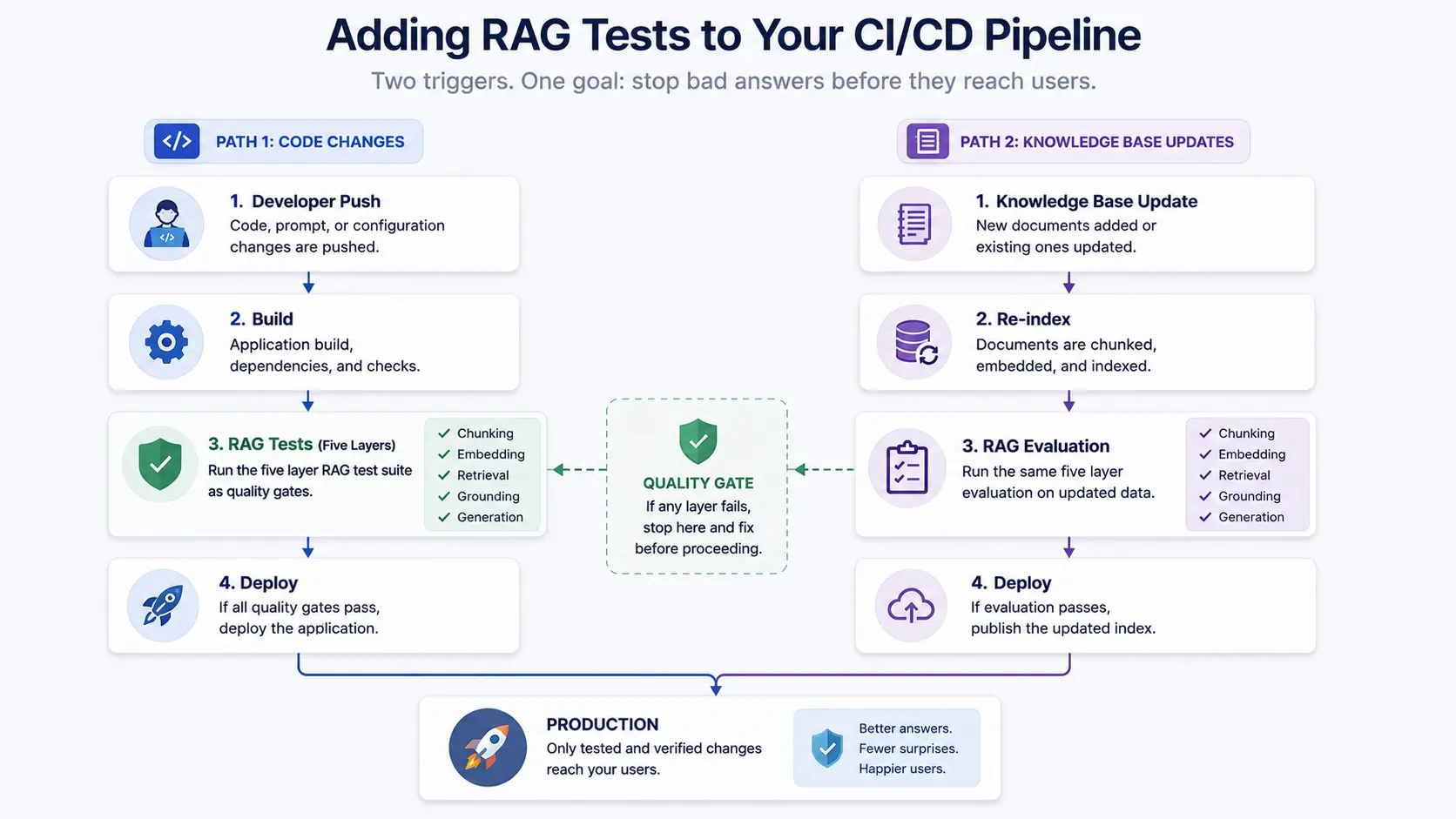
Most CI/CD pipelines only test the code. But RAG systems have two change surfaces: the code and the knowledge base.
Your knowledge base can change without touching any code: a document update, a re-index, a swapped embedding model. Any of these silently breaks retrieval accuracy. That's a governed data problem standard pipelines aren't built to catch.
Two patterns that close this gap:
- Test on every code push against a frozen knowledge base snapshot: catches regressions in chunking logic, retrieval thresholds, and context assembly.
- Test on every knowledge base refresh against a fixed golden query set: catches answer quality drops from document changes, re-indexing, or embedding updates.
According to Stack Overflow's 2025 Developer Survey, 76% of developers use AI tools, but AI pipeline testing and semantic search testing for retrieval-augmented generation remain underdeveloped. Vector database testing needs its own CI stage after the index build step.
Key Takeaways
- Standard tests don't check whether the right information was retrieved: RAG systems need a dedicated test layer.
- Three failure modes drive most issues: semantic mismatch, chunk fragmentation, stale knowledge base content.
- A five-layer framework puts one check at each stage: chunking, embedding, retrieval, grounding, generation.
- RAGAS fits pure RAG pipelines; DeepEval covers AI agents and broader Agentic RAG setups.
- CI/CD for RAG needs two triggers: code changes and knowledge base refreshes.
Before You Scale, Get the Foundation Right
Most RAG failures aren't dramatic. No alarms go off. The system keeps running, users keep asking questions, and wrong answers keep going out the door until someone notices a pattern in the support queue.
The five-layer framework in this guide doesn't require a rewrite of your pipeline. A golden dataset, a framework choice between RAGAS and DeepEval, and one extra CI/CD stage. That's the entire foundation.
Teams that build this before they scale catch retrieval failures in minutes. Teams that skip it tend to catch them in incident reports. The gap between those two outcomes is smaller than most engineering managers expect, and the cost of closing it is lower than the cost of not doing so.
People Also Ask (FAQs)
Q1. What is retrieval failure in a RAG pipeline?
Ans: Retrieval failure is when your system returns the wrong chunks for a query. The LLM builds its answer from that material, producing confident but hallucinated responses.
Q2. How do I build a golden dataset for RAG evaluation?
Ans: Sample 50 to 200 real queries, match each to the correct chunk, and use that labelled set as ground truth in RAGAS or DeepEval.
Q3. What is the difference between RAGAS and DeepEval?
Ans: RAGAS is purpose-built for RAG evaluation. DeepEval covers broader LLM system testing, including Agentic RAG workflows, and integrates with LLM observability tools like Datadog.
Q4. Can Selenium or standard API frameworks test a RAG pipeline?
Ans: No. RAG outputs are non-deterministic and need semantic evaluation, not string matching. Use an LLM-as-judge approach via RAGAS or DeepEval instead.
Q5. How do we monitor RAG quality in production?
Ans: Use LLM observability tools like Datadog, Arize, or Confident AI. Track retrieval hit rate and map user feedback to query clusters to surface failures.

.webp)