


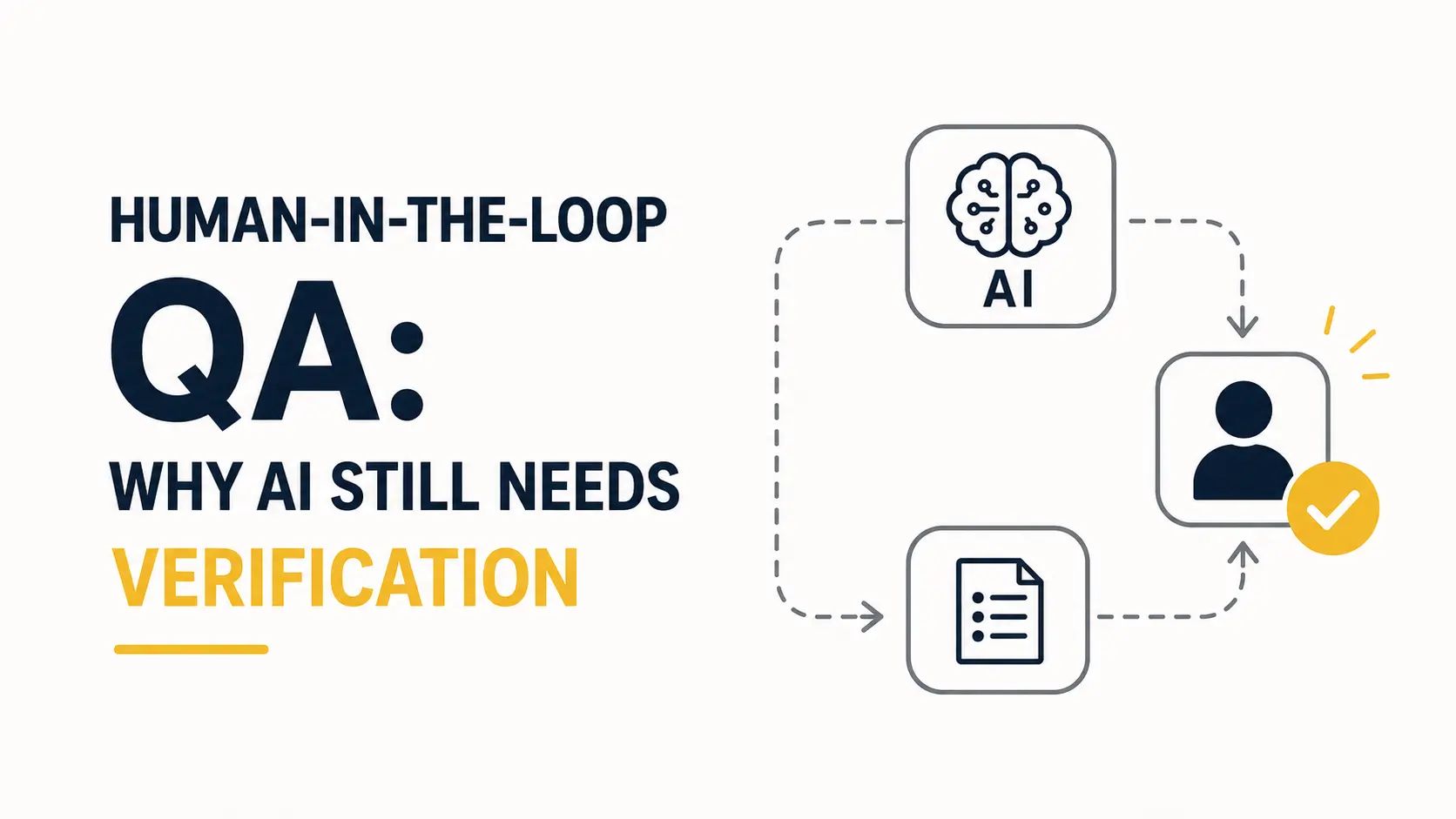
When Elon Musk stated, “AI is a fundamental risk to the existence of human civilization”, it sounded like an overstatement, right?
It is, perhaps, an exaggerated statement. Maybe AI is not the problem. But the overdependence on AI surely is.
We have witnessed the rise of ChatGPT and other AI tools and LLMs followed by it. We have seen millions of written and visual content being produced by AI.
Then we are witnessing a phase where it has become cliché, and so is AI-created content. So much so that companies have to impose an AI detector in the loop, which is again an AI.
In between all of these, we learned that we have started relying so much on AI without even utilizing it to the fullest.
Why Is A Human Needed In The AI Verification Process?
The result of overdependence on AI is evident when Amazon brought human employees back into the loop when its retail website collapsed because of AI-suggested advice. If there was a human in their workflow before implementing the AI suggestion, it might not have happened at all.
Still, it would be incorrect to say that using AI is useless. Because the possibilities of AI are still unexplored.
Nonetheless, AI works best when there is a human oversight in the loop for quality assurance, which is one of the main reasons for keeping a human to supervise AI workflow, whether it is for content creation or business operations.
Here are five reasons why AI still needs human supervision and verification.
AI Hallucinations
AI hallucinations are the most underwhelming side of using AI and depending on it.
When you use misinformation, outdated data, and inaccurate facts in your assignments, scholarly articles, content for marketing purposes, business decisions, and coding and programming, the whole project and hard work get smashed.
AI exactly does that with your work. AI hallucinates you with inaccurate information and false data. When you look for specific information in AI, it studies multiple existing content, both old and new.
It sometimes misreads the content, mixes up statistics across different queries, and then provides data that is not appropriate for a certain query confidently without verifying.
Even to fit the prompt, it sometimes guesses, fabricates facts, and changes the meaning of a certain incident you might want to know about.
Remember, in Tom and Jerry, the robot cat brought in to replace Tom eventually started malfunctioning after chasing too many mice at once?
AI works just like the robot cat in the show.
To prevent that, a reliable AI detector can always be helpful. Still, it is again an AI after all. So, this is where human supervision is most needed.
Compare Against Secondary Sources
Another significant drawback of AI is that, in terms of data accuracy is that it never verifies information by checking secondary resources where it gets it from.
It confidently claims that the data and facts are true based on guesswork. As it delivers information with so much conviction, the information provided by data remains unchecked and untrue.
But when humans consider data to mention in their writing, they always compare it against the secondary source and review the citation appropriately before finally including it in their content or an operational system.
So, to check that the data, a claim, or a quote is correct, and the secondary source is credible enough, a human is the only 911.
Contextual Alignment
Another major drawback of AI is that it does not understand the alignment between the content or decisions it provides and context, time, and place.
Contextual alignment is a fundamental feature of content quality assurance. When content is created, or a decision is made in the present time and space, it makes complete sense and becomes useful.
The misalignment between the content and context can result in devastating failure in business operations or marketing campaigns.
This is exactly what happened with Amazon when their retail website crashed.
They implemented a decision made by an AI agent that was based on outdated information. So, AI is unable to give output that aligns with the present time and place where an initiative will be operated.
It applies to every type of output AI and LLMs provide against a prompt. So, no matter what reason AI is being used, human verification is necessary when you put AI in a workflow loop.
Quality Check
Quality check is something where even a human sometimes gets tricked. Especially regarding content quality, it is not limited to checking data accuracy or context alignment. You have to ensure the overall quality in totality.
For quality check, you have to prioritize readability in the first place. AI-generated content is mostly monotonous and monolithic. There is no breathing space for readers when AI writes content. Each paragraph throughout the whole content is lengthy, containing complex sentences.
A human moderator, thinking like a reader, ensured that the whole writing seems easy to read and digestible for their audiences.
The next important thing to fix in LLM content is the tonality of language.
LLMs usually write too accurately with correct grammar and sentence structure, which makes it unnatural and robotic. It never feels like a conversation with the audience or even engaging to the readers.
Human supervision brings normalcy and a flowy style in the language that easily engages the readers.
Finally, relevance is a key feature of good quality content, which AI writers mostly lack. Human reviewers ensure relevance and connection between the content and the brand voice or the objective of the organization it is being created for.
Evidently, AI can only mimic humans but never thinks like a human or empathizes with them when writing something. So, there is no alternative to human oversight in the loop for quality assurance when AI creates content.
Accountability
Accountability is something that AI cannot ensure. It does not give any justification or explanation of the responses, solutions, and suggestions it provides.
If we go back to the case of Amazon taking an AI agent’s advice, we see that they did not blame AI for the collapse of their website because they knew this is the way AI works.
It is only humans who can be held accountable for something. Humans not only justify an action or advice, but also take responsibility after a mishap happens.
So, human intervention is crucial in an AI workflow to rationalize suggestions and advice given by AI, and take responsibility for repairing damages after a collision.
Final Thought
It is undeniable that AI has made a lot of our work easier both in our daily lives and our professional lives. But it is also true that AI can never replace what humans are able to do.
But we can get the best out of AI if human supervision is there while enjoying the privileges it gives us, like time-saving, handling manual workload, and making many of the complicated and exhausting tasks easier.
All we need to do is consider it as an assistant whom you have to constantly keep under observation to keep the workflow going faster than before.


.webp)

.webp)