

AI projects often start with promising prototypes, but the real challenge begins when turning them into dependable business applications. Microsoft AI Foundry helps bridge this gap by providing developers with a unified platform to build, test, and deploy AI applications.
Unlike traditional AI development environments that require multiple tools and complex infrastructure, Microsoft AI Foundry combines models, development workflows, and governance tools into a single platform. This approach speeds up the AI development process and makes it easier to move AI projects from experimentation to production.
What Is Microsoft AI Foundry?
Microsoft AI Foundry is a unified platform where developers and data scientists can create, customize, and manage AI applications and intelligent agents.
It serves as a central environment for:
- Building AI workflows
- Testing models
- Deploying scalable AI solutions
It’s important to note that Microsoft AI Foundry and Azure AI Foundry often refer to the same platform. The latter term is commonly used when discussing the service within the Microsoft Azure ecosystem.
By bringing together models, development tools, and evaluation frameworks, the platform simplifies the AI development lifecycle. Teams can build AI applications in one integrated system rather than managing multiple frameworks and APIs.
One of the platform’s standout features is its extensive model library, offering access to more than 11,000 AI models, including:
- GPT-4o
- Llama
- Microsoft Phi models
Core Components of Microsoft AI Foundry
Microsoft AI Foundry includes several important components that support modern AI development:
Foundry Models
A model catalog that allows developers to browse thousands of AI models from Microsoft, OpenAI, and open-source providers.
Foundry Agent Service
Tools for building AI agents capable of performing autonomous tasks and executing workflows.
Prompt Flow
A development environment for designing, testing, and debugging AI model workflows.
Foundry Tools
Services such as AI Search and Content Safety that ensure responsible and secure AI usage.
Together, these components create a structured environment for building scalable AI applications.
Key Azure AI Foundry Features
The Azure AI Foundry platform provides several features that streamline and accelerate AI development.
Unified Development Environment
A centralized workspace to build, test, and deploy AI applications with both low-code and code-first options.
Extensive Model Catalog
Access to over 11,000 AI models from providers such as:
- Microsoft
- OpenAI
- Meta
- Mistral
- Hugging Face
Azure AI Agent Service
Tools for building AI agents capable of reasoning, memory retention, and multi-agent collaboration.
Foundry IQ (RAG)
Retrieval-Augmented Generation capabilities that allow AI applications to access business data sources and deliver accurate responses.
Prompt Flow
A framework for testing prompts, debugging workflows, and evaluating model interactions.
Security and Governance
Built-in safeguards including:
- Content filtering
- Safety guardrails
- Hallucination detection
Monitoring and Analytics
Tools for tracking:
- Model performance
- Token usage
- System behavior
Flexible Deployment
Deployment integrations with:
- GitHub Actions
- Azure DevOps
- Scalable APIs
What Is Traditional AI Development?
Traditional AI development focuses on creating rule-based or deterministic systems designed to perform specific tasks such as:
- Predictions
- Data classification
- Statistical analysis
These systems rely heavily on structured data and predefined algorithms to automate decision-making within a limited scope.
Unlike modern platforms like Microsoft AI Foundry, traditional AI approaches are typically used for:
- Data-driven analytics
- Predictive modeling
- High-precision rule-based applications
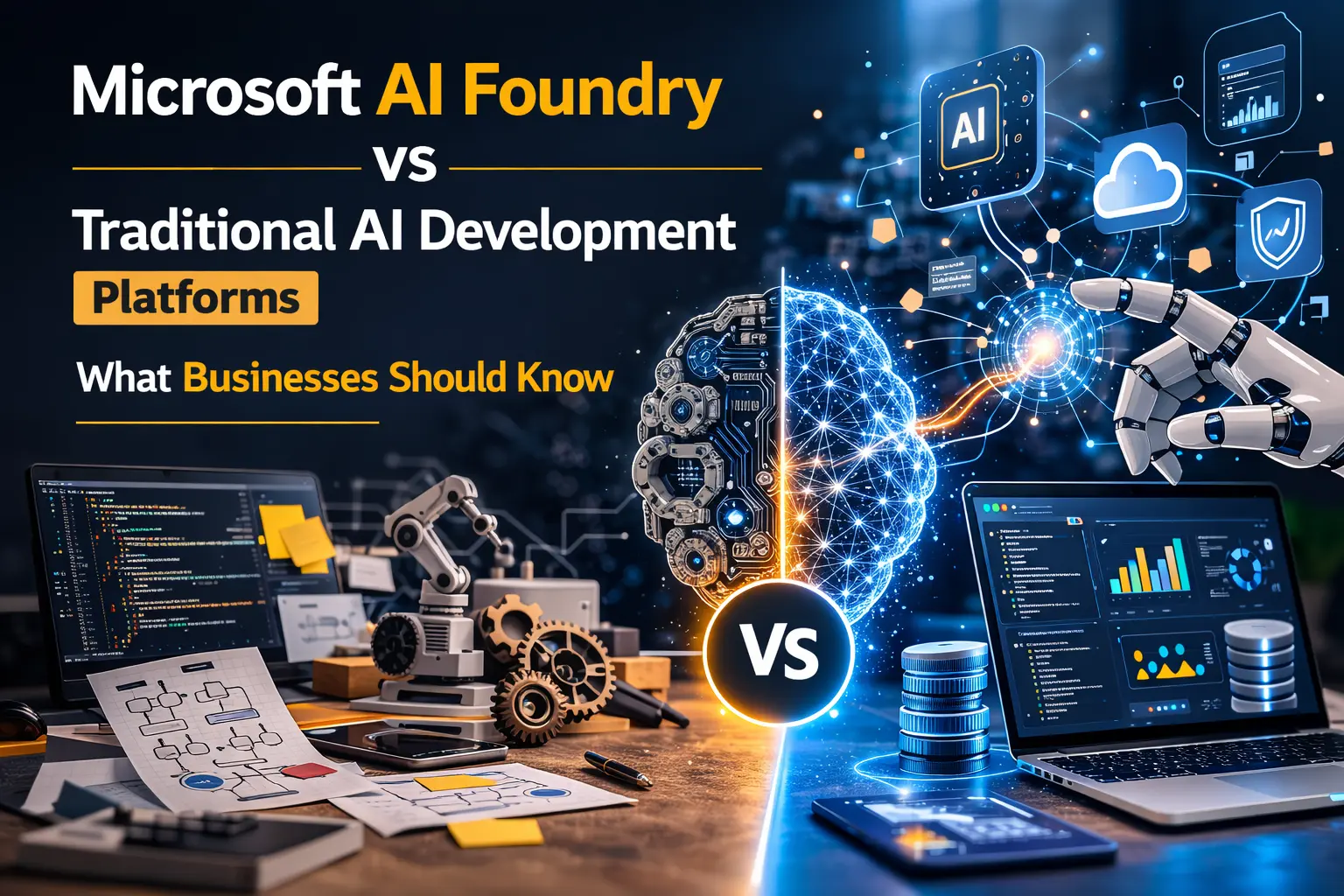
Microsoft AI Foundry vs Traditional AI Development Platforms
Understanding the differences between modern AI platforms and traditional AI systems is essential when building scalable AI applications.
Traditional AI systems excel in highly precise analytical tasks but require more infrastructure and manual configuration. Microsoft AI Foundry simplifies this process with an integrated platform.
Azure AI Foundry vs Azure AI Studio
A common question is whether Azure AI Foundry is the same as Azure AI Studio.
The answer is no.
Azure AI Foundry represents the next evolution of Azure AI Studio, expanding it into a comprehensive enterprise platform.
Traditional AI vs Modern AI
Another important comparison is between traditional AI systems and modern AI platforms.
Modern AI platforms like Microsoft AI Foundry provide advanced environments where AI systems continuously learn and scale across complex business use cases.
What Does Microsoft AI Foundry Focus On?
Microsoft AI Foundry is designed to help businesses build production-ready AI solutions rather than simple prototypes.
Agentic AI Development
Supports the creation of AI agents capable of reasoning, planning, and executing complex workflows.
End-to-End AI Lifecycle
Combines model selection, testing, deployment, and monitoring within one platform.
Multi-Model Customization
Allows developers to select models from a large catalog and customize them with proprietary data.
Responsible AI Governance
Includes built-in monitoring, safety guardrails, and compliance features.
Continuous Monitoring
Tracks model performance and ensures reliability after deployment.
When Should Businesses Choose Each Approach?
Both approaches serve different project requirements.
Choose Microsoft AI Foundry When:
- Building generative AI applications
- Developing AI agents
- Scaling enterprise AI solutions
- Requiring centralized lifecycle management
- Using multiple AI models without managing infrastructure
Choose Traditional AI Platforms When:
- Training highly specialized ML models
- Working with structured predictive analytics
- Running AI in strict on-premise environments
- Requiring full control over ML pipelines
Conclusion
Choosing the right AI development platform is essential as artificial intelligence becomes a key driver of business innovation.
Microsoft AI Foundry and Azure AI Services simplifies the development and deployment of modern AI applications by providing an integrated platform with tools for building, scaling, and managing AI systems.
Traditional AI development methods remain valuable for specialized machine learning projects that require custom infrastructure and precise control.
By understanding the strengths of both approaches, businesses can build AI solutions that drive innovation while maintaining operational efficiency.
Frequently Asked Questions
Is Microsoft AI Foundry free?
Yes, the platform can be explored for free, but the AI models and services used are billed according to Azure pricing.
What is the difference between Microsoft AI Foundry and Copilot?
Microsoft AI Foundry is designed for developers building AI applications, while Microsoft Copilot focuses on creating AI assistants with minimal coding.
Is Azure AI Foundry now called Microsoft Foundry?
Microsoft Foundry is commonly used as a broader name for Azure AI Foundry as Microsoft moves toward a unified AI development platform.
Will AI replace Azure?
No. AI services actually run on Azure infrastructure and rely on its cloud platform for computing and deployment.
What is Microsoft’s AI platform called?
Microsoft AI Foundry serves as Microsoft’s central platform for developing, deploying, and managing AI applications.
What is the difference between Traditional AI and Generative AI?
Traditional AI analyzes data for predictions, while generative AI creates new content such as text, images, or code.
What are the four types of AI?
The four commonly referenced AI categories are:
- Reactive Machines
- Limited Memory
- Theory of Mind
- Self-Aware AI

.webp)