

A single QA engineer opens Postman, builds a collection for one API endpoint, and within a quarter the same pattern repeats across a dozen teams, each running its own auth logic with no single owner for coverage. That's how most enterprise Postman API testing programmes start, and why so many stall by year two. Postman is one of the most recognisable API testing tools available, whether through the desktop app, Postman online in the browser, or the Postman CLI in a pipeline.
At its core, Postman software is an API client for building, testing, and automating requests, which is what Postman does for most teams in one sentence. At enterprise scale, that same postman api platform needs pairing with CI/CD pipelines, standardised collection design, and a clear line between testing and runtime control across live digital infrastructure. This piece covers what Postman does, how to structure it once more than one team touches it, how to automate it with the Postman CLI inside automated pipelines, and where governance stops and runtime enforcement has to start.
What Is Postman?
Postman is an API client at the platform level, not a single-purpose testing tool. At its simplest, it's used for building, sending, and automating API requests, whether that happens through the desktop app, the browser, or a CI/CD pipeline.
What Postman Actually Does at the Request Level
At the request level, the core Postman features are:
- A request builder for the standard API methods (GET, POST, PUT, DELETE, PATCH).
- A response viewer for checking each API response against expected values.
- Collections and workspaces, plus a Collection Runner to execute a full set in sequence.
- Mock servers and mock APIs for testing before a backend even exists.
Install Postman, build a request, save it into a collection, and share it with the team. The Postman software quickly becomes the source of truth for how a service behaves.
Where Postman Sits Relative to CI/CD and the SDLC
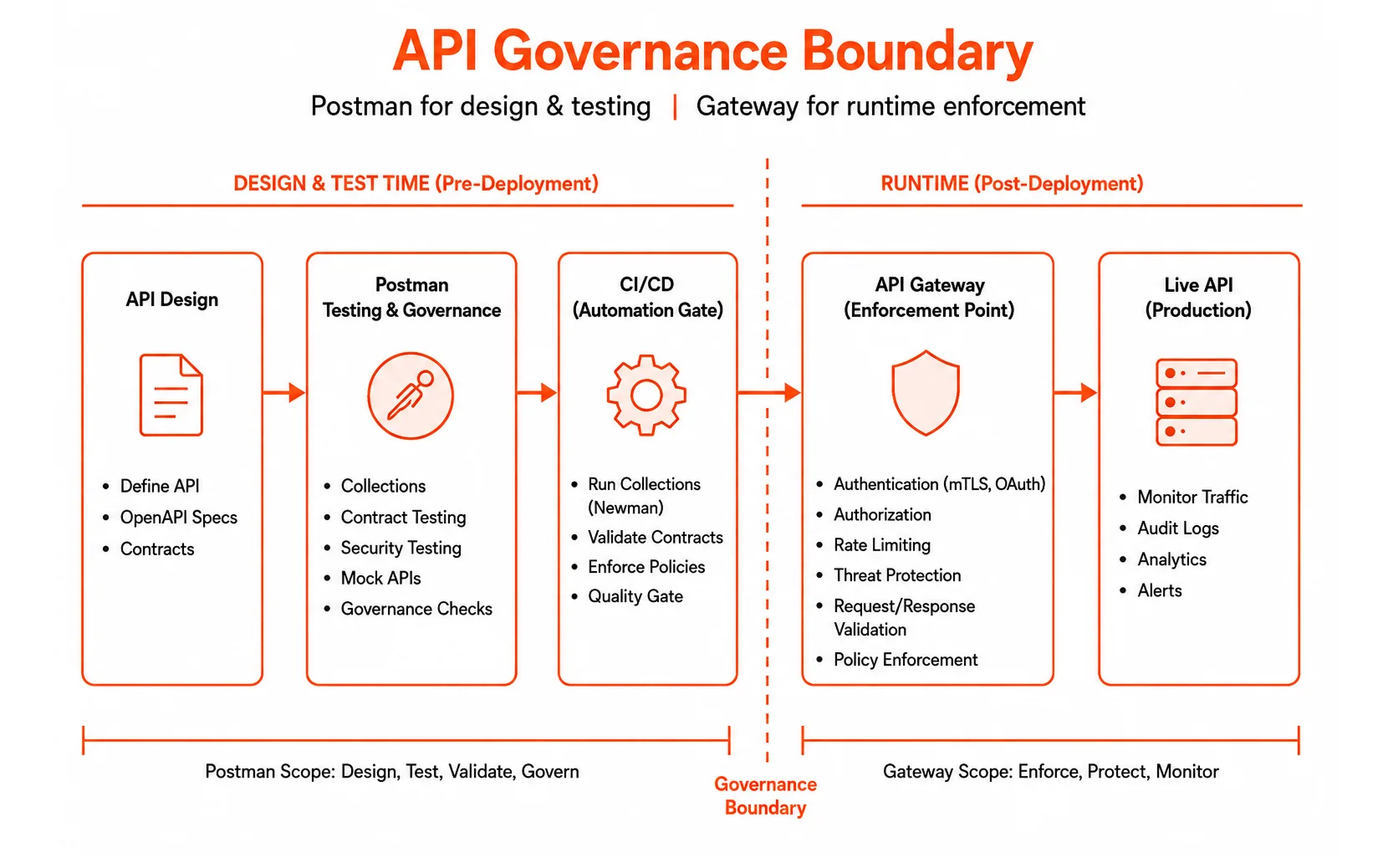
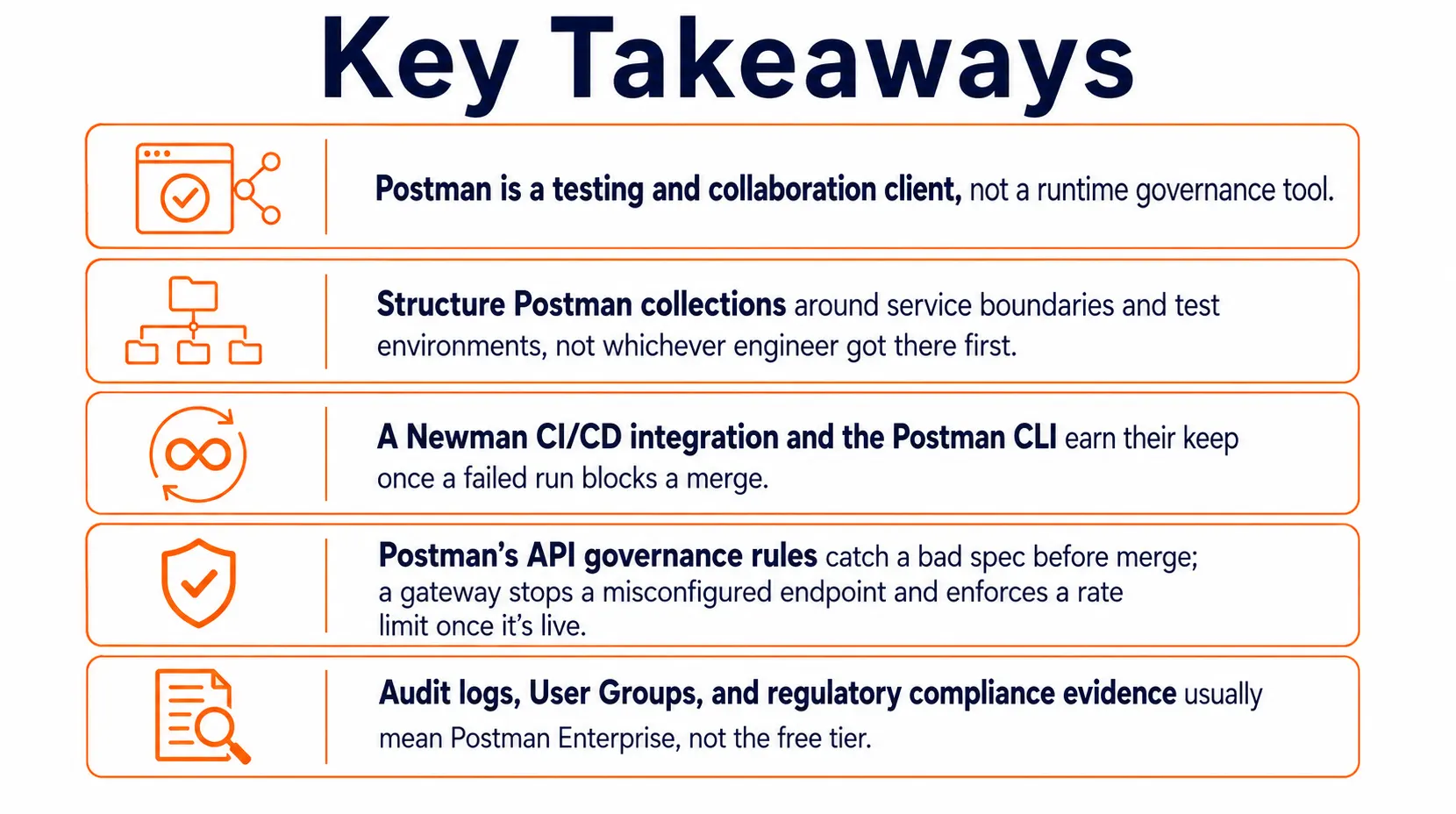
Postman tests an API from the outside, the way a consumer would call it, which is also what makes it a reliable Postman testing tool for pre-merge checks. As a postman api platform, it fits design and pre-merge testing, with the Postman CLI (Newman) bridging into CI/CD pipelines. Once code merges and traffic goes live, Postman's role is finished, and confusing that testing role with a governance layer is where most enterprise rollouts go sideways.
Postman API Testing Strategy for Enterprise Teams
A mid-size fintech client came to us with roughly 40 Postman APIs across nine teams, three different auth patterns, and no single owner for which collection was current. The symptoms were familiar:
- Duplicate Postman collections testing identical API endpoints.
- Authentication tokens and API keys hardcoded instead of stored per test environment.
- No shared view of test coverage across teams.
More collections is not automatically better coverage. A smaller, well-owned set of Postman collections beats a sprawling one with duplicate assertions and stale tokens, every time. Enterprise API programs rarely fail because of Postman itself; they fail because ownership was never assigned.
Postman's own 2025 State of the API Report found that 93% of API teams face collaboration blockers, and 35% specifically point to duplicated effort, which is exactly what turns one team's Postman collections into a company-wide dependency once nobody owns it.
Collection Design Patterns for Large Test Suites
Flat collections work fine until they don't. Past roughly fifty requests, structure becomes essential:
- Folder-per-endpoint-group instead of one flat list.
- Pre-request scripts for shared setup (auth token generation) instead of duplicating logic per request.
- A dedicated Collection Runner sequence for regression test cases, kept separate from exploratory requests.
Here's what that shared pre-request script actually looks like in practice, generating a fresh auth token before each request runs instead of hardcoding one:
// Pre-request script: refresh the auth token before every request
pm.sendRequest({
    url: pm.environment.get("auth_url"),
    method: "POST",
    body: {
        mode: "raw",
        raw: JSON.stringify({ apiKey: pm.environment.get("api_key") })
    }
}, (err, res) => {
    pm.environment.set("auth_token", res.json().token);
});
The matching test script then asserts on the response automatically, instead of someone checking it by hand:
pm.test("Status code is 200", () => {
    pm.response.to.have.status(200);
});

pm.test("Response includes required fields", () => {
    const data = pm.response.json();
    pm.expect(data).to.have.property("id");
    pm.expect(data).to.have.property("status");
});
Used well, Postman becomes less of a scattered postman api tool and more of a genuine testing framework the team relies on. Our advanced Postman testing techniques guide goes further for teams past this point.
Environment and Variable Management Across Dev, Staging, Production
Environment-scoped Postman environment variables keep each test environment (dev, staging, production) cleanly separated, whilst global variables should carry almost nothing sensitive. The common mistake we see: An API key or authentication token hardcoded into a shared collection and reused for eighteen months, unrotated. Structuring collections around service boundaries, not whichever engineer built them first, keeps that maintenance burden from creeping back.
Automating Postman Test Execution With Newman and CI/CD
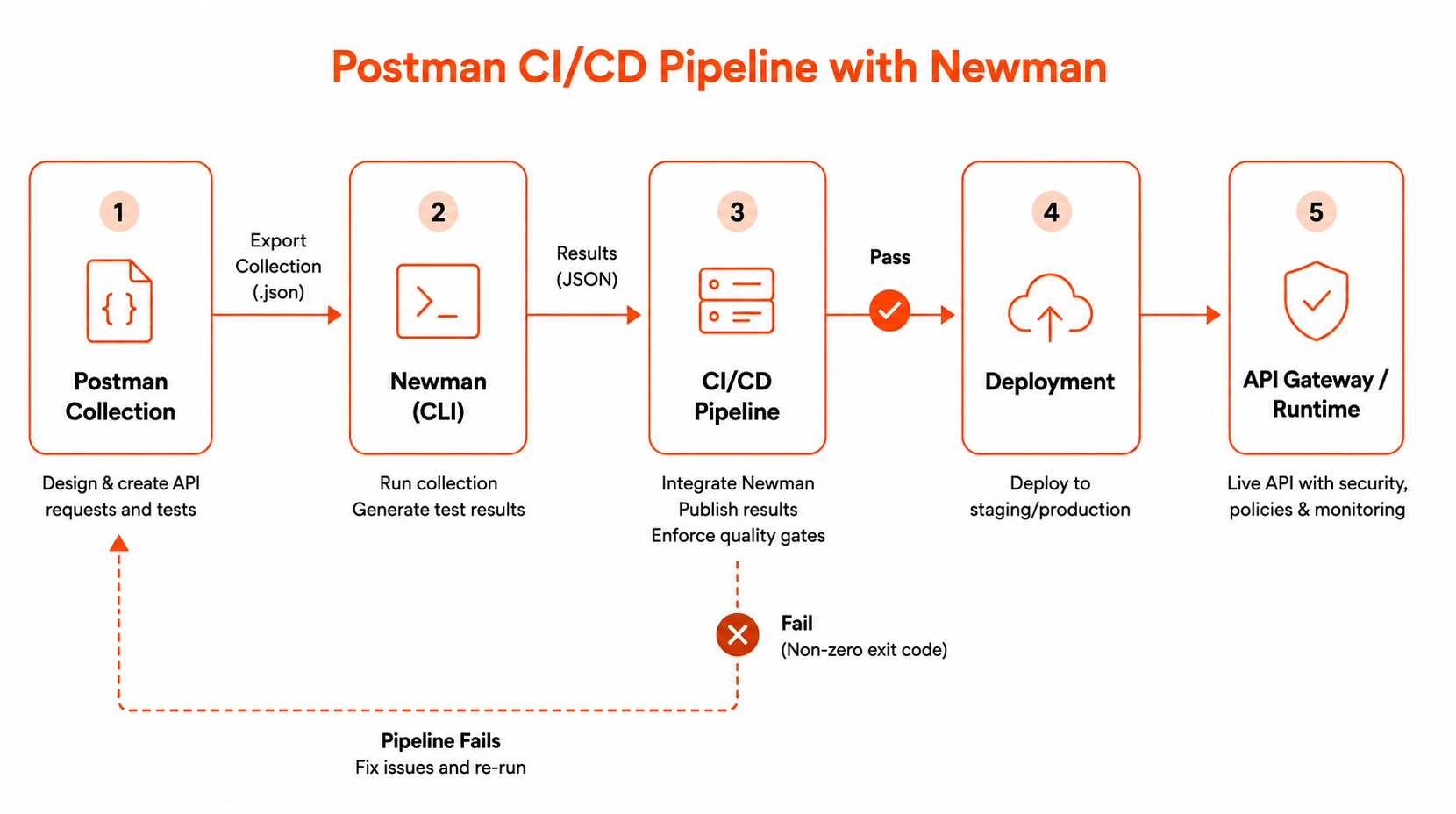
Newman, Postman's own CLI, turns a collection from something a person runs manually into something automated pipelines enforce on every change. A failed run blocks a merge; skip that step, and Newman just logs a warning nobody reads, defeating the point of a Newman CI/CD integration.
Wiring Newman Into Jenkins, GitHub Actions, and GitLab CI
The shape of a typical pipeline step is short:
- name: Run Postman collection with Newman
  run: |
    npm install -g newman
    newman run collection.json -e staging.postman_environment.json --bail
Store the exported collection and environment JSON in the repo, versioned alongside the API code, not handled through a manual process someone repeats by hand.
Handling Flaky Tests and Data-Driven Runs at Scale
Flaky runs in CI rarely mean Postman is broken. Usual causes:
- Two test cases racing over the same shared record.
- A third-party dependency returning inconsistent error responses.
- Rate limit thresholds hit mid-run, throttling API traffic and skewing performance checks.
Isolated test data and scoped retries fix this; re-running the pipeline and hoping does not. Data-driven runs using CSV or JSON iteration files extend regression coverage without hand-writing a request per input combination. For the fuller pattern, see our API test automation best practices.
Postman API Governance, Where the Boundary Sits
Postman's own governance tooling checks API schemas and specifications, not live traffic; an API specification is a design-time document to lint, not a runtime contract to enforce. It lints an OpenAPI document via Spectral or Postman's built-in rule library before a spec merges, genuinely useful, but not the same as api governance in the sense most enterprise buyers mean.
Fewer than four in ten organisations enforce centralised governance standards at all, per the same Postman 2025 report; research points to a similar gap. Regulated industries feel this most: Regulatory compliance reviews expect a clean spec on the api governance side and audit logs proving runtime enforcement.
Enforcing Naming, Auth, and Schema Standards Across Teams
Postman's rule library, or a custom Spectral ruleset, catches inconsistent naming, missing auth schemes, and broken schemas before a spec merges. None of that helps unless it's wired into the same CI/CD gate as the test run; an unenforced governance check is just documentation.
What Postman's Governance Feature Doesn't Cover
Rate limit enforcement, mTLS, live API traffic inspection, and cross-gateway policy sit outside Postman's scope: It doesn't sit in the request path between a consumer and the live service. It can't run real API load testing or flag a SQL command injection attempt in production. OWASP's API Security Top 10 is a solid checklist for what a runtime layer should cover.
How Frugal Testing Helps You Scale Postman API Testing Without Building an In-House Framework
Standing up a shared testing framework, or automation framework, across a dozen teams takes dedicated ownership most engineering organisations lack spare capacity for. That's usually when we get the first call. Our API testing service covers test strategy, Postman CLI automation, CI/CD pipelines, and API security testing - not a rewrite, just consolidating what's there.
What Our Postman API Testing Engagement Looks Like
Our engagement runs in four steps:
- Audit existing collections, test environments, and CI/CD gates for gaps.
- Consolidate collections around service boundaries and key API integrations.
- Move auth logic, API keys, and authentication tokens into pre-request scripts.
- Wire the result into the pipeline with Newman, including flaky-test and error response handling.
The same pattern surfaced those 40 overlapping Postman APIs at the fintech client earlier. The client walks away owning a documented collection set and a working pipeline gate. Nobody owns the collection past the person who built it, and that point arrives earlier than most engineering leads expect.
Who This Is For
- Engineering managers whose Postman usage has outgrown a single team's ownership
- DevOps leads who need automation wired into an existing pipeline, not a manual process
- IT directors weighing Postman Enterprise against building governance in-house.
- Teams under regulatory compliance pressure who need audit logs, not just test cases
Our API testing checklist is a good place to start. Talk to us before the next audit cycle, not after gaps show up in production.
"Postman tests what a consumer sees. Governance tells you if the spec is clean. Neither one watches your live traffic, and pretending otherwise is how gaps get found in production."
Conclusion
Postman is the right tool for request-level and contract testing, full stop. Scaling that across enterprise digital infrastructure is different: Deliberate collection structure, a CI/CD gate Newman enforces, and a clear line to where governance hands off to runtime control. That's usually the part teams discover the hard way, around when a misconfigured endpoint reaches production. Whatever you call it, Postman used for API testing remains the common thread, whether evaluating it for the first time or scaling an existing Postman program.
People Also Ask (FAQs)
Q1. Is Postman available online, or do I need to install it locally?
Ans: Postman online runs in the browser through your account, so installing the desktop app is optional. Most enterprise teams still install Postman locally for offline work and heavier collection management.
Q2. Do you need coding experience to use Postman?
Ans: Not for basic use as a Postman testing tool. Building requests and running collections needs no coding, though pre-request scripts and Newman automation involve some JavaScript for Postman coding tasks.
Q3. What does the name Postman actually mean?
Ans: The postman meaning has nothing to do with mail delivery; it's simply the product's brand name. The postman definition in practice is an API client for building and automating requests.
Q4. Is there a free version of Postman for individuals and small teams?
Ans: Yes. Postman offers a free tier for individuals and small teams, while Postman Enterprise is reserved for organisations needing audit logs, User Groups, SSO, and centralised governance controls at scale.
Q5. How does Postman compare with other API testing tools?
Ans: Among REST API testing tools, Postman leads in collaboration. Tools like Insomnia and SoapUI cover similar ground, but most enterprise teams standardise on Postman for its ecosystem.


.webp)