

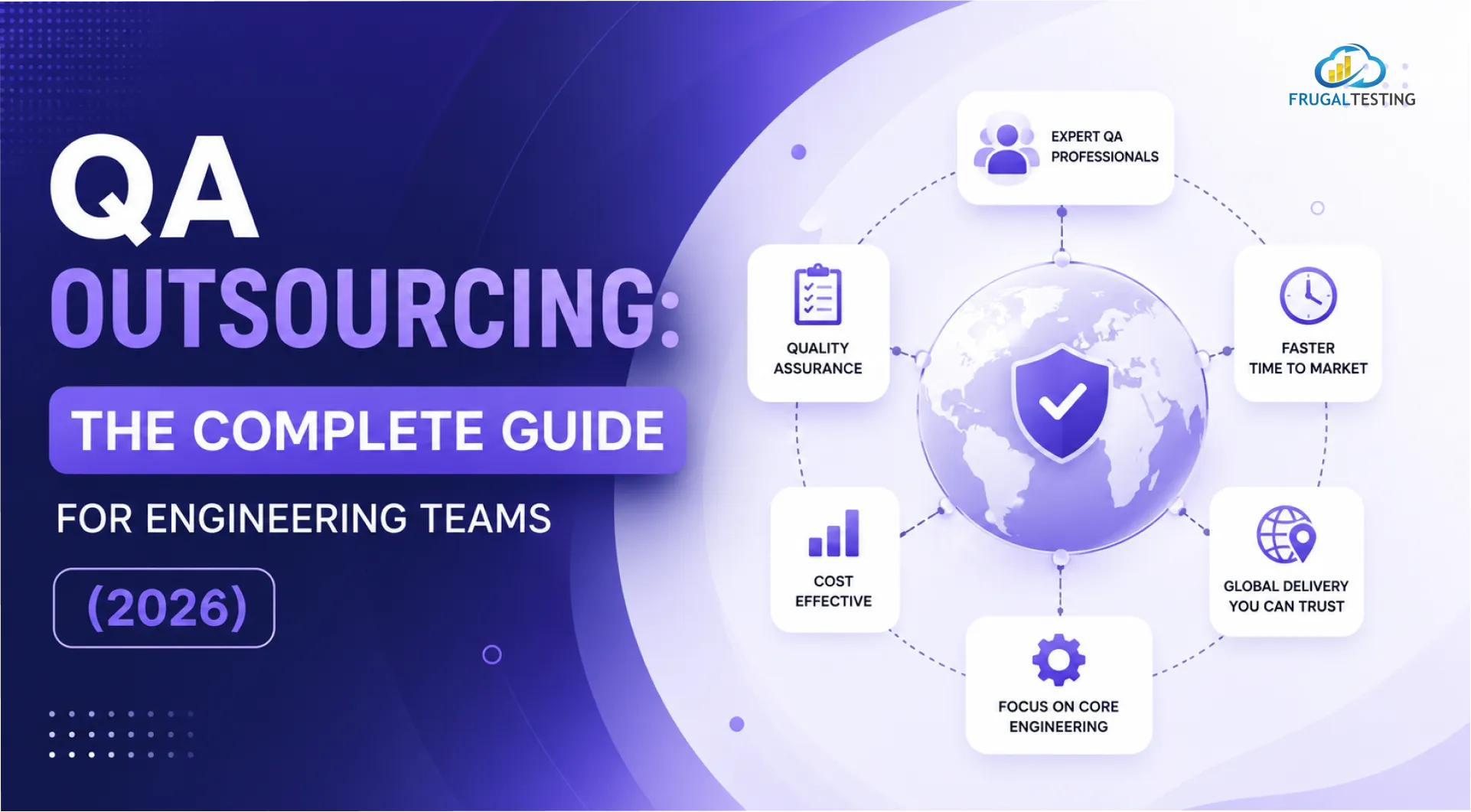
QA outsourcing means engaging a third-party QA team to handle software testing from test case creation and regression suite management to test automation framework setup and CI/CD integration.
Engineering teams today ship faster than ever, but quality assurance often struggles to keep pace. Whether you are a startup not yet ready to hire a full-time QA lead, a scaling company overwhelmed by regression suites, or an enterprise managing complex CI/CD pipelines, outsourcing gives you specialized expertise without the overhead of building it in-house. This guide covers outsourcing models, pricing, vendor selection, and when a hybrid approach makes more sense.
What Is QA Outsourcing and Why Engineering Teams Need It
What QA outsourcing is and how it fits into modern software development
QA outsourcing is delegating software testing to an external partner rather than handling it entirely in-house. This can mean outsourcing a specific layer like test automation or performance testing or engaging an external team for end-to-end software quality assurance across your entire product.
QA today is not a phase that happens after development. It runs in parallel, feeds directly into CI/CD pipelines, and produces bug reports, test suites, and regression scripts that engineering teams rely on every day. Outsourcing this function does not mean losing control, it means extending your team's capacity with people who specialize in exactly this work.
How QA outsourcing differs from in-house software testing and when to choose it
In-house QA teams bring deep product knowledge, institutional memory, and tight collaboration with developers. The tradeoff is cost, hiring time, and scalability building a capable team takes months and requires ongoing investment in tools and training.
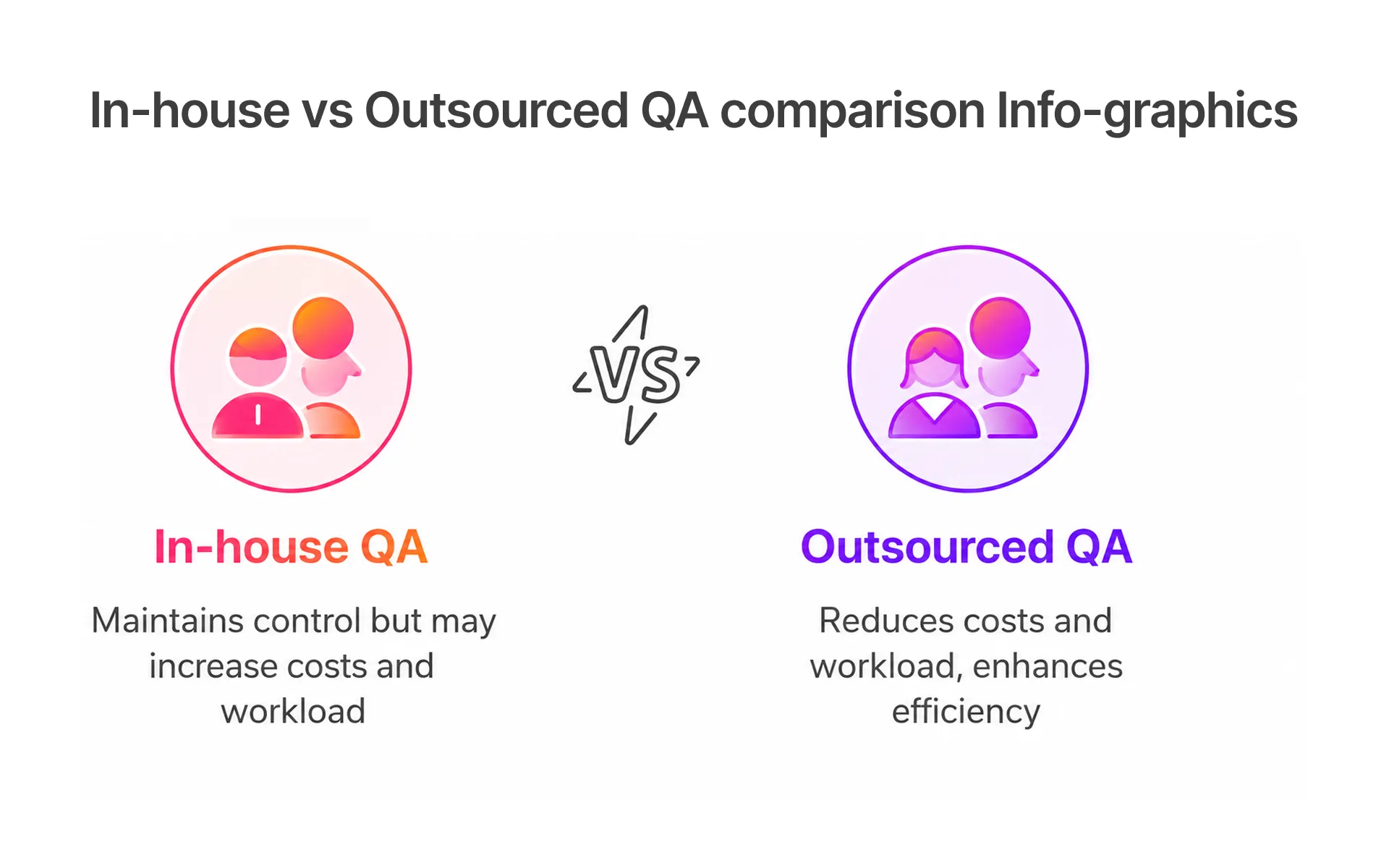
Outsourced QA services offer immediate access to trained QA engineers and ready-to-deploy automation frameworks. Consider outsourcing when:
- Your internal team is consistently blocked by testing backlogs.
- You need specialized skills like API testing or security testing quickly.
- Your release cycles demand more coverage than your current team can provide.
Key trends shaping quality assurance outsourcing in 2026
Three trends are reshaping outsourced QA this year:
- AI-powered testing is enabling faster test creation through natural language test creation and self-healing test automation that adapts to UI changes automatically
- AI-native QA providers now offer intelligent test coverage recommendations rather than just execution
- Nearshore demand particularly in Latin America has grown significantly as teams seek timezone alignment alongside cost efficiency
When Should Engineering Teams Outsource QA Testing
Early-stage, scaling, and enterprise signals that indicate it's time to outsource
The right time depends on where your team is in its growth:
- Early-stage teams outsource when they need structured testing before a mobile launch or platform rewrite but lack the headcount to build QA from scratch
- Scaling teams outsource when regression suites are expanding, CI pipelines are slower, and developers are being pulled into triage meetings instead of building features
- Enterprise teams outsource specific functions like automation framework setup or multi-tenant migration testing where deep specialization matters
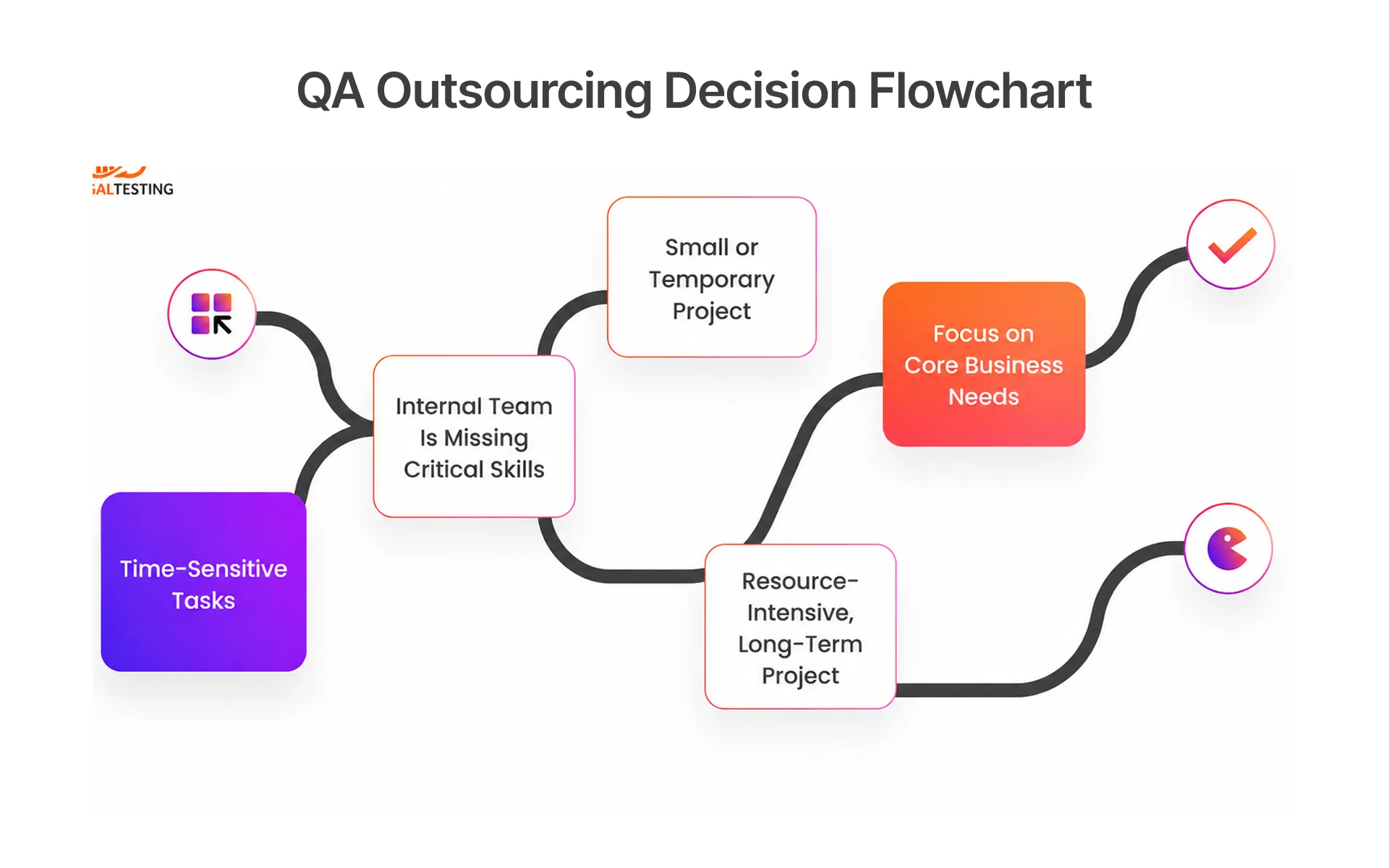
Situations where outsourcing QA testing delivers the most business value
Outsourcing delivers the highest return where speed and specialization intersect a CRM solution preparing for a major release, an e-commerce platform managing a multi-tenant migration, or a SaaS product undergoing a platform rewrite. According to the Capgemini World Quality Report, over 83 percent of organizations cite quality engineering and testing as critical to their digital transformation outcomes, with specialized QA partners consistently outperforming internal-only testing teams on defect detection rates and release cycle speed.
How to assess your team's current QA maturity before making the decision
Before engaging any QA service provider, audit where your team currently stands across three questions:
- How much of your regression testing is automated versus manual?
- How often do bugs escape to production?
- How long does it take to go from code commit to a full regression pass?
If your answers reveal low automation coverage, frequent production incidents, and slow CI checks, outsourcing is not just an option, it is a strategic necessity.
Benefits and Challenges of Outsourcing Software Testing
Top benefits of outsourcing QA testing for modern engineering teams
The most immediate benefit is access to a full QA team without the hiring timeline. A provider like Frugal Testing can have trained QA engineers working on your test suite within days, not months. Beyond speed, outsourcing gives you:
- Access to specialized skills across performance testing, security testing, API testing, and automation frameworks.
- Scalability to expand or reduce testing capacity based on release demand.
- Dedicated focus, meaning test cases are written with more rigor and coverage is more consistent.
- Cost efficiency, particularly when working with nearshore or offshore QA teams.
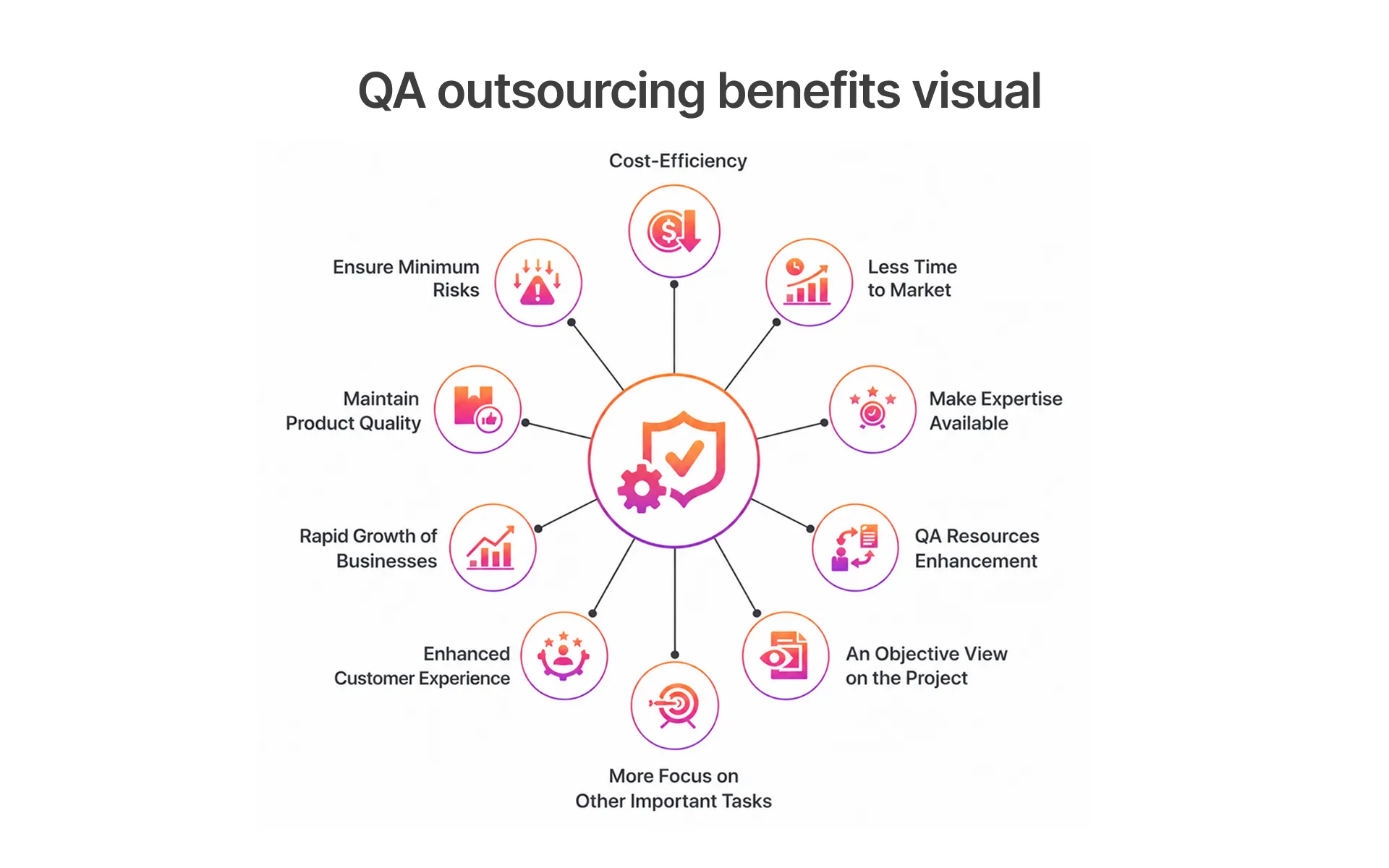
Outsourcing also brings external objectivity. An in-house QA engineer embedded in a team for months can develop blind spots. An outsourced team brings fresh eyes to your codebase on every engagement.
Common QA outsourcing challenges and how to avoid them
The most common challenge is knowledge transfer. An external team needs two to four weeks to understand your product architecture, critical user flows, and core functionality before they can test effectively. Most outsourcing engagements stumble here if not planned properly.
Other challenges to watch for:
- Misaligned bug severity definitions that create friction between developers and external QA engineers.
- Inadequate access to testing environments, which delays feedback loops.
- Communication gaps across Slack, Jira, and shared documentation when workflows are not standardized from day one.
The fix is a structured onboarding process: document your critical user flows, agree on a shared bug severity matrix, and give the outsourced team direct access to your CI/CD environment before work begins.
Managing communication, security, and quality risks effectively
Both communication and security risks are manageable with the right structures in place. On the communication side, establish weekly sync cadences, use shared Jira boards for test case visibility, and agree on response time expectations for bug reports. On the security side, require NDAs and data masking protocols, and verify whether the provider holds ISO 27001 or SOC 2 certification before sharing access to any production-adjacent systems.
QA Outsourcing Models and What Each One Covers
Offshore, nearshore, and onshore software testing outsourcing compared
Choosing between outsourcing models is primarily a decision about cost, timezone overlap, and communication ease. The table below compares offshore, nearshore, and onshore QA outsourcing across cost, timezone overlap, and best-fit use cases use it as a first-pass filter before shortlisting providers.
Nearshore QA teams in Latin America have become increasingly popular with US-based teams because they offer cost efficiency without the communication friction of large timezone gaps.
Dedicated QA teams vs. on-demand outsourced QA services
A dedicated QA team attends standups, contributes to sprint planning, and builds deep product knowledge over time best for teams with continuous testing needs and stable roadmaps.
On-demand outsourced QA services work differently. You engage them for a specific release, migration, or performance testing sprint and scale down when that need passes. This suits teams with variable testing demand or those needing specialized coverage for a single project.
Core QA testing services included in a typical outsourcing engagement
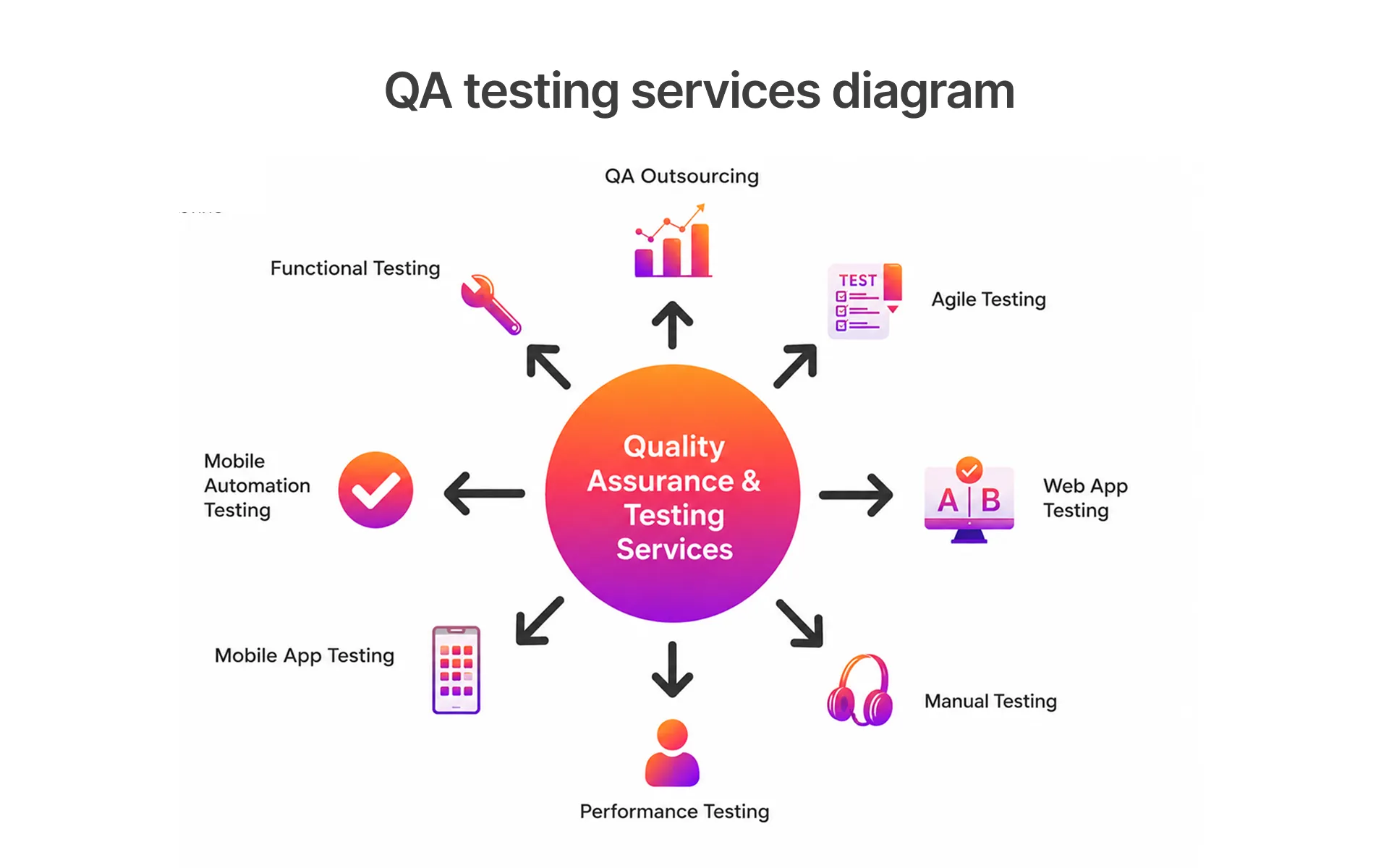
A typical engagement covers functional testing, regression testing, smoke testing, API testing, performance testing, and security testing. Standard deliverables include test case creation, test suite management, and bug reporting. Advanced engagements add test automation framework setup, Playwright tests, and AI-driven test automation with self-healing tests that reduce maintenance overhead as your product evolves.
Test Automation Outsourcing and the QA Process Explained
Test automation outsourcing: frameworks, tools, and ROI expectations
Test automation outsourcing means engaging an external team to build, maintain, and execute your automated test suite from selecting the right automation framework to writing automation scripts, integrating them into CI/CD, and maintaining them as your product changes.
The ROI case is straightforward. Manual regression testing of a mid-size application can consume 40 to 60 hours per release cycle. A well-built automation framework reduces that to under five hours while increasing coverage. Teams working with Frugal Testing on QA automation engagements consistently see defect escape rates drop by 40 to 60 percent within the first three months driven by automated regression coverage and risk-based test prioritization across CI/CD pipelines.
The QA process in software testing from kickoff to sign-off
A well-run outsourced QA process follows a consistent structure:
- Discovery the team reviews your architecture, identifies critical user flows, and defines testing scope.
- Test case creation and environment setup.
- Test run against your staging environment with severity-classified bug reports.
- Regression pass to confirm all fixes before sign-off.
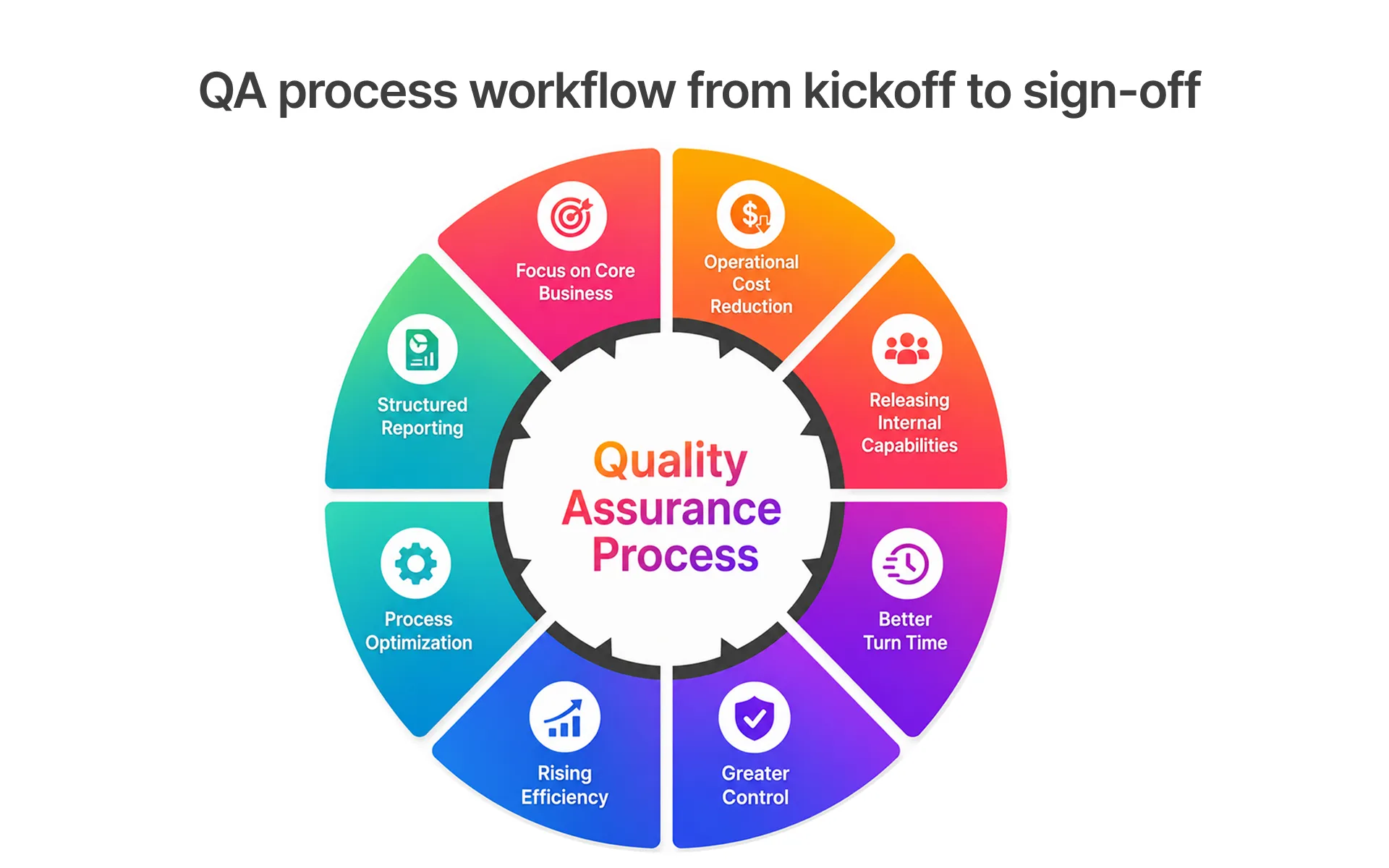
What separates strong providers from weak ones is how they handle CI check failures, how quickly they update regression scripts after UI changes, and whether they flag environment issues proactively rather than reactively.
Integrating QA automation services into your existing CI/CD pipeline
Integrating an outsourced automation team into your CI/CD environment requires three things:
- Environment access read and write access to your test repository.
- Trigger configuration ability to trigger test runs through your CI pipeline.
- Reporting setup a dashboard that surfaces results to your engineering team in real time.
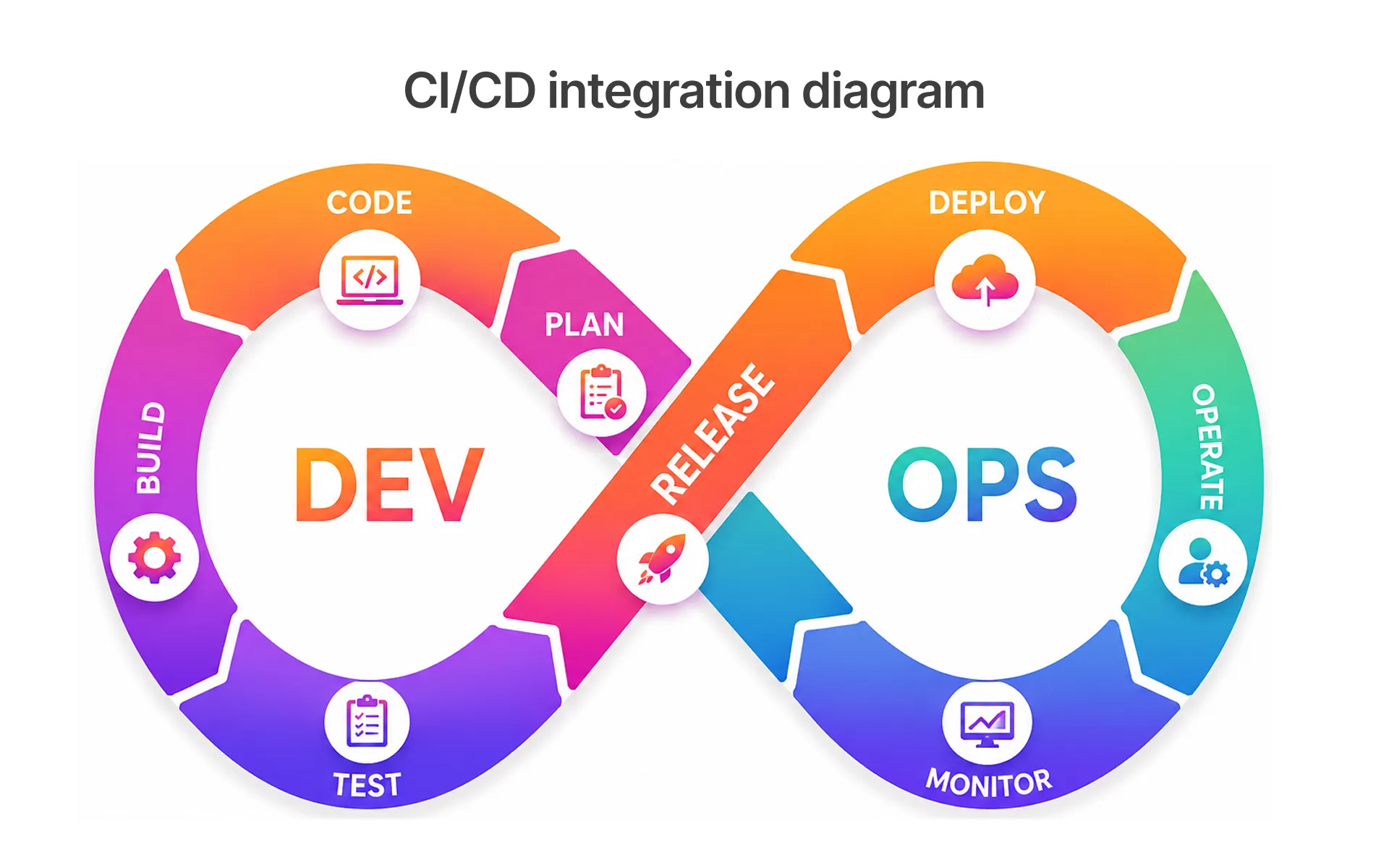
Tools like Playwright combined with cloud infrastructure for parallel test execution make it possible to run full regression suites in under 30 minutes fast enough to fit inside a deployment pipeline without becoming a bottleneck.
QA Outsourcing Costs, Pricing Models, and ROI
What determines the cost of outsourced QA services
Four factors drive the cost of outsourced QA services:
- The engagement model you choose.
- The geographic location of the team.
- The technical complexity of your product.
- The level of automation involved.
A manual testing engagement for a simple web application costs significantly less than a full automation framework built for a multi-tenant SaaS platform with Lightning Web Components and complex API layers.
Fixed-price vs. time-and-materials engagement models explained
Fixed-price works best when scope is clearly defined for a specific release cycle, performance testing sprint, or automation framework build. You pay an agreed amount for a specific output.
Time-and-materials suit ongoing or evolving testing needs where scope changes frequently. You pay for hours worked, which gives flexibility but requires closer oversight to avoid cost overruns. Most engineering teams start with a fixed-price pilot to validate the provider, then transition to time-and-materials once trust is established.
How to estimate and measure QA outsourcing ROI for your engineering team
Measure ROI across three dimensions: defect escape rate reduction, release cycle compression, and internal engineering time reclaimed. If your team was spending 15 hours per sprint on manual regression testing and that drops to two hours after outsourcing automation, that is 13 hours per sprint returned to feature development. Multiply that by your average developer hourly rate and the financial case becomes clear within the first quarter.
How to Choose the Right QA Service Provider
Key criteria for evaluating software testing consulting companies
When evaluating software testing consulting companies, look beyond pricing. Assess:
- Experience with your technology stack and approach to test automation.
- Quality of documentation and sample test cases from previous engagements.
- Whether QA engineers hold relevant certifications.
- Domain experience in your industry a provider that has tested e-commerce platforms will approach a CRM solution very differently than one specializing in fintech.
Evaluating security, compliance, and data protection in QA engagements
Security evaluation is non-negotiable for healthcare, fintech, and enterprise SaaS products. Before signing any engagement:
- Verify ISO 27001 or SOC 2 Type II certification.
- Confirm data masking practices for production-adjacent test environments.
- Review policies on user login credentials, data retention, and access revocation after engagement completion.
Any provider that cannot answer these questions clearly is not ready to work on regulated or sensitive products.
A vendor evaluation framework: questions to ask and red flags to watch
Use these questions when evaluating any QA service provider:
- What does your onboarding process look like for a new product?
- How do you handle scope changes mid-engagement?
- What is your process when a CI check fails at 2 a.m.?
- Can you show us an automation framework you have built and maintained?
Red flags include vague answers about testing methodology, no clear process for regression script maintenance after UI changes, and providers who treat test automation as a one-time deliverable rather than an ongoing responsibility.
QA Outsourcing vs. In-House Testing: Making the Right Call
Total cost comparison: in-house QA team vs. outsourced QA services
According to Glassdoor's 2026 QA engineer compensation data, hiring a single mid-level QA engineer in the United States costs between $85,000 and $110,000 annually in salary alone, before benefits, tooling, onboarding, and management overhead. A comparable outsourced QA engagement typically costs 40 to 60 percent less annually, with no hiring risk and faster time to productivity.
Speed, scalability, and flexibility: where outsourcing wins
In-house teams are slow to scale hiring and ramping a new QA engineer takes three to six months. An outsourced QA team can be operational in days. This matters most during product launches or platform rewrites where testing demand spikes temporarily. Outsourcing lets you match capacity to demand without carrying permanent headcount.
Hybrid QA models: how leading engineering teams blend both approaches
The most effective engineering teams use both. A common hybrid model keeps a senior QA lead in-house to own strategy and manage the vendor relationship while the outsourced team handles execution, running regression suites, managing test cases, and expanding automation coverage across API layers and UI changes. This combines institutional knowledge with execution scale.
The Future of QA Outsourcing and Software Testing
AI-powered testing, shift-left QA, and autonomous testing trends in 2026
AI is fundamentally changing what outsourced QA looks like:
- Natural language test creation converts behavioral statements written in plain English into executable Playwright tests automatically.
- Self-healing test automation uses vision models to detect UI changes and update scripts without human intervention.
- AI agents are beginning to perform exploratory testing autonomously, identifying edge cases that manually written test cases miss entirely.
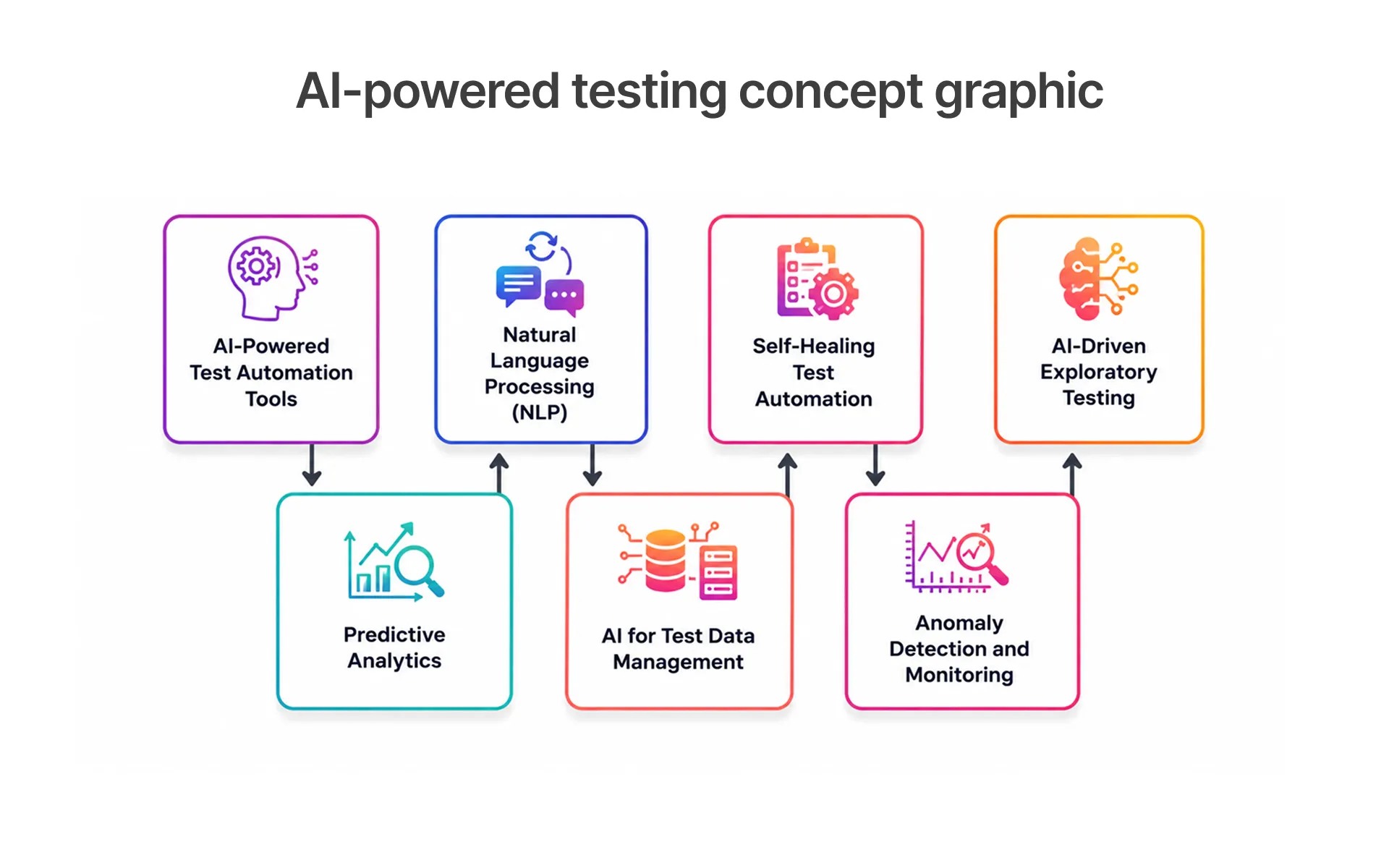
Shift-left QA integrating testing earlier in the development cycle rather than at the end is accelerating this change. Leading QA outsourcing providers are building shift-left capabilities into their standard engagement models, not treating it as an add-on.
How to future-proof your QA outsourcing strategy for 2026 and beyond
Choose a provider that is investing in AI-driven test automation and automation frameworks built for maintainability, not just initial execution. Look for self-healing test support, cloud infrastructure for parallel execution, and a clear point of view on how AI systems will change their service delivery over the next two years. The providers integrating AI into their QA process today will be the ones capable of delivering digital assurance at scale tomorrow.
Conclusion: Choosing the Right QA Outsourcing Partner for Your Team
Why strategic QA outsourcing is essential for engineering teams in 2026
QA outsourcing is no longer a cost-cutting measure, it is a strategic capability. Engineering teams that treat quality assurance as a core part of their delivery process ship faster, catch more defects before production, and spend less time in reactive triage. In a market where release cycles are measured in days, having a dedicated QA function that scales with your team is not optional.
How Frugal Testing helps engineering teams build and scale QA outsourcing
Frugal Testing provides end-to-end QA outsourcing services built specifically for engineering teams that need to move fast without sacrificing quality. From test automation framework setup and regression suite management to API testing and CI/CD integration, Frugal Testing operates as an extension of your engineering team not a downstream vendor. Frugal Testing combines structured QA processes with modern automation tooling, giving engineering leads the coverage and confidence they need at every release.
Getting started with Frugal Testing as your end-to-end QA service provider
Getting started is straightforward. Share your current testing challenges, your stack, and your release cadence with Frugal Testing's team. They will assess your QA maturity, identify the highest-impact areas to address first, and propose an engagement model that fits your timeline and budget whether that is a dedicated QA team, targeted automation testing services, or a one-time performance testing sprint.
People Also Ask (FAQs)
Q1. Can a QA outsourcing partner work across multiple time zones without slowing down our sprint cycles?
Ans: Yes, if structured correctly. The key is establishing a follow-the-sun testing model where your outsourced QA team runs test cycles overnight relative to your engineering team's timezone. This means bugs are logged and ready for your developers by the time they start their day, effectively compressing your QA feedback loop without adding sprint overhead.
Q2. How do we handle disagreements between our internal developers and the outsourced QA team on bug severity?
Ans: This is one of the most overlooked friction points in QA outsourcing. The fix is agreeing on a shared bug severity matrix before the engagement starts, not after the first disagreement surfaces. A well-defined matrix aligned to your product's risk tolerance eliminates subjective back-and-forth and keeps release decisions objective.
Q3. Is QA outsourcing viable for products that release multiple times a day using continuous deployment?
Ans: It is, but it requires the outsourced team to operate inside your CI/CD pipeline rather than alongside it. This means they need direct access to your test environments, automated trigger-based test execution, and real-time reporting dashboards not end-of-day summary reports.
Q4. How do we prevent outsourced QA teams from becoming a bottleneck as our engineering team scales?
Ans: The most common cause of this bottleneck is treating the outsourced QA team as a downstream step rather than a parallel workstream. Teams that avoid this problem embed QA into their planning ceremonies not just execution so test coverage planning happens alongside feature development, not after it.
Q5. What level of QA documentation should we prepare before onboarding an outsourced testing team?
Ans: At minimum you need three things ready before day one: a test environment setup guide, a list of critical user flows that must never break, and access credentials to your staging environment. Everything else test cases, automation scripts, regression suites can be built collaboratively during the engagement. Over-documenting before onboarding is one of the most common reasons QA outsourcing kickoffs get delayed unnecessarily.

.webp)