

A regression defect ships to production. Two engineers both believed the feature was covered. One had written a scenario. The other assumed test cases existed underneath it. Neither was technically wrong. But the team had no shared documentation structure connecting the two, and the gap cost them a release.
Quick answer: A test scenario is a single-line statement of what to validate. A test case is the step-by-step specification used to validate it. Both serve different purposes, and collapsing them is where most QA teams lose test coverage.
TL;DR: Test scenarios define coverage targets. Test cases define execution methods. In mature QA workflows, both coexist by design. Skipping either layer shifts the cost to defect triage and production incidents.
What Is a Test Case in Software Testing?
A test case is a formal, documented artifact specifying exactly what to validate, under what conditions, and what the software application must return. It is the atomic unit of QA execution: not a mental note, but a repeatable instruction set.
In most structured QA workflows, test cases in software testing are derived from test scenarios. They can stand alone for isolated component validation, boundary checks, or defect-specific regression testing.
Types of Test Cases
Types of test cases are a coverage map. Each closes a different category of risk.
- Functional test cases: Validate whether a feature behaves as expected given defined inputs.
- Usability test cases: Assess navigation, accessibility, and task completion rate.
- Database test cases: Validate that data is stored, retrieved, updated, and deleted correctly.
- Security test cases: Evaluate hardening against SQL injection, XSS, and privilege escalation.
- UI test cases: Validate button states, form behaviour, label text, and cross-browser consistency.
- Integration test cases: Verify that modules or services exchange data correctly.
- Performance test cases: Assess system response under load and throughput thresholds.
- Regression test cases: Verify existing functionality still works after a code change; prime candidates for test automation in CI/CD pipelines.
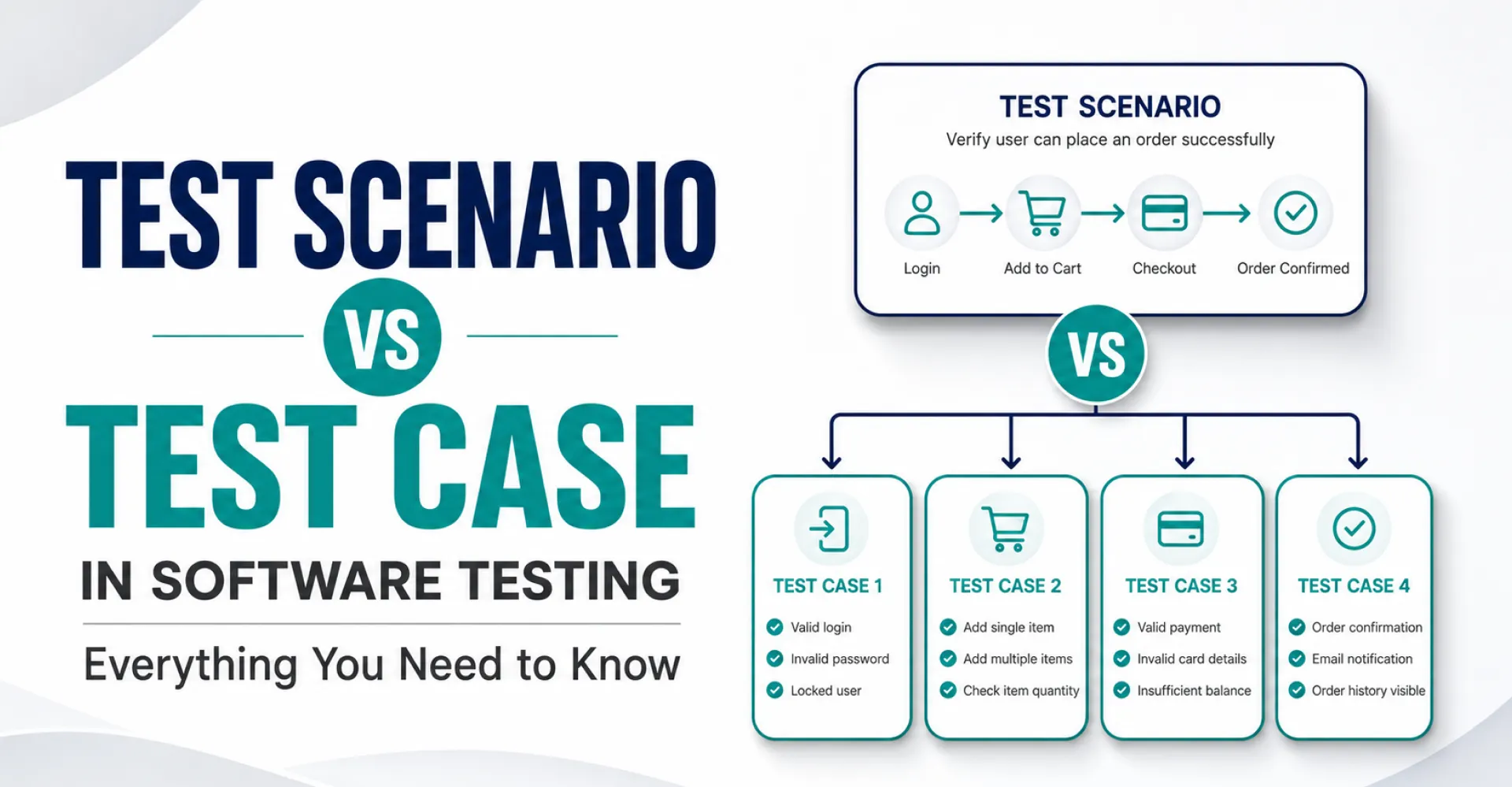
One scenario can generate multiple test case types. A "verify checkout flow" test case scenario might produce functional, security, and regression cases, all from one scenario statement.
Core Components of a Test Case
Precondition in test case deserves emphasis: Skipping it is the most common authoring mistake and the root cause of inconsistent results across environments.
How to Write a Test Case
Writing a test case is a specification act, not a documentation formality. A poorly written case produces false confidence without catching real defects.
Core authoring steps:
- Assign a Test Case ID and write a specific, descriptive name tied to a requirement.
- Set test priority by risk criteria and define all preconditions.
- Specify exact test data and write each step as a single atomic action.
- Document expected results for each step, then record pass/fail criteria and any postconditions that apply.
Three mistakes to avoid: Vague expected results; skipping negative paths; omitting test data. A standardised test case template enforced through your test management platform eliminates inconsistency. Most test management tools provide these natively.
Test Case Example
TC-AUTH-001 | P1 | Verify successful login with valid credentials. Precondition: Registered account (user@example.com / ValidPass123!) exists in staging with verified email status. Test Data: Username: user@example.com / Password: ValidPass123!
Pass/Fail Criteria: Pass if redirect and session token occur; fail on any deviation.
This structure applies to API validation, checkout flows, or any user registration process.
Test Case Tips and Best Practices
- Prioritise by risk, not feature size: P1 covers the critical path before anything else.
- Cover both positive and negative paths: A suite covering only happy paths is a demonstration, not test coverage.
- Keep steps atomic: Bundled steps produce ambiguous failures requiring extra investigation.
- Ground every case in documented requirements: Writing from assumptions leaves coverage gaps that only surface when a defect ships.
What Is a Test Scenario in Software Testing?
A test scenario is a single-line, high-level statement of what needs to be validated, derived from SRS, BRS, user stories, or acceptance criteria. It is the bridge between product intent and QA execution planning.
Three misconceptions to correct: A test scenario is not a test plan, not a test suite, and not a vague to-do item. It is a scoped, single-line objective tied to a specific requirement.
The hierarchy matters. A test condition in software testing sits above scenarios: The raw inventory of "what could go wrong?" from requirements. In order: Test condition feeds test scenario, test scenario generates test cases, test cases become test scripts.

Types of Test Scenarios
- Functional scenarios: Validate that a feature performs as requirements specify; example: "Verify a registered user can complete checkout using a saved payment method".
- Negative scenarios: Validate graceful handling of invalid inputs or unauthorised access; the most skipped type and the most likely to surface production defects.
- Edge-case scenarios: Validate behaviour at exact input boundaries; example: "Verify file upload handles a file at exactly the 25MB limit without error".
- End-to-end scenarios: Validate a complete user journey across multiple features; a single E2E scenario can generate 10 to 15 test cases once all paths are mapped.
How to Write a Test Scenario
A well-written test scenario is the foundation every downstream test case is built on. Too broad and it cannot be decomposed. Too narrow and it duplicates specificity that belongs in the test case layer.
Core authoring steps:
- Identify the feature from user stories or acceptance criteria and define the objective in one line.
- Set scope boundaries and write the scenario name as a single, action-oriented statement.
- Link to the source requirement, assign test priority, and review with a stakeholder outside QA.
- Identify how many test cases this scenario will generate and what types they will cover.
Most common mistake: Writing a scenario too broad to execute. "Test the entire checkout process" is a theme. "Verify a guest user can complete checkout using a credit card without creating an account" is a scenario.
Test scenario template fields: Scenario ID, scenario name, objective, source requirement, priority, derived test cases, reviewed by.
Test Scenario Example
TS-AUTH-001 (US-012): Verify login functionality with valid credentials. Derived: TC-AUTH-001 (redirect to /dashboard), TC-AUTH-002 (session continuity), TC-AUTH-003 (SSO redirect).
TS-AUTH-002 (US-012): Verify login behaviour with invalid or missing credentials. Derived: TC-AUTH-004 (generic error), TC-AUTH-005 (empty email blocked), TC-AUTH-006 (empty password blocked), TC-AUTH-007 (locks after 5 failed attempts).
For BDD teams, Gherkin syntax serves double duty: QA documentation and automation specification at once.
Given a registered user is on the login screen.
When they enter a valid email and password and click Login
Then they are redirected to /dashboard, and a valid session token is set
This eliminates the translation step between test documentation and test script authoring.
Test Scenario Tips and Best Practices
- One scenario, one objective: If "and" appears in the scenario name, split it into two.
- Involve stakeholders early: 30 minutes of PM review during sprint planning prevents hours of rework.
- Tie every scenario to a requirement: Untraceable scenarios produce untraceable test coverage.
- Revisit scenarios when requirements change: A scenario tied to a modified requirement is no longer valid.
Test Scenario vs Test Case: Side-by-Side Comparison
The working reference QA leads and engineering managers reach for when debating what to write for an upcoming sprint.
Comparison Table: Test Scenario vs Test Case

Adjacent comparisons:
- Test case vs test plan: A test plan covers scope, approach, and schedule for an entire testing effort. A test case is a single executable specification within it.
- Use case vs test case: A use case describes user interaction intent in product documentation. A test case validates that the software application implements it correctly.
- Test case vs test script: A test case is the human-readable spec. A test script is the executable code in automation frameworks like Selenium or Playwright. A script without a corresponding test case becomes a maintenance liability when requirements change.
How Frugal Testing Structures Test Scenarios and Test Cases for Your Team: Without the Overhead
A QA lead at a US SaaS company came to us with a familiar situation: 18 months of weekly shipping, QA documentation in a stale Confluence page, and one engineer holding all the tribal knowledge. When a payment defect reached production, nobody could explain the coverage gap.
We audited, mapped, and restructured their test design layer in three weeks. Within two sprints, they had traceable scenarios, execution-ready test cases, and a regression suite their CI/CD pipelines actually trusted.
That is the service: Scenario mapping, test case authoring, and test suite architecture embedded directly into your sprint workflow. We have helped more than 50 US engineering teams go from zero structured test documentation to a CI-integrated library in under three weeks.
What Our Test Design Engagement Looks Like
- Week 1 (Audit): Review test artifacts, user stories, and acceptance criteria. Surface coverage gaps and misaligned cases.
- Week 2 (Scenario authoring): Every scenario tied to an acceptance criterion, reviewed with your PM before moving to the test case layer.
- Weeks 3 to 4 (Test case authoring): Every field populated, every step atomic, every expected result precise. Cases loaded into your test management platform tagged by area, priority, and test type.
- Week 5 onward: Regression tagging, deprecated case retirement, and CI/CD pipeline integration for teams moving toward test automation.
At close, your team owns a fully structured library: Traceable to requirements, organised by feature area, ready for any new test analyst or QA engineer to pick up.
Who This Is For
Engineering teams of 5 to 50 shipping weekly or bi-weekly where QA is handled ad hoc, shared across developers, or outsourced to a generalist team.
Three trigger situations: A regression defect reached production with no documented case covering it; test documentation lives in a stale spreadsheet or one engineer's memory; or the team is scaling from exploratory testing to test automation and needs a structured specification layer to build on.

Conclusion: Build the QA Coverage Your Team Can Actually Trust
Test scenarios and test cases are not competing artifacts. They are sequential layers: Scenarios define the coverage target; test cases define the execution method, the conditions, and the expected results.
Both coexist by design in mature QA workflows. Scenarios give visibility before test execution begins. Test cases give precision during and after it. The bottleneck is rarely the concept. It is having the bandwidth to author and maintain both at the pace development moves.
People Also Ask (FAQs)
Q1. What is the difference between a test scenario and a test case in software testing?
Ans: A test scenario defines what to test across a user flow in a single line. A test case specifies how, with steps, test data, preconditions, and expected results.
Q2. Which comes first: a test scenario or a test case?
Ans: Always the test scenario. Define what you are validating before specifying how. One scenario typically generates 3 to 10 test cases covering all positive and negative paths.
Q3. What is a precondition in a test case, and why does it matter?
Ans: A precondition is the exact system state required before step one runs. Skipping it is the primary cause of inconsistent test results across environments and flaky CI/CD pipeline automation.
Q4. What is the difference between a test case and a test script?
Ans: A test case defines what to validate and what to expect. A test script is the executable code in automation frameworks like Selenium or Playwright that runs it.
Q5. Can a test case exist without a test scenario?
Ans: Yes, for isolated component testing or defect regression. For feature-level test coverage planning, scenario-first is standard practice because it makes coverage gaps visible before test execution begins.

.webp)

.webp)