

Global payment fraud losses crossed $48 billion in 2023. Real money. Real damage. Most fraud teams use AI detection now. But the testing infrastructure did not move with them. Not even close. Frugal Testing has seen this mess for years. Hundreds of audits. Dozens of late-night calls. Seven problems keep coming back every single time. Those seven problems are missing shadow tests, static holdout sets, no schema validation, zero data drift monitors, untested real-time latency, unexplainable model decisions, and skipped regression against old fraud patterns.
What Even Is AI Fraud Detection Anyway?
Machine learning looks at transactions. Neural networks spot strange patterns. Random forests produce risk scores. Deep learning catches account takeover attempts. Some teams use NLP for phishing emails. Other teams use graph networks to find fraud rings.
Every company builds differently. Open source here. Vendor tool is there. Internal model with no documentation. Testing that layered pile becomes genuinely awful work.
A two-year-old fraud rule blocks good people. Or misses new attacks. Sometimes both happen at once. Fraudsters change tactics every week. AI retrains automatically. Legacy rules just sit there. Waiting to cause trouble.
The Seven Problems Nobody Wants To Talk About
1.Data Quality, Data Drift, and Both Hurt
Bad data does not crash an AI model. Wish it did. That would be easier to find.
Bad data just sits there. Quietly corrupting everything. Garbage comes out looking like a confidence score. No error message appears. No red flag shows up. No siren sounds. Just wrong answers. Real customers get hurt.
Data drift happens when inputs change without notice. A new market launches. Transaction volume spikes from a new currency. The model keeps scoring against old baselines. Nobody receives an alert. Nothing blows up. Just silent failure everywhere.
Concept drift works differently. Fraud patterns themselves change over time. New attack channels pop up. New social engineering tricks appear. The model logic grows old. But scores still look normal. That is the sneaky part.
What actually works? Run distribution checks before every retraining. Not once per quarter. Every single time. Treat GDPR as a pipeline test. Not a document on a shelf. Enforce data governance inside the test suite. Policy files stop nothing.
2.The Model Changes Its Mind
A rules engine test checks one condition. IF amount over $500 THEN flag. Write once. Run forever.
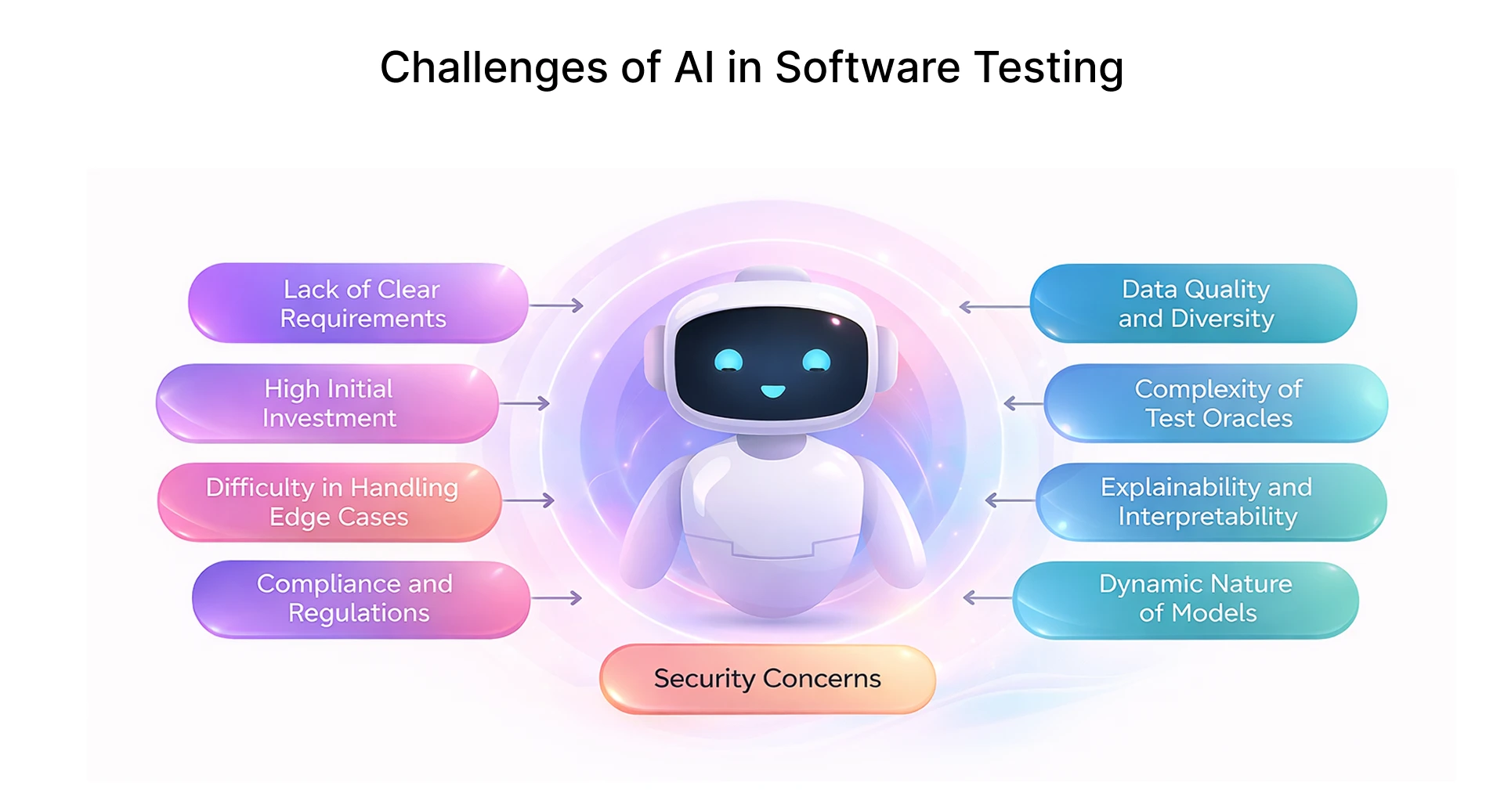
ML models do not work that way. Hundreds of features exist. Probability distributions appear everywhere. Activation functions fire inside hidden layers. Smart engineers have cried over this problem. Not joking about that.
Two days of debugging a flaky test. The test is not flaky, though. The model is doing what models do.
Run statistical equivalence tests across repeated runs. Build adversarial test cases too. Attackers do not use clean data. Neither should QA tests. Flag wildly different scores on similar transactions. That means something broke internally.
3.False Positives Kill Customer Relationships
A 1% false-positive rate sounds small. Do the actual math. A high-volume platform sees thousands of angry customers every single day.
LexisNexis True Cost of Fraud report shows false positives drive churn. More than actual fraud declines. Think about that finding carefully.
Frugal Testing worked with a mid-sized payment processor. Real story here. A loyal customer gets declined on Friday night. 200 milliseconds pass. No reason is provided. No explanation appears. That customer does not call support. That customer goes to a competitor instead. Never comes back.
Root causes appear regularly. Class imbalance tops the list. Fraud is rare. Models overcorrect constantly. Overfitting to old cases happens often. Old cases look nothing like new attacks. Legacy rules still run. Nobody turned them off.
What metrics actually matter? False positive rate under one percent. Precision above 95 percent. Recall above 90 percent. F1 above 0.92. ROC-AUC above 0.97. Track all of them together. One metric alone always lies.
4.The Tooling Situation Is Sad
Most QA engineers have great REST API tools. Web UI testing tools work fine, too.
Three things happen in the real world. First, teams build custom tooling from scratch. Expensive approach. Slow to build. Wrong on first try usually. Second, companies buy something that half-fits. Months of integration pain follow. Third, teams skip validation entirely. Happens more than anyone admits. Frugal Testing sees this every week.
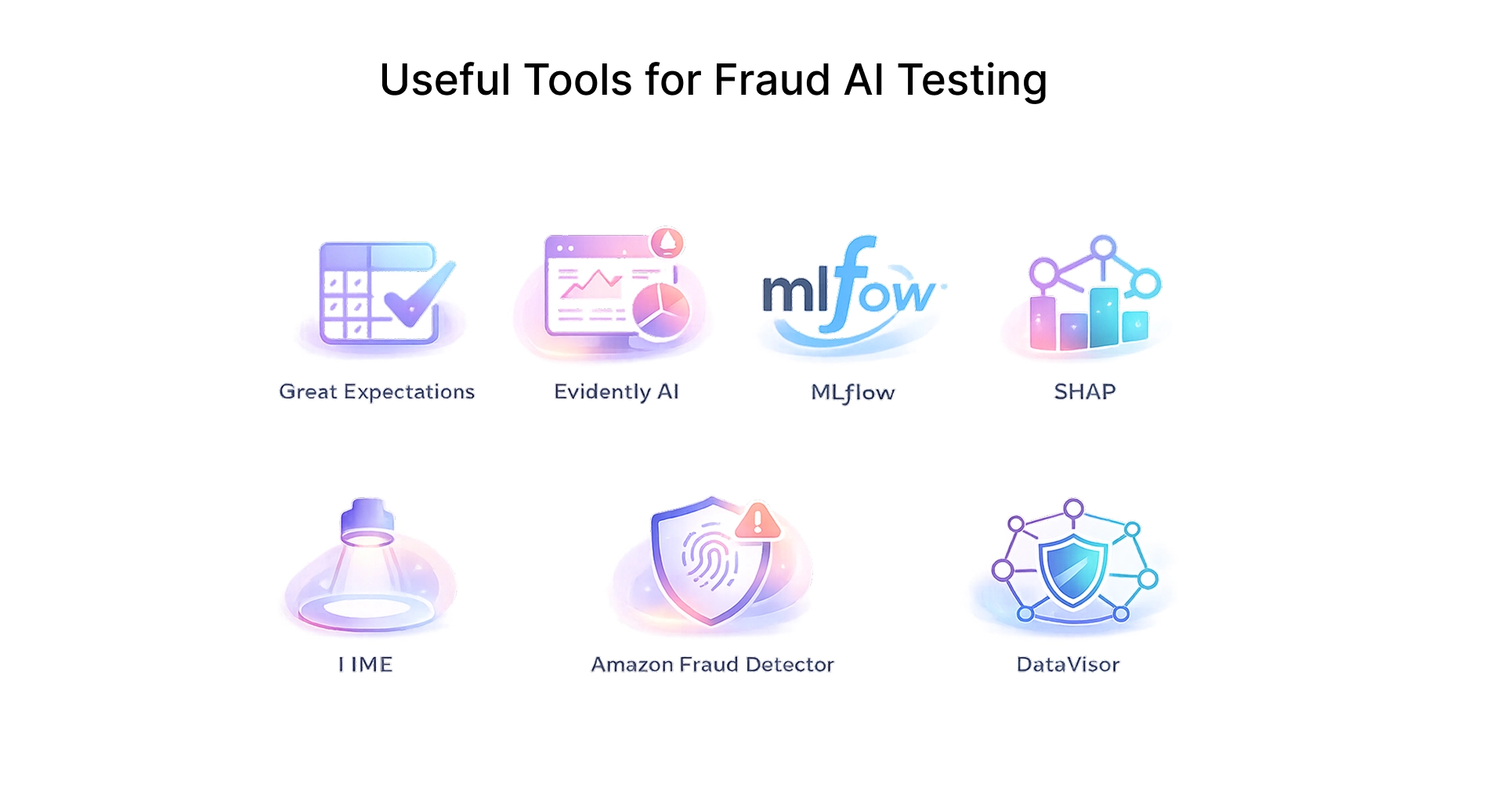
Tools that actually help include these options. Great Expectations for data quality. Evidently, AI for drift monitoring. MLflow for versioning control. SHAP and LIME for explainability. Amazon Fraud Detector for pre-built tests. DataVisor for unsupervised plus supervised ML.
5.The Clock Is Ticking
Different models give different trade-offs. K-nearest neighbor runs under 10ms. Lower accuracy follows. Fine for simple fraud cases. Gradient boosting takes 20-80ms. Strong balance appears here. Most teams end up with this option. Deep learning takes 50-200ms. Highest accuracy possible. Real latency risk exists at peak load.
Average latency numbers lie constantly. P95 and P99 decide real outcomes. A 400ms p99 means declining good transactions regularly.
Client example from real work. A payment processor validated at average daily volumes. Load tests passed initially. A big retail promotion weekend arrived. P99 hit 410ms hard. Legitimate transactions declined in batches. The feature store timeout behavior appeared. Never tested under peak load conditions.
What works instead? Simulate three to five times peak volume. Run accuracy checks during load tests. Not separately as an afterthought. Test feature store failures mid-scoring. That will happen eventually in production. Validate third-party responses under degraded networks.
Example of degraded behavior. A fraud API returns stale cached data after 150ms. No timeout error appears. Just old scores come back. The system keeps working. Scores are completely wrong. Test specifically for that scenario.
6.The Black Box Problem
Deep learning gives accuracy without reasoning. A QA problem and a compliance liability together.
SHAP example from real audits. The model says a transaction is flagged because of the amount. The transaction amount was four dollars. Something is clearly wrong. That is how teams end up on the evening news.
Validate SHAP values map to real fraud indicators. Not random noise patterns. Test reproducibility across identical inputs. The same model version must give the same explanations. Confirm documentation meets regulatory standards. Get legal sign-off before release. Audit for demographic bias before every release. Verify human review before automated freezes.
Put explainability testing on every release checklist. No exceptions allowed. Treating this as optional creates current risk. Not future risk somewhere down the road. Current risk right this moment.
7.Models Get Dumb Over Time
Degradation happens silently every day. No alert sounds. No warning appears. The system keeps scoring anyway. Loss reports start climbing slowly.
Catastrophic forgetting occurs during retraining. New fraud data kills old pattern accuracy. Test against historical holdout datasets after every cycle. Training data poisoning happens, too. Bad data manipulates future behavior badly. Validate training data integrity before each retraining. Silent accuracy drift appears gradually. Decline below thresholds without any alert. Automated monitoring provides the only real defense.
What actually works in production? Lock accuracy baselines after every retraining. Use these as regression benchmarks. Shadow test new models against production traffic. Run shadow tests before any rollout. Validate the sanctions list compatibility with every AML update. Do not explain a failure to a regulator later. Set automated alerts for FPR and miss rate crossings. Kill manual weekly dashboard reviews entirely.
Best Practices for QA in AI Fraud Detection
Frugal Testing learned these lessons the hard way. Many late nights. Many angry calls.

Distribution testing replaces binary outcomes completely. Look at score distributions across thousands of transactions. A shifted distribution signals a real problem. A single failed assertion signals nothing useful.
Build a continuous testing pipeline. Three phases work well.
Pre-deployment phase:
- Run model validation against holdout datasets
- Do not use training data ever
- Training data gives false confidence
- Perform bias testing across demographic groups
- A model working for one group may fail another
- Find failures before customers find them
- Verify that explainability outputs meet regulatory standards
- Get legal sign-off before release
- Not after a regulator asks questions
Post-deployment phase:
- Deploy drift detection for every input feature
- Use automated alerts for significant shifts
- Do not wait for human reviews
- Monitor false positive rates every single day
- Slow creep upward means something changed
- Catch creep before a crisis hits
- Track accuracy against a fixed holdout set weekly
- Do not change the holdout set often
- A stable benchmark reveals degradation clearly
Retraining cycles phase:
- Shadow test the new version against live production
- Run side by side for seven full days
- Compare every decision before trusting the new version
- A/B compare false positive and miss rates
- A small improvement in one metric may hide a large regression
- Validate AML and sanctions list compatibility after every retraining
- Regulators do not accept outdated checks
- Build validation into the retraining pipeline directly
Wire everything into CI/CD. Manual gates do not work. People forget tests constantly. People run the wrong tests often. People skip tests when deadlines loom large.
Automate every validation step completely. Catch degradation before production deployment. Not after customers start complaining loudly.
Set hard pipeline failure conditions. FPR above two percent stops deployment. Precision below 90 percent stops deployment. No exceptions for emergency releases ever.
Keep all validation results from each retraining cycle. Store model versions alongside test outputs. Store data distribution profiles too. Explainability outputs need permanent storage. A regulator may ask about a transaction from six months ago.
Where Things Are Headed
Regulators are moving quickly now. The Bank of England published CP6/22 on AI. The EU AI Act is in force as of 2024. The US follows compressed timelines.
Tier 1 banks and major processors push new approaches. The National Payments Corporation of India has requirements. Singapore and Australia watch closely.
What arrives next? Synthetic fraud simulation for edge cases. LLM-powered anomaly validation for explanations. Agentic QA systems that test autonomously. Federated learning validation across institutions. Blockchain audit trails for immutable logs.
EU AI Act deadlines are already published. Bank of England enforcement timelines are coming. Teams building this now will face fewer surprises.
Wrapping This Up
Testing AI fraud detection needs organizational buy-in. Not just a better test suite alone. Not just a shiny new tool. Real commitment from leadership down to every QA engineer.
Frugal Testing caught a twenty-two percent loss increase. A Tier 2 bank model failed silently. The accuracy degraded during a routine retraining cycle. Nobody noticed for three full weeks. A simple shadow test would have caught the failure immediately. Frugal Testing builds those lightweight safety checks.
The seven problems connect tightly. A weak data pipeline creates biased training data. Biased training data drives false positives higher. Poor monitoring hides degrading miss rates. Missing explainability creates regulatory exposure.
Probabilistic validation must run consistently. Active drift monitoring must run consistently. Explainability testing must run consistently. Data governance across every release cycle.
Frugal Testing built these practices across dozens of payment companies. The patterns work reliably. Failures decrease significantly. Regulators stay satisfied with the results.
Audit Before The Next Incident
Frugal Testing runs fraud AI QA assessments for payment platforms. Precision and recall validation included. Explainability testing against regulatory standards is included. Continuous QA pipeline implementation included.
Book a Fraud AI QA Assessment with Frugal Testing. The next fraud incident or regulatory review is coming. The only real question is whether testing is ready first.
FAQs (People Also Ask)
Q1.How do QA teams validate AI fraud models without fixed expected outputs?
Ans: QA teams validate AI fraud models using score ranges. Define acceptable score ranges for known fraud cases. Define acceptable score ranges for known non-fraud cases. Apply statistical equivalence testing across repeated runs. Validate confidence intervals against labeled historical fraud datasets.
Q2.How do teams test real-time fraud detection under production conditions?
Ans: Testing real-time fraud detection needs production load simulation. Simulate three to five times peak transaction volumes. Not the average daily load for testing. Measure P95 and P99 latency carefully. Run accuracy validation during load tests simultaneously. Test upstream failure paths as expected events. Not as edge cases to ignore.
Q3.What role does data drift play in model failures?
Ans: Data drift shifts input distributions without crashing the model. Accuracy degrades silently while scores return normally. Automated monitoring with threshold alerts provides the only reliable detection.
Q4.How should QA teams validate model updates before rollout?
Ans: Validating model updates requires shadow testing first. Shadow test new versions against production models first. Regression test against historical fraud datasets. Use datasets covering multiple fraud pattern eras. Compare false positive rates before any full rollout. Compare miss rates before any full rollout, too.
Q5.Why does explainability matter in fraud AI QA?
Ans: Explainability matters because regulations demand clear answers. GDPR Article 22 requires explainable automated decisions. KYC standards require explainable automated decisions. AML documentation frameworks require the same. Missing explanations create regulatory exposure. Missing explanations eliminate debugging capability entirely.

.webp)

.webp)