


The regression occurred in two sprints after the team flagged the feature as "complete" despite its existence since a change in schema in the third sprint prior. The regression lay around, untouched because no one was tasked with running the single path of regression, which had not been automated yet. This is how agile testing looks when it works imperfectly, not a complete failure, but one missing piece that survives the sprint that produced it.
Under the Agile methodology, software quality is not a separate step in software development but rather integrated through continuous testing. Breakdowns usually occur as a result of three problems: Unclear user stories, regression backlog overtaking sprint capacity, and inadequate test automation. Adding more testers does not solve these problems, since it means adding more guesses.
What Is Agile Testing
Agile testing is software testing woven into every sprint rather than saved for the end. Testers work alongside developers throughout the agile testing life cycle instead of waiting for a handoff at the sprint's close, whether you call it agile testing methodology or simply testing in agile.
Developers, testers, and product owners share ownership of quality under this model, rather than routing everything through a separate quality assurance department. It sits inside a broader family of agile software methods:
- Extreme Programming pairs automated unit testing with every code change.
- Dynamic Software Development Method (DSDM) timeboxes testing into fixed delivery windows.
- Crystal Method scales rigour to team size and risk.
- Behavior-Driven Development (BDD) and Acceptance Test-Driven Development (ATDD) write test cases from user stories before code exists, echoing test-driven development principles.
How Agile Testing Differs from Traditional Testing
- Timing: Traditional software testing runs sequentially, build first, test after, while agile testing in software testing runs concurrently with development.
- Feedback loops: A defect caught on day two costs a fraction of one caught in staging three weeks later.
- Ownership: Development and testing teams share the acceptance bar instead of testing sitting downstream.
- Pace: Software testing agile style happens every sprint, not once per release, the core of shift left testing in agile.
The Framework Behind It: Agile Testing Quadrants
Lisa Crispin and Janet Gregory's Agile Testing Quadrants model splits testing into two axes: Technology-facing versus business-facing, and supporting the team versus critiquing the product. Every challenge below maps back to one quadrant.
Principles, Life Cycle, and Tools
- Principles of agile testing: A whole-team activity; continuous feedback loops; early testing (shift left testing in agile) before defects compound into regression cycles; automate the repetitive through process automation; working software over documentation, straight from the agile manifesto.
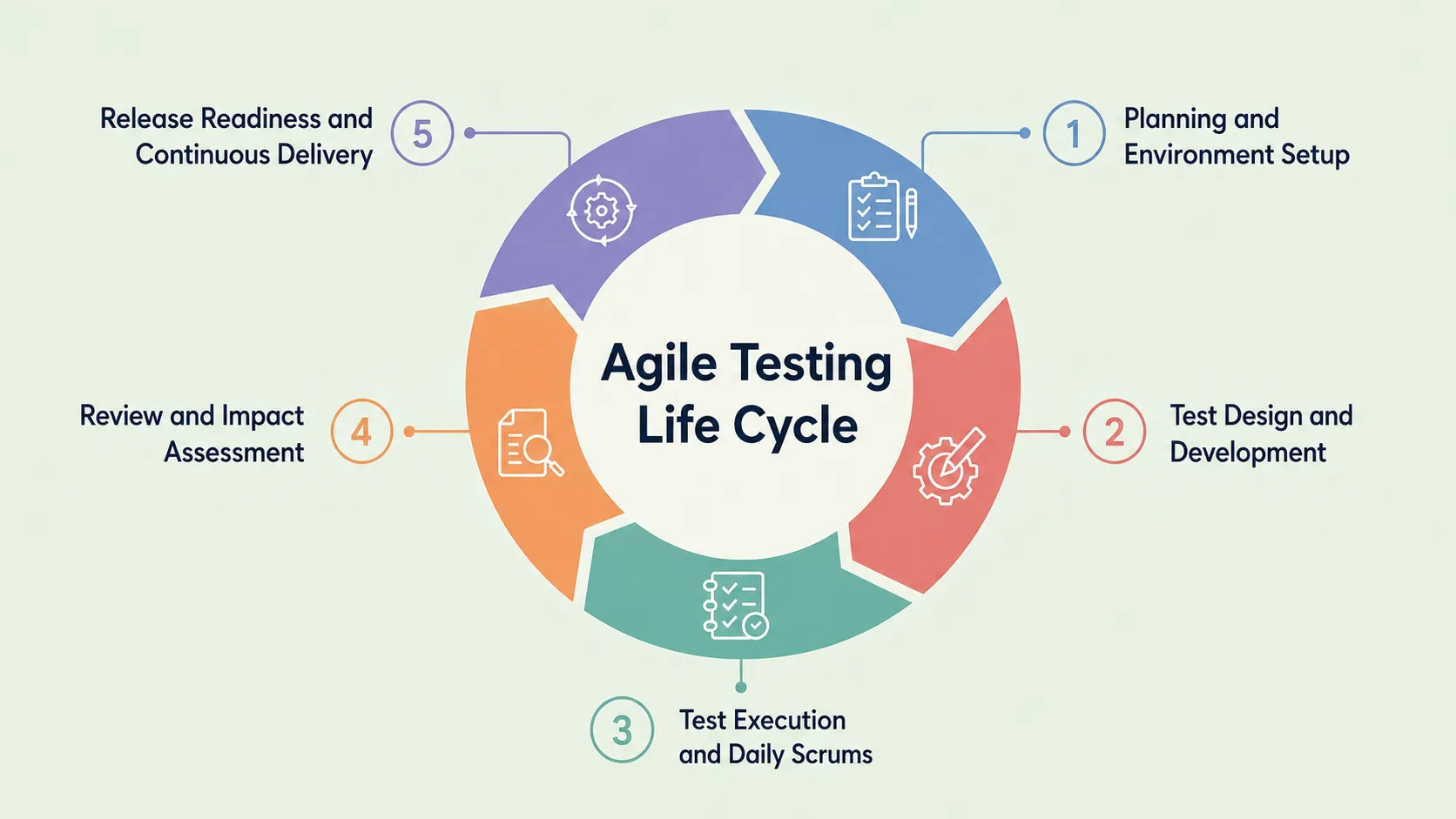
- Agile Testing Life Cycle, usually the answer to what are the stages of software testing (shown in an agile testing life cycle diagram): User stories and acceptance criteria, sprint planning, test cases and test scripts, testing via automated tests and exploratory and session-based testing, bug tracking in each pull request, and finally regression testing before release.
- Agile testing tools include automation frameworks like Selenium, Cypress, Playwright, API testing tools like Postman, test management tools like Jira, TestRail, and CI tools like Jenkins, GitHub Actions, and GitLab CI.
- Types of agile testing are unit testing, agile functional testing, API testing, performance testing, security testing, usability testing, exploratory testing, and acceptance testing.
The Core Challenges in Agile Testing and How We Fix Each One
The QA lead from a SaaS company of ninety employees informed us that her team was "doing agile," and they seemed to be so on all the ceremony checklists. However, an error in their login process left password resetting impossible for one out of twenty users due to a "the user can log in" story. It is not agile testing that fails due to bad agile execution; it is process-driven failures that make agile testing fail.
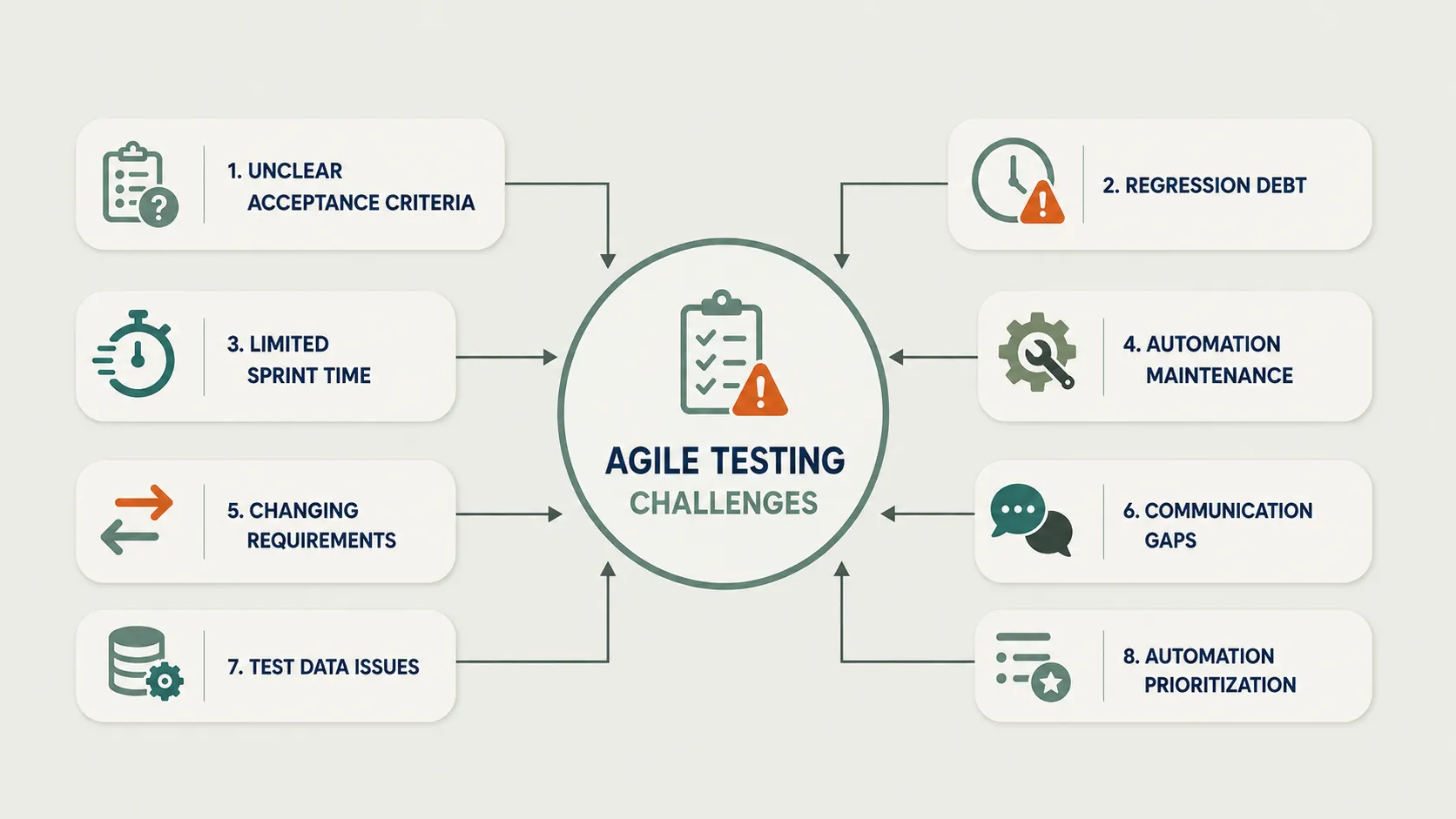
Vague or Incomplete Acceptance Criteria
Challenge: "The user can log in" is not a specification. It says nothing about locked accounts, expired sessions, or retry limits, so testers guess at edge cases or block the sprint waiting on clarification. In our experience, this single habit causes more regression escapes than any tooling gap.
Fix:
- A Three Amigos review: Developer, tester, product owner, before a story enters the sprint.
- Set a minimum acceptance-criteria threshold a user story cannot pass the sprint gate without.
- Write acceptance testing scenarios alongside the story, not after, so edge cases surface early.
Regression Debt Accumulating Faster Than Sprints Can Absorb
Challenge: Every sprint adds code, and every addition needs a regression check against everything shipped before it. Left unmanaged, this becomes technical debt that manual regression cycles cannot absorb.
Fix:
- Automate the highest-traffic regression paths first.
- Run them through continuous integration across CI/CD pipelines on every pull request, via Jenkins, GitHub Actions, or GitLab CI.
- Reserve manual effort for genuinely new functionality.
Fitting Full Testing Coverage Into a Two-Week Sprint
Challenge: Full regression coverage plus new-feature testing plus exploratory or session-based testing rarely fits into ten working days once standups and environment issues are counted in.
Fix:
- Risk-based testing: Full regression on high-impact features, smoke tests on routine ones.
- Decide by a scoring model, not a sprint-by-sprint argument.
- Tighter release windows make this prioritisation non-negotiable once a team ships weekly instead of monthly.
Test Automation That Cannot Keep Pace With the Backlog
Challenge: Teams build automated tests fast and skip the maintenance plan. Flaky tests accumulate, developers stop trusting red builds, and test automation coverage stalls well below what the team assumes.
Fix:
- Quarantine flaky tests the moment they are flagged.
- Dedicate a fixed share of effort to maintaining existing automated testing frameworks, not just writing new test scripts.
- Track defect detection rate and test execution times as quality metrics, not just pass or fail counts.
Requirements That Shift Mid-Sprint
Challenge: A rigid test suite built for the original requirement breaks the moment it changes, and rewriting test scripts after the fact is slower than writing them with the change in mind.
Fix:
- Use behavior-driven development as a requirements-clarity tool.
- Given-When-Then format surfaces ambiguity the instant someone writes the test.
- Keep test data aligned to the current requirement, not the original one.
Communication Breakdowns Between Distributed QA and Dev Teams
Challenge: A tester in one timezone finds a defect the developer will not see for hours, and by the time they respond, the test environment context has gone stale.
Fix:
- A short recorded reproduction instead of a text-only bug report.
- A dedicated tester-developer sync kept separate from full standup.
- Shared test management tooling so both sides see the same test case history.
Test Data Management Across Environments
Challenge: Test data quietly breaks more sprints than most retrospectives admit. A tester runs a suite against staging data a teammate has already modified, and the team loses half a day debugging a problem that was never in the code. We would argue this challenge gets far less attention than it deserves relative to the time it wastes.
Fix:
- Refresh or seed test data at the start of every sprint.
- Use synthetic test data for edge cases live data rarely covers.
- Isolate test environments per feature branch where the pipeline allows it.
Deciding What to Automate First
Not every test type deserves equal investment, and the table below shows where to start.
Risk-based testing beats "automate everything" every time we have seen it tried. Full coverage sounds safer on paper, but it is usually why automation backlogs stall at sixty percent and never finish.
How Frugal Testing Helps You Close the Gap Between Agile Theory and Sprint Reality
We call this agile QA embedding: Testers who join a client's sprint cycle rather than review finished builds. We sit in sprint planning, help define acceptance criteria before a story is pulled in, and build the risk-based regression model above alongside the client's own development and testing teams. The goal is a team that owns its agile test strategies once we leave, not one that depends on us.
We help three kinds of teams most often: Fast-growing SaaS companies whose feature velocity has outpaced their regression suite, teams shifting from ad hoc testing into a real agile testing process, and distributed organisations where QA and development sit in different time zones, and the communication gaps above are a daily tax rather than occasional friction.
Across our engagements, unclear acceptance criteria is the most common root cause we trace regression escapes back to. Most of what breaks agile testing is a process gap, not a headcount gap, which is the case for an embedded partner over hiring in-house: The fix is structural.
What Our Agile QA Engagement Looks Like
- Process audit against where the current process actually breaks.
- Acceptance-criteria workshop with product, engineering, and QA in the same room.
- Risk-based test model build, prioritising what gets automated first.
- Embedded sprint participation, working inside the team's own ceremonies.
At close, the client owns a documented test strategy and best practices they can keep evolving, not a dependency on us.
Who This Is For
Teams past their first two or three sprints, seeing regression escapes or missed acceptance criteria as a pattern, are the clearest fit: A production defect traced to unclear acceptance criteria, or a QA team that has quietly stopped trusting its own automated suite.
Conclusion
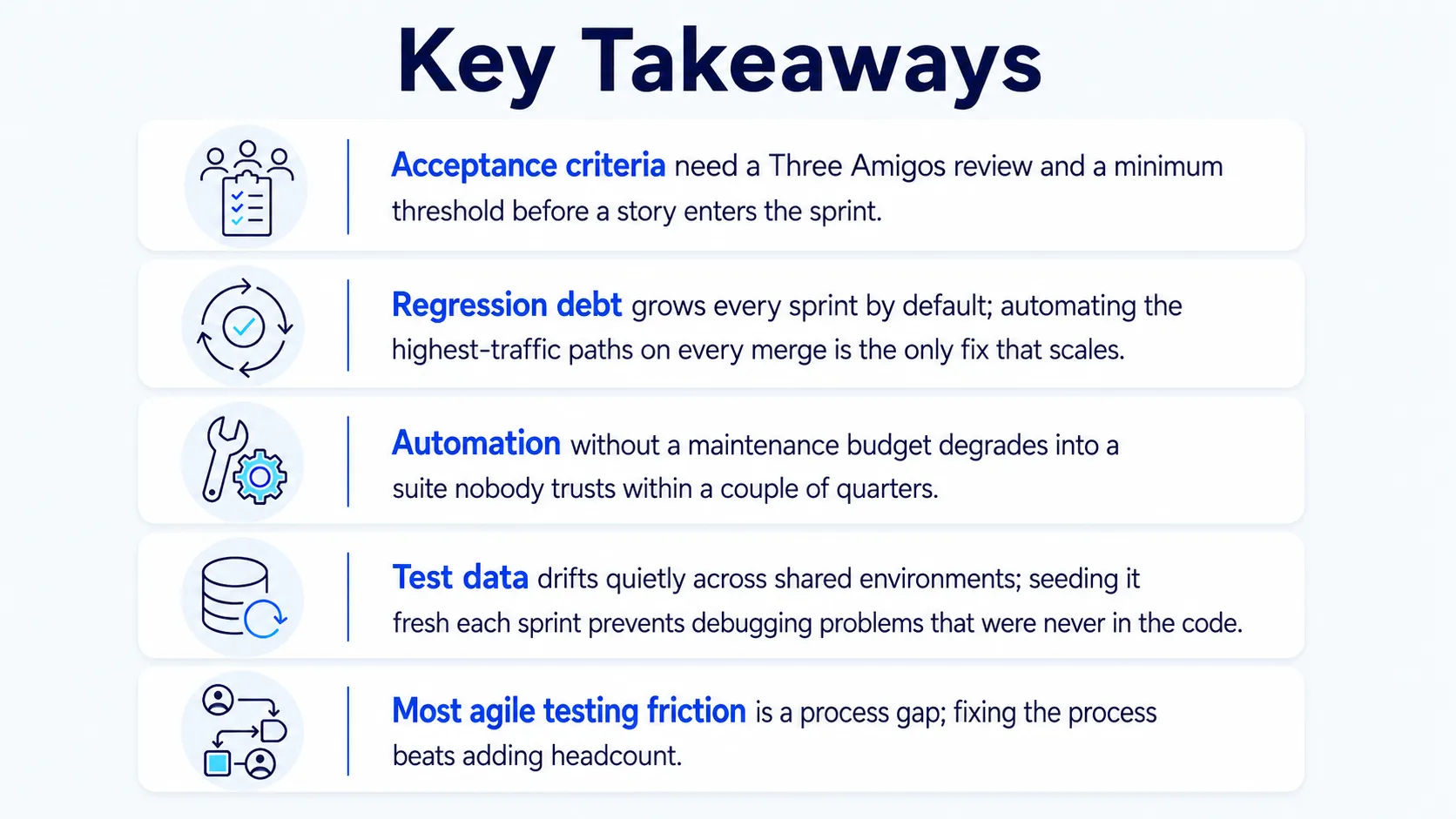
Acceptance-criteria clarity, risk-based regression prioritisation, and a communication structure built for distributed teams fix most agile testing friction, not more tooling. Agile testing was never meant to be a bigger version of the old gate, just moved earlier. Customer satisfaction usually follows the same quality metrics teams already track internally, and agentic AI is starting to touch test case generation and defect triage, though Artificial Intelligence still needs a clean development lifecycle underneath it to be worth anything. The teams that get the basics right rarely talk about it. The ones that do not usually find out in production.
People Also Ask (FAQs)
Q1. What tools do teams commonly use for agile testing?
Ans: Most teams combine automation frameworks like Selenium or Playwright with API testing tools such as Postman, and test management platforms like Jira or TestRail to track cases and defects.
Q2. How long does it take to build an effective agile testing process?
Ans: Most teams see meaningful improvement within two to three sprints once acceptance-criteria reviews and automated regression checks are in place, though a fully matured practice takes longer.
Q3. Does agile testing remove the need for a dedicated QA team?
Ans: No. Agile testing spreads ownership across developers and product owners too, but dedicated testers still lead test strategy, and the exploratory judgement calls automation cannot replicate.
Q4. How does agile testing fit into a DevOps or CI/CD driven workflow?
Ans: Agile testing supplies the test cases and automated checks that DevOps pipelines run on every pull request, making continuous integration and continuous delivery possible without slowing releases.
Q5. Are there recognised certifications for agile testers?
Ans: Yes. The ISTQB Agile Tester extension and ICAgile's testing certifications are the most widely recognised, though many hiring teams weigh hands-on automation experience just as heavily.