

A QA lead at a mid-size fintech company once told us their regression suite was green the week before a payment gateway outage cost four hours of checkout failures. Every functional test had passed. Not one had touched what happened when the fraud-detection service their checkout flow depended on simply stopped responding. At Gartner's widely cited estimate of $5,600 per minute for unplanned downtime, that single outage worked out to well over a million dollars in impact, before counting the customers who never came back.
That gap, between a green pipeline and a system that actually survives failure, is exactly what chaos engineering exists to close. Retries, failovers, and circuit breakers get written into the architecture diagram and then rarely get tested under real conditions until an actual incident becomes the first real test.
What is Chaos Engineering
So what is chaos engineering, in practice rather than in theory? It is the discipline of experimenting on a system to build confidence that it can withstand turbulent conditions in production. Instead of waiting for a real failure to expose weaknesses, teams create one deliberately, in a controlled way, and watch how the system responds. It relies on hypothesis-driven experimentation rather than guesswork, predicting system behavior under a specific failure and then testing whether reality matches.
A passing regression suite proves the code is correct. It says nothing about system resilience once a dependency disappears mid-request, and that gap matters more every year as architectures shift toward microservices and distributed systems. Netflix learned this directly: during a real 2015 DynamoDB outage, their systems recovered faster than other AWS customers because they had already tested that exact failure mode using Chaos Monkey.
The chaos engineering principles most teams build around come from the same source, the Principles of Chaos Engineering framework that formalised what Netflix was already doing informally. Three ideas carry most of the weight:
- Steady state: What normal system behavior looks like, measured in real system metrics rather than assumed.
- Hypothesis: The specific prediction of what should happen when a particular failure hits.
- Blast radius: How much of the system, and how many real users, an experiment can touch before it shuts down automatically.
More tests are not always the better answer. Three well-designed experiments that run on every deploy teach a team more about system resiliency than thirty run once, during an audit, and never repeated.
Chaos Engineering vs. Chaos Testing
Chaos engineering and chaos testing get used interchangeably on most QA tickets, and that is usually where scoping problems start. Chaos engineering is the ongoing discipline, the habit of continuously probing assumptions about fault tolerance and reliability in testing as the system evolves. Chaos testing is a single experiment run within that discipline. Treating one chaos test as proof of resilience is how a resilience testing programme quietly turns into a one-off audit exercise.
A Comparison Table: Chaos Engineering vs. Performance Testing
Performance testing, sometimes called load testing or stress testing, checks whether a system holds up under expected traffic. Chaos engineering checks whether it survives when something unexpected breaks.
How Chaos Engineering Works
Every experiment follows the same loop end to end, regardless of which failure type or tool is involved, and it does not stop once the failure is injected. The last two steps, identifying what actually broke and fixing it, are where most of the real value sits, even though they are the two steps most rollout guides skip entirely.
- Define Steady State: Measure what normal system behavior actually looks like, using real system metrics rather than assumptions. Response times, error rates, throughput, whatever the team already tracks becomes the baseline everything else gets compared against.
- Form Hypothesis: Predict exactly what should happen to that baseline when a specific failure hits, and write it down before touching anything. A hypothesis with no written pass condition is just guessing with extra steps.
- Inject Controlled Failure: Trigger the failure defined in the hypothesis- a killed instance, added network latency, a downed dependency- inside the blast radius agreed on beforehand. The experiment halts automatically if that radius gets exceeded.
- Observe System: Watch how the system actually responds against the steady-state baseline, not against what the architecture diagram claims should happen. This is where the gap between configured and genuinely tested usually shows up.
- Identify Weaknesses: Compare what was observed to what the hypothesis predicted. A match confirms the resilience mechanism works. A mismatch- a circuit breaker that never opened, a fallback that returned the wrong response- is the actual finding.
- Improve Architecture: Feed that finding back into the system itself, not just into a ticket that sits untouched. Fixing the weakness and re-running the same experiment is what turns a chaos engineering exercise into an architecture that is demonstrably harder to break each time.
This loop is what separates chaos engineering from a single chaos test: The same six steps run again on the next release, not just once during an audit.
How to Start Chaos Engineering Without Causing a Real Outage
A usable hypothesis beats a vague intention. "Check if payments break" gives an experiment no defined pass condition, while a properly scoped one names the specific failure, predicts the exact system response, and states how the team will know whether it held.
Four phases turn that hypothesis into a repeatable practice instead of a one-off experiment nobody revisits:
- Hypothesis: Write it first, before touching any infrastructure. A prediction with no written pass condition is just guessing with extra steps, and it gives the team nothing to check the result against afterward.
- Staging: Run the first experiment here, where a wrong guess costs time, not real users, and surfaces exactly which fallback mechanisms actually fire versus which ones only look configured.
- Pipeline gate: Once staging results hold steady across several repeated runs, not just one green pass, fold the experiment into the CI/CD pipeline as a pre-deployment gate rather than something someone remembers to run occasionally.
- Production: Graduate to low-risk game days only after the rollback path is confirmed and ready, starting with the smallest blast radius that still produces a useful signal.
Skipping straight to phase four is how a controlled experiment turns into a real incident. It is the single most common reason teams try chaos engineering once and never come back to it, and it is also the easiest phase to skip under pressure to "just prove it works" for a demo or an audit.
What to Test: 5 Failure Types
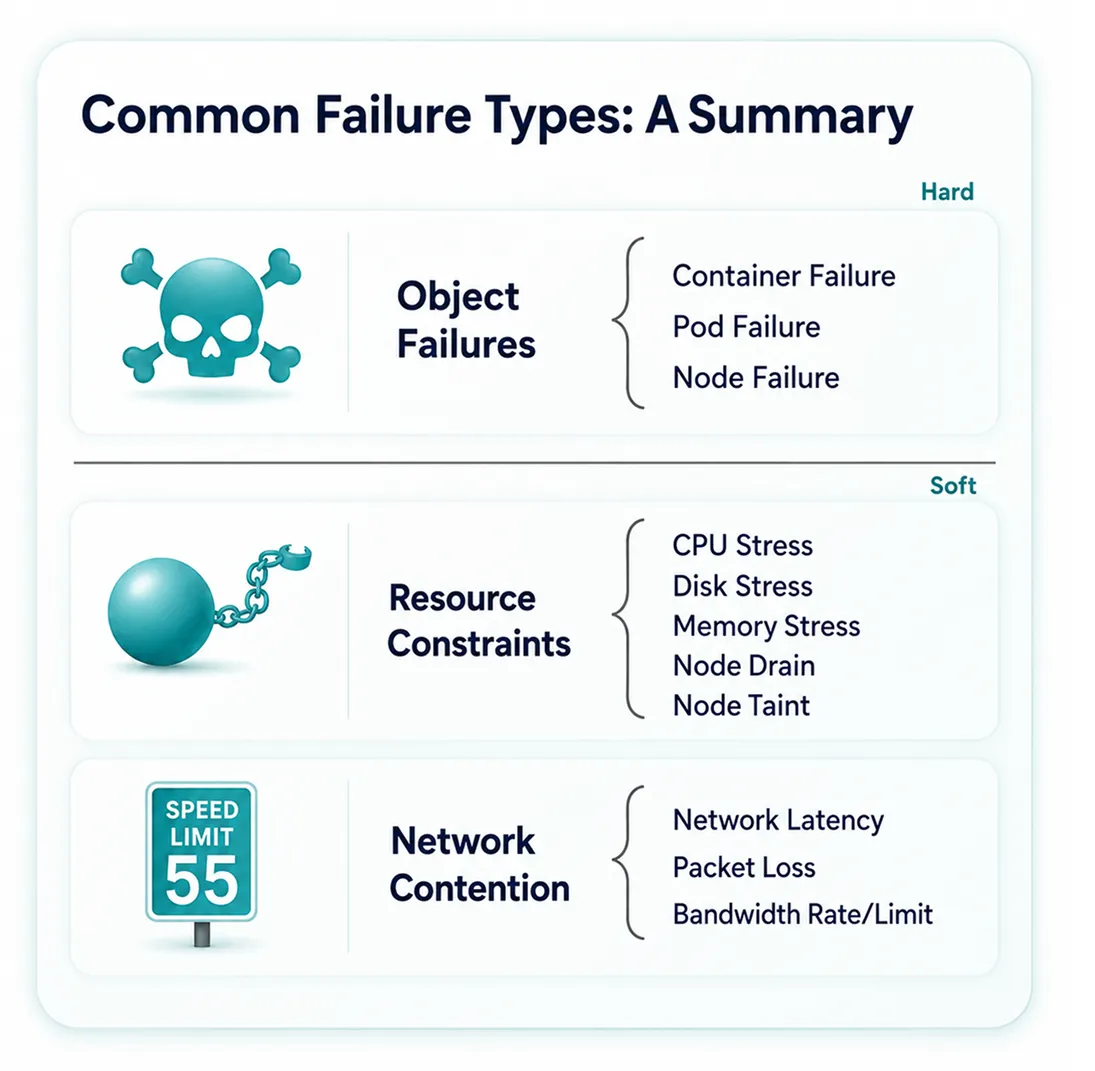
Testing "resilience" in the abstract does not give a team anything concrete to plan a sprint around. Breaking failure surface area into five categories fixes that, and each one targets a different class of system vulnerabilities.
1. Infrastructure Failures
- Injected: Server termination, resource exhaustion, a pool of web servers losing nodes.
- Validates: Auto-scaling, health checks, whether the load-balanced pool and security groups reroute traffic correctly.
2. Network Failures
- Injected: Network latency spikes, packet loss, dropped network connections, DNS failures.
- Validates: Timeout handling, retry logic without cascading failures.
3. Service Dependency Failures
- Injected: A downed API, a slowed database call.
- Validates: Circuit breakers, fallback responses, graceful degradation.
4. State and Data Failures
- Injected: Database failover, cache invalidation across distributed databases.
- Validates: Replication integrity, whether disaster recovery stays invisible to the end user.
5. Application-Level Failures
- Injected: memory leaks, thread pool exhaustion in system components.
- Validates: whether monitoring catches performance issues before a customer does.
Most B2B SaaS teams get the most value starting with service dependency and network failures, since that is where untested assumptions cluster fastest once a product has more than a handful of external integrations.
Chaos Engineering Tools QA Teams Actually Use
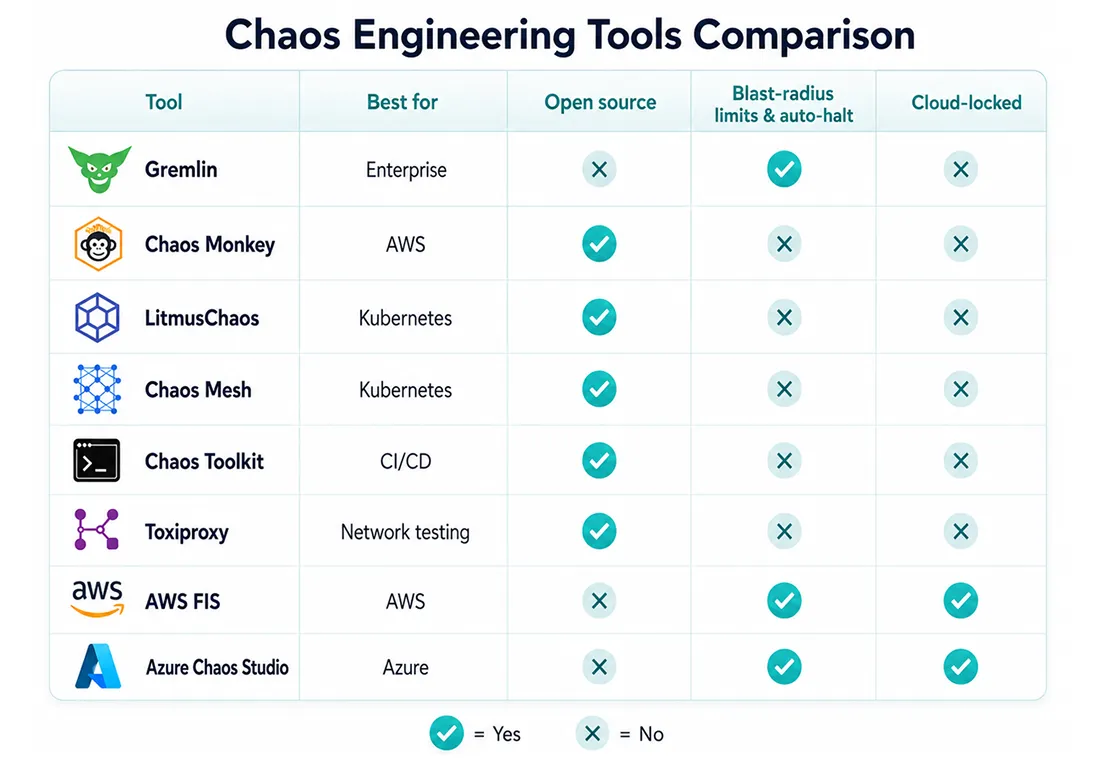
No single tool wins across every stack. What matters is fit:
- Gremlin: Managed platform, built-in blast-radius limits, automatic halt conditions
- Chaos Monkey: the tool that started the category, part of Netflix's Simian Army alongside Latency Monkey (injects delay) and Chaos Gorillas (simulates a full availability-zone failure). The chaos monkey meaning is literal: it randomly terminates instances unpredictably and was originally built for chaos monkey AWS EC2 workloads. Teams doing chaos monkey testing today usually start on a much smaller blast radius than Netflix ever ran.
- LitmusChaos / Chaos Mesh: Kubernetes-native, built for Kubernetes chaos engineering against containerised, cloud-native systems
- Chaos Toolkit: open-source, declarative experiments defined in code, plugs into most CI/CD pipelines
- Toxiproxy: purpose-built for simulating network connection issues without touching infrastructure, a low-risk entry point among chaos testing tools
- AWS Fault Injection Simulator / Azure Chaos Studio: cloud-native options tied to a platform's own reliability tooling
Which one fits your team?
- Already deep in Kubernetes: LitmusChaos or Chaos Mesh.
- Need blast-radius guardrails already built: Gremlin.
- Already committed to AWS or Azure: Use the platform-native option.
Open-source tools need more setup time and infrastructure access. Managed platforms cost more but arrive with safety controls already built.
How Frugal Testing Helps You Test Failure Before It Finds You
Our service maps directly to this problem: Embedding resilience testing into an existing QA or automation engagement, not selling a standalone chaos platform that sits unused after the kickoff call. We map critical dependencies, audit which fallback mechanisms are actually tested versus just configured, and build a chaos testing practice inside the client's existing pipeline. Enterprises tend to bring us in right after a production incident, once they realise the resilience mechanisms on the architecture diagram were never actually verified.
What Our Chaos Engineering Engagement Looks Like
The engagement follows the same four phases covered above, and each one produces something the client keeps rather than a report that sits in an inbox.
- Hypothesis mapping: Map critical dependencies and co-write the first testable hypotheses with the engineering lead.
- Staging experiments: Run the first controlled experiments alongside the existing regression suite, so chaos and functional findings get triaged together.
- Pipeline gate build: Once results hold steady, fold the experiment into the CI/CD pipeline as a permanent gate.
- Production handoff: Help the team graduate to low-risk game days with a rollback path confirmed, handing over the reasoning behind it.
What the client owns at close is a resilience testing practice integrated into their own pipeline, not a black box only we can touch.
The most common systemic weakness we find is a fallback mechanism configured once, never tested, and quietly broken after an unrelated deployment, usually surfacing during incident response rather than before. That gap is a reliability management issue more than a tooling one, and it is cheaper to close early than to absorb the system failures it eventually causes.
Who This Is For
This fits teams with a working CI/CD pipeline and at least one resilience mechanism already in place, or teams evaluating chaos engineering tools for the first time. The conversation usually starts after a recent incident traced to an untested failover, a SOC 2 review requesting evidence of resilience testing, or a migration to a microservices architecture that inherited failure modes nobody has tested yet.
Key Takeaways
- Chaos engineering tests survival, not just whether the code is correct.
- A written hypothesis, not a random outage, is what makes an experiment worth running.
- Start in staging, gate the CI/CD pipeline, then graduate to production, never in reverse.
- QA is well positioned to lead scenario design, since it already knows which flows carry the most business risk.
- Tool fit depends on infrastructure and safety needs, not popularity: Open source and managed platforms trade setup effort against built-in guardrails.
Conclusion
Chaos engineering tests survival, not just correctness, and it starts with a written hypothesis rather than a random outage. Done properly, it builds the kind of business continuity that a passing test suite alone can never promise, since a green pipeline only confirms the happy path was covered. QA is well positioned to lead scenario design here, not just support DevOps on it, since QA usually already knows which user flows carry the most business risk.
People Also Ask (FAQs)
Q1. What is Chaos Monkey?
Ans: Chaos Monkey is Netflix's original tool for randomly terminating production instances. It is open source and remains a common starting point for teams new to chaos engineering on AWS infrastructure.
Q2. How is chaos testing different from a disaster recovery drill?
Ans: A disaster recovery drill rehearses a known, scripted scenario end to end. Chaos testing probes for unknown weaknesses through smaller experiments, often without the team knowing what was injected beforehand.
Q3. What skills does a QA engineer need to run chaos experiments?
Ans: Familiarity with the system's architecture matters more than deep infrastructure expertise. Most QA engineers pick up chaos engineering tools within weeks if they already understand the service dependencies being tested.
Q4. How often should chaos experiments run once a team adopts this practice?
Ans: Mature programmes run small experiments continuously through CI/CD, not as quarterly events. Continuous, low-blast-radius testing catches regressions in resilience mechanisms earlier than periodic game days ever will.
Q5. Does chaos engineering work for monolithic applications, or only microservices?
Ans: It works for both, though the value is higher in distributed systems with more failure points. Monoliths benefit most from testing database failover and resource exhaustion rather than network-level chaos.