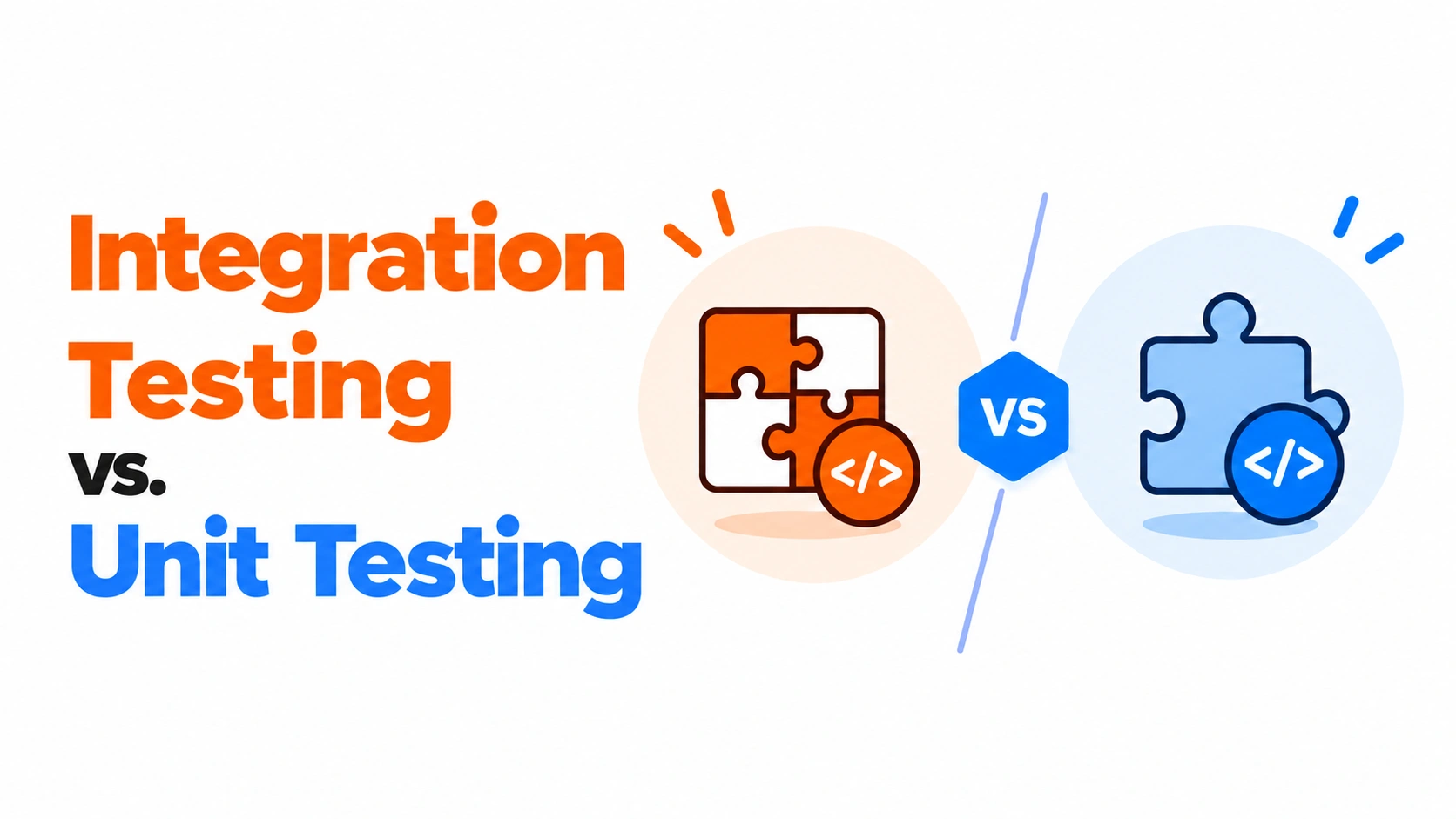



Most teams adopting microservices architecture take several months to rebuild their services and pipelines. They also blindly apply the old quality assurance playbook. That is the main issue.
Monolith testing is not faulty. It is faulty six months later in production as a problematic incident that took hours to investigate and link back to the deployment decision no one can recall making.
Recently, we carried out a coverage audit for a fintech team with over 20 members. They had 400+ unit tests, no contract tests, and had encountered three production issues in six weeks. These issues were all related to changes in the schema between two services.
The issue is not the lack of tests. It is the lack of tests on the right layers.
Why Your Microservices Testing Playbook Is Probably Still Built for a Monolith.
In nearly every post-mortem we’ve been part of, the finding is the same: tests were passing, deployments looked clean - and something still broke.
The issue isn’t in the code itself. It’s what the tests were designed to validate.
Why Do Microservices Fail in Ways Monolith Tests Never Catch?
In a monolith, a test catches the failure exactly where it happens - inside a function. In microservices, failures behave differently. A service doesn’t always crash immediately. It degrades gracefully - and before any visible symptom appears, multiple downstream services may already be returning corrupted or inconsistent data.
Blind spots that can take teams by surprise:
- Service dependencies - a schema change in service A breaks service B's response body parameters with no compile-time warning and no failing test until staging
- Distributed state - data consistency across databases becomes a test environment problem that didn't exist when everything shared one database
- Independent deployments - teams ship on different cycles. A provider silently breaks a consumer contract, and both test suites pass.
- Observability gaps - without Jaeger or Prometheus in your test environments, you're flying blind when a distributed failure hits
The Domain Layer, Protocol Layer, Persistence Layer, and External Layer each carry failure modes your unit tests will never catch.
How Missing One Test Layer Can Lead to Costly Production Incidents
Every new version of the microservice layer of the payments has been published by a mid-size SaaS team. A field within the body of the response is renamed - a two-line modification that is nothing to panic over. E2E clears. Three consumer services had burst into production when the on-call engineer was finally paged. Two engineers could still be seen in a war room, a sprint had been abandoned, and escalation had already made it to the CRO, six hours later.
The figures below are estimates based on typical hourly engineering rates, average downtime revenue loss for a mid-market SaaS, and observed sprint impact - not tied to any specific client.
These estimates are based on aggregated observations from multiple fintech and SaaS testing audits conducted. Actual impact may vary depending on system scale and the duration of downtime.
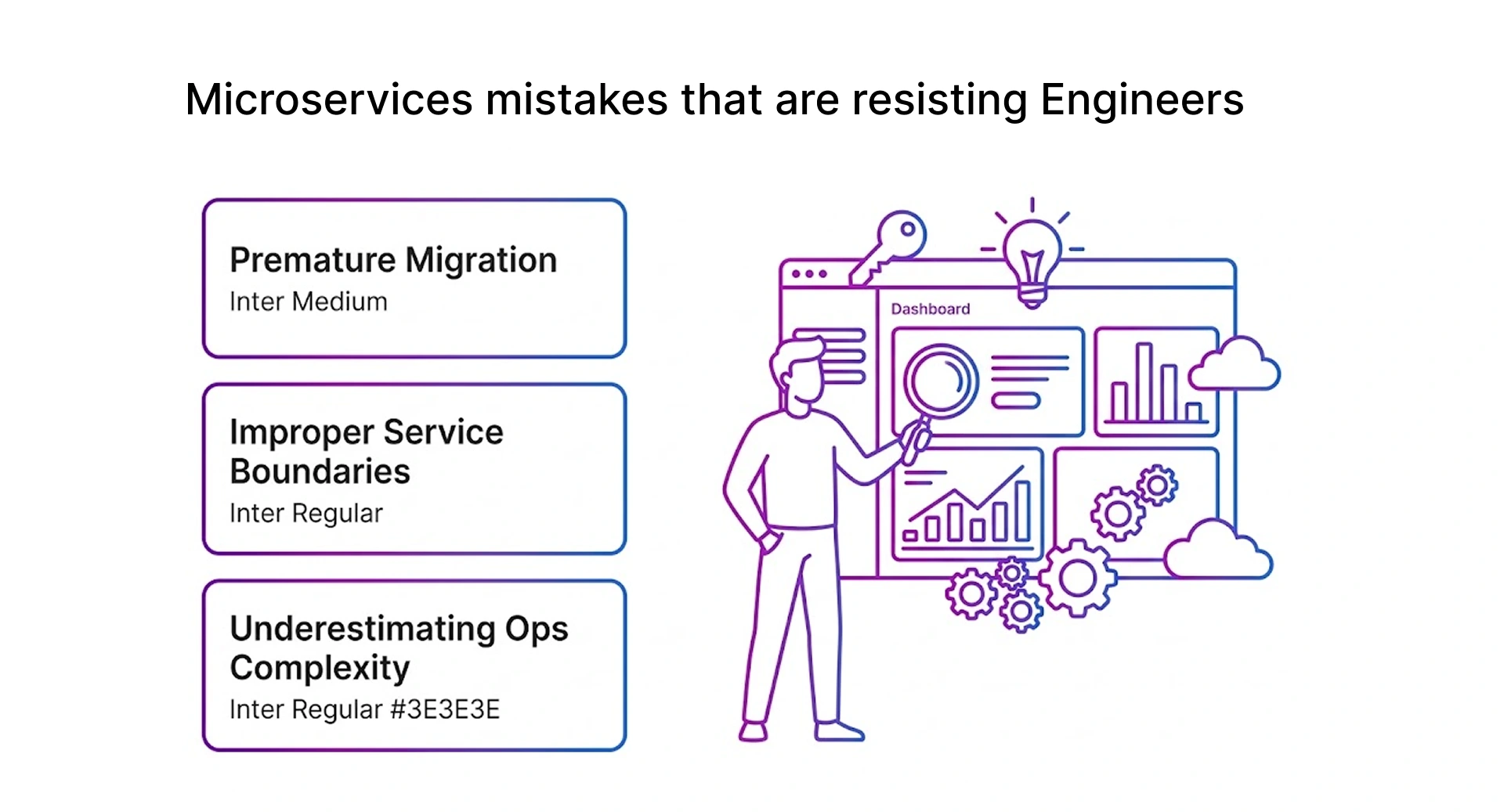
What Are the Most Common Microservices Testing Mistakes?
Across more than 40 fintech and enterprise SaaS engagements, five patterns come up in almost every QA audit:
- Over-relying on E2E tests with no lower layers - 45-minute suites that fail intermittently and don't tell you where the failure is
- Skipping contract testing between independently deployed services, assuming integration tests cover the same ground - they don't
- Testing against non-parity environments - staging that doesn't mirror production Kubernetes configs, Docker versions, or Kafka structures
- Manual QA as the final release gate - workable at 8 engineers, a two-day bottleneck at 25
- No test ownership across service teams - coverage exists on paper, nobody is accountable, and it drifts.
Which Testing Layer Should Your Team Prioritize First?
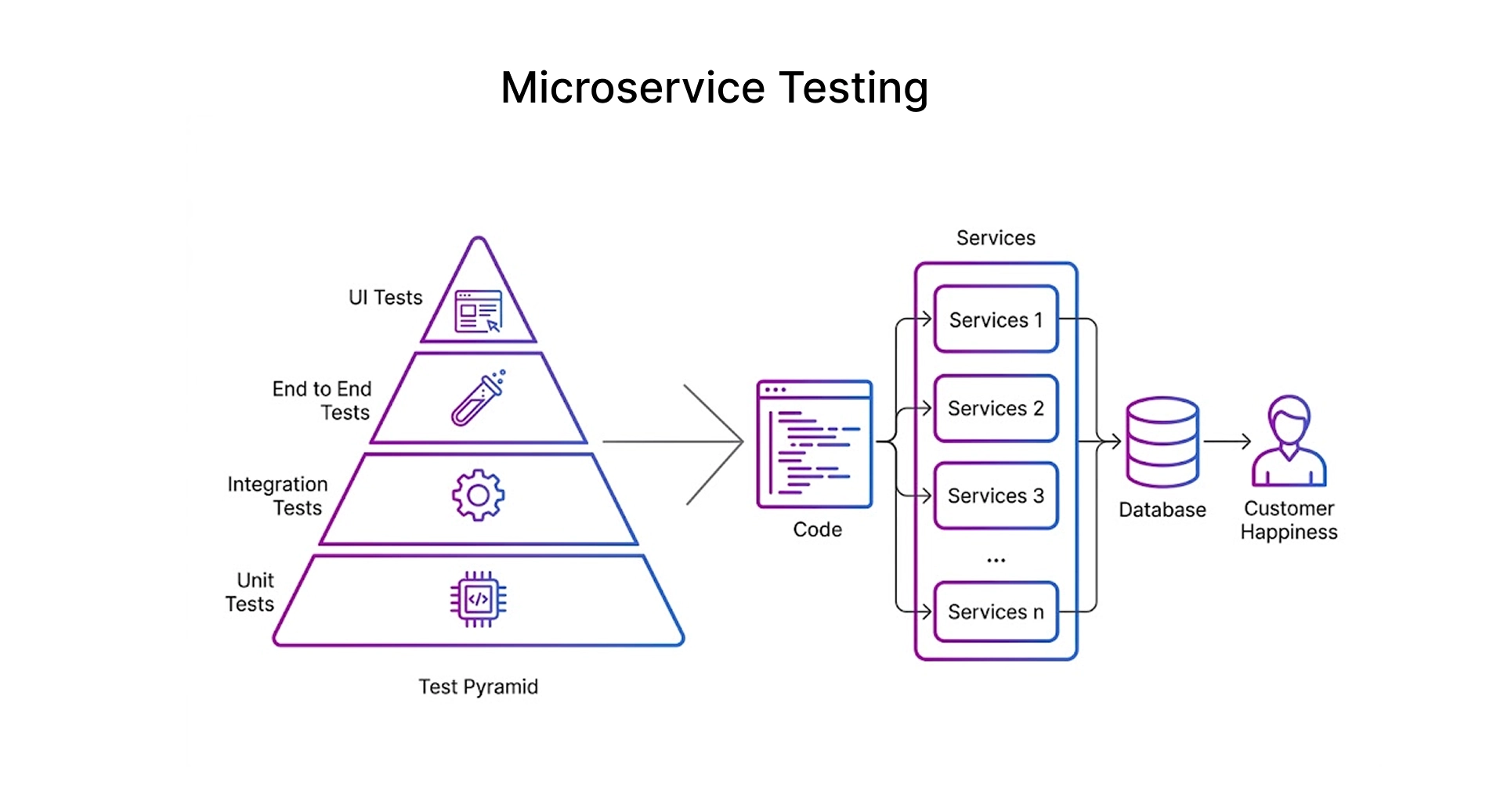
The heavy unit bottom, light E2E top standard testing pyramid fits microservices, though with a single exception. Service boundary failures are not defined within a single service, so unit tests alone can never be given the same weight as contract tests. In the absence of that, you will receive all the unit coverage, and you will have production incidents that will not be caught at all.
Testing automation pyramid proportions provide you with:
- Unit tests - large base, milliseconds to run, highest return per test written
- Integration tests - middle layer, validate service interactions and data flow
- Contract tests - cross-team layer, prevent breaking changes between independently deployed services
- E2E tests - small top, validate complete user workflows, most expensive to maintain
How to Decide: A Testing Layer Decision Framework for Microservices Teams
Unit Testing Microservices: Catch the Defects in the Source, Not in Production
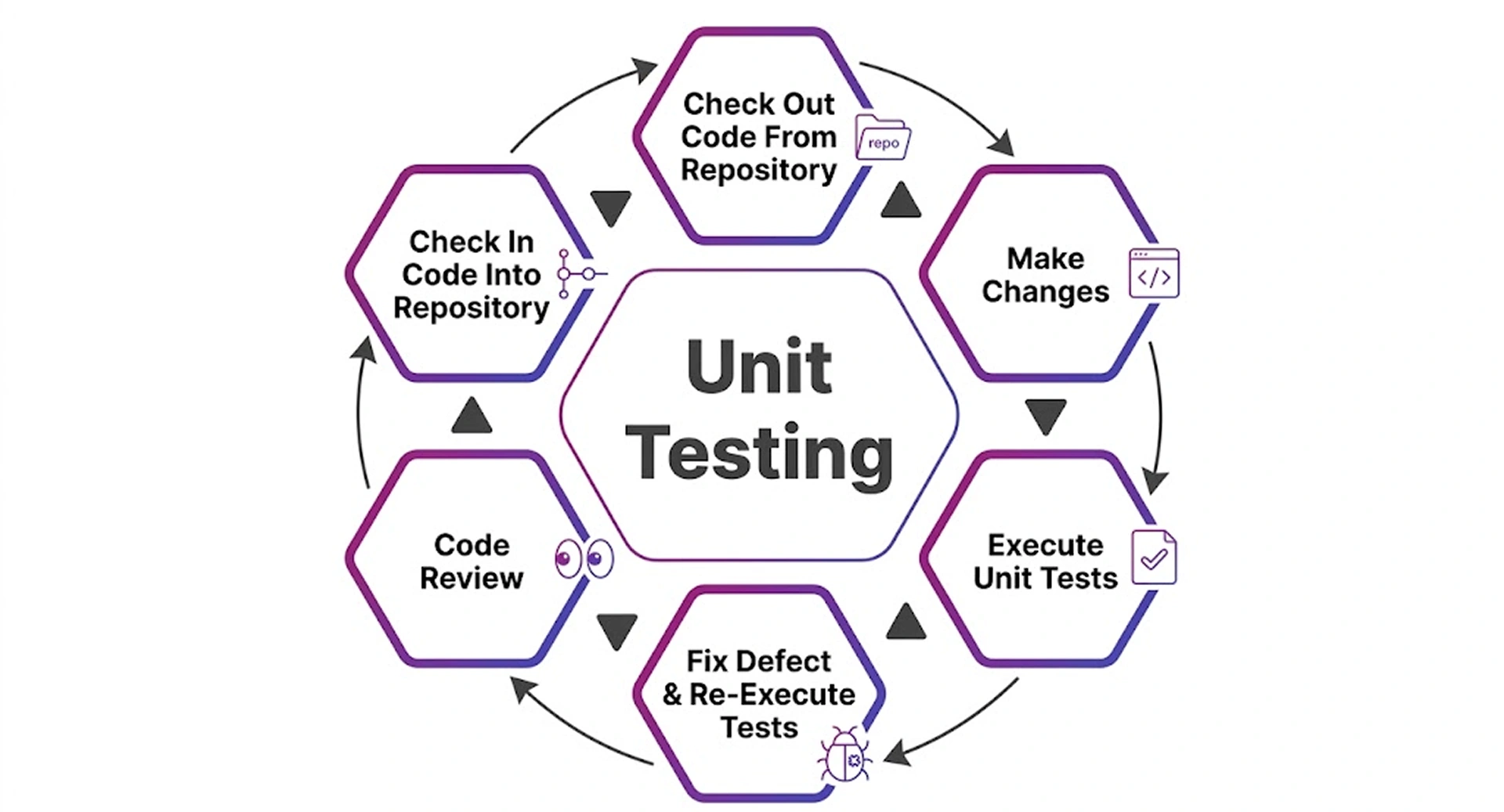
Unit tests catch defects at the lowest possible cost - they run in milliseconds, provide instant feedback, and don’t require shared environments.
The impact of unit testing on your microservices team
Unit testing validates the internal logic of a single service in complete isolation - without relying on external systems like databases, APIs, or networks.
- Reduced debugging cost - fixing a bug at the unit level is far cheaper than diagnosing it in a distributed system.
- Faster CI cycles - tests run in milliseconds, enabling quick feedback.
- Safer refactoring - developers can modify internal logic without breaking downstream services.
- TDD improves API design - writing tests first forces clearer service contracts and better-defined boundaries.
Best Practices of Unit Testing that high-performing engineering teams use
- Write tests first - enforces more API design at the service boundary.
- One assertion per test - each test should validate a single behavior, making failures easier to diagnose
- Keep tests fast - if your test suite takes more than a few minutes, developers will stop running it frequently
- Ensure reliability - flaky or slow tests create false confidence and reduce trust in coverage
How to Select the right Unit Testing Tool and Unit Testing Tool.
This example shows how a unit test isolates the service layer using mocks. The goal is to validate business logic without relying on external systems like databases.
// JUnit 5 with Mockito Java microservice example.
@ExtendWith(MockitoExtension.class)
class PaymentServiceTest {

    @Mock
    private PaymentRepository paymentRepository;

    @InjectMocks
    private PaymentService paymentService;

    @Test
    void shouldProcessPaymentSuccessfully() {
        Payment payment = new Payment("order-123", 99.99);
        when(paymentRepository.save(any())).thenReturn(payment);

        PaymentResult result = paymentService.process(payment);

        assertThat(result.isSuccessful()).isTrue();
        verify(paymentRepository, times(1)).save(payment);
    }
}Frugal Testing installs unit test systems directly into your CI pipeline, Jenkins, GitHub Actions, Bitbucket Pipelines, and coverage reports into Jira and Confluence by default.
Integration Testing: Verifying Your Services Actually Work Together
Two of the services, which are both clearly green in their test suites, both run without issue, and anything fails when communicating with another. The Reason why most Microservices Bugs live there is that Service A sends an ISO 8601 date, while Service B expects a Unix timestamp. Both unit test suites pass - but the failure only appears in production.
Why Most Microservices Bugs Hide Between Services
- Service A sends an ISO 8601 date. Service B will require a Unix time. Both unit suites pass. The failure hits production
- Between calls to a service, an auth token expires. The auth service has also been mocked in the unit test and will not be observed. The actual failure is caught by integration.
Which Integration Testing Strategy Works for Your Team Size?
- WireMock / Mountebank - virtualize services that are not provided in the test mode.
- Seed test data are explicit, clean up, and do not share state between tests.
- Test on all pull requests - not only pre-release.
Integration Testing Tools Worth Knowing
version: '3.8'
services:
  payments-service:
    build: ./payments
    environment:
      - DB_URL=jdbc:postgresql://db:5432/payments
      - KAFKA_BROKER=kafka:9092
  db:
    image: postgres:15
    environment:
      POSTGRES_DB: payments
  kafka:
image: confluentinc/cp-kafka:7.4.0Contract Testing in Microservices - Stop Breaking Other Teams' Services
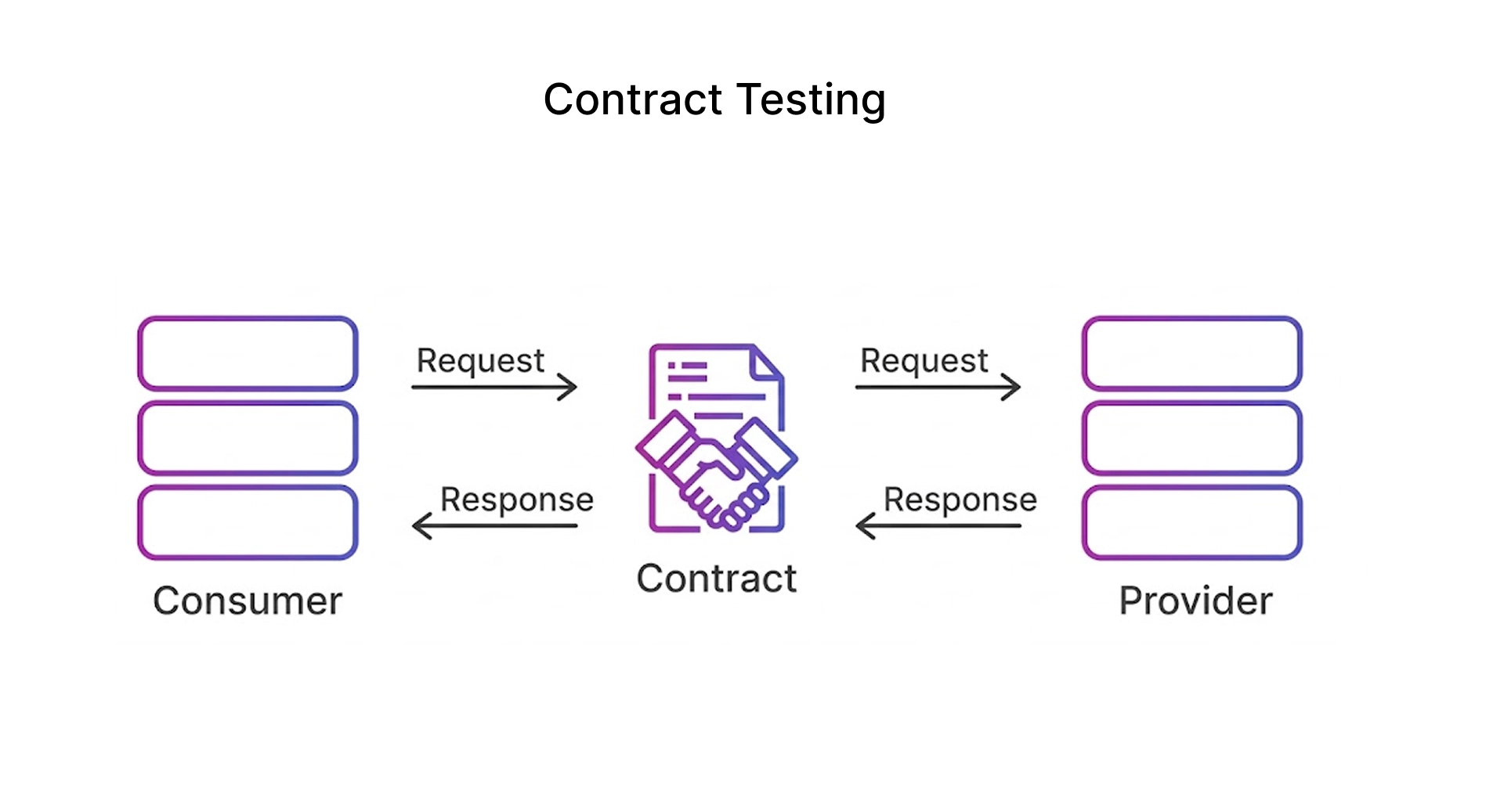
This is the most common situation we encounter when deploying multi-team microservices: two services push at the same time on the same afternoon, both pipelines turn green, something breaks in production, and neither team can tell us why. The Contract verification paper between those services was changed 3 days ago. No one had a mechanism that could be used to check it prior to deployment.
What is Contract Testing, and why do Rapidly-Moving Teams need to take note of it?
Consumer-based testing: the consumer specifies what it requires of a provider - fields, response body parameters, HTTP status codes. The provider has their own CI pipeline to ensure it continues to deliver exactly that on each deployment.
Team A renames the user_ id to userId - it is a change of two characters, nothing that can look dangerous on the inside. The service of Team B gently crashes. Two different deployments, same afternoon, no one talking to each other. It took two hours until users reported 500 errors. Using Pact as the CI gate, the provider verification succeeds before a deployment is deployed to an environment.
How to Implement Contract Testing Without Slowing Down Your Release Cycle
This Pact example defines a consumer-driven contract, ensuring the provider service continues to return the expected response structure before deployment.
// Pact consumer test -- Node.js example
const { Pact } = require('@pact-foundation/pact');

const provider = new Pact({
  consumer: 'OrderService',
  provider: 'UserService',
  port: 8080,
});

describe('User Service Contract', () => {
  before(() => provider.setup());
  after(() => provider.finalize());

  it('returns user profile for valid user ID', async () => {
    await provider.addInteraction({
      state: 'user 123 exists',
      UponReceiving: 'a request for user profile',
      withRequest: { method: 'GET', path: '/users/123' },
      willRespondWith: {
        status: 200,
        body: { userId: '123', email: like('user@example.com') }
      }
    });
  });
});
- The contract is written by the consumer and defines only what is actually used.
- CI is a provider verify on each build, not only the release.
- Pact Broker assigns contracts to teams- no hand-offs.
Which Contract Testing Tool Should You Use?
Frugal Testing adds contract testing to multi-team workflows, including teams on an independent release cycle and with GitOps deployments and Helm deployments.
E2E Testing: Validating Business Workflows Across Your Entire System
E2E tests are slow to develop, slow down your pipeline, and do not respond to infrastructural changes. There is no argument against them - it is an argument in favor of being careful about what they test.
What E2E really Tests (and what it doesn't)
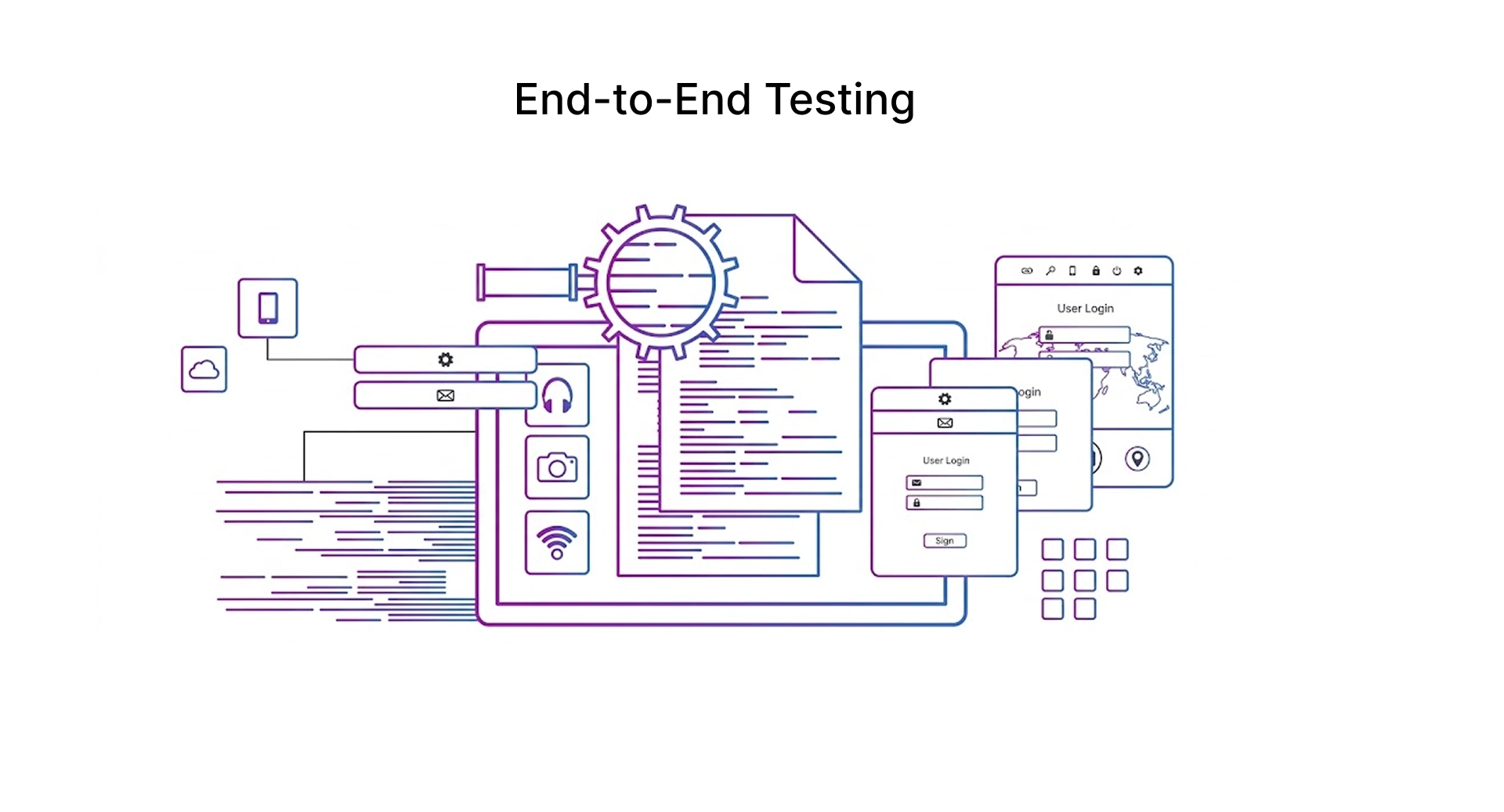
E2E testing certifies end-to-end user workflows within the entire ecosystem of microservices. It captures issues that no other layer will ever have access to: infrastructure configuration issues that will manifest themselves only in actual deployments, cross-service failure, frontend-to-backend data flow issues, and SLA violations under real-world load.
We ran 200 E2E scripts, virtually no contract layer team, the teams took 55 minutes per run to run, and had a failure rate of approximately 1 in 3. The test suite architecture was misconstrued in the first place.
How to Run E2E Tests Without Destroying Pipeline Speed
E2E Testing Tools and Automation Frameworks
// Playwright E2E test -- critical checkout journey
const { test, expect } = require('@playwright/test');

test('user completes checkout successfully', async ({ page }) => {
  await page.goto('https://app.example.com');
  await page.fill('#email', 'test@example.com');
  await page.fill('#password', 'SecurePass123');
  await page.click('button[type="submit"]');
  await page.click('.product-add-to-cart');
  await page.click('.checkout-button');
  await page.fill('#card-number', '4111111111111111');
  await page.click('.place-order');
  await expect(page.locator('.order-confirmation')).toBeVisible();
});
This Playwright test validates a complete user journey, ensuring that multiple services work together correctly in a real-world scenario.
How to Scale Your Microservices Testing Strategy as Your Team Grows
A testing strategy that doesn’t prevent production issues isn’t a strategy - it’s a false sense of security; it is a liability that gives the impression of security to the team, which will never be read.
The Right Microservices Testing Mix for Your Architecture.
The ones with the quickest rate of reduction of production incidents do not have the highest number of tests. They are the ones whose coverage is where the risk of failure exists, as a matter of fact.
How Frugal Testing Builds Maintainable Coverage for Engineering Teams
Frugal Testing creates a coverage that is maintainable at scale - not architectures that appear full in a deliverable report and not maintainable in six months.
- Current state audit - map coverage of all four layers, gaps, and risk quantification.
- Gap analysis - focus on architecture, team, and release cycle.
- Framework build - unit, integration, contract, E2E into your CI/CD pipeline.
- Team handover - Confluence runbooks, Loom walkthroughs, and Jira integration so that your team no longer relies on us to support it.
Ready to close the gaps? Sign up for a free consultation with Frugal Testing and receive a coverage audit during the first meeting.
People Also Ask (FAQs)
Q1.We have a QA department, and yet we continue to receive incidents in production with our microservices. Why?
Ans: QA headcount and QA coverage are literally different issues, and this is where microservices are costly. We've audited teams with six dedicated QA engineers still shipping two production incidents a month. Any test that they possessed was contained within a single service - complete coverage of the wrong surface area. No one had mapped the service boundaries, and no one owned the test that failed when service A altered its schema and service B was still expecting the old service. Adding another QA engineer to that setup doesn't fix the problem. It just means more people running tests that can't see the failures that actually cause incidents.
Q2.Our releases are constantly slipping because testing is taking too long. Where is the bottleneck?
Ans: The bottleneck is almost always the same: E2E tests doing the job of three other layers. That's what we find slowing things down in roughly 8 out of 10 audits. A 40-minute suite with 30% failures is a test architecture problem, not a hardware one. Building unit and contract coverage underneath lets you trim E2E to the journeys that genuinely require full-stack execution - typically 5–10 at most. Most teams that make this shift get pipeline time under 15 minutes within a sprint.
Q3.How do you handle test data management across multiple microservices?
Ans: Test data management becomes complex in microservices because each service may have its own database and data lifecycle. High-performing teams avoid shared test data and instead generate isolated, deterministic datasets for each test run.
Common approaches include:
- Using seeded data per test environment to ensure consistency
- Creating test data on demand via APIs instead of relying on static datasets
- Cleaning up data after each test execution to avoid state leakage
- Using tools like Testcontainers to spin up fresh dependencies with controlled data
Q4.How do you scale microservices testing without slowing down CI/CD pipelines?
Ans: Scaling microservices testing without slowing CI/CD pipelines requires distributing tests across layers instead of relying heavily on E2E. Teams run fast unit and integration tests on every commit, enforce contract testing as a CI gate, limit E2E to critical journeys, and use parallel execution with production-like environments. This keeps pipelines fast while maintaining high release confidence.
Q5.How do you enforce contract testing in a CI/CD pipeline?
Ans: Contract testing can be enforced in the CI/CD pipeline by making provider verification a mandatory step in the CI process. This means that consumers will publish their contract, which could be in the form of a Pact, to a broker, and then the provider will fetch and verify the contract in every build. If there is a failure in the contract, then the build will be marked as a failure.