


Let's be honest, if you've ever managed QA for a microservices system, you've probably had this exact conversation with your team: "Our end-to-end tests keep breaking the pipeline. Should we just cut half of them?" And someone else in the room says, "But what if we miss something in production?"
Both people are right. That's the tension.
End-to-end tests are irreplaceable for catching real integration issues and validating product quality from a user's perspective. But at scale, they're slow, fragile, and they punish you every time someone touches an API. Pact contract testing, on the other hand, is fast and surgical but it's not trying to simulate what a user does. It's doing something different entirely.
The teams that figure this out stop treating these tools as competitors. They use both deliberately, at the right layer of the test pyramid. This guide walks through how to actually do that: the automated testing workflows, the tools, the test coverage goals, how microservices API testing fits in, and the CI/CD integration steps that make the whole thing work in practice.
Why Pact and End-to-End Testing Work Better Together
There's a persistent myth in software development circles that contract testing and end-to-end testing are rivals. Pick one, commit to it, move on. In practice, that thinking creates blind spots at exactly the layers of your system where things go wrong. These are complementary tools and understanding why means looking at what quietly breaks when quality assurance teams over-invest in one side.
The Problem with Relying Solely on End-to-End Tests
Picture a team running a 35-minute e2e suite on every pull request. Developers stop waiting for results. They merge anyway. By the time the pipeline flags an integration issue, three other PRs are already stacked behind it, and nobody's sure which change caused the failure.
That scenario plays out constantly in real software development teams. End-to-end tests simulate real user behaviour across the full system stack they're genuinely valuable for validating critical journeys and confirming product quality before release. But when they're the primary integration testing safety net, the costs compound fast:
Feedback loops slow to a crawl. A full e2e suite running 20–40 minutes in CI means every pull request waits. Software development cycles stretch. Flakiness creeps in network timeouts, race conditions, test environment drift and developers start ignoring failures because half of them aren't "real." Maintenance becomes a part-time job: one API schema update can shatter dozens of tests across unrelated test scenarios. And because e2e tests only catch integration issues after code is merged and deployed to a shared environment, by the time a failure surfaces, the context is gone and the fix is expensive. To make things worse, large e2e suites tend to accumulate duplicate test scenarios with no clear mapping to specific features, making test coverage visibility almost impossible to reason about.
In microservices architectures, all of this gets worse. With 10, 20, or 50 services talking to each other over APIs, a single schema change in one provider can silently break multiple consumers and your e2e tests might not catch it until the next full pipeline run, hours later. Integration issues between services become harder and harder to isolate the larger the system grows.
What Is Pact Contract Testing?
Pact is a consumer-driven contract testing framework. Here's the core idea: instead of spinning up both services and hoping they talk to each other correctly, Pact records the exact HTTP interactions a consumer service expects from a provider, stores those expectations as a "pact" file (a contract), and then verifies independently that the provider can actually honour them no shared test environment required, no live network, no database.
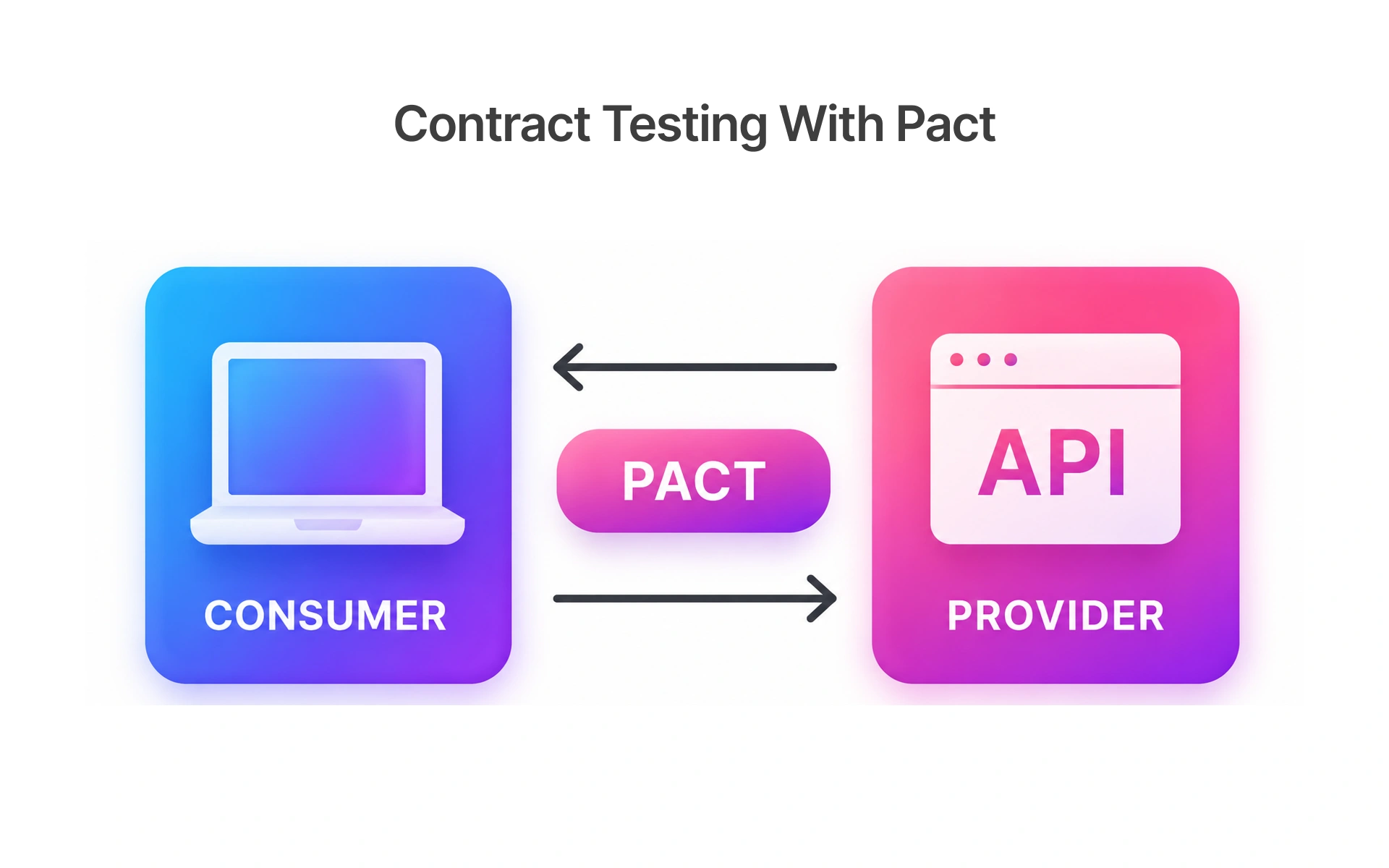
Think about what that means in practice. Your quality assurance team can catch API mismatch bugs at the unit testing layer, in milliseconds, before code is even merged. A Pact test answers one specific question: "Can service A still talk to service B given what A expects?" That's it. And for that one question, it's extraordinarily fast and reliable.
What Pact doesn't do and was never designed to do is validate user journeys, test UI components, verify database correctness, or check third-party integrations. That's where end-to-end tests remain essential for maintaining product quality. The tools have different jobs.
Where Pact and E2E Tests Sit in the Test Pyramid
The test pyramid is one of the most useful mental models in quality assurance and software development. It describes how to balance your automated testing investment by speed, cost, and confidence. From the bottom up:
Unit testing fast, isolated, focused on individual functions and classes. The widest, cheapest layer of your test strategy. Contract tests (Pact) verify service-to-service API compatibility without live dependencies or a shared test environment. Integration testing test real database connections, message queues, and infrastructure behaviour to catch integration issues that unit tests can't see. End-to-end tests validate full user journeys across the deployed system, confirming product quality from the user's actual perspective.
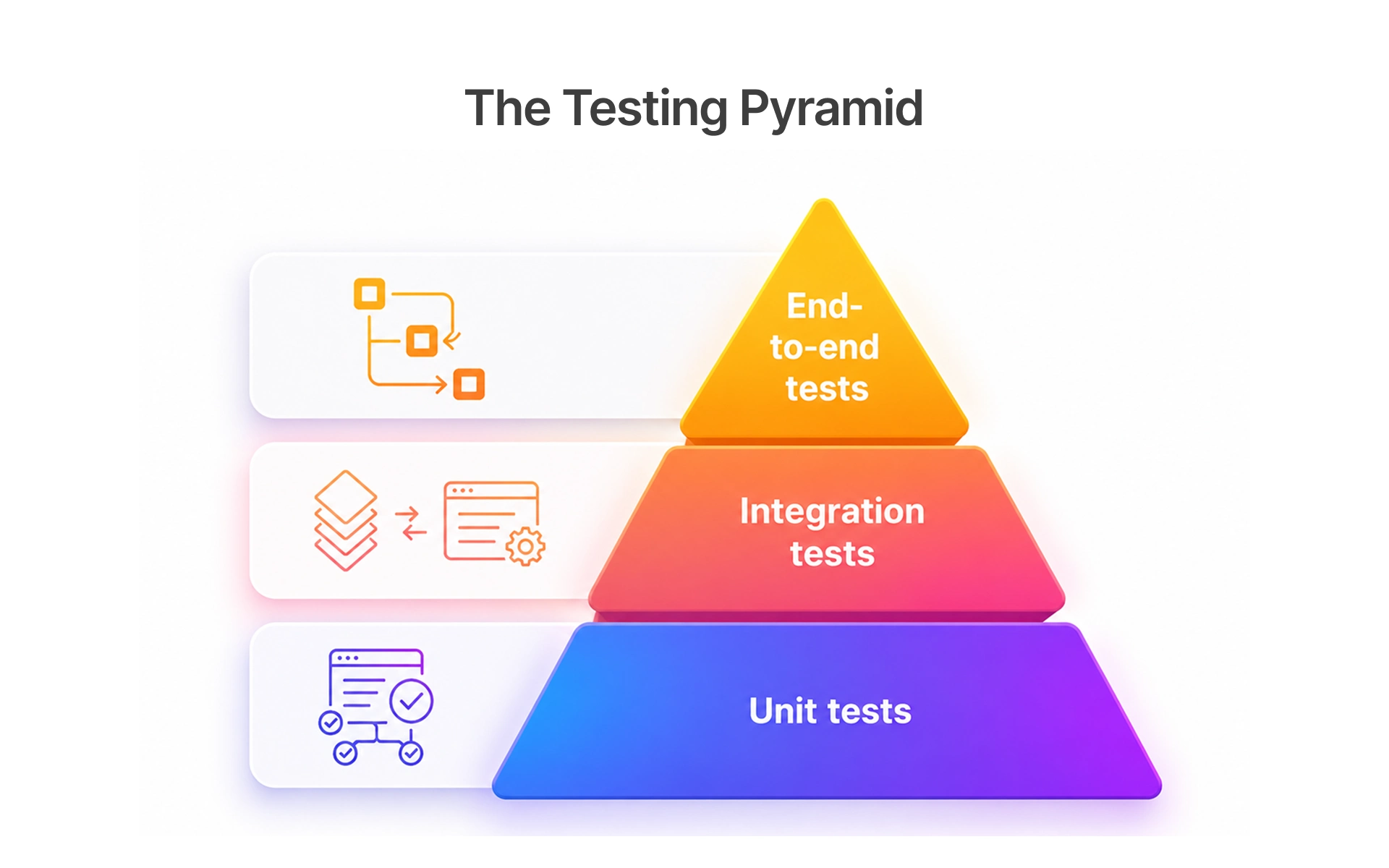
A well-balanced microservices team typically lands here: lots of unit tests, a solid layer of Pact contract tests covering all service boundaries, a handful of integration tests for infrastructure concerns, and a lean e2e suite covering only the critical user journeys that matter most. Once Pact is covering service boundaries, you can often safely reduce your e2e suite to 15–30 focused test scenarios without losing confidence in product quality because the API layer is already covered.
Key Benefits of Combining Pact with E2E Testing
When you combine these two layers with intention, the compounding benefits are real. CI pipelines get faster Pact's automated testing runs in seconds, and e2e tests only run for test scenarios that genuinely need a full system in the loop.
Failures surface earlier: API contract breaks appear on a developer's machine before merge, catching integration issues long before they reach a shared test environment. E2E flakiness drops, because with API compatibility guaranteed by Pact, any e2e failure genuinely points to a user journey problem rather than test environment noise. Teams can deploy services independently with confidence using can-i-deploy checks, without waiting for a full e2e run to complete.
Test coverage becomes genuinely comprehensive every part of the system, from API contracts to UI components, has appropriate automated testing at the right layer. And because your e2e suite shrinks, your quality assurance team spends less time updating test scenarios every time a UI or API evolves, freeing capacity for actual test strategy work.
Pact Tools and Frameworks: Choosing the Right Setup
Pact works across most modern languages and frameworks. Before you write your first contract test, it's worth taking ten minutes to understand how the framework fits into a real microservices architecture because the tooling choices you make early will directly shape how maintainable your automated testing is a year from now.
How the Pact Framework Works: Core Concepts and Flow
The Pact automated testing flow has three steps, and once you see them together, the whole thing clicks.
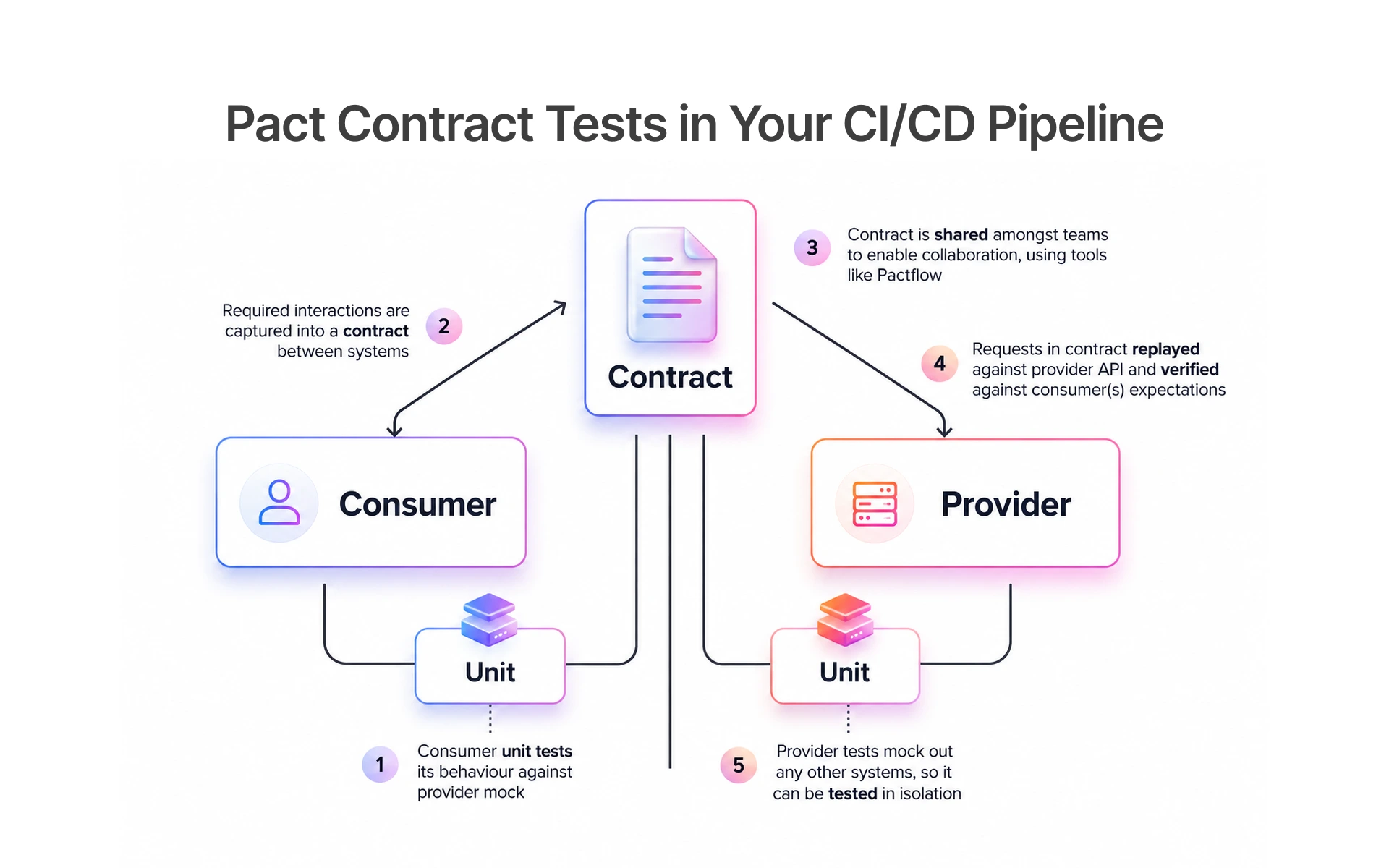
First, the consumer writes a test. The consumer service defines the HTTP request it plans to send and the response it expects back. Pact captures this interaction and writes it to a pact file a JSON document that serves as your API contract. This is effectively unit testing at the API boundary layer. Second, that pact file gets published to a Pact Broker a central repository for contracts, version control for API expectations, and a core piece of your test environment infrastructure. Third, the provider service fetches the pact from the broker and replays every recorded interaction against its actual implementation. If the provider's response doesn't match what's in the contract, verification fails and the build stops.
A few terms worth knowing: a consumer is any service calling another service's API. A provider owns and implements that API. Matchers let you write flexible assertions "any integer" rather than a hardcoded value which prevents brittle automated testing that breaks for the wrong reasons.
Pact supports JavaScript/TypeScript (pact-js), Java/JVM (pact-jvm), Python, .NET, Go, Ruby, and more. Pact v4 introduced a unified FFI-based core (pact-reference) that provides consistent behaviour across all language implementations particularly important for polyglot software development teams where services are written in different languages.
Real-World Architecture: How Pact Fits into a Microservices System
Take a typical e-commerce system: an Order Service that needs to talk to a Payment Service and an Inventory Service. Here's how Pact fits into this architecture and test strategy in practice.
The Order Service writes Pact consumer tests defining exactly what it expects from Payment Service responses for instance, a 200 with a transactionId field. This is unit testing the API contract at the boundary. Those contracts get published to a Pact Broker (either self-hosted or via PactFlow), which acts as version control for all inter-service API expectations. When the Payment Service is updated, its CI pipeline pulls the latest pact and runs provider verification. If the Order Service's contract breaks, the Payment Service build fails immediately before anything reaches the test environment.
Before any deployment, the can-i-deploy CLI command queries the broker: "Have all consumers verified against this version of the provider?" If the answer is no, the deployment is blocked. Product quality in production stays protected.Playwright
What this architecture achieves is that API compatibility is guaranteed before any e2e tests run. When your e2e suite executes, it can focus entirely on user journey correctness and product quality not on re-checking API contracts that Pact already handles.
Pact vs Spring Cloud Contract: Which Should You Use?
If your entire stack is Spring Boot and your providers want to own contract definitions, Spring Cloud Contract is worth evaluating. If your team is polyglot or if you want consumers to drive contract definitions as part of your test strategy Pact is almost certainly the right choice.
Setting Up Pact Broker to Manage Contracts Across Teams
The Pact Broker is what makes contract testing scalable beyond a handful of services. It stores pact files, tracks verification results, provides version control for all API contracts, and powers the can-i-deploy safety gate a critical quality assurance component in any serious pipeline.
You have two options. Self-hosted Pact Broker is open-source, Docker-based, and free to run. Suitable for software development teams that want full control over their test environment get it running with
docker run -p 9292:9292 pactfoundation/pact-broker. PactFlow is the SaaS version with a free tier, adding bi-directional contract testing, secrets management, and a visual dependency graph of your automated testing coverage.
Once your broker is live, consumers publish pacts using the Pact CLI or language-specific commands. Providers pull pacts in their CI pipeline and post verification results back. This two-way flow creates a live compatibility matrix a real-time test coverage map across all your services.
End-to-End Testing Strategy: Tools, Frameworks, and Scope
With Pact handling API contract verification, your end-to-end tests can finally do what they're actually good at: proving the full system behaves correctly for real users. That shift in purpose also changes which tools, test scenarios, and scope actually make sense.
Playwright, Cypress, or Selenium: Picking the Right E2E Framework
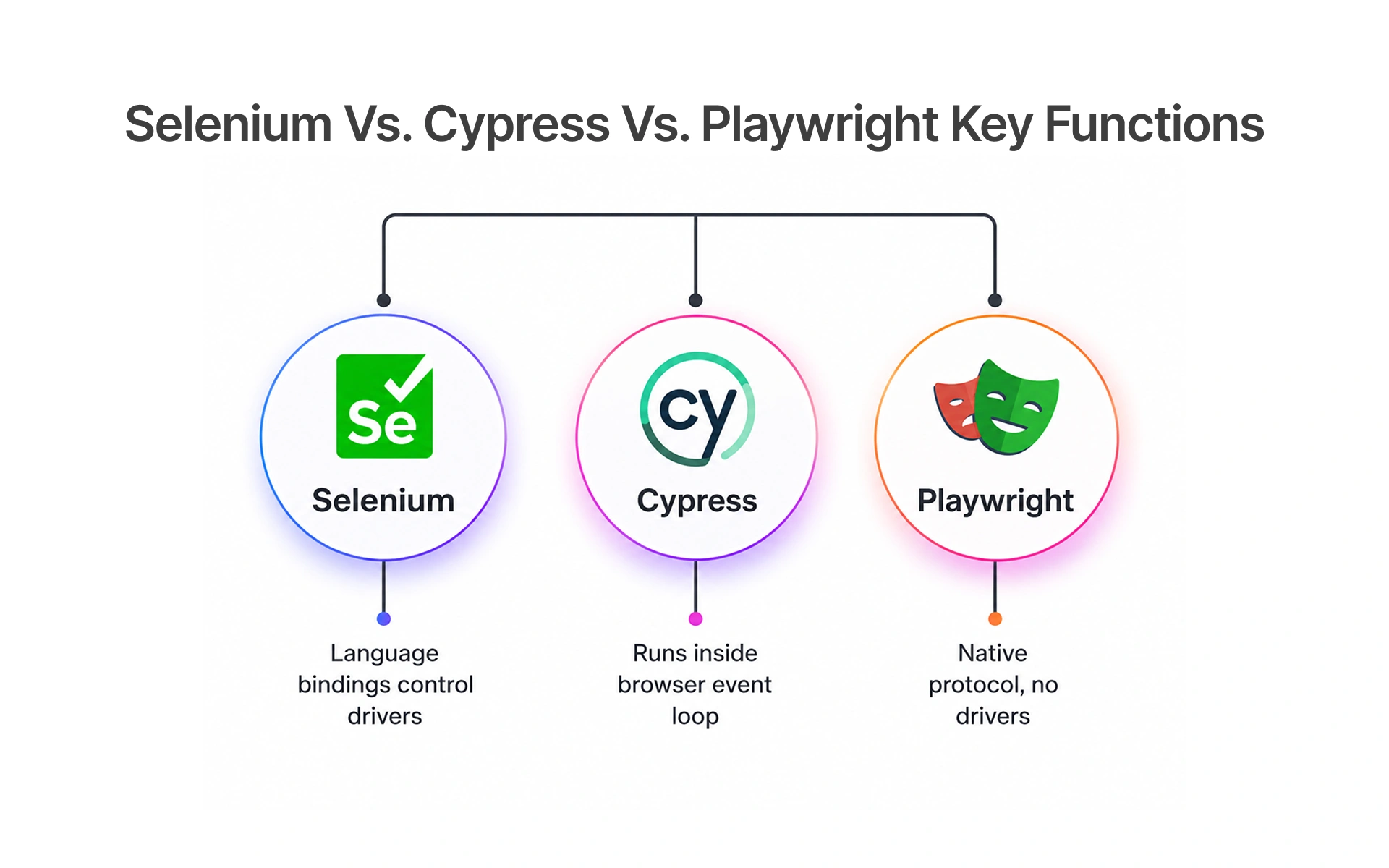
Playwright is the strongest choice for most quality assurance teams in 2026. It supports all major browsers (Chromium, Firefox, WebKit), runs test scenarios in parallel out of the box, has excellent API automated testing support via request fixtures, and its auto-wait behaviour dramatically reduces flakiness. It works well alongside Pact because you can verify API contracts (Pact) and validate UI component journeys (Playwright) in the same CI pipeline.
Cypress has an excellent developer experience and a real-time test runner that makes debugging test scenarios genuinely pleasant. Its limitation is browser support primarily Chromium in default configuration and it struggles with multi-tab or multi-origin flows. It's a solid choice for teams already invested in the Cypress ecosystem who don't need broad browser coverage.
Selenium is the most mature option and still the standard for organisations with strict cross-browser requirements, complex UI component testing needs, or large legacy automated testing suites. It requires more boilerplate, runs slower than Playwright, but has unmatched breadth through Selenium Grid, BrowserStack, and Sauce Labs.
What Belongs in Your End-to-End Test Suite (and What Doesn’t)
Once Pact covers your service boundaries, your e2e suite should shrink sometimes significantly. A useful rule of thumb: if a test is really just checking API request/response compatibility, it belongs in Pact, not e2e. If it's checking whether a real user can complete a journey involving live UI components and integrated services, it belongs in e2e. This boundary is the foundation of a sensible test strategy and the reason your test coverage stays meaningful at every layer.
What belongs in e2e test scenarios: critical happy paths like user registration, login, checkout, and payment flows across multiple UI components; high-risk regression test scenarios based on past production incidents that affected product quality cross-service journeys that expose integration issues between multiple parts of the system working together.
What doesn't belong: every permutation of form validation (unit testing handles this far more efficiently); API response shape verification that's Pact's job in your automated testing layer; database consistency checks (integration testing territory); isolated UI component behaviour that doesn't need a full test environment to prove out.
Reducing Flakiness in End-to-End Test Automation
Flaky tests are the number one reason quality assurance teams eventually abandon e2e automated testing. The Pact + focused e2e combination already eliminates one of the biggest sources of flakiness API mismatch and integration issues but a few additional practices keep things stable as the system grows:
Use auto-wait Playwright's built-in waiting removes almost every reason to write explicit sleep() calls in automated testing. Fixed time delays are fragile; auto-wait adapts to reality. Use stable selectors: data-testid attributes or ARIA roles hold up across refactors far better than CSS classes or XPath tied to UI components that change constantly. Isolate test data so each test scenario creates and cleans up its own state shared test environment data causes cascading failures when one test modifies what another expects. Configure one retry for infrastructure-related flakiness like container startup delays, but treat any test scenario that regularly needs two retries as an active investigation target. Move known-flaky test scenarios to a quarantine suite that runs post-merge rather than blocking PRs, and track them against a flakiness SLA. Finally, keep your test environment settings, fixture data, and configuration files in version control alongside your test code reproducible automated testing starts with reproducible setup.
Microservices API Testing: Using Contract Tests as Your First Line of Defence
Testing APIs in a microservices system is genuinely different from testing a monolith. Services are independently deployed, often owned by different quality assurance and software development teams, and communicate over APIs that evolve continuously without anyone necessarily coordinating. Integration issues can appear silently across service boundaries, and by the time a full e2e run surfaces them, the damage is already done.
Contract testing is the automated testing layer that catches these problems early at the boundary, before anything is deployed.
Step-by-Step Pact Workflow for Microservices API Contract Testing
Here's a complete automated testing workflow for a two-service interaction. This test strategy scales to any number of services:
The consumer quality assurance team writes a Pact test using the Pact mock server, recording the expected HTTP request and response. This is unit testing at the API contract layer. Running that test produces a JSON pact file your machine-readable API contract. The CI pipeline publishes the pact file, tagged with the consumer's git branch and version for version control traceability. The provider's CI fetches all pacts from the broker and replays each test scenario against the provider's real running code in an isolated test environment. Pass or fail, the verification result is posted back to the broker and recorded against specific consumer and provider versions, updating your automated testing coverage matrix.
Finally, before deploying either service, CI runs pact-broker can-i-deploy to confirm the version being deployed is compatible with everything already in production the final product quality gate.
What Contract Testing Doesn’t Cover: API Security in Microservices
Pact is not a security testing tool. It's great at verifying that request/response shapes match consumer expectations and catching integration issues related to API contracts but it doesn't touch authentication and authorisation (JWT validation, OAuth flows, RBAC enforcement), injection vulnerabilities via API parameters, rate limiting and DDoS resilience, or sensitive data exposure in API responses that could compromise product quality and user trust.
For API security in microservices, complement your Pact automated testing with OWASP ZAP for dynamic scanning, Snyk or Trivy for dependency vulnerability checks, and dedicated auth integration testing that validates token validation and permission boundaries. These security checks slot naturally into a separate CI/CD pipeline stage after Pact verification and before e2e tests giving you complete test coverage across all risk dimensions.
Top Microservices API Contract Testing Tools ComparedSpring Cloud Contract
Pact is the most widely adopted contract testing tool in software development, but it's not the only option. Here's how the leading automated testing tools compare for microservices API contract test coverage:
- Pact consumer-driven, polyglot, mature ecosystem, Pact Broker for contract management and version control. The best all-round choice for most quality assurance teams.
- Spring Cloud Contract provider-driven, JVM-only, tight Spring Boot integration. Excellent if your entire software development stack is Spring.
- Dredd tests your API against its OpenAPI or API Blueprint specification. Simpler than Pact but provider-only, with no consumer perspective for catching integration issues.
- Schemathesis property-based automated testing against OpenAPI specs. Strong at finding edge cases in test scenarios and unexpected inputs; complements Pact rather than replacing it.
- PactFlow Bi-Directional Contract Testing combines consumer Pact tests with provider OpenAPI specs, well-suited for quality assurance teams that already maintain API documentation as part of their test strategy.
Integrating Pact and E2E Tests into Your CI/CD Pipeline
A Pact + e2e automated testing strategy only delivers its full value when it's wired into your CI/CD pipeline properly. The goal is a pipeline where API contract failures surface immediately, e2e test scenarios only run after contracts are verified, and nothing reaches production without a can-i-deploy quality assurance check.
Where to Place Pact Contract Tests in Your CI/CD Pipeline
The recommended pipeline stage order for your test strategy is:
The recommended stage order for your test strategy is: unit testing first fastest feedback, base of your automated testing pyramid. Then consumer Pact tests generate and publish pact files on every consumer PR, fail the build if the pact can't be generated.
Provider Pact verification runs on every provider PR, fetching the latest consumer pacts from the broker and verifying against the live test environment, failing on any verification failure. Integration testing runs in parallel with Pact verification, catching infrastructure-level integration issues contract tests don't cover.
E2E test scenarios run after all contract and integration tests pass with Pact in place, this suite is smaller and focused entirely on product quality validation. And the can-i-deploy gate runs immediately before any deployment step, blocking the deployment if the quality assurance check fails.
GitHub Actions, GitLab CI, and Jenkins: CI/CD Tools for Contract and E2E Automation
All three major CI platforms support Pact and e2e automated testing workflows. The right choice depends on your existing software development infrastructure and version control setup.
GitHub Actions use the pact-foundation/pact-broker-action for publishing and can-i-deploy quality assurance checks. Add a separate job for Playwright e2e test scenarios that depends on the contract test job using needs: [contract-tests]. Integrates directly with GitHub version control for clean traceability across branches and releases.
GitLab CI define stages: [test, contract, e2e, deploy]. The contract stage runs Pact publish and verify jobs in the test environment. The e2e stage runs only if the contract passes, using the stage dependency in your .gitlab-ci.yml. GitLab's version control integration makes it easy to tag pacts by branch.
Jenkins uses a declarative Jenkinsfile with a parallel stage for unit testing and contract tests, followed by a sequential e2e stage. Use the Pact CLI Docker image to avoid manual Pact Broker CLI installation and ensure a consistent test environment.
Regardless of which platform you're on, the architectural principle is the same: e2e test scenarios must be downstream of contract verification. Running e2e tests before Pact automated testing verification completes is a pipeline design error.
Balancing Test Speed and Coverage in Your CI/CD Pipeline
The most common quality assurance complaint about e2e tests in CI is that they take too long. With Pact handling contract verification and automated testing coverage at the API layer, you have a clear path to a meaningfully faster pipeline.
Run Pact tests on every PR they take seconds and give immediate feedback on API compatibility, catching integration issues before they touch the test environment. Parallelize e2e test scenarios Playwright and Cypress both support sharding split your suite across 4–8 workers to keep automated testing run time under 10 minutes. Run e2e tests on merge to main if your suite is already small and focused on product quality; if it still takes over 15 minutes, gate it to post-merge only. Cache Pact Broker results if no pact has changed since the last provider build, the provider doesn't need to re-verify, saving CI time without sacrificing test coverage. And target a total pipeline time under 15 minutes: unit testing plus contracts under 5 minutes, e2e test scenarios parallelised under 10.
This is achievable for most software development teams. Keep all pipeline configurations CI YAML files, Pact Broker credentials, test environment settings in version control so every team member runs the same automated testing setup.
Conclusion: Building a Testing Strategy That Scales
The most effective testing strategies for microservices teams aren't built on picking the "right" tool. They're built on clarity about what each layer of automated testing is actually responsible for unit testing individual functions, integration testing infrastructure behaviour, Pact verifying API contracts, e2e tests validating product quality for real users.
Pact contract testing and end-to-end testing serve different purposes. Used together in a deliberate test strategy, they create a quality assurance safety net that's faster, more reliable, and easier to maintain than either approach alone. Together they give your software development team full test coverage across service boundaries, UI components, and user journeys without the fragility that comes from trying to make e2e tests do everything.
Start by introducing Pact at the boundaries between your highest-traffic services. Publish contracts to a Pact Broker, set up provider verification in your CI pipeline, and add can-i-deploy gates before your deployment steps. As your automated testing coverage grows, audit which e2e test scenarios are really just verifying API compatibility rather than user journeys, and move that coverage into Pact. Your e2e suite shrinks. Your pipeline speeds up. Your confidence in deployments and in product quality increases.
The goal isn't to eliminate end-to-end testing. It's to make every e2e test scenario actually count.
People Also Ask (FAQs)
Q1.Is Pact contract testing only useful for REST APIs, or does it work with GraphQL and gRPC too?
Ans: Pact works best with REST APIs and supports GraphQL through community tooling, but gRPC support is still limited. For gRPC contract verification, tools like Protolock or Buf tend to be the more practical choice as part of a broader test strategy. For most quality assurance teams, Pact plus REST is the right starting point for microservices API automated testing with GraphQL and gRPC handled as secondary concerns once core test coverage is established.
Q2.What happens to existing end-to-end tests when you introduce Pact do you delete them?
Ans: Most teams run Pact alongside existing e2e automated testing first, then remove overlapping API-focused test scenarios over time. The recommended test strategy is a deliberate audit over a sprint or two: test scenarios verifying API compatibility move to Pact, while genuine user journey test scenarios and UI component flows stay in e2e. Most quality assurance teams reduce their e2e test coverage by 30–60% after adding meaningful Pact coverage, without losing confidence in product quality a figure consistent with Frugal Testing's experience across microservices QA engagements.
Q3.How do you test against a third-party API using Pact when you don’t control the provider?
Ans: You can't run Pact provider verification directly against a third-party API you don't control its test environment or software development pipeline. The practical solution is to wrap the external dependency in an internal adapter layer and write Pact tests against your own adapter. For the external service itself, use vendor sandboxes or schema validation tools to catch breaking changes covering the integration issues that Pact cannot reach across team boundaries.
Q4.Who owns the Pact contract the consumer team or the provider team?
Ans: In Pact contract testing, the consumer team owns the contract. They define what data and behaviour they expect; the provider team verifies compatibility against those expectations and maintains the responsibility of not breaking them. The Pact Broker's pending pacts feature gives providers a grace period to address new consumer contracts without their builds being immediately blocked an important part of a healthy cross-team test strategy and version control workflow.
Q5.How do you know when your end-to-end test suite has grown too large?
Ans: Three signals to watch: CI automated testing runs exceeding 15 minutes, more than 10–15% flaky failures unrelated to real integration issues, or test scenarios duplicating Pact's API contract test coverage. When any of those appear, it's time to move API validation logic to Pact or unit testing and keep e2e for the critical user flows that directly validate product quality. Your e2e suite dreading every UI component change is a good sign it's carrying too much responsibility.


.webp)

.webp)