

A payment confirmation screen at a 40-person fintech startup looked perfect in QA, with every unit test and integration test green. Then a customer clicked "Confirm," and the page hung, because the payment processor's webhook arrived after the interface gave up waiting. Nobody had tested that handoff end to end, and that is the gap automated end-to-end testing exists to catch.
Teams often respond by adding more E2E testing as the system grows, and end up with test suites nobody trusts. This guide covers a practical end-to-end testing strategy, part of any wider software testing strategy: The automation framework, test data, and CI/CD pipeline decisions that keep an end-to-end testing process reliable at scale.
What Is End-to-End Testing?
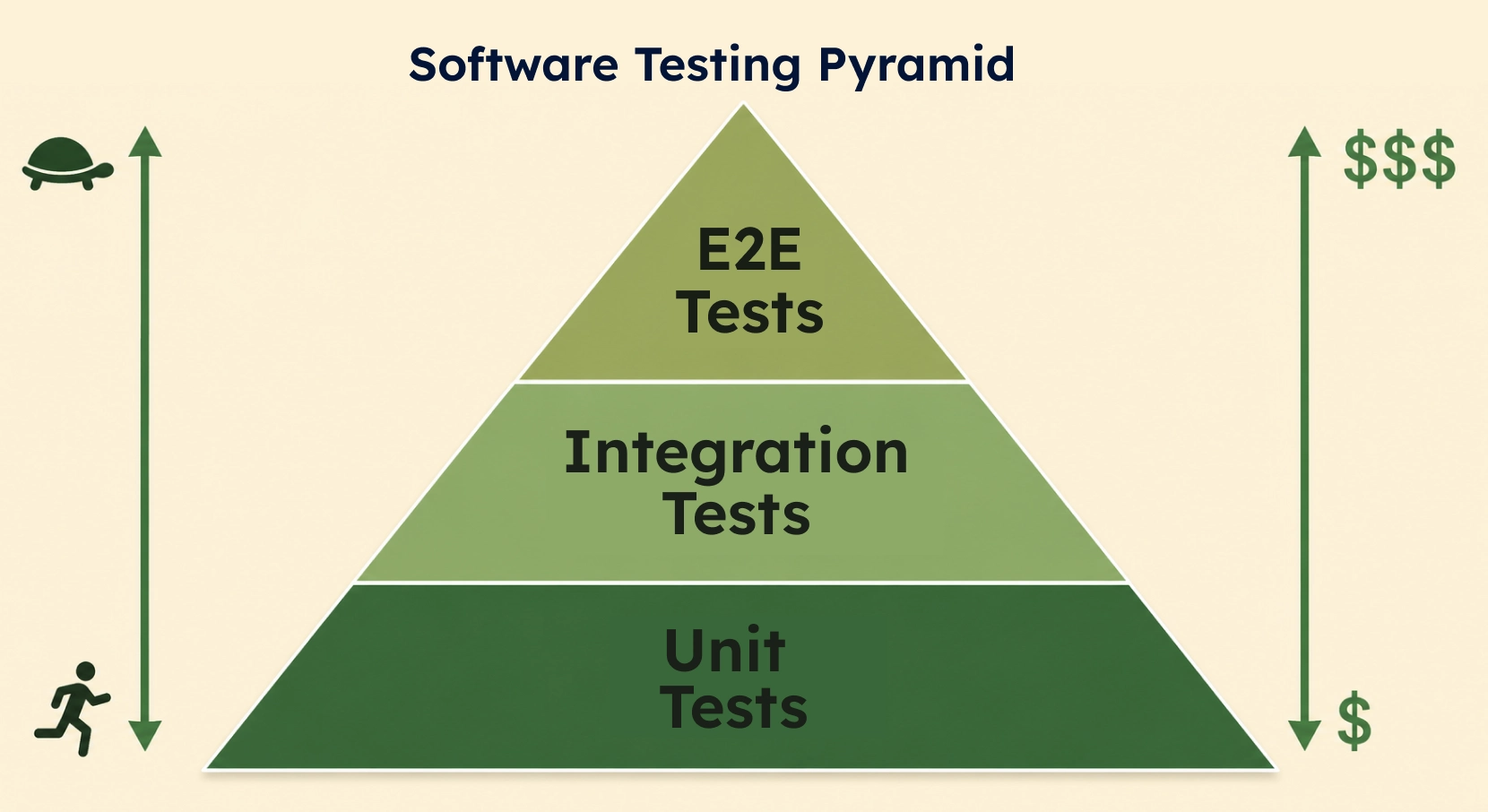
End-to-end (E2E) testing, or End-to-End Testing, validates a complete user journey across every system it touches: User interface, backend, database, and third-party integrations, not one service in isolation. It sits atop the pyramid, above unit testing and integration testing: Fewer test cases, but more test maintenance.
A common question, what is end-to-end testing with an example, is easiest to answer with a checkout:
- Unit test: Confirms the discount calculation is correct.
- Integration test: Confirms the cart service talks to the pricing service.
- End-to-end test: Confirms a customer can add an item, apply a code, pay, and get confirmation, in one unbroken sequence.
That scope difference is why system testing vs end-to-end testing gets confused. System testing validates one system against its own requirements, while end-to-end integration testing validates the journey across systems your team doesn't own, like a payment gateway.
The table above is the quickest way to settle end-to-end testing vs unit testing: more tests do not automatically mean more safety.
Automation Framework Strategy: Choosing and Structuring for Scale
A testing framework built for five engineers and forty tests strains at three hundred. Selectors tied to CSS classes break on every design refresh, two engineers write the same login flow differently, and nobody owns the shared test utilities.
None of that is really a framework problem. It's an architecture problem wearing a framework's name, and what matters more than the brand is a small set of habits:
- A page object structure the whole team follows, not just its author.
- Shared component libraries for logins, navigation, and other repeated flows.
- Code review discipline for test frameworks that matches production code.
- A clear owner for shared utilities, so fixes land instead of piling up.
More E2E tests are not automatically better. A smaller, reliable suite the team trusts outperforms a bloated one that gets ignored on every red build.
Choosing Between Playwright, Cypress, and Selenium WebDriver for Your Stack
Playwright, Cypress, and Selenium WebDriver are the most common e2e testing tools, and they solve the same problem differently. Compare them on parallel execution, cross-browser support, and CI/CD platform integration effort, not popularity.
- Playwright: Cross-browser, including Safari via WebKit, and parallelises out of the box. Wrong choice with zero JavaScript experience and a hard Java-only mandate.
- Cypress: Fastest debugging loop of the three, with time-travel snapshots. Wrong choice if Safari on iOS is a hard requirement.
- Selenium WebDriver: Right call if your team already relies on the WebDriver API in Java or C#. Wrong choice for a greenfield JavaScript stack, where it adds ceremony the others don't need.
Some teams run more than one tool: Cypress locally, Playwright in CI for the wider browser matrix. That split works only if both suites share the same page object layer, so a fix isn't repeated twice.
Structuring Page Objects and Reusable Components for Team Scale
When ten engineers write tests in parallel, the login flow gets written ten times unless someone stops it early. Keep shared utilities like login, checkout, or search in one place, and have every test import them instead of reimplementing them.
A simple way to enforce this is a naming convention: Every shared action lives under a helpers/ or pages/ folder, and code review blocks any test that duplicates a flow already defined there.
Test Data and Sandbox Environment Strategy
Ghost data is one of the most common reasons a suite passes locally and fails in a CI pipeline. A test creates a user, doesn't clean it up, and a later test collides with that record in a shared test environment.
There are two honest approaches to test data management, and good test data management tools support both:
- Fresh data per run: Every test creates and tears down its own records. Slower, but the collision risk disappears.
- Curated static seed data: A known dataset resets before each run. Faster, but only works if nothing outside the suite touches it.
Most teams past a few hundred tests need fresh data for payments and account state, and seed data for read-heavy flows like search. Forcing one approach across the whole suite is usually where cloud databases drift out of sync with production environments.
Sandbox vs. Mocking Third-Party Dependencies
Mock data only proves your code handles the response you told it to expect, and it says nothing about integration failures between real cloud applications. Use the real sandbox environment when the API interactions themselves are under test, like a webhook race condition or a payment gateway's retry logic.
A practical rule for end-to-end test cases: If a test would still pass after deleting the third-party integration, run it against mock data. If deleting the integration would make the test meaningless, it belongs in the sandbox.
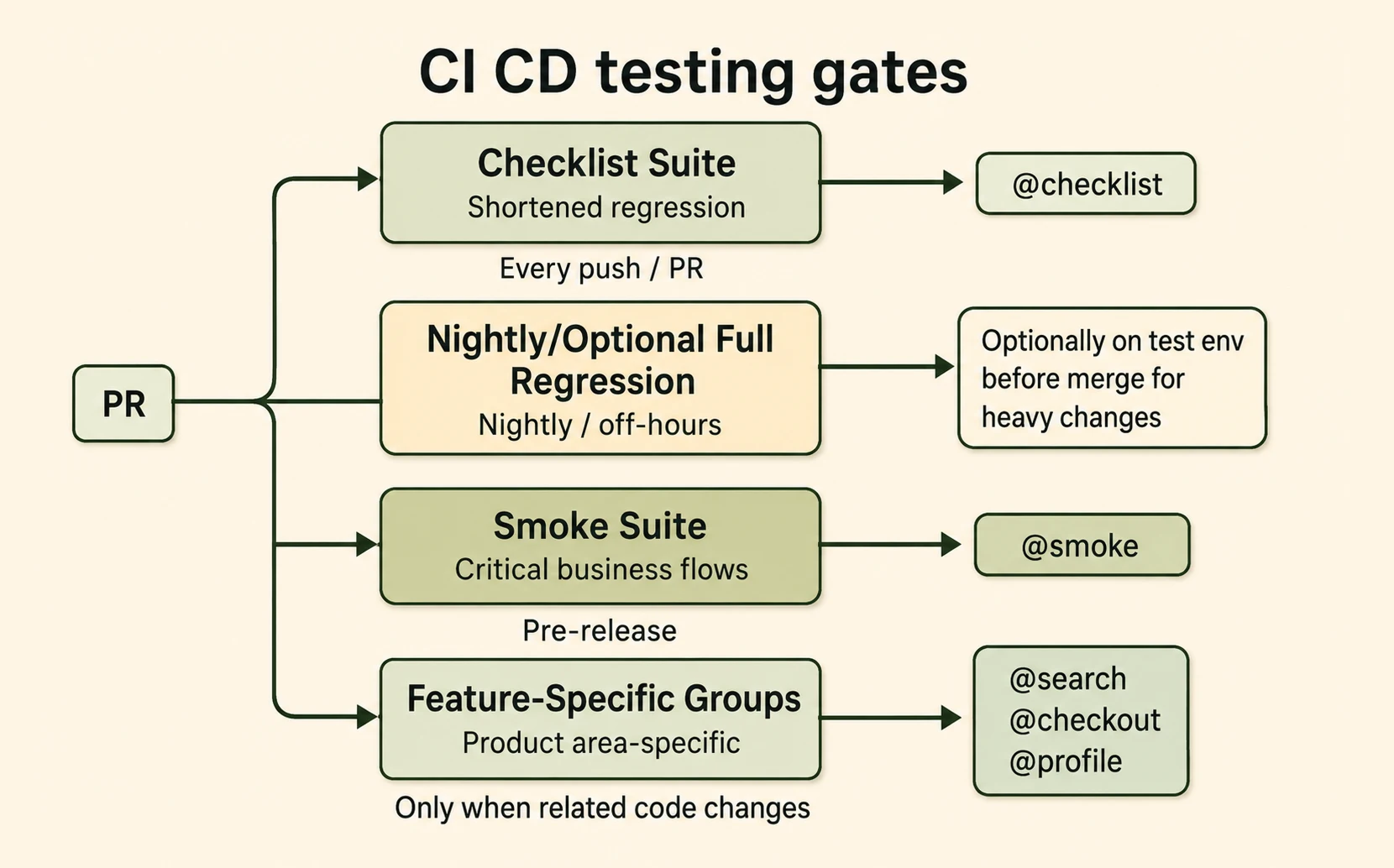
CI/CD Integration Strategy: Gating, Not Just Running Tests
A platform team at a mid-size SaaS company ran their full 400-test E2E suite on every pull request. Merges took forty minutes, engineers merged with a red stage and "fixed it later," and the pipeline was disabled entirely within six months.
That pattern is predictable. Running the full regression suite on every PR instead of gating on a smoke suite is the most common reason a pipeline gets disabled within six months.
- Smoke suite: Critical user workflows only (login, checkout, P1-level flows); every pull request, under five minutes.
- Regression suite: The full set of test scenarios, run as thorough regression testing; nightly or pre-release, where longer run time is acceptable.
This separates continuous integration testing in a real DevOps environment from a nightly report nobody reads. A required gate works only if the team trusts that red means real, thereby protecting the downstream user experience.
Diagnosing Flaky Tests Before You Rewrite Them
Not every flaky test needs a rewrite. Split the diagnosis first: Timing needs explicit waits; environment needs containerised parity between the local machine and CI.
A practical way to tell the two apart: rerun the failing test twenty times in a loop. Consistent failure at the same step points to timing; failure only alongside other tests or on a different runner points to environment. According to Google's Testing Blog, roughly 16% of their tests show some flaky behaviour, most traceable to exactly these two causes. AI-Powered platforms for flake detection exist too, though this manual split usually suffices.
How Frugal Testing Helps You Execute This Strategy
Automation framework architecture, test data management, and CI/CD gating are decisions your team can make internally, but getting all three right at once while shipping features is hard. Our end-to-end testing solution starts with an audit of the flakiness sources in an existing suite, whether that suite is end-to-end testing software built in-house or a mix of open-source frameworks.
From there, we rebuild the automation framework around clear ownership and design a continuous testing and CI/CD gating strategy your team can maintain after we leave. The pattern across engineering teams past the twenty-engineer mark is almost always the same: The framework isn't the real problem; ownership is.
What Our E2E Engagement Looks Like
The engagement, our end-to-end test automation offering, runs in four steps:
- Audit the existing suite: Map tests to flows, flag flaky and duplicate tests, and measure CI run times.
- Diagnose root causes: Sort each failure into timing, environment, or a genuine defect.
- Rebuild around ownership: Restructure page objects with a named owner, and match the test data strategy to each flow.
- Hand off documented: Smoke and regression gates wired into the pipeline, with a runbook your team can maintain.
Your team owns the suite outright at close, including the reasoning behind every gating decision.
Who This Is For
This fits engineering teams past roughly twenty engineers doing end-to-end software testing at real scale, where E2E ownership has quietly become nobody's job. Usual triggers: A suite the team has started ignoring, a pipeline slowed by nightly runs nobody investigates, or a system that just crossed from a monolith into microservices and inherited a shift-left testing strategy that no longer fits- the kind of gap our QA professionals see in almost every audit.
"More E2E tests are not automatically better. A smaller, reliable suite the team trusts beats a bloated one that gets ignored on every red build."
Conclusion
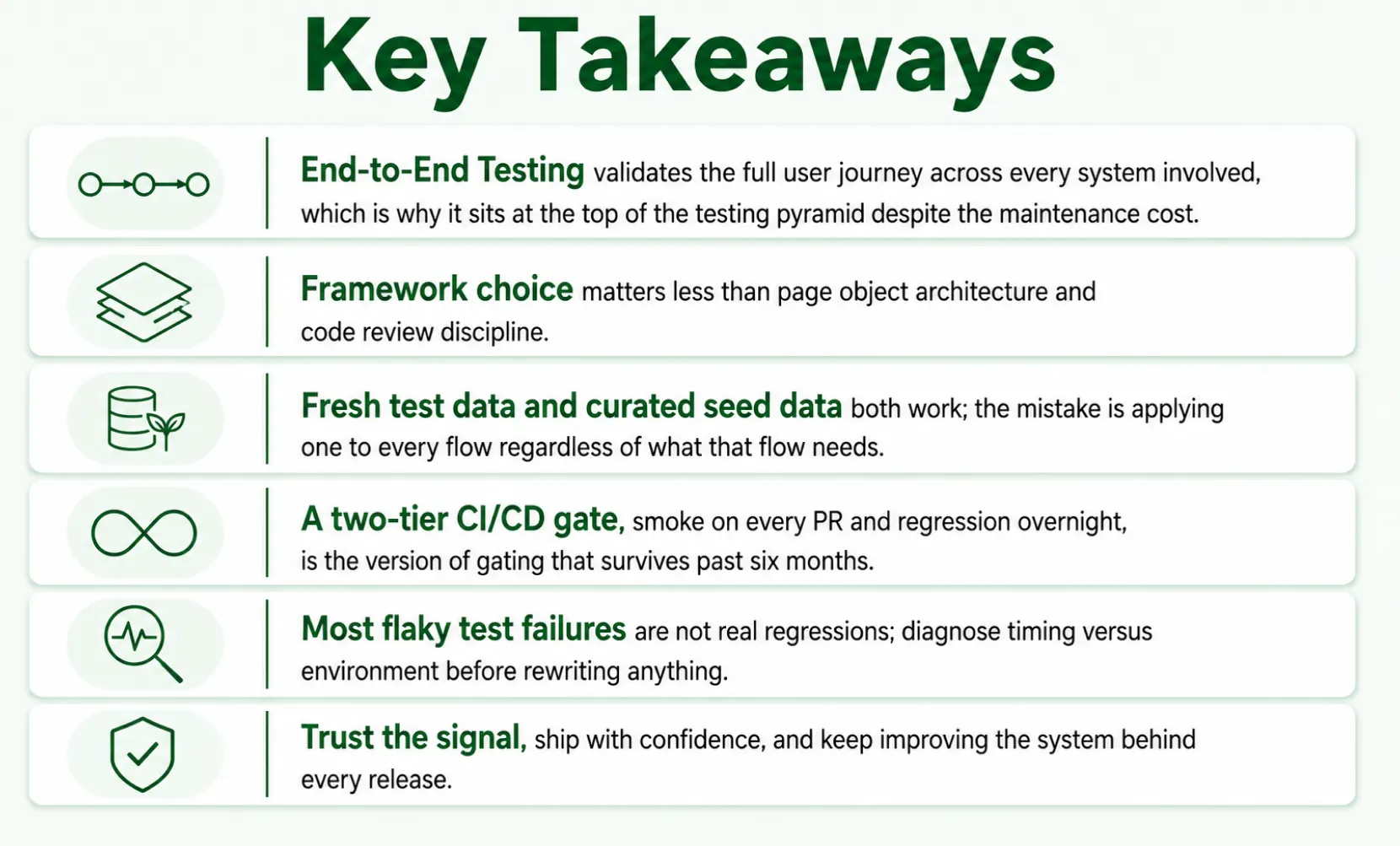
An end-to-end testing strategy that scales rests on four decisions: Definitional clarity about what E2E actually tests, a framework built around ownership rather than brand, test data management that matches the flow, and a CI/CD gate the team trusts. Getting all four right at once, while the system keeps changing shape underneath, is what most teams miss, and that's why software quality still feels shaky eighteen months in.
People Also Ask (FAQs)
Q1. What should a complete end-to-end test plan include?
Ans: A complete plan covers the user journeys to test, required environments and test data, tool selection, clear suite ownership, and the pass criteria each release gate must meet.
Q2. What are some end-to-end testing scenario examples for a typical SaaS application?
Ans: Common examples include user sign-up through email verification, subscription checkout with a live payment gateway, password reset flows, and data exports triggered from a dashboard.
Q3. How is end-to-end mobile testing different from testing a web application?
Ans: End-to-end mobile testing has to account for device fragmentation, app store builds, network variability, and native gestures, none of which a browser-based web testing setup needs to handle.
Q4. What other e2e testing tools exist besides Playwright, Cypress, and Selenium?
Ans: Beyond the big three, teams also use TestCafe, WebdriverIO, Puppeteer, and AI-powered platforms like Testim or mabl, which suit teams wanting lower-code authoring or built-in self-healing selectors.
Q5. How long does it typically take to build an end-to-end testing process from scratch?
Ans: Most teams need four to eight weeks to stand up a working process, covering framework setup, initial test cases, and a basic CI/CD gate, longer at enterprise scale.

.webp)