


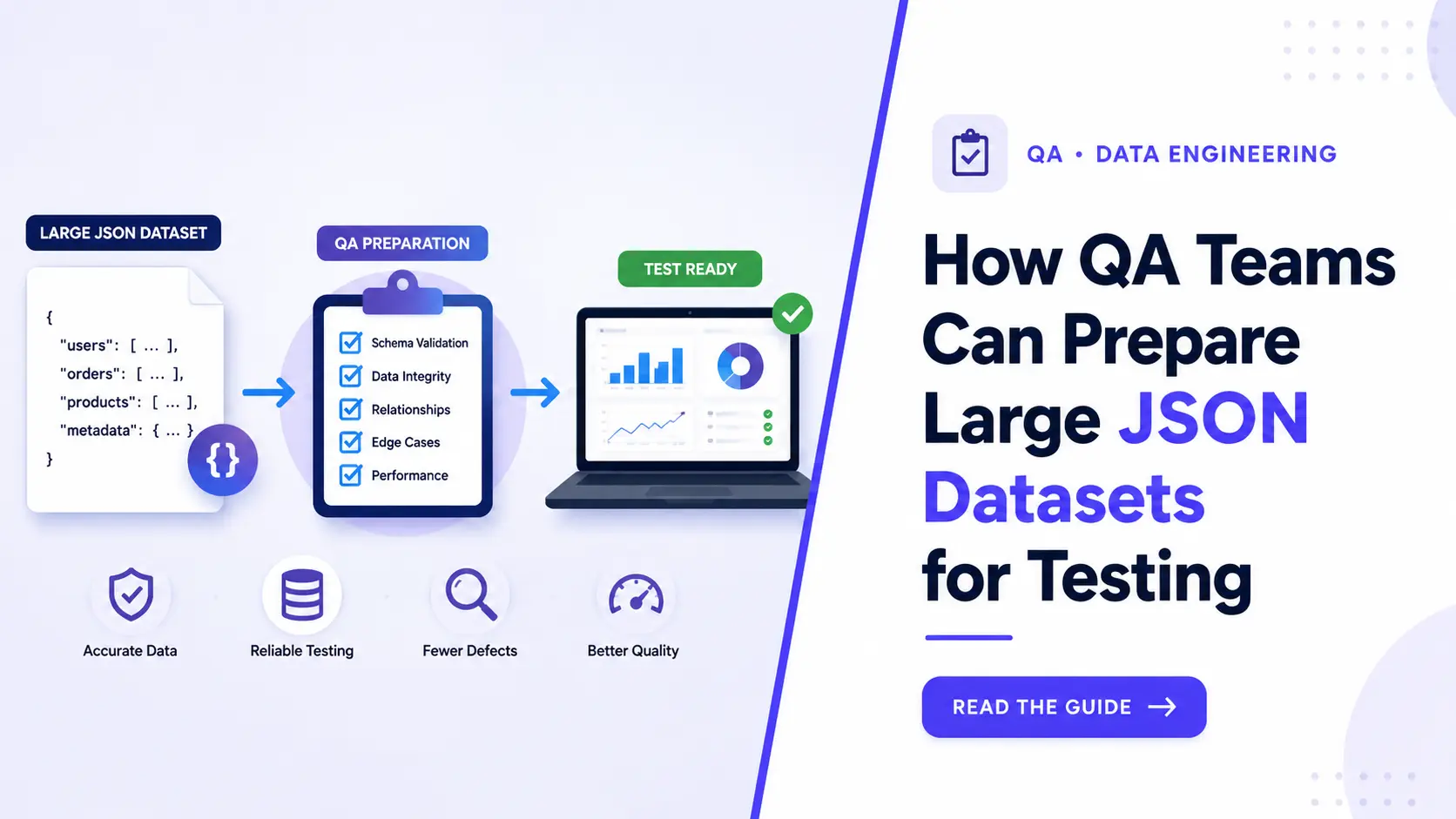
For many QA teams, preparing JSON data is one of the most common causes of a slow testing process. As JSON files continue to grow in terms of size and complexity, reviewing records, spotting inconsistencies, and organizing data for different test scenarios becomes difficult.
If a structured approach isn’t adopted by QA teams, each stage involved in the preparation of JSON datasets will become far more complex and time-consuming than necessary.
This detailed blog post will walk you through essential steps that should be taken in this regard to ensure maximum speed, accuracy, and efficiency.
Approach for QA Teams to Prepare Large JSON Datasets for Testing
In the section below, we have discussed an effective approach that QA teams can follow to prepare large JSON data for testing.
1. Validate the Data First
The first step for QA teams is to validate the large JSON dataset. Validation is basically a process of checking data to make sure it follows the standard rules and is free from syntax and structural errors.
Note that if the dataset contains even a single syntax error (i.e., a missing comma or bracket), it will cause the scripts, APIs, or software to fail. This will ultimately lead to inaccurate test results.
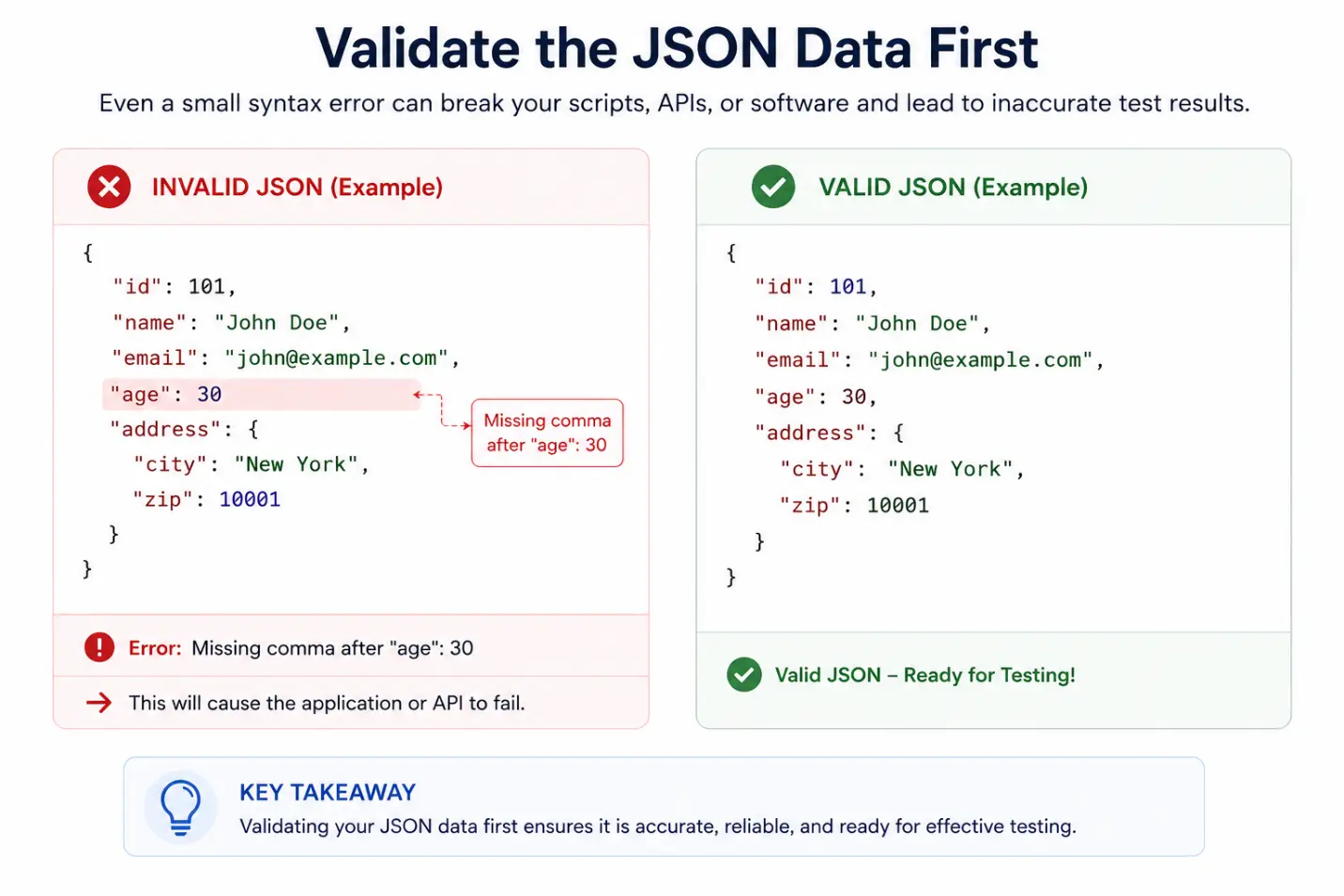
That’s why validation is considered important when preparing a JSON dataset for testing. Here is what QA teams need to do:
- Carefully check whether the dataset follows the correct JSON syntax. Ensure brackets, commas, and nesting are properly structured.
- Make sure all the required fields are present, and each value matches the expected data type.
- If the application or software uses a predefined JSON schema, then it is essential to validate the dataset against that schema as well to find inconsistencies.
We understand that manually validating huge volumes of datasets is not only time-consuming, but also error-prone. For this reason, many QA teams rely on specialized JSON validators to automate the entire process with a single click.
2. Clean and Standardize Data
After validation, it is now time to start cleaning and standardizing JSON data. This is because large datasets often consist of:
- Duplicate records
- Obsolete attributes
- Inconsistent naming conventions
- Formatting differences
Such types of issues make the dataset difficult to manage. To clean and standardize JSON datasets, QA teams need to remove all duplicate and unnecessary entries that can affect the testing process.
Additionally, they should also standardize date formats, naming conventions, and value formats throughout the JSON datasets.
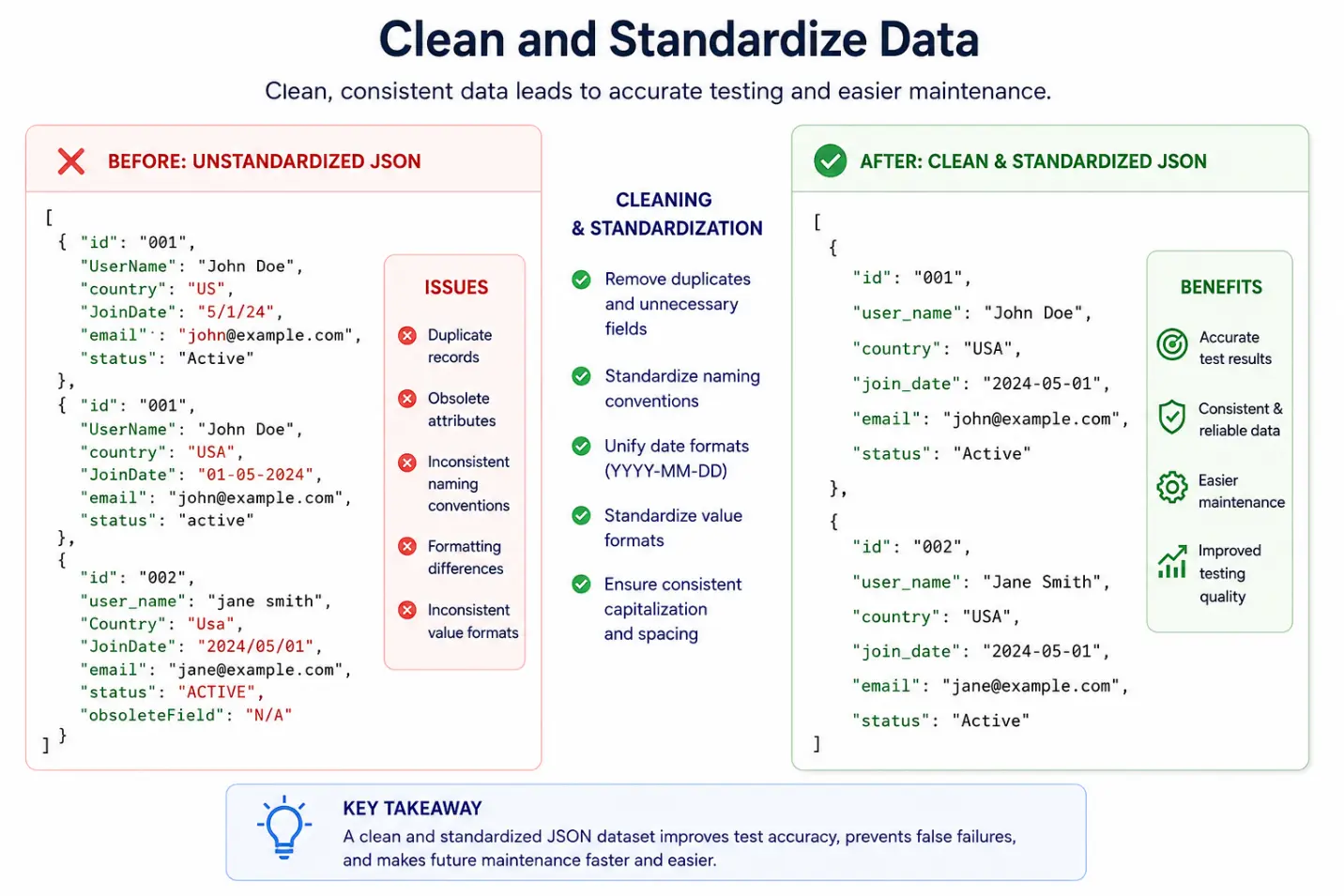
Let’s understand with an example.
Using different value formats such as “US” or “USA” throughout the data to represent the same country, the United States, can be confusing. Maintaining consistency will help prevent false test failures and enhance the overall testing quality.
Note that a clean and standardized JSON dataset not only improves preparation and testing but also makes future maintenance easier.
3. Organize Data for Different Test Scenarios
QA teams know that not every test requires the same JSON dataset. That’s why organizing data into different test scenarios is considered an important part of the preparation process.
Doing so will allow teams to perform testing more efficiently and locate the required data in no time.
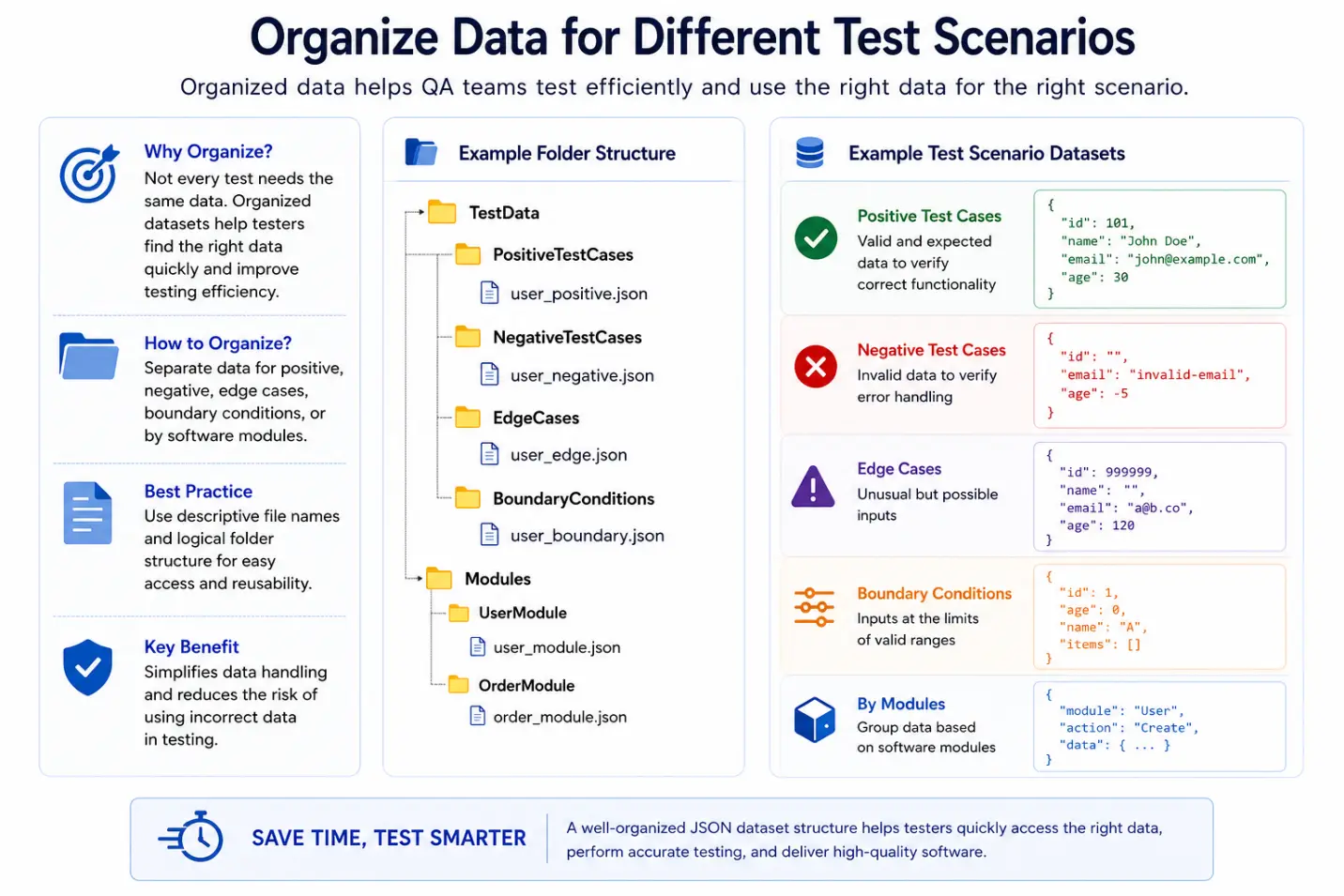
Below, we have listed how a large JSON dataset can be organized for different test scenarios.
- First, create separate datasets for positive test cases, negative test cases, edge cases, and boundary conditions. QA teams can also categorize the data according to software modules.
- Keep the file names descriptive and save folders logically. This way, testers can immediately access the dataset relevant to the scenario they want to execute, saving valuable time spent on manually searching through a massive JSON file.
Following this approach will simplify data handling and preparation while also reducing the risk of using incorrect data for testing.
4. Convert JSON Data into Spreadsheet Format
It is quite difficult for QA teams to review and prepare large JSON datasets when it is available in raw form. This is because nested objects and lengthy arrays make it challenging to find and review multiple entries or values at once.
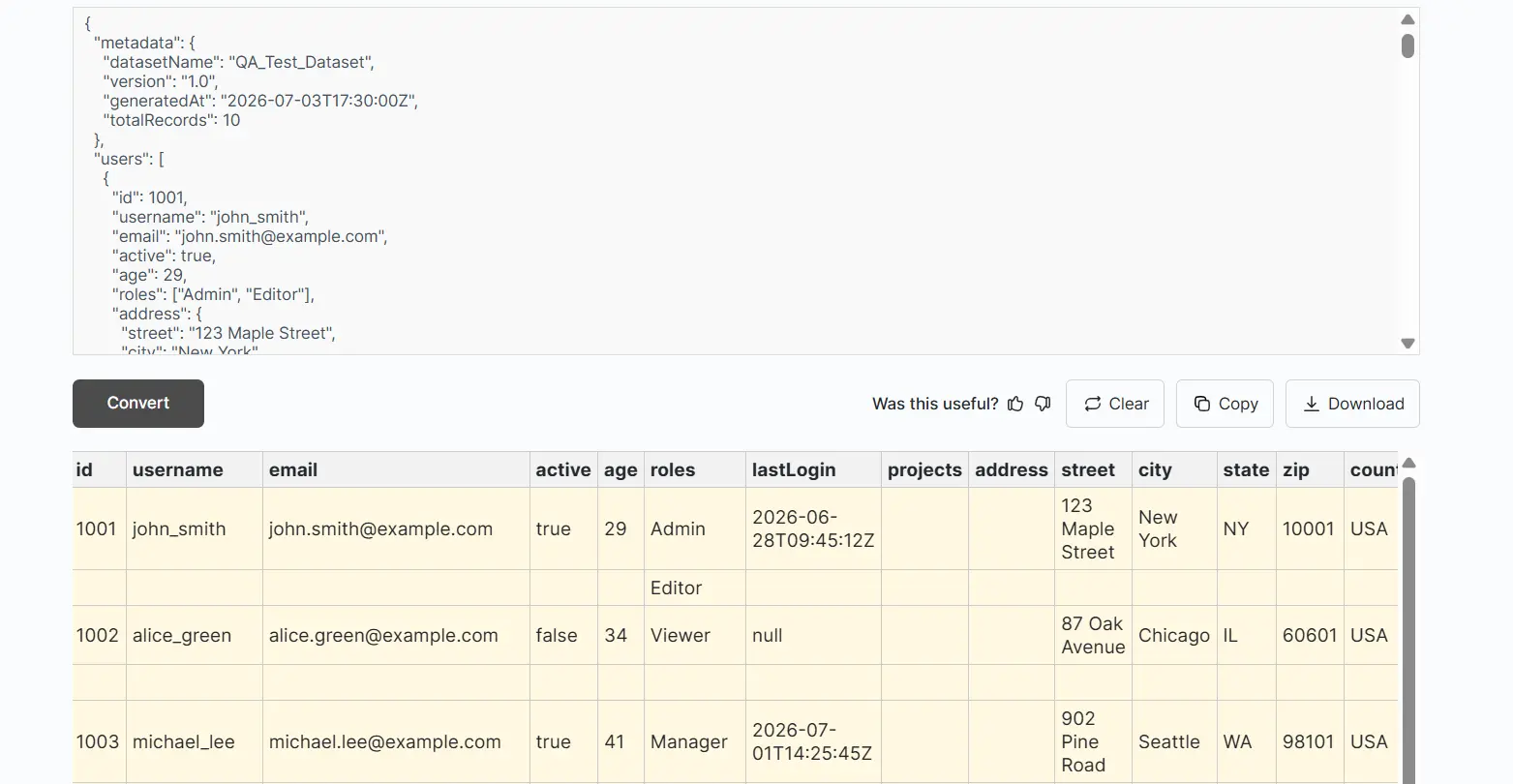
However, this won’t be the case if a large JSON dataset is converted into an editable Excel sheet. The spreadsheet will allow QA teams to quickly sort, search, edit, delete, and filter any type of attribute or entry without navigating through complex data structures.
This approach is especially useful in collaborative testing sessions where not every team member is comfortable engaging with a raw JSON dataset. Keep in mind that QA teams can either manually convert JSON files into Excel or take help from online JSON to Excel converters.
Usually, their preferred option is to opt for a dedicated JSON to Excel converter to ensure maximum speed, accuracy, and efficiency in the conversion process. These converters work by analyzing the complex dataset and then transforming it into organized rows and columns of a spreadsheet.
A screenshot of one such converter is attached below to provide you with a better idea.
Source: https://www.minifier.org/json-to-excel
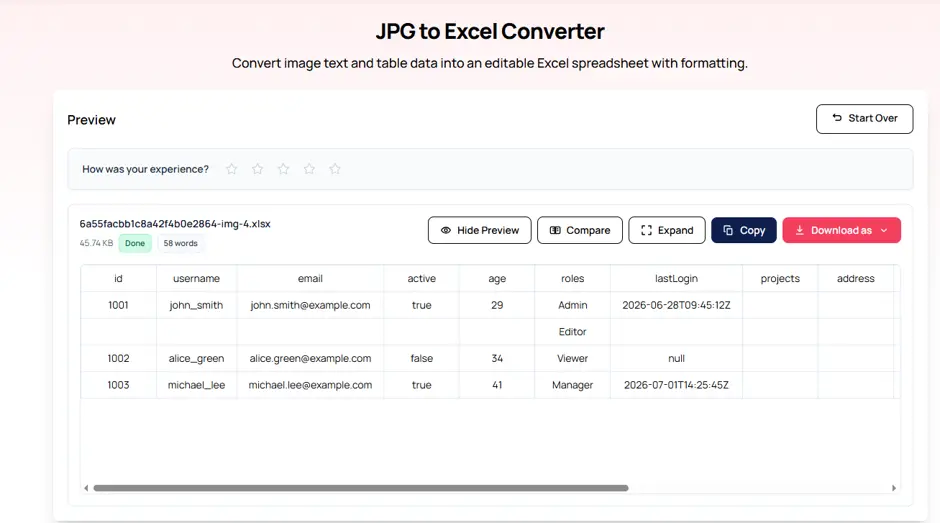
Getting JSON data into structured rows and columns will make testing easier and better for the QA teams. Sometimes the source data isn't a clean JSON export at all, it's a screenshot of an API response, a scanned test report, or a table captured as an image. In these cases, a JPG to Excel converter can pull the tabular data straight into a spreadsheet using OCR, saving QA teams from retyping rows and columns by hand.
5. Secure Sensitive Data
When preparing JSON data of applications and software for testing, there is a strong chance it will contain information such as:
- Customers/users
- Financial records
- Other sensitive details
Exposing such sensitive data to everyone will create security and compliance risks for the company. That’s why, before using a JSON dataset, identify any sensitive information, replace it with generic data, and securely store the original version.
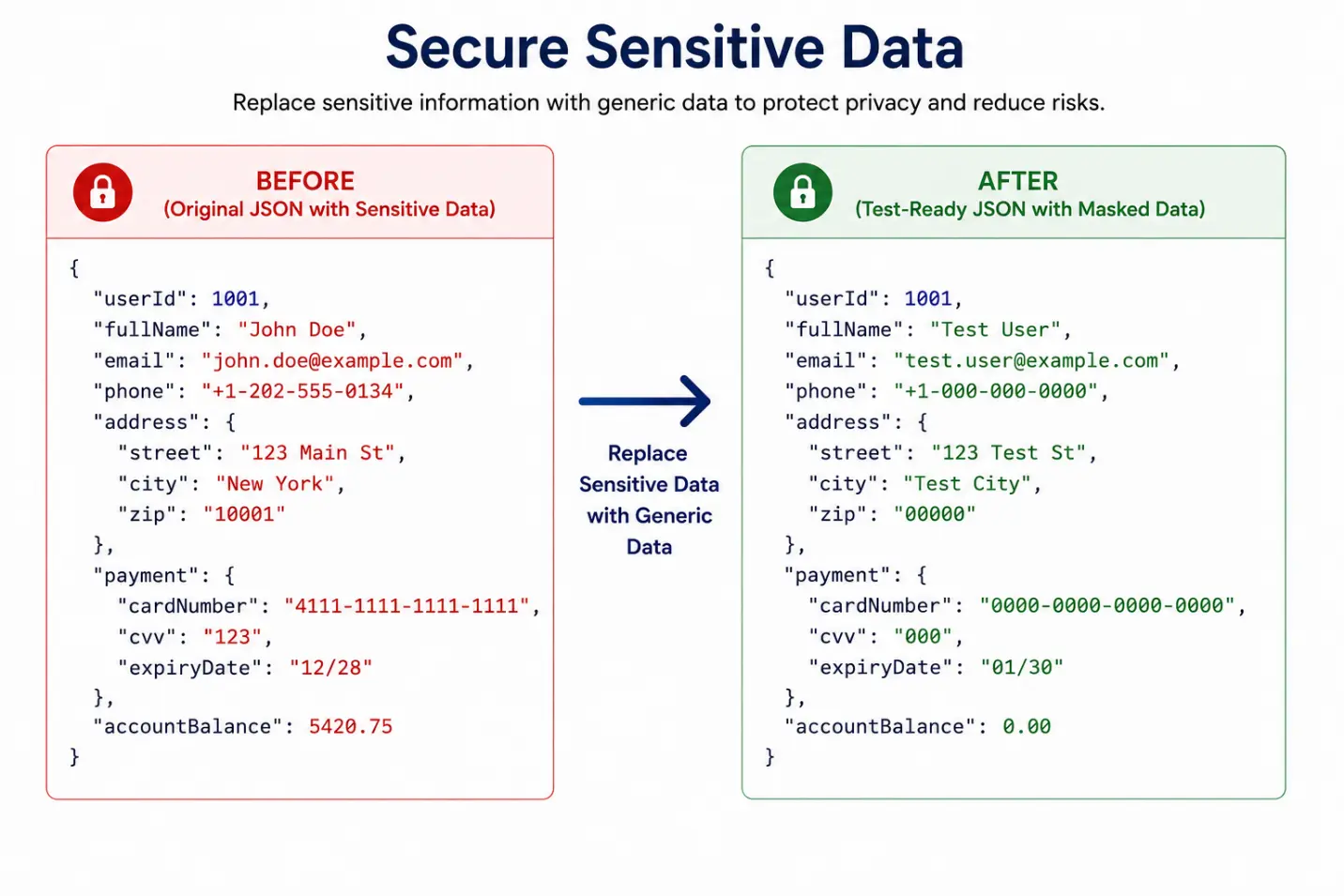
Remember, QA teams should only proceed with real sensitive data when it is absolutely necessary and under heavy security controls. Adopting this approach will help reduce security and compliance risks.
6. Maintain and Update Datasets
Finally, maintaining and updating datasets is essential to keep test data relevant over time. As the application or software evolves with the passage of time, new features, bug fixes, and changing requirements often require updates to existing datasets and the creation of new test data.
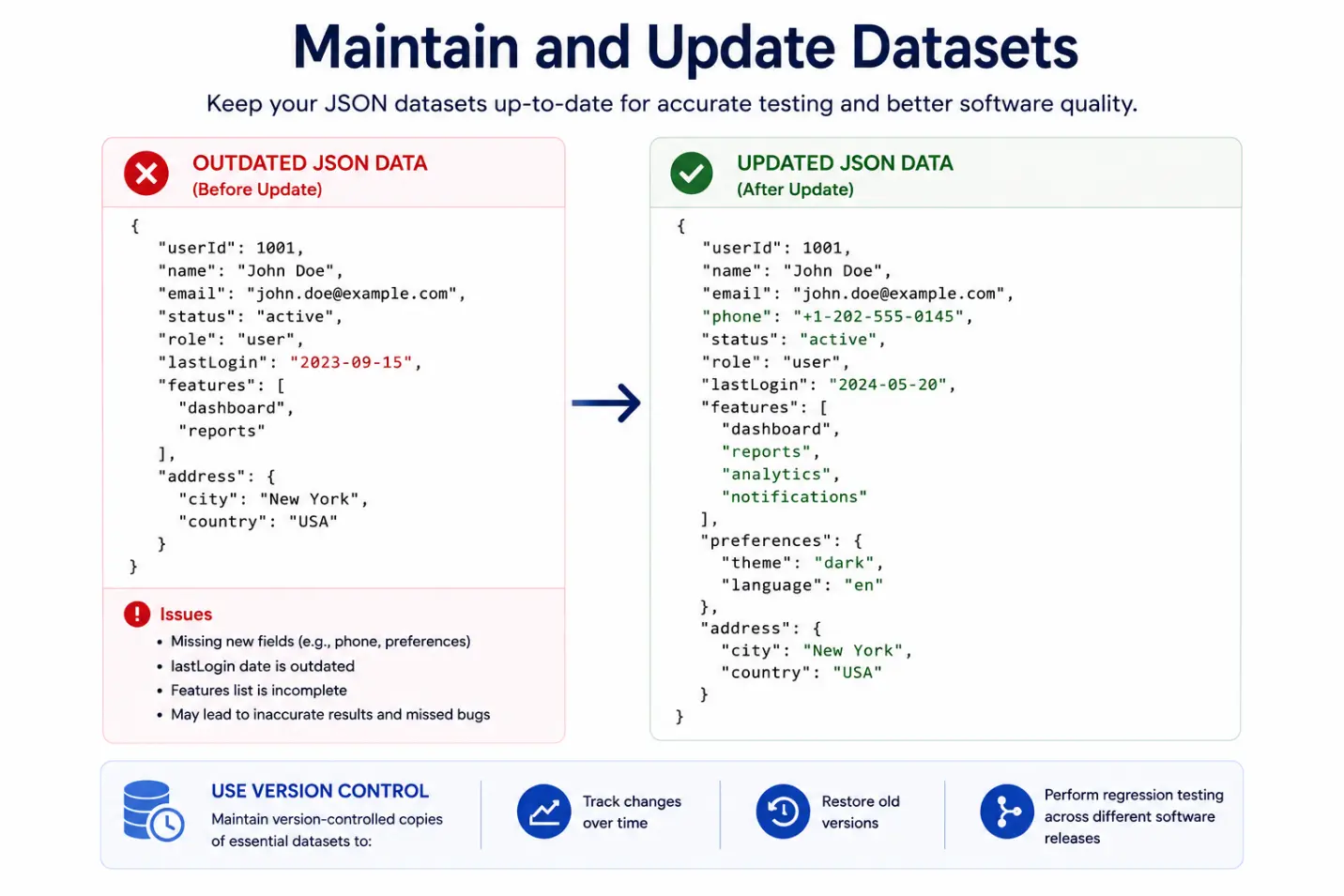
Therefore, QA teams should update their dataset accordingly. Testing with outdated data will result in inaccurate results, missed bugs, and failed test executions.
Here is what teams need to do to maintain and update a large JSON dataset.
- Regularly review the JSON dataset to eliminate duplicate and obsolete records.
- If required, add new test cases and update field values that reflect the latest software updates.
- In case the data structure of the application is changed, QA teams should also modify the JSON datasets accordingly so that it remains fully compatible with the current version of the application.
One suggestion from our side is that teams should have version-controlled copies of essential datasets. This way, they can easily track changes over time, restore old versions, and perform regression testing across different software releases.
Bottom Line
For effective testing, it is crucial for QA teams to prepare the large JSON datasets first. Doing so will allow them to identify issues faster, execute tests more reliably, and decide more effectively. Although preparing large datasets for testing is a technical and complex process, it can be simplified if the right approach is followed. This article has discussed a few important steps that can be taken in this regard.



.webp)

.webp)