

Imagine a support bot that succeeds in passing the checks on Tuesday. The question becomes phrased slightly differently on Wednesday and causes the checks to fail, yet nobody had altered the code at all. That is how AI-powered testing works: Measuring the quality of probabilistic output instead of proving that a single specific output is the one correct answer.
This guide follows the order of work across the software development lifecycle. First, you will define good quality, create an evaluation dataset, conduct bias, security, performance, and cost testing, and automate the process inside CI/CD pipelines.
What Is AI-Powered Testing?
AI-assisted testing refers to the utilization of artificial intelligence (AI), machine learning algorithms, and large language models to expedite software testing processes through automation. This technique enables testing teams to perform quicker tests without manually writing checks.
While test automation is based on scripted test runs, AI testing brings about flexibility and pattern recognition. This technique lies in the sphere of AI in software testing, generative AI in software testing, and has three layers:
- AI-assisted: The co-pilot, which creates test cases and code.
- AI-augmented: Test run data mining and bug prediction, as well as flaky test detection.
- Autonomous: The agent that writes, executes, and fixes tests from a user story.
Why AI-Powered Features Are Hard to Test
An LLM can answer one question five ways, and four may be good, so exact-match assertions fail correct answers and pass subtly wrong ones. Three failure modes each need their own test:
- Hallucination: Confident, false statements. They often happen when the model has too little relevant data or context, so it fills the gap with a plausible guess.
- Drift: A model or prompt change shifts behaviour. Even small edits to wording, data, or model version can change how the model responds.
- Bias: Quality differs by user group or phrasing. Training data often over-represents some groups and under-represents others.
Natural language processing adds another twist: One intent arrives in endless phrasings.
Building an AI Testing Strategy
The testing process for AI begins with clear quality measures and a specific owner who is responsible for the passing score before choosing any tool. Your Testing Maturity determines your level of ability to move forward, and the Test Automation Roadmap defines the next steps.
Define Quality Criteria and Acceptance Thresholds
'The answer should be good' is not a criterion. The following wording of a criterion for a support chatbot is better (numbers are illustrative): At least 90% of the responses to 100 labeled refund-policy queries comply with the policy and have no discounts invented. All good criteria have the following three properties:
- Measurable: A score on a labelled set, not an opinion. A number lets two reviewers reach the same verdict on the same answer.
- Per feature: Each feature gets its own pass mark. A refund bot and a search assistant carry different risks, so one shared threshold fits neither.
- Owned: One named person signs off. Without an owner, nobody decides when a failing score blocks a release.
Shift Left Testing: Map Risks to Test Types
Shift left testing means reviewing prompts and design before staging, as software development teams already do with code. Each risk gets one test type, written as test scenarios:
- Measurable: A score on a labelled set, not an opinion. A number lets two reviewers reach the same verdict on the same answer.
- Per feature: Each feature gets its own pass mark. A refund bot and a search assistant carry different risks, so one shared threshold fits neither.
- Owned: One named person signs off. Without an owner, nobody decides when a failing score blocks a release.
LLM Evaluation Framework: Core Testing Layers
LLM Evaluation Framework is a process involving a collection of datasets, metrics, and scripts used to evaluate a model's performance against established standards. It involves three levels: Input data, model output, and the whole feature.
Data and Input Validation
Evaluation is only as honest as its data, so run a validation process on inputs before trusting results:
- Base data collection on real usage data, not the tidy prompts engineers write.
- Move production logs over a secure connection and strip personal details.
- Validate retrieval and fine-tuning data too; stale policy documents produce confident, outdated answers.
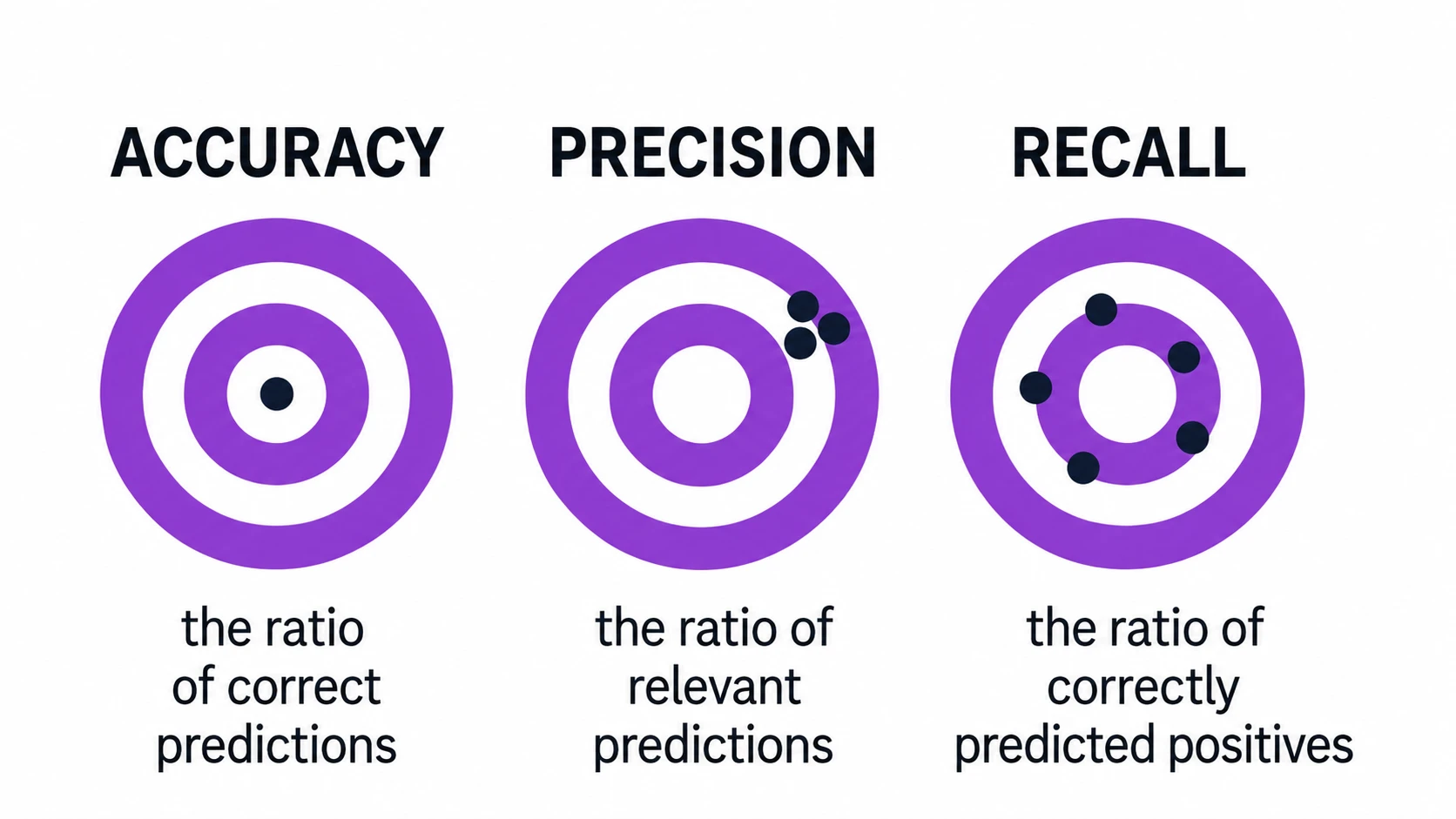
LLM Evaluation Metrics: Accuracy, Precision, and Recall
LLM evaluation starts with three familiar metrics.
Use LLM evaluation metrics as a set, because a healthy average hides the answer that causes the incident.
Test Coverage for Prompts and Outputs
Test coverage for an AI feature refers to prompt type, user intent, and edge cases, not lines of code. Measure the number of examples for each user intent in your test suite, since problems tend to occur in only three places:
- Rare user intent which still comes from real users, like cancelling the subscription or disputing charges.
- Multiturn dialogues, in which the answer to one prompt influences the response to another one.
- Adversarial or misspelled phrasing.
Bias and fairness checks
Bias appears as quality disparity and not as an error. Input two things that are the same except for the name, accent, or region, and then evaluate:
- Tone: How warm or cold the language is to one group.
- Usefulness: How comprehensive and helpful the response is to all groups.
- Refusal rate: If there is a higher refusal rate for one group over the other.
Sector guidelines vary, but the NIST AI Risk Management Framework can be used as a reasonable reference.
Safety, security, and prompt injection testing
A prompt injection attack is crafted input that makes a model ignore its instructions. Indirect prompt injection hides inside content the model retrieves, and the OWASP Top 10 for LLM Applications lists it first. Three prompt injection examples worth testing:
- A message telling the bot to 'ignore previous instructions'.
- A support ticket with hidden text ordering a refund.
- A retrieved document asking the assistant to leak the conversation.
AI red teaming is the manual exercise behind this, with people trying to break the feature. Every successful attack becomes a regression test, which makes it core software security testing.
.webp)
Performance, latency, and cost
Perform performance testing with the performance testing software you use now, but include one more metric: Cost per Request. Pay attention to these four aspects:
- Latency at load level: A call that is quick in a demo can become much slower under simultaneous users.
- Token cost: The spending increases depending on traffic and call length; thus, a seemingly inexpensive feature becomes costly in production mode.
- Tail response time: Monitor the slowest response time received by users, not the average, as it is what causes complaints.
- API validation: Check schemas, timeouts, and error handling so a delayed or failed model call degrades smoothly.
AI Test Automation
AI test automation, or AI-driven automation testing, turns the manual checks above into repeatable runs. Newcomers ask what test automation in software is: It is using scripts and tools to run tests without manual effort.
What to Automate and What Needs Human Review
Automated testing allows repeatable tests, so humans can focus on judgment. Do regression testing on the evaluation set, schema and latency checks, and flaky test detection by rerunning the failures to identify unstable tests. Keep people up to date on new failure modes, tone, and red team discoveries. AI-assisted testing will reduce the maintenance effort for your test suite:
- Self-healing tests will fix test scripts on UI changes, and this reduces test maintenance.
- Test generation will write test scenarios and edge cases based on requirements.
- Visual testing relies on computer vision and visual AI for defect detection; visual AI validation identifies layout issues missed by DOM checks in UI testing and cross-browser testing.
- Autonomous testing, which includes agentic automated testing, allows agents to plan, execute, and triage; this is still new, so keep human oversight.
Continuous Testing: Evaluation Pipelines in CI/CD
Continuous testing of AI capabilities requires that every update to prompts or models triggers the execution of the test set, comparing the score against the latest passing baseline, and stopping the merge if the score falls below the threshold. Keep datasets and baselines with tests in test repositories separate from the codebase. Our test automation in CI/CD guide covers the basics.
name: llm-eval-gate
on:
  pull_request:
    paths: ["prompts/**", "src/llm/**"]   # run only when prompts or LLM code change
jobs:
  evaluate:
    runs-on: ubuntu-latest
    steps:
      - uses: actions/checkout@v4
      - uses: actions/setup-python@v5
        with: { python-version: "3.12" }
      - run: pip install -r eval/requirements.txt
      # Fails the build below the threshold or on regression against the baseline
      - run: python eval/run_eval.py --dataset eval/golden.jsonl --baseline eval/baseline.json --min-score 0.90
LLM-as-a-Judge and Its Limits
LLM-as-a-judge means using one model to grade another model's output against a rubric. It scales well, but it has known weaknesses:
- Judges favour longer answers, even when shorter ones are better.
- Scores can change between runs on the same output.
- A judge can share blind spots with the model it grades.
Each week, compare a sample of judge scores with human labels. If they drift apart, trust the humans and fix the rubric.
AI Testing Tools Worth Evaluating
AI testing tools fall into three groups: Evaluation libraries, browser automation frameworks, and commercial AI testing platforms. Test automation tools overlap, so choose by the job.
A test automation framework such as Playwright or Selenium can be augmented with LLM requests. Automated software testing tools designed for conventional user interface tasks do not interpret significance, and therefore, those mentioned above coexist with them.
Common Pitfalls and Best Practices
Failures in AI tests usually originate from preventable errors, and there is always a best practice to avoid them:
- No last known good metric: Without it, 'worse' is meaningless. Save it in the repository and update it via the review process, never automatically.
- Too small evaluation set: It cannot represent all intents. Grow it with production data.
- Prompt editing considered as non-code: Version it, review it, and gate every change in CI.
- No responsible party defined: Define the criteria explicitly, define the threshold owner, and create one injection test per intent class and one CI gate.
How Frugal Testing Helps You Test AI-Powered Features, Without the Overhead
Everyone knows what effective AI testing means, but there simply isn't enough time to implement it. With our AI testing services and QA automation services, we will work side-by-side with your engineers, so you stay in control of quality decisions while we handle testing design and automation, with no new platform to adopt.
From QA consulting services, where we look at your process, through software QA services and QA testing services, to outsourced QA services and automation testing services, you retain ownership of all datasets, scripts, and baselines from day one.
What Our AI Testing Engagement Looks Like
A typical engagement runs in four stages:
- Week 1: We examine your AI features and risks, after which we settle on passing marks and ownership.
- Week 2: We construct an annotated test suite from the production log, including injection and bias scenarios.
- Week 3: We wire in evaluation controls into the CI/CD pipeline as a gate for each prompt/model change.
- Week 4: We deliver baselines, dashboards, and a runbook, and educate your team on how to build on them.
Conclusion:
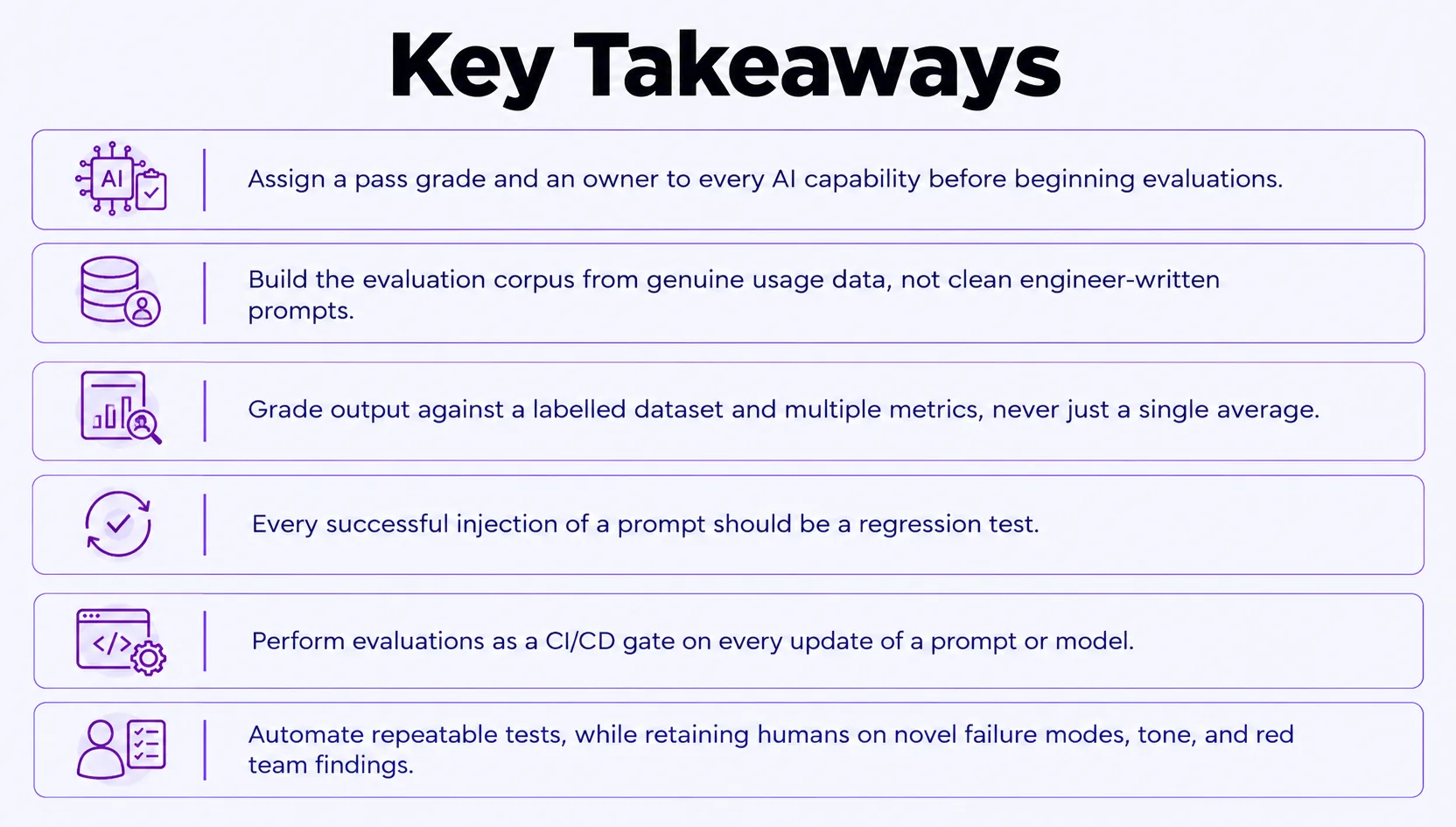
Three points carry this guide. Define pass marks with a named owner before testing starts. Score output with a labelled dataset and several metrics, never one average. Turn every successful prompt injection into a regression test, and run each change through a CI/CD gate.
AI-powered testing is much less about tricking a model and much more about defending the decision to release it. Test behavior rather than exact wording, and back every AI release decision with evidence, not just a green dashboard, so your team ships with confidence and fewer surprises.
People Also Ask (FAQs)
Q1. What is prompt injection?
Ans: Prompt Injection Attack refers to an attack scenario where an attacker sends a carefully crafted prompt to bypass the AI's prompts and instructions. It can either be direct or indirect.
Q2. How often should you refresh an evaluation dataset?
Ans: Refresh it whenever the product, prompts, or user behaviour change, and review it at least quarterly. Add real production failures and retire examples that no longer reflect actual usage.
Q3. How do you test an AI feature when the model vendor ships an update?
Ans: Rerun the full evaluation set on the new version before switching, compare scores with your stored baseline, and check latency and cost. Roll out gradually and watch for drift.
Q4. How do you test AI features in regulated industries?
Ans: Document criteria, datasets, and results so every release decision is auditable, add bias and privacy checks, and map tests to the relevant rules. Confirm requirements with compliance before launch.
Q5. What should an AI testing engagement with a QA partner deliver?
Ans: Expect a risk map, a labelled evaluation dataset, scored baselines, security and performance results, and a CI gate your team can run alone, plus a handover session.

.webp)

.webp)