

The most innovative QA teams in 2026 don't write more tests; they leave all this work to AI, starting from test generation through test execution to test maintenance, to allow engineers to deal with those bugs that matter instead of looking after scripts.
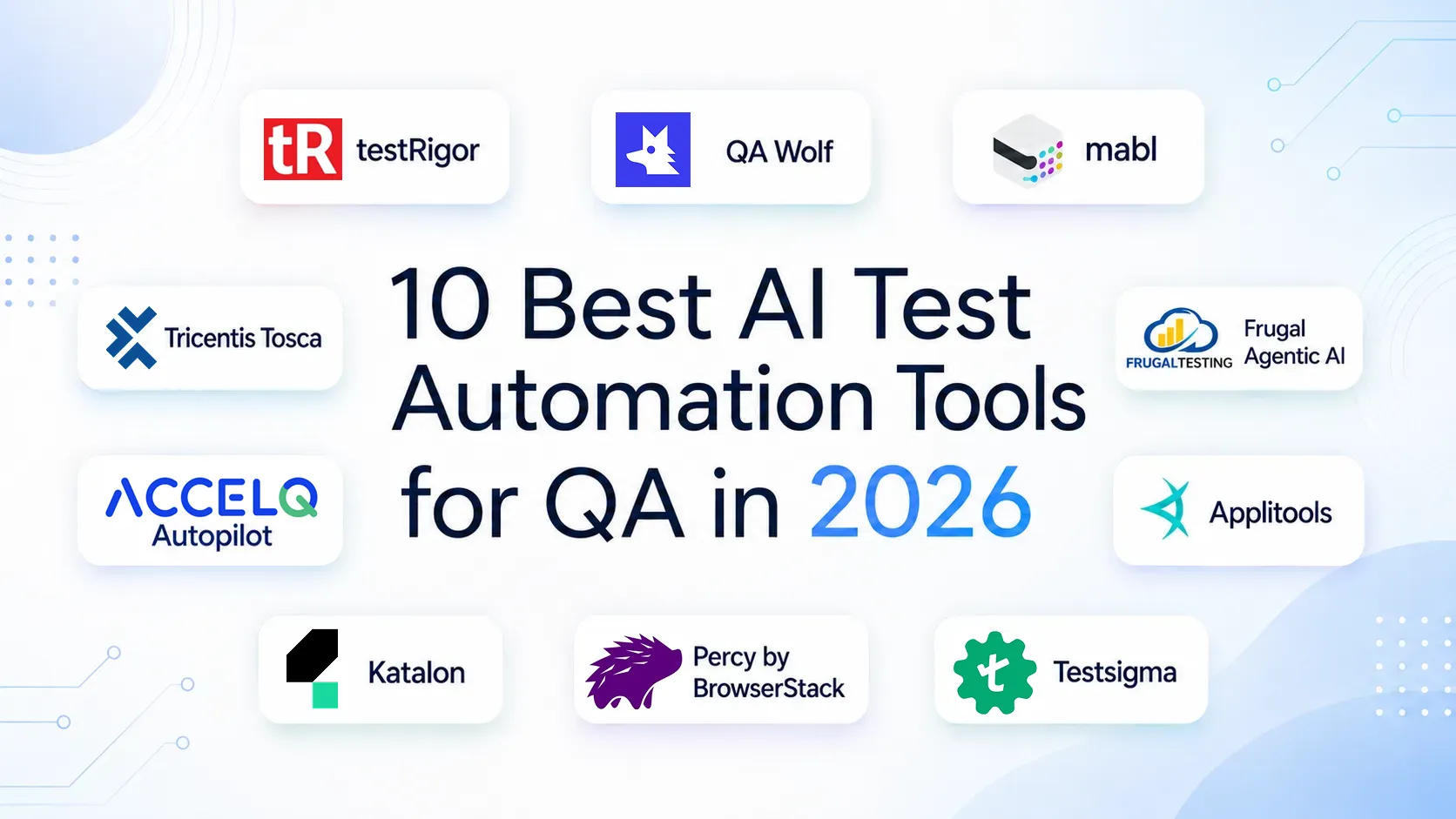
This guide will provide you with a clear overview of the 10 most effective AI test automation tools in 2026: what each of them is, how it operates, and what type of testing automation each of them provides. You will see that today, if you just Google "test automation AI," you will see tons of options, but only 10 of them are worth your consideration.
What Counts as an "AI Test Automation Tool" in 2026
The AI-based testing tool adopts machine learning algorithms for dealing with either test creation, test running, or test maintenance processes rather than being dependent solely upon manually written scripts. It does not matter whether you refer to them as AI automation testing tools, AI software testing tools, or AI tools for software testing because all of them utilize generative AI in software testing for quicker performance. There are two approaches in the market: natively AI-based platforms founded on agentic AI right from the beginning and AI-enabled frameworks adding AI capabilities to the script-based solutions like Katalon Studio. Both approaches still fall under the same umbrella: AI-native platforms and AI-assisted frameworks alike count as AI Testing Tools, and each one is, at its core, an AI-powered testing tool built on agentic AI features.
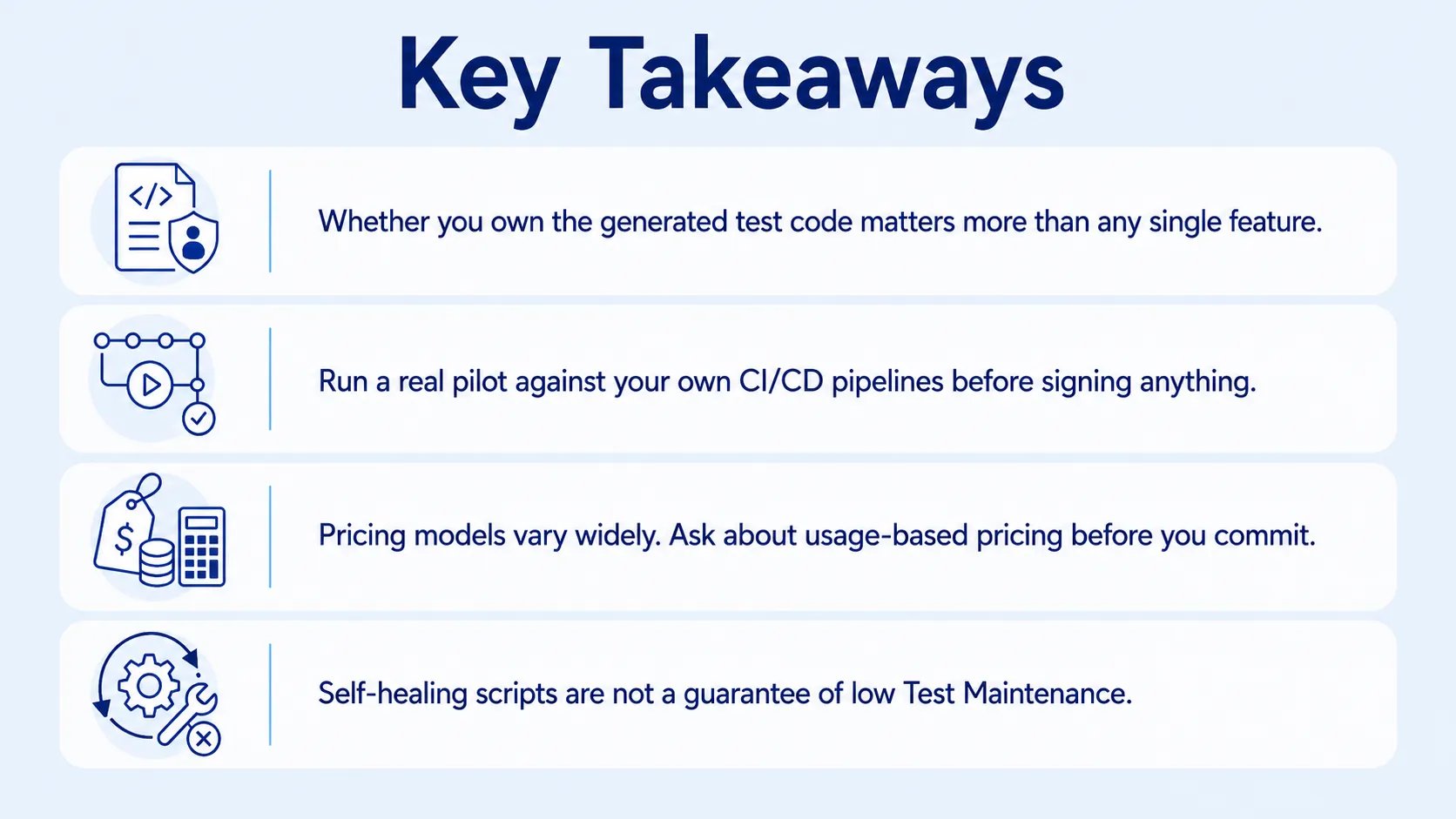
Some tools generate test code you own and run inside your own CI/CD pipelines. Others run tests inside their own platform and hand nothing back. That difference decides more of your outcome in software testing than any feature list.
How We Evaluated These AI Test Automation Tools
- Test coverage, Test case generation (including automated test case generation), and support for real Test scenarios and UI tests.
- CI/CD pipeline integrations, including GitHub Actions and GitLab CI.
- API testing and API integrations (Postman API, REST Assured API, k6 Performance).
- Test data management, test environment support, and app knowledge bases built from your existing docs.
- Visual testing, visual validation, accessibility testing, and content moderation checks.
- Test management, Test Reports, and reporting add-ons like TestDino Reporting.
- Test optimization, Test maintenance, and overall QA process fit.
The 10 Best AI Test Automation Tools
Each tool below covers what it is, how it works, which type of testing automation it falls under, and who it is best for.
1. Katalon
What it is: Katalon Studio is an immensely popular testing automation tool that supports low-code testing as well as coding for testing applications on the web, mobile, API, and desktop platforms.
How it works: Testers either record actions on the application or create test cases themselves, and self-healing scripts and AI-based test creation are done above Selenium Web UI and Appium Mobile testing engines.
Type of testing automation: AI-assisted framework. Your team still owns test design and Test Maintenance, with AI extending automation capabilities around the busywork.
Best for: Teams wanting a familiar, script-based platform with AI convenience features rather than full autonomous test generation.
2. Frugal Agentic AI
What it is: Frugal Agentic AI is Frugal Testing's own agentic AI platforms are built to take a project from requirements to a maintained workflow with minimal manual scripting. Much like how Agentic SEO utilizes autonomous tools to streamline search optimization, automated browser agents execute complex web actions dynamically.
- User stories: Starts with project requirements, synced automatically from tools like Jira, ClickUp, or Azure DevOps.
- AI test case generation: The AI reads those requirements and generates positive, negative, and boundary test cases covering expected behaviour, invalid inputs, and edge cases.
- AI test planning: It organises the test cases into a full plan, linked to acceptance criteria.
- AI browser agent execution: A browser agent runs the tests live. If something breaks, such as a dashboard widget failing to render, it detects the validation error during execution.
- Result analysis: The AI reviews outcomes. Successful runs get marked complete, the regression suite updates, and tests are archived. Failures trigger a defect loop: a bug gets logged, a screenshot attached, a developer assigned, and a retest scheduled once fixed.
Type of testing automation: Agentic automated testing. The AI generates, executes, and triages tests, respecting feature flags during rollout and meeting SOC 2 requirements for regulated teams.
Best for: Teams that want AI to own test case generation and execution end to end, without losing ownership of their test code.
3. Percy by BrowserStack
What it is: Percy by BrowserStack is a visual AI testing solution designed to help detect visual regressions on web pages and web components.
How it works: It takes UI screenshots on each build, compares them against the baseline through visual validation, and alerts you of any changes detected, which include moderation tests of user-generated UI states.
Type of testing automation: Visual testing, which is essentially a validation layer over your existing Cypress Web UI or Playwright Web UI test suite.
Best for: Organizations with functional testing in place who want to detect visual issues that are not detected via regular regression testing.
4. Applitools
What it is: Applitools is a visual test tool that uses its proprietary Visual Recognition engine.
How it works: The tool makes a comparison of the actual UI with the baseline using human-eye-like comparison to reduce the number of false positives caused by rendering differences and support accessibility testing.
Type of testing automation: Visual AI testing on top of an execution tool rather than a replacement for it.
Best for: Large organizations requiring visual testing in an enterprise-level environment.
5. testRigor
What it is: testRigor is an AI-powered automation platform that allows users to develop their test cases in simple English.
How it works: The AI converts the simple language instructions to automated actions, with self-healing tests continuing to work even as the DOM changes its structure.
Type of testing automation: AI-driven, natural-language-based testing.
Best for: Teams that don't have coding capabilities but need to perform automated testing anyway.
6. Testsigma
What it is: Testsigma is an AI-native test automation tool that converts requirements into tests.
How it works: It consumes Jira tickets and Figma designs to develop a knowledge base of your application and automate test cases and Test Scenarios on both the web and mobile platforms.
Type of testing automation: It performs agentic automated testing with excellent mobile capability.
Best for: Mobile-based QA teams who want native Appium Mobile testing automation but don't want to write test cases manually.
7. mabl
What it is: mabl is a fully agentic AI testing tool that transformed itself from an AI-assisted tool to an autonomous one in 2026.
How it works: The self-healing scripts are automatically adapted whenever there is a change in DOM structure with a multi-agent workflow process that includes Test generation, Test execution, and Test reports.
Type of testing automation: Agentic, adaptive test execution.
Best for: Teams wanting adaptive, low-maintenance coverage without a script library.
8. Tricentis Tosca
What it is: Tricentis Tosca is a high-end model-driven automation tool designed for complex application environments.
How it works: Rather than creating individual scripts, it creates models for risk and process for applications, and then uses AI to generate test cases and perform visual verification for web, SAP, and mainframe applications.
Type of testing automation: Model-driven automation with generative AI.
Best for: Complex enterprises having SAP, mainframe, or regulated applications.
9. QA Wolf
What it is: QA Wolf is an agentic automated testing platform generating real, owned test code from prompts.
How it works: It produces Playwright Web UI and Appium Mobile test suites that run within your own CI/CD pipelines, with parallel execution to keep test runs fast.
Type of testing automation: Agentic, deterministic, and code-based.
Best for: Teams wanting CI-ready coverage they fully own and can audit.
10. ACCELQ Autopilot
What it is: ACCELQ Autopilot can be said to be among the most comprehensive test automation platforms that are native to AI.
How it works: It features an AI engine that is capable of writing and executing the tests automatically, and that includes Salesforce Lightning components and APIs.
Type of testing automation: Agentic automated testing with broad platform coverage.
Best for: Enterprise teams testing beyond a standard web app, especially SAP or Salesforce shops.
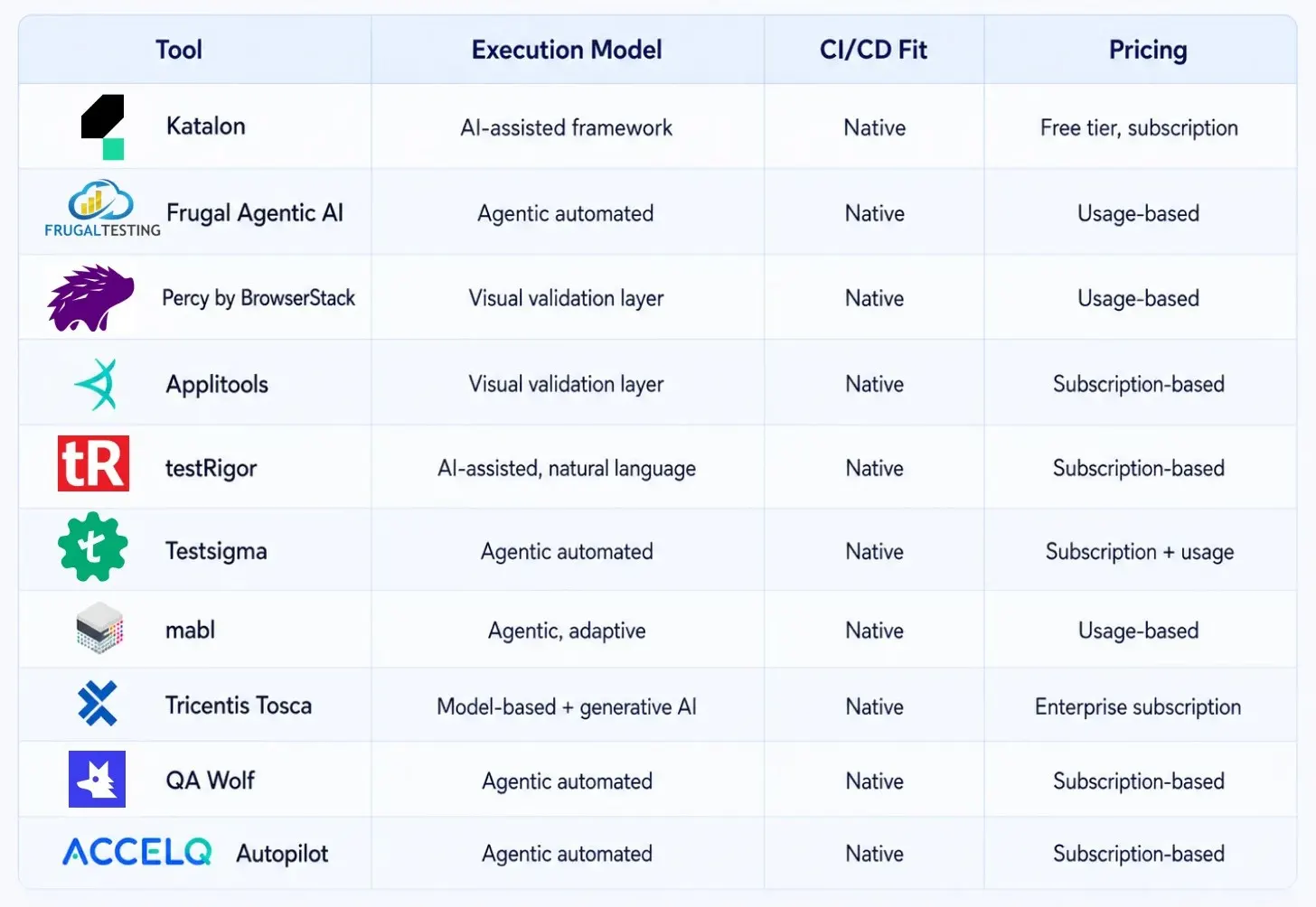
Comparison Table - Execution Model, Pricing, and CI/CD Fit
Mistakes Teams Make When Choosing a Tool
- Picking a tool from a demo instead of testing it in your own test environment.
- Not checking whether the tool supports Test Data Management, or only synthetic test data.
- Assuming self-healing tests, or self-healing test maintenance, mean zero maintenance. DOM structure changes still need a human to review the error message first.
- Ignoring dependency scanners and other checks bundled into CI/CD workflows.
- Skipping a migration work plan when moving off Selenium or Cypress.
- Not asking how the tool handles feature flags during test runs.
How Frugal Testing Helps in Automating Your Test Suites
We remove the pain points above so you do not have to learn them the hard way.
We run a real pilot against your CI/CD pipelines before recommending anything, using two or three shortlisted automation tools, so the decision is based on your codebase, not a demo. Our agentic AI and AI-assisted frameworks handle test generation, test execution, and test maintenance, so your QA team spends less time babysitting scripts. We integrate with GitHub Actions, GitLab CI, and your existing test management platform, and support SOC 2-compliant environments out of the box.
Conclusion
Every tool on this list earns its place for a different kind of project. The right test automation platform depends on release cadence, compliance needs, and how much test maintenance you want in-house. Pick based on fit, and you get a QA process that scales with you.
People Also Ask (FAQs)
Q1. What is AI test automation?
Ans: It uses machine learning to generate, run, or maintain automated tests, rather than relying only on hand-written scripts.
Q2. How does AI test automation work?
Ans: Tools read prompts, your app, or recorded behaviour, then generate test code or run tests directly.
Q3. What is the difference between AI test automation and traditional automation?
Ans: Traditional automation needs scripts maintained by hand. AI tools generate or adapt those scripts using machine learning.
Q4. Are AI test automation tools free?
Ans: Several, including Katalon, testRigor, and mabl, offer free tiers or trials. Most enterprise platforms are quote-based.
Q5. Does AI test automation cover API and performance testing?
Ans: Yes. Most platforms in this list support API testing through integrations like Postman API, REST Assured API, and k6 Performance for load checks.