

Claude's 200K token context window processes approximately 500 pages of text in a single session more than OpenAI GPT-4 Turbo's 128K limit, and significantly more accurate at mid-context retrieval than models with larger but less optimized windows. For legal review, codebase analysis, and long-document research, this combination of capacity and consistency is what separates Claude from the alternatives.
Imagine handing a 500-page legal contract to your assistant and asking them to find every clause that could expose your company to financial risk and getting a precise, accurate answer in seconds. That's not science fiction anymore. That's Claude.
At Frugal Testing, we work with engineering and QA teams who constantly deal with massive codebases, lengthy test documentation, and complex API specs. One of the biggest pain points we hear repeatedly is this: most AI tools forget what they read halfway through a document. Claude doesn't. And in this post, we're going to show you exactly why and how smarter context engineering is changing the way professionals work with AI entirely.
What Is a Context Window and Why Does Size Matter?
Most people jump straight into using AI tools without understanding the one thing that determines how useful they actually are the context window. Get this wrong, and you're working with a tool that's essentially reading your document through a keyhole. Everything looks fine on the surface, but critical details are being missed every single time.
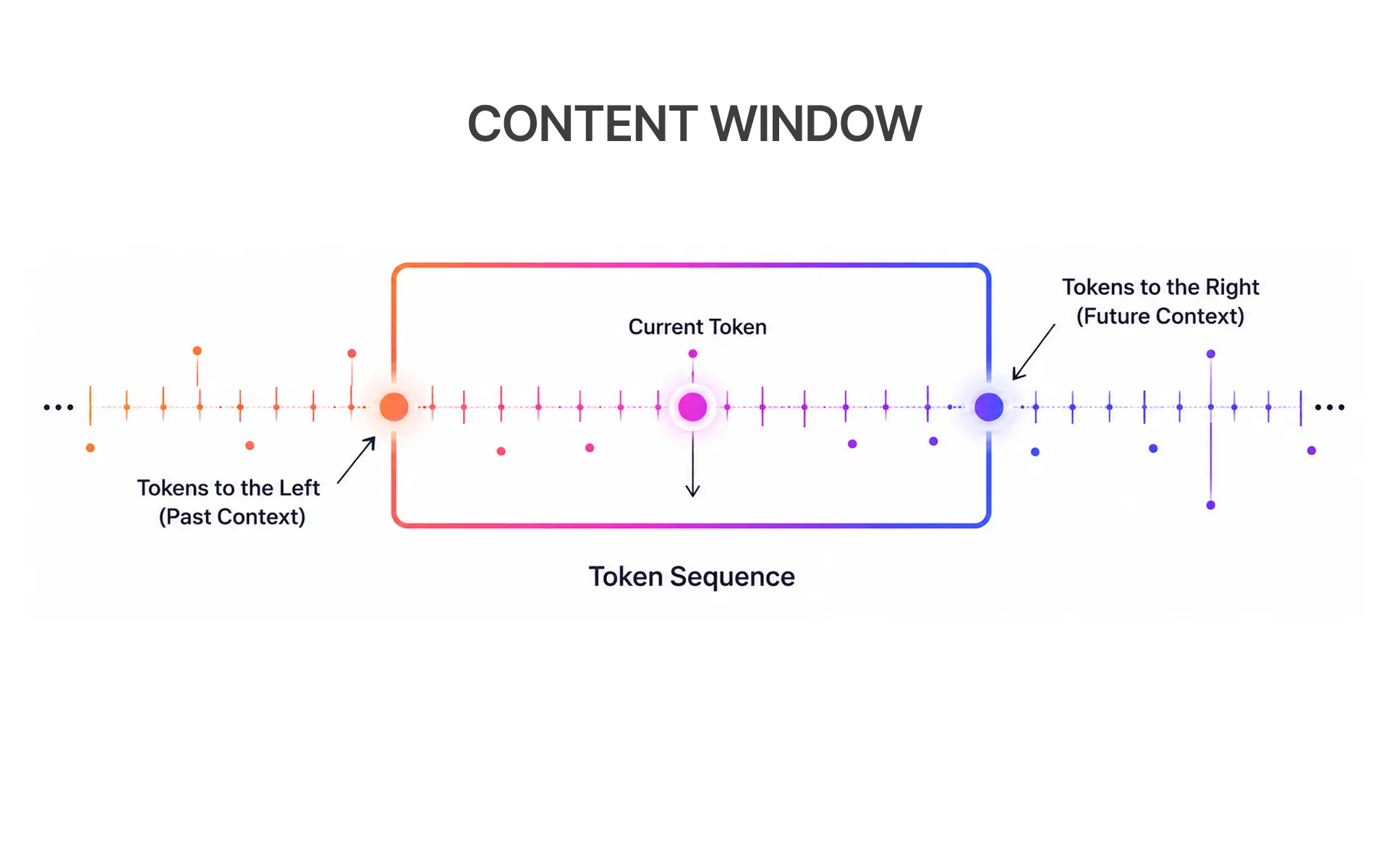
What Is a Context Window in AI and How Does It Work?
A context window is the total amount of text an AI model can read, process, and hold in mind during a single session. Think of it like a whiteboard everything the model needs to reference has to fit on that whiteboard at once. Once it's full, older information gets wiped to make room for what's coming in next.
Here's what typically lives inside a context window at any given moment:
- Your input the document, question, or prompt you send
- The model's full conversation history from earlier in the session
- Any system instructions or background context you've set
- Tool result clearing the output of any tools the model has called during the session
- The response the model is currently generating
The bigger the whiteboard, the more the AI can work with without losing track of what came before.
Understanding Tokens: The Currency of AI Memory
Tokens are the basic unit AI models use to process language and they're not the same as words. One token is roughly 0.75 of an English word. So when people ask how many tokens Claude can handle, the answer is 200,000 which works out to about 150,000 words, or roughly 500 pages of text.
Output tokens matter just as much as input. Claude's output token limit determines how long and detailed a single response can be which becomes especially important for tasks like financial analysis, large-scale code generation, or producing multi-section research summaries.
To put that in perspective:
Good context management knowing what to include, what to leave out, and how to structure your input is what separates average AI users from people who get genuinely useful results.
Why Long-Context AI Models Matter in 2026
The way people use AI has shifted dramatically. Back in 2023, most people were using AI to draft short emails or generate quick summaries. In 2026, teams are using it to review entire software projects, run financial analysis across multi-year reports, and conduct end-to-end contract due diligence all inside a single uninterrupted session.
This shift makes long-context AI models not just useful but genuinely essential:
- Legal teams need AI that reads an entire 200-page agreement without glossing over the middle sections
- Engineering teams using Claude Code need AI that understands the full codebase before suggesting a single line change
- Researchers need AI that cross-references findings across 20 papers simultaneously without losing the thread
- QA teams at companies like Frugal Testing need AI that holds the entire test suite in mind when spotting coverage gaps
Short-context models force you to chunk your work and every time you split the input, you lose coherence and accuracy. Long-context models like Claude eliminate that problem entirely.
Context Window vs Memory What's the Difference?
This is one of the most misunderstood distinctions in AI right now. A lot of people assume that if Claude can read 500 pages, it must be remembering things between conversations. It isn't and understanding the difference saves a lot of frustration.
- Context window = everything the model can see within a single session, including the full conversation history
- Long-term memory = information stored and recalled across sessions via the memory tool
- Retrieval systems = external databases or RAG pipelines that feed relevant content into the context on demand
Think of the context window as your desk everything currently spread out in front of you. Long-term memory is the filing cabinet in the corner. Retrieval systems are the assistant who fetches the right folder when you ask. Claude uses all three, but they serve very different purposes.
Claude's 200K Token Context Window in Practice
Knowing Claude has a 200K token window is one thing. Seeing what you can actually do with it is something else entirely. This is where Claude separates itself from every other model on the market not just in spec sheets, but in real work.
How Many Pages Can Claude Read at Once?
At 200,000 tokens, Claude can process approximately 500 pages of standard text in a single prompt. That's the first three Harry Potter books back to back. That's a full software engineering specification document. That's six months of customer support tickets analyzed in one sitting.
Here's what that looks like across real professional scenarios:
- Academic research: Upload 15 papers and ask Claude to find contradictions across all of them in one go
- Software development with Claude Code: Paste an entire repository and get a full dependency map with no manual cross-referencing
- Legal review: Drop in a 100-page contract and ask Claude to flag every indemnification clause including the ones buried on page 74
- Financial analysis: Feed in a full annual report and ask for a risk-weighted executive summary with specific figures called out
No chunking. No losing track. No re-explaining what you already told it twenty minutes ago. Claude holds it all and response quality stays consistent whether you're at token 1,000 or token 190,000.
Real-World Use Cases What People Actually Use Claude For
The best AI for long documents isn't determined by token count alone it's determined by what people actually accomplish with it day to day. Here's how real teams are using Claude's long context window right now:
At Frugal Testing, QA engineers use Claude to review large test suites against full product requirement documents. What previously required 2–3 days of manual cross-referencing now completes in under 30 minutes with Claude holding the entire test suite and requirements document simultaneously, catching coverage gaps that manual review routinely missed.
How Claude's Attention Mechanism Handles Massive Inputs
Here's the technical part explained without drowning in jargon. Claude, like most modern LLMs, is built on a transformer architecture that uses multi-head attention. Each attention head specializes in capturing different types of relationships within the text one might track logical dependencies across sections, another might follow references across hundreds of pages.
The attention weights assigned to each token determine how much influence that token has on the final response. The attention scores shift dynamically as the model processes your input and managing this well across 200,000 tokens is genuinely difficult.
The common failure mode is attention drift where a model's attention scores for content in the middle of a long document start to drop, causing it to effectively skim rather than read. Claude's training specifically targets this. Positional encodings the way the model understands where each token sits in the sequence are optimized in Claude to remain stable even at maximum context lengths, unlike older architectures that degrade beyond 32K tokens.
The practical result:
- More accurate recall from the middle of long documents
- Better reasoning across content spanning hundreds of pages
- Stronger response quality even as inputs approach the 200K ceiling
- Fewer hallucinations when working with dense, technical material
Claude vs GPT-4 and Gemini Context Window Compared
When teams evaluate AI tools, context window size is usually one of the first specs they look at. But the raw number doesn't tell you much on its own. Here's an honest head-to-head look at how Claude stacks up against OpenAI GPT-4 Turbo, Gemini 1.5 Pro, Qwen 3, and Grok models.
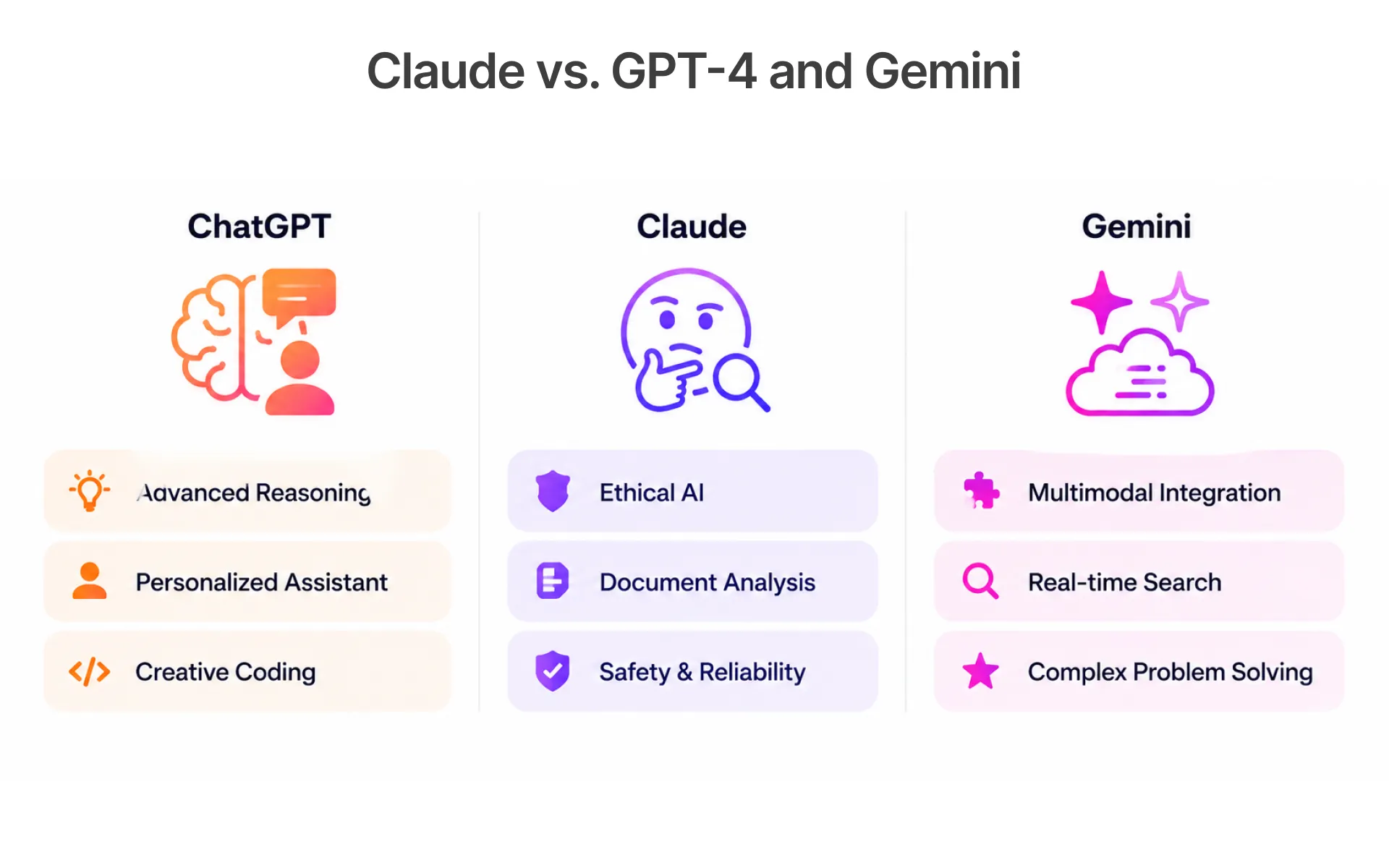
Claude vs GPT-4 Token Limits and Accuracy
OpenAI GPT-4 Turbo supports up to 128,000 tokens about 64% of Claude's 200K limit. For everyday tasks, that's perfectly fine. But when you're working with truly long inputs full codebases, multi-document legal reviews, or book-length research the gap becomes significant fast.
Beyond raw numbers, independent evaluations show Claude maintaining stronger mid-context accuracy than GPT-4 Turbo on long-document retrieval tasks. Where attention budget constraints start causing other models to miss information buried in large inputs, Claude holds steady.
Claude vs Gemini 1.5 Pro Who Handles Long Context Better?
Gemini 1.5 Pro's 1 million token window is technically extraordinary. But there's a critical distinction between context window capacity and retrieval accuracy within that window. A model that can hold 1 million tokens but loses precision at 50K is less practically useful than one that holds 200K and stays sharp all the way through.
Key differences between Claude and Gemini on long-context tasks:
- Consistency: Claude shows more stable attention scores across the full context length
- Reasoning quality: Claude delivers more coherent multi-step reasoning on complex documents
- Hallucination rate: Claude produces fewer fabricated details when token loads are high
- Context engineering flexibility: Claude responds better to deliberate prompt engineering that manages how information is distributed across a long input
- Practical availability: Claude's 200K window is accessible on standard paid plans without specialized API configurations
For most professional use cases legal, engineering, research, QA Claude's combination of context size and consistent accuracy makes it the stronger real-world choice.
Why a Bigger Context Window Doesn't Always Mean Better Results
This is the part most AI comparison articles quietly skip. A million-token window means very little if the model hits scaling walls in its attention mechanism at 50,000 tokens in. The real metric isn't how much an AI can read it's how accurately it processes information across the entire input.
Think about human reading speed. You can technically read 1,000 pages in a day if you're skimming but comprehension drops close to zero. An AI with a massive but poorly optimized context window faces the exact same problem.
Some newer architectures including Recurrent Memory Transformers and models experimenting with probabilistic attention mechanisms are exploring ways to push past this limitation. These approaches are promising but still largely research-stage. Today, Claude remains the most practically reliable option for professional long-context work.
What actually matters in a long-context model:
- Retrieval accuracy across the full context length
- Attention consistency no blind spots in the middle of documents
- Attention budget management how the model allocates focus across thousands of tokens
- Reasoning coherence when synthesizing information from distant sections
- Hallucination resistance under high token loads
How Claude Solves the "Lost in the Middle" Problem
This section matters more than any benchmark table because it explains why Claude isn't just big, it's accurate where it counts most.
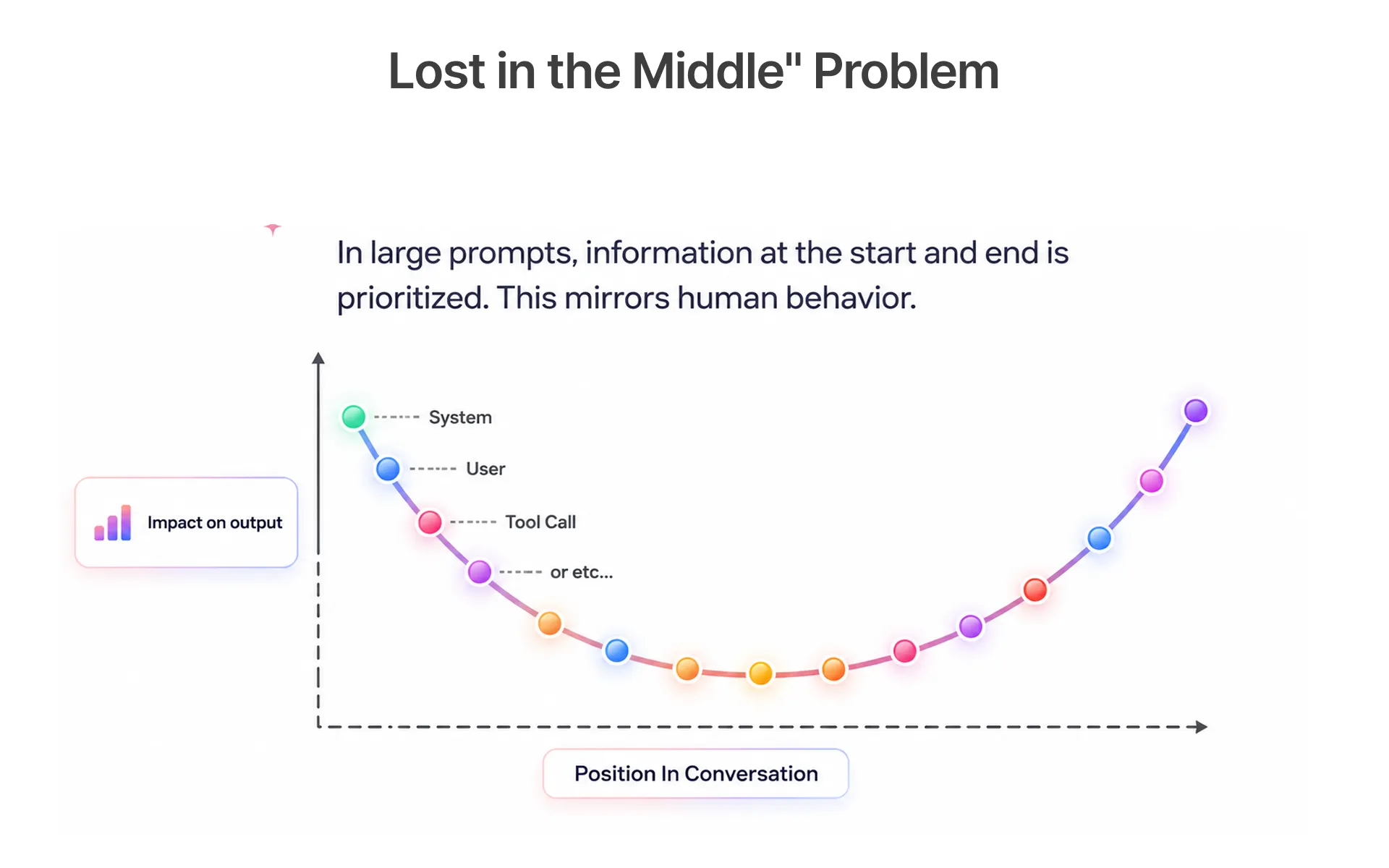
What Is the "Lost in the Middle" Hallucination Problem?
In 2023, Stanford researchers demonstrated that most large language models perform significantly worse when relevant information sits in the middle of a long document rather than at the beginning or end. This is now widely known as the "lost in the middle" problem, and it's directly tied to how attention weights get distributed across long sequences.
In practical terms, this means:
- An AI reviewing a 100-page contract might completely miss a critical clause sitting on page 52
- A model analyzing a large codebase might overlook a bug buried in the middle files the ones nobody thinks to double-check
- An AI summarizing research might skip the most important findings simply because they appear in section four rather than section one
For professional use cases, this isn't inconvenient it's a liability. And it's exactly the kind of failure that smart context engineering and deliberate prompt engineering are designed to prevent.
Needle-in-a-Haystack Tests Claude vs Competitors
The needle-in-a-haystack (NIAH) test is the industry standard benchmark for measuring long-context recall. A specific piece of information the needle is hidden inside a massive document the haystack and the model is asked to retrieve it precisely. This directly tests how well a model manages its attention budget when context is long and the signal is buried.
According to Anthropic's published model evaluations, Claude maintains strong recall accuracy across the full context window with performance remaining consistently high even as inputs approach the 200K token ceiling. In independent NIAH evaluations, OpenAI GPT-4 Turbo, Qwen 3, and Grok models all show more pronounced accuracy drops at higher token counts which is consistent with the attention budget optimization differences between these architectures.
For the latest benchmark figures, refer to Anthropic's model documentation and published research.
How Claude's Architecture Reduces Attention Drift
Anthropic has invested heavily in training Claude to maintain consistent attention scores across the full context window not just at the beginning and end where models naturally focus.
Several specific decisions contribute to this:
- Optimized positional encodings that remain stable at 200K tokens older architectures start drifting well before that
- Training on diverse long-document datasets that specifically force mid-context reasoning
- Extended thinking a feature in Claude's advanced configurations that allows the model to reason more carefully before generating, reducing errors on complex long-context tasks
- Context editing techniques during training that teach the model to update its internal understanding as new information arrives later in a long input
The result is a model that reads your document the way a careful human analyst would not skimming for the easy parts, but working through the whole thing with consistent attention. For teams at Frugal Testing running long test documentation reviews, this means Claude doesn't just scan it reads, retains, and reasons across everything it's been given.
Conclusion Is Claude the Best AI for Long Context Tasks?
After everything we've covered, the answer isn't simply yes it's yes for specific, high-stakes use cases where accuracy across long inputs is non-negotiable. If your work involves documents that run to hundreds of pages, codebases that span thousands of files, or research that requires synthesizing information from dozens of sources at once, Claude isn't just a good option it's the right one.
Key Takeaways on Claude's Long Context Advantage
Here's what makes Claude genuinely stand out as a long-context AI model:
- 200K token window approximately 500 pages processed in a single session
- Strong NIAH performance consistent recall accuracy maintained across the full context length, per Anthropic's published evaluations
- Reduced attention drift optimized attention weights and positional encodings that keep mid-context accuracy high
- Extended thinking deeper, more careful reasoning on complex long-form tasks
- Claude Code purpose-built for long-context software development and full codebase review
- Memory tool + retrieval systems session-level context plus cross-session recall for persistent, professional workflows
Who Benefits Most from a 200K Token Window?
Claude's long context window isn't for everyone and that's fine. But for these roles and teams, it's genuinely transformative:
How to Get Started with Claude for Long-Form Tasks
Getting started is simpler than most people expect. Here's a practical path to getting real value from Claude's long context window from day one:
- Step 1: Sign up for a Claude paid plan on claude.ai confirm current plan-specific context window availability at support.claude.com before selecting a tier
- Step 2: Start with a real document you've been struggling to analyze a long contract, a large codebase, or a stack of research papers you've been putting off
- Step 3: Use deliberate prompt engineering place your most important question upfront, give clear instructions, and provide the full document rather than fragments
- Step 4: Enable extended thinking for complex reasoning tasks where accuracy matters more than raw speed verify the current feature name at docs.anthropic.com before referencing in internal documentation, as Anthropic's terminology may update with new model releases
- Step 5: Use follow-up questions within the same session Claude holds the complete conversation history throughout, so you never have to re-explain context
The difference between a frustrating AI experience and a genuinely productive one almost always comes down to giving the model the full picture. Claude is built to handle exactly that.
People Also Ask (FAQs)
Q1.Does Claude's context window reset with every new conversation?
Ans: Yes. Claude's 200K token context window is session-based each new conversation starts completely fresh. However, the memory tool on paid plans stores key facts across sessions, and retrieval systems can be configured via the API to automatically inject relevant historical context into new sessions.
Q2.Is there a speed difference when Claude runs at its full 200K token limit?
Ans: Yes. Larger inputs require more computation particularly through the multi-head attention layers so response times increase with input length. That said, the accuracy and coherence gains from providing full context upfront far outweigh the processing time difference for most professional tasks.
Q3.Does the 200K token limit apply to both input and output?
Ans: The 200K context window covers the combined total of your input and output tokens within a session. Output is capped separately meaning the bulk of the 200K is available for your input content. For tasks requiring very long outputs, good context management breaking the task into logical sections within the same session helps significantly.
Q4.How does Claude handle conflicting information within a long document?
Ans: Claude is designed to surface contradictions rather than silently resolve them. When conflicting information appears in a long document, it typically flags both instances and notes the inconsistency rather than defaulting to one version or fabricating a resolution. This is particularly valuable in legal and financial analysis workflows where precision is non-negotiable.
Q5.Will Claude's context window grow beyond 200K in future versions?
Ans: Anthropic hasn't confirmed specific numbers for future releases. However, the trajectory across the AI industry points clearly toward larger, more accurate context windows as a core area of model development. Emerging architectures including Recurrent Memory Transformers and models exploring probabilistic attention mechanisms are actively being researched to push past current scaling walls, making expanded context a likely direction for future Claude versions.

.webp)