


.webp)
A regression suite goes green on a Friday afternoon. Three hundred and forty regression tests pass deploy approved. By Monday, a client's integration threw 500s because an endpoint accepted a malformed JSON Web Token mid-session and kept serving requests. No amount of rest api testing against known paths would have caught it.
Across 150+ client engagements, one pattern keeps repeating: A green regression suite ships, and the failure that follows was never in scope for a script in the first place. This piece looks at what that gap actually contains, when ad hoc testing is worth running, and how we run a session.
What Is Ad Hoc Testing in the Context of an API?
Ad hoc testing for an API means interacting with a live endpoint, whether REST APIs, SOAP APIs, or general HTTP APIs, with no test case written beforehand. It is the same ad hoc testing used in software testing generally, just applied to APIs.
That lack of a script separates it from randomly clicking around in Postman. A tester running it well has a model of the API's likely failure points, built from experience with how auth flows degrade.
- Send a stale or malformed token mid-session instead of a fresh one.
- Check the API Response: Does it reject cleanly with the right HTTP status code, or fall back to an unauthenticated state?
Most teams have never checked, and that gap is the ad hoc testing example this piece keeps returning to.
.webp)
Ad Hoc vs. Exploratory API Testing, Where the Line Actually Is
Teams blur ad hoc testing with exploratory testing constantly. Asking what is exploratory testing next to ad hoc, the difference is whether you wrote a plan first.
- Exploratory testing: A charter written before you touch the API; session time-boxed to that plan.
- Ad hoc testing: No charter. You open your API client and react to what comes back.
- Rule of thumb: Document the plan first, call it exploratory. Reacted live, call it ad hoc.
Teams describing "exploratory testing" without writing a charter are usually just running an unstructured ad hoc method with a formal name attached.
Why a Passing Test Suite Doesn't Mean a Safe API
A regression suite verifies one thing: The happy path someone anticipated when writing the test scripts. Modern Application Programming Interfaces expose dozens of API endpoints at once, and in microservices architectures that gap widens fast.
Three failure modes slip through consistently, each tracing back to an assumption nobody wrote into a test case.
- Unexpected field combinations nobody tested together in the request body.
- State left behind by a prior call that the current API request depends on, especially once an API gateway sits between client and services.
- Authentication methods and tokens reused past the context they were issued for.
According to OWASP's API Security Top 10, also called the OWASP API Top 10, broken object-level authorization alone causes roughly 40% of API attacks, a gap api security testing rarely surfaces. Dedicated api security testing tools, including api penetration testing tools, catch some of this with a scanner instead of a live probe, but they confirm the contract holds rather than how the API behaves once real traffic hits it.
Test coverage is not a vanity metric; it is a business risk statement, and test coverage tools only report what they were configured to check.
The Failure Modes Regression Suites Are Structurally Blind To
This is a design limitation, not a coverage problem. A suite only checks what it was told to, whatever software architectures it sits on.
A concrete case built on CRUD operations, the kind every API leans on:
- An endpoint behaves correctly in isolation.
- It breaks when hit right after a different endpoint changes shared state through the same API integration.
- Run each endpoint alone and both pass. Hit them in the sequence a real external service sometimes will, and one fails.
No amount of adding assertions to the isolated tests catches that. Only probing the live sequence does.
When to Run Ad Hoc Testing on an API
Three moments pay off consistently, each lining up with a point where the API's behaviour has likely shifted.
- Right after a deploy through your CI/CD pipelines, whether Azure DevOps or something homegrown.
- Right before a release freeze, when the team most needs confidence that nothing fragile slipped through unnoticed.
- Any time a schema, an API contract, or an authentication flow changes.
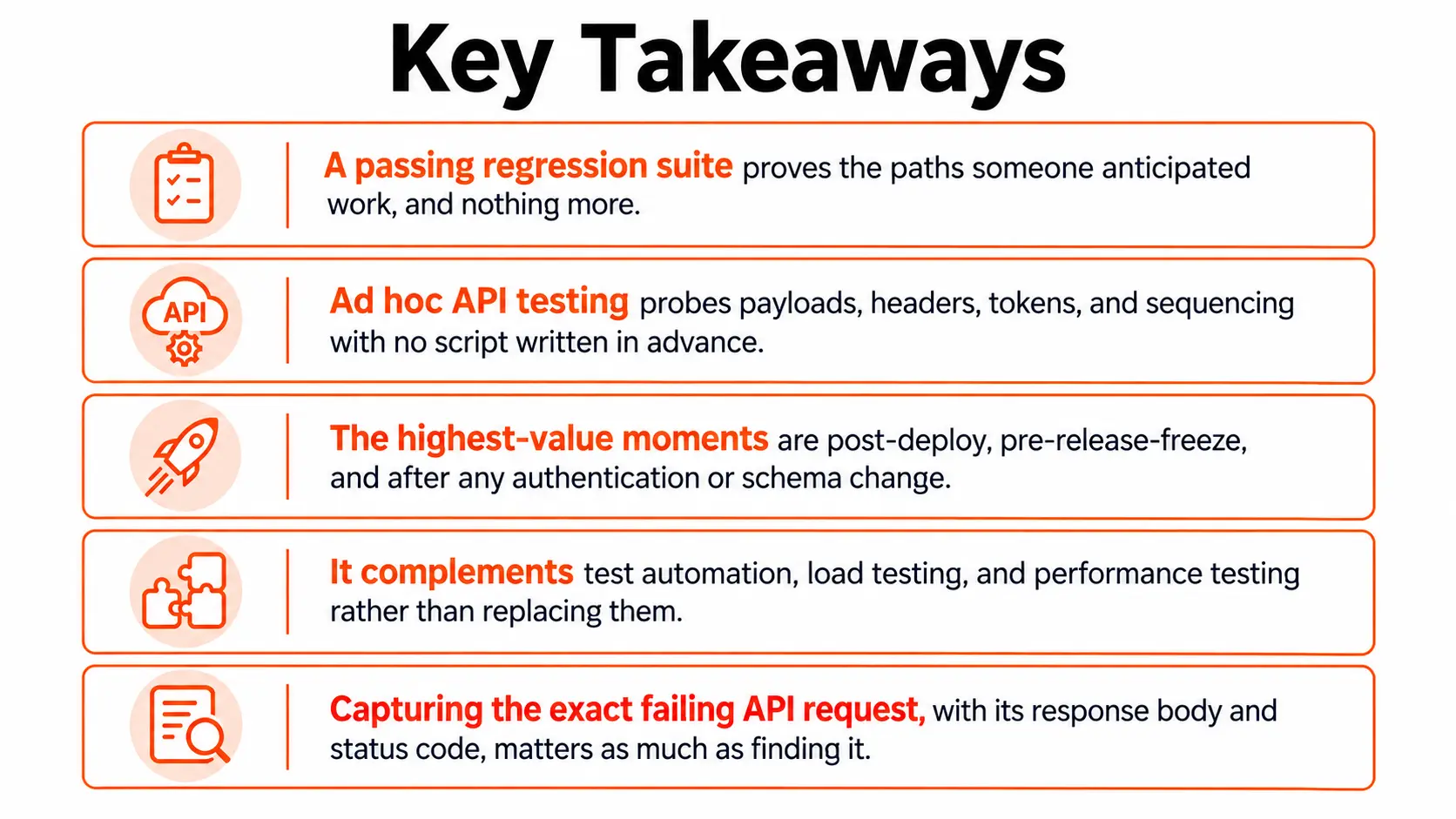
Ad hoc testing is not a substitute for regression testing, load testing, performance testing, test automation, or contract testing, including api contract testing where producer-consumer promises are on the line. It is a complement, aimed at what those layers were never designed to catch.
Breaking an API Beyond Its Test Cases: A Practical Approach
Before touching a request, map the API's state machine in your test environments: Which endpoints mutate shared state, which tokens carry context, where sequencing assumptions live. That map is your own api testing checklist, and the first of our api testing best practices.
Manipulating Payloads, Headers, and Auth Tokens on the Fly
Work through these live, one variable at a time, checking negative testing scenarios rather than the happy path the suite covers.
- Swap content types mid-request.
- Strip a header the API assumes will always be present.
- Send a stale or malformed token, and watch how API authentication responds.
- Push past documented Rate Limits and see what error handling triggers.
The check that matters most is not whether the API returns an error, but whether it is clear, or whether it silently accepts something it should reject.
Chaining Requests Out of Their Intended Sequence
This is informal chaos engineering applied to a single API layer: Break the order everyone assumes will hold, firing requests in a sequence nobody scripted for.
- Hit endpoints in an order the frontend would never generate on its own.
- Delete a resource mid-update.
- Call a dependent endpoint before its prerequisite runs, breaking the expected order of CRUD operations.
This catches real bugs by exposing state assumptions nobody wrote down. Isolated tests never see it.
.webp)
Ad Hoc Fuzzing Without a Formal Fuzzing Framework
Feed an endpoint boundary values, oversized strings, and unexpected types manually, without standing up a tool like ZAP. This is not a substitute for real fuzz testing or negative testing in software testing run through a dedicated scanner. It is a fast, low-setup way to catch obvious cracks.
Tools We Reach for During Ad Hoc API Testing
Automation is not the priority here. Speed of request modification is, shaping which api testing tools earn a place here.
- Postman api testing and insomnia api testing dominate this kind of session, working as an API client and REST Client.
- Testing frameworks such as rest assured api testing and playwright api testing matter for structured API test automation, not this technique.
- Contract testing tools like Pact contract testing, built around consumer-driven contract testing, catch producer-consumer mismatches that an ad hoc session was never designed for.
- Generative AI can draft test scripts and suggest edge cases, but live exploration still needs a person reacting to the API.
- Good API documentation speeds up every session; undocumented endpoint URLs slow it down.
Postman and Insomnia for Fast Manual Exploration
Collection variables and pre-request scripts let you modify requests on the fly without rebuilding them each time, which is what makes Postman and Insomnia faster for this than anything built for scripted runs. One habit separates a useful session from a wasted one: Save the exact API request that produced a failure, including response time and body, so the dev team can reproduce it fast.
How Frugal Testing Breaks Your API Before Your Users Do
Our API testing and QA engineering engagements put testers directly against your live or staging endpoints, ad hoc, as part of a broader API Development strategy that still leans on manual testing. This is one of our core api testing services, and for teams weighing outsourcing qa testing over hiring in-house, it is the fastest way to see the value. We build a state map first, covering test data and authentication flows, then run structured sessions targeting the endpoints most likely to break, documenting every failure with a reproducible request, status code, and response times, not a vague pass or fail note.
Enterprises bring us in for one reason: Our testers are not attached to the API's assumptions the way the team that built it is. That distance is also why outsourcing qa through a qa outsourcing services provider surfaces bugs an internal team avoids chasing.
What Our Ad Hoc API Testing Engagement Looks Like
The engagement runs in four steps, simple enough for a client team to follow without a QA background.
- Map the API's state, authentication flows, and API contracts before writing.
- Identify the highest-risk endpoints based on recent changes or auth flows.
- Run targeted ad hoc sessions against those endpoints inside your existing test environments.
- Document every reproducible failure with the exact request that triggered it.
At close, you own a defect log with reproduction steps, not just a pass or fail report.
Who This Is For
This fits engineering teams shipping API changes fast through CI/CD pipelines like Azure DevOps, without the bandwidth to build fuzzing or exploratory coverage internally. Right before a major release, after a security-sensitive auth change, or after an incident the suite missed: Those are the moments teams call us.
Conclusion
A passing suite was never proof of safety. It proves the paths someone thought to write down still work, a narrower claim than most teams treat it as. Ad hoc testing targets what automated API tests cannot reach: Undocumented sequencing, unscripted auth edge cases, and payload combinations nobody imagined.
It does not replace regression testing, and should not try to. It sits alongside it, one of several ad hoc methods aimed at the gap between "tests pass" and "the API is actually safe."
People Also Ask (FAQs)
Q1. What's the difference between ad hoc testing and contract testing?
Ans: Contract testing checks that an API still matches its agreed schema between producer and consumer. Ad hoc testing checks what happens when someone steps outside that schema, live.
Q2. Does ad hoc testing fit into a formal api testing checklist?
Ans: It can sit as a scheduled line item, usually after deploys and before release freezes, but the technique resists the fixed script a checklist normally assumes.
Q3. Can ad hoc testing support API penetration testing efforts?
Ans: It can flag the same weak points a penetration tester would target, like fragile auth handling, but it is not a replacement for a formal, scoped engagement.
Q4. How do you measure test coverage after an ad hoc testing session?
Ans: Most teams track it through the defect log itself: Which endpoints were probed, which failures were reproducible, and which assumptions the session disproved that automated reports never flagged.
Q5. Is ad hoc testing something an outsourced QA team can run effectively?
Ans: Often more effectively than an in-house team, since outsourced testers carry fewer assumptions about how the API is supposed to behave and probe accordingly, without preconceptions.

.webp)


.webp)