

TLDR: Enterprise software testing fails at scale because of fragmented ownership, tool sprawl, and suites that block deployments rather than protect them. This guide covers the strategy, tool stack, and staffing model that actually fix all three.
Enterprise software testing is the practice of planning, executing, and managing software quality across large engineering organisations, where multiple squads, tech stacks, compliance mandates, and data security requirements operate simultaneously. Unlike standard QA, the software testing challenges at this scale are rarely about individual test cases. They are systemic: siloed ownership, no shared visibility, CI/CD integration that queues instead of gates, and manual testing backlogs that automation has not yet caught up with.
The World Quality Report 2024-25 found that 68% of organisations have adopted Generative AI for testing, yet only 31% have aligned their processes to support it. The tooling moved fast. The operations did not.
Why Software Testing Breaks Down at Enterprise Scale
Two root causes drive most QA failures at enterprise scale: The compounding cost of late defects and uncontrolled test suite growth over time.
The Cost of Late-Stage Defects in Enterprise Releases
A QA lead at a SaaS company told us their regression testing suite had grown to 1,400 test cases over three years. It took four hours to run. Developers stopped waiting. They merged anyway. Defect escape rate to production had quietly tripled.
That is not a testing problem. It is a scaling problem.
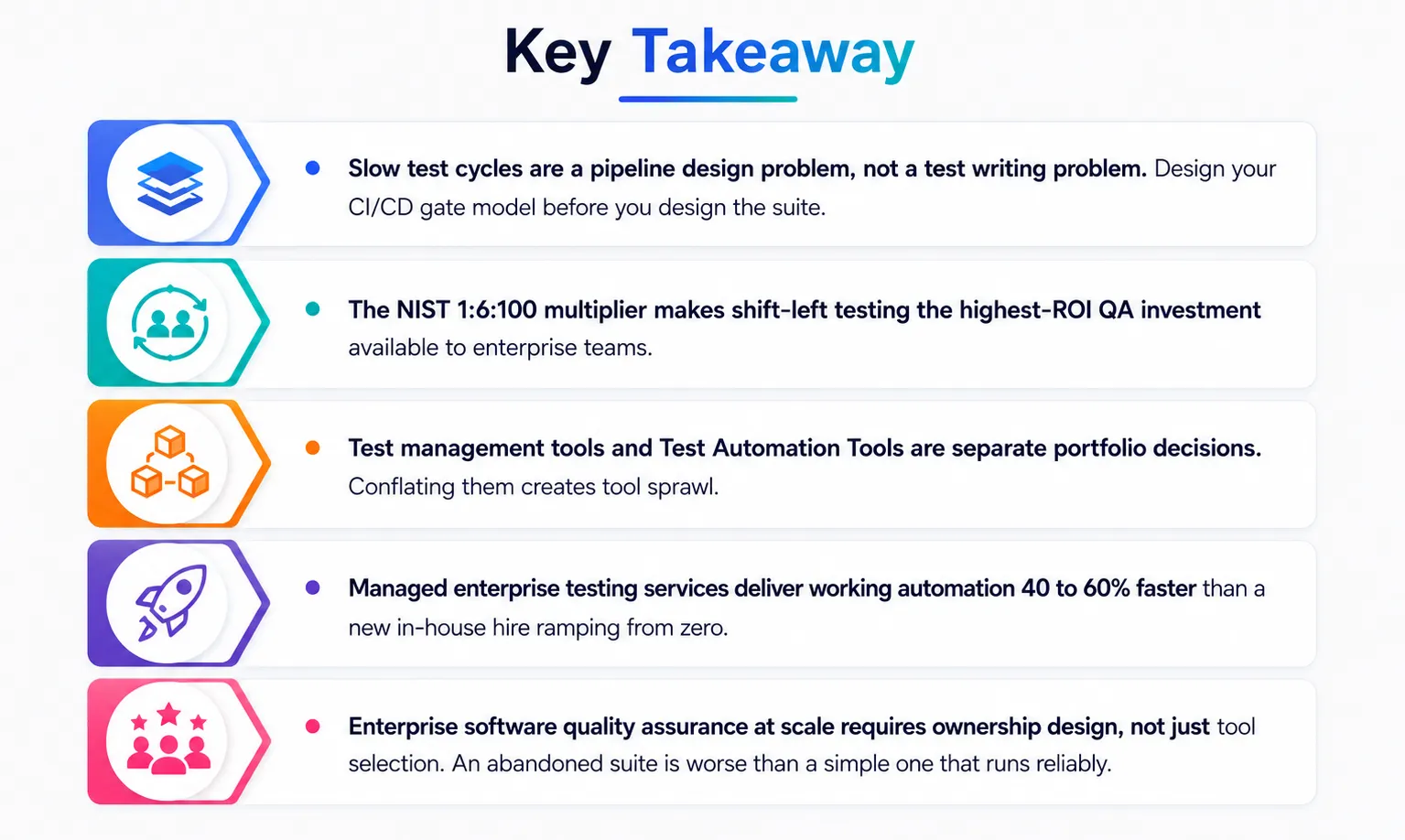
The NIST cost multiplier benchmarks defect cost at 1:6:100 across development, QA, and production. At enterprise scale, that ratio compounds across:
- Cloud-native environments with distributed services.
- Legacy systems that break silently under load.
- ERP Systems and multi-platform environments with unpredictable integration behaviour.
- Releases that cross teams with no shared quality signal.
A single escaped defect at this scale does not just trigger a hotfix sprint. It triggers an SLA conversation, a postmortem, and a credibility problem with the engineering leadership.
How Test Suite Sprawl Slows Enterprise CI/CD Pipelines
Test suite sprawl looks like growth. It behaves like rot. Suites accumulate over time without governance:
- Duplicate coverage written by different squads solving the same problem.
- Flaky test scripts tied to UI selectors that break on every redesign.
- Regression tests with no clear owner when a service changes.
- Integration testing scenarios that only pass on one engineer's machine.
According to DORA research via DX, elite teams deploy multiple times per day with lead times under one day. Most enterprise teams sit in the medium-to-low band: weekly releases, month-long lead times, and change failure rates that quietly climb as test suites lose governance.
The Enterprise Software Testing Strategy Framework
Three practices underpin a scalable enterprise QA function: Shifting testing left, prioritising by risk, and designing CI/CD gates with intention.
Shift Left Testing: Moving Quality to Where Defects Are Created
Shift left testing means moving test design and automated testing earlier into development rather than waiting for a dedicated QA phase. A senior SDET on one of our client teams described it as "the cheapest performance metric improvement any engineering team can make." That is accurate.
Implementation mechanics for enterprise applications:
- Functional testing and unit tests owned by developers at PR level.
- API testing at every service boundary using contract testing frameworks.
- Security testing (SAST, DAST) and compliance testing running inside CI/CD workflows.
- Automated testing gates enforced via Azure DevOps or GitHub Actions.
The shift-left testing strategy keeps test creation costs manageable as your application portfolio grows. Defects found in the IDE cost minutes. Found in staging, they cost sprints.

Risk-Based Test Prioritisation Across a Large Codebase
Not every test case needs to run on every commit. Risk-based prioritisation uses three inputs: change frequency, business criticality, and historical defect density. From those, build a three-tier cadence:
- Smoke tests: Every commit, under 5 minutes, core user paths only.
- Regression suite: Every PR to main, 15 to 30 minutes, full functional testing coverage.
- Full suite: Pre-release only, including performance testing, security testing, and User Acceptance Testing.
Most teams skip tier design entirely. That is why their CI/CD pipeline queues on every merge.
Designing CI/CD Testing Gates That Don't Block Deployment
The gate model that works at enterprise scale runs in sequence: Lint, unit, contract, API testing, smoke, selective UI. Each stage only triggers the next on pass. Nothing merges without clearing the smoke layer at minimum.
CI/CD platforms like Azure DevOps and GitHub Actions support this natively through Continuous Integration pipeline configuration. CI/CD workflows built this way add seconds to a fast build, not 40 minutes to every merge. That is what deliberate CI/CD integration looks like in practice.
Choosing the Right Enterprise QA Tool Stack
Getting tool selection right means evaluating two distinct decisions separately: How your team manages tests and how you automate them at scale.
The right set of software testing tools spans three layers: Test management, test automation, and observability. No single enterprise testing tool covers all three. Tool selection must be driven by your organisational needs and how your squads work day-to-day.
Test Management Tools for Enterprise Teams
The core question is whether test management workflows should live inside or outside Jira. Both approaches work. The choice depends on squad structure, organizational needs, testing requirements, and how tightly your test reporting connects to your issue tracker.
Agile test management tools like Zephyr and Xray work well when your squad structure mirrors your Jira project hierarchy. When it does not, TestRail's decoupled model is easier to govern across a large application portfolio that spans CRM Systems, Customer Relationship Management platforms, and Human Resources tooling.
Selecting an Enterprise Test Automation Framework
The right enterprise qa tool for automation comes down to four criteria: language alignment with the dev team, parallel execution across cloud-based testing environments, CI/CD platform plugin availability, and community maturity.
- Widely adopted frameworks: Playwright, Selenium, Cypress, and Katalon Studio lead enterprise adoption. Open-source frameworks provide flexibility and strong community support.
- Low-code/no-code access: Katalon Studio suits teams sitting between manual testing and full SDET-led automation, with low-code/no-code capabilities built in.
- AI-powered testing tools are closing gaps in test creation, test reporting, and Model-Based Test Automation fast. AI Testing is no longer a pilot category. Teams using it for usability testing and regression tests report measurable reductions in overhead.
- Ownership design matters most: Automation testing tools selected without a clear ownership model lead to abandoned test scripts within six months. Who writes them and who maintains them when legacy systems migrations break the suite: That matters more than the enterprise testing tool itself.

Our Take: Most teams pick their enterprise test automation framework based on what a senior engineer already knows. That is not wrong, but it is incomplete. Maintainability across the whole team is the criterion that actually holds up at scale.
Build vs. Outsource: How Enterprise Teams Staff QA at Scale
The staffing decision comes down to one practical question: Do you need long-term institutional knowledge built in-house, or fast capability delivered now?
What Managed QA Services Actually Deliver vs. Staff Augmentation
Three staffing models exist for enterprise testing: in-house SDET team, fully outsourced software testing services, and the hybrid embedded model. The decision is a resourcing and speed question, not a quality one.
Staff augmentation is input-based: You direct the work, own the scope, manage the ramp. Managed enterprise testing services are outcome-based. A well-structured engagement delivers:
- A documented software testing strategy aligned to your release cadence.
- Automated test suite integrated to CI/CD workflows covering API testing, integration testing, security and compliance, and regression testing.
- Test reporting dashboards and performance metrics your team can act on.
- Runbooks and handover documentation for internal maintenance.
A managed engagement delivers a working suite 40 to 60% faster than a new in-house hire ramping from zero. Signals that point toward enterprise testing services: release velocity outpacing QA capacity, a greenfield automation project with no existing framework, or a need for User Acceptance Testing, usability testing, and compliance testing coverage.
How Frugal Testing Scales Enterprise QA: Without the Overhead
Here is what our embedded engagement model looks like in practice, and the specific team profiles and trigger situations it works best for.
What Our Enterprise QA Engagement Looks Like
We embed inside your sprint cycle as an enterprise tester team, not as a separate vendor in a silo. We work directly with your backlog, CI/CD platform, and sprint board from day one.
The engagement runs in four stages:
- Weeks 1 to 2: Discovery and coverage audit. We map existing suites, identify gaps across API testing, integration testing, and UI coverage, and confirm testing requirements against release gates.
- Weeks 3 to 4: Test strategy and framework setup. We define the enterprise test automation architecture and configure CI/CD workflows aligned to your sprint cadence.
- Weeks 5 to 8: Suite build. We write, review, and integrate automated testing across functional testing, regression testing, performance testing, and security testing layers.
- Week 9 onward: Handover. The client owns the suite, documentation, and runbooks. No ongoing dependency on us to keep it running.
At close, the client owns a complete software testing strategy, a working suite in their repository, and CI/CD integration that holds up across cloud-native and multi-platform environments.
Who This Is For
This engagement model works best for:
- Engineering teams with QA coverage that has not kept pace with release velocity.
- Teams testing enterprise applications across ERP Systems and CRM Systems who need coverage without rebuilding.
- Organisations with a manual testing function that need to layer automation without disrupting release gates.
Common trigger situations: regression tests taking four-plus hours, no API testing coverage on microservices, or test scripts broken after a stack migration. Across 50-plus US engineering teams, we have reduced regression cycle time by 40% on average.
Wrapping Up
Enterprise software testing at scale requires three things: A shift-left testing strategy embedded in development, software testing tools matched to your team's maturity, and a staffing model that fits your release velocity.
Most teams get one of the three right. The cost of getting the other two wrong compounds: Defects escape, CI/CD platforms slow, User Experience degrades, and engineers stop trusting the suite. Better software testing basics built in from the start prevent this entirely. For teams that want to close that gap without a six-month build cycle, that is what we do.
People Also Ask (FAQs)
Q1. How does enterprise software testing differ from software testing in startups?
Ans: Enterprise testing requires coordinating compliance testing, security and compliance mandates, and multi-team test management workflows across legacy systems. Startups rarely face this level of regulatory and organisational complexity simultaneously.
Q2. What role does performance testing play in enterprise release cycles?
Ans: Performance testing validates that enterprise applications hold up under real production load, catching bottlenecks before release rather than in production where defects are costlier and performance metrics harder to track.
Q3. How do enterprises handle software testing across legacy systems and modern cloud-native environments?
Ans: Teams maintain separate automation frameworks for legacy systems and cloud-native environments, unifying them through a shared test management layer that provides consistent test reporting and software delivery visibility.
Q4. What is the difference between User Acceptance Testing and functional testing in an enterprise context?
Ans: Functional testing validates software against technical specifications. User Acceptance Testing confirms it meets real business and User Experience expectations, typically involving business stakeholders rather than QA engineers alone.
Q5. How should enterprises approach data security in automated testing environments?
Ans: Use masked or synthetic data in all test environments. Embedding data security checks into CI/CD workflows ensures compliance testing runs alongside functional and regression tests on every release.

.webp)

.webp)