

A team ships a checkout change on a Friday. All 1,400 unit tests pass. By Monday, refund complaints are piling up: The basket service sent pounds, and the payment service expected pence. No test had ever put the two side by side, so nothing caught the mismatch before customers did. That gap is exactly what separates the two test types.
Unit testing checks one function or class in isolation. Integration testing checks that modules, databases, and APIs work together. Both belong in any serious software testing strategy, and the real question is the split. By the end, you will know which to write first and how to divide effort. We keep the advice practical, with tools, examples, and a simple decision rule.
What Is Unit Testing?
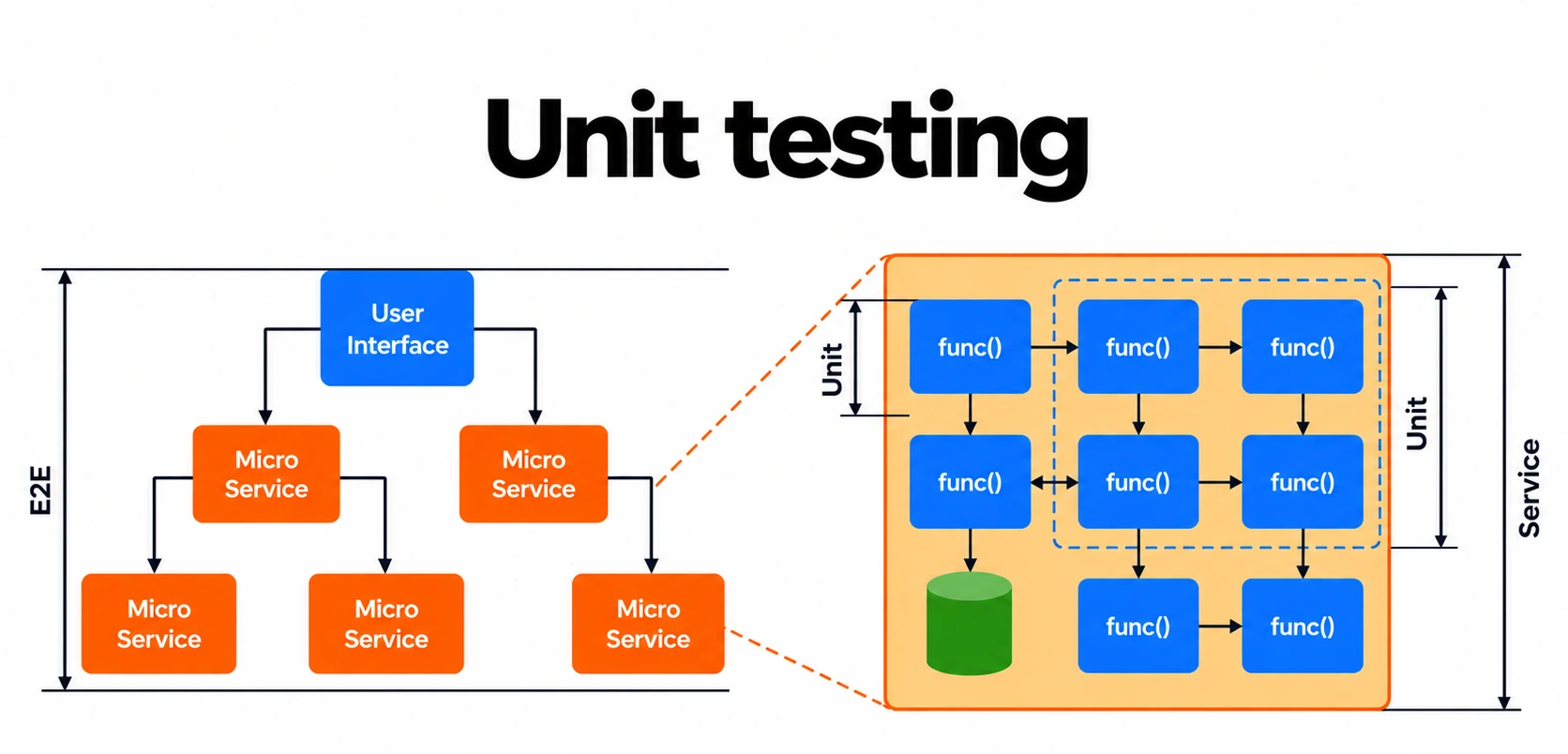
Unit testing is a software testing method that verifies the smallest testable part of an application, such as a function, method, or class, in isolation. Its external dependencies are replaced with mocks or stubs, so each test validates one behaviour.
Why it matters:
- A failure points to one function, so bugs are found fast.
- It gives precise functional testing of pure logic: Zero amounts, negative refunds, rounding at half a penny.
- Tests run on the build machine, so native development needs no emulator.
When to perform it: Write it alongside the code and run it on every commit. The limit is realism: A mock returns only what you told it to, so it cannot spot real service differences.
Unit Testing Tools
The best test automation tools for unit testing are the ones your language supports. Three software test automation tools cover most teams:
Run these automation tools in CI so automated testing happens on every commit. AI-assisted tools can draft tests, and AI test automation speeds that up, but AI in test automation still needs a reviewer.
What Is Integration Testing?
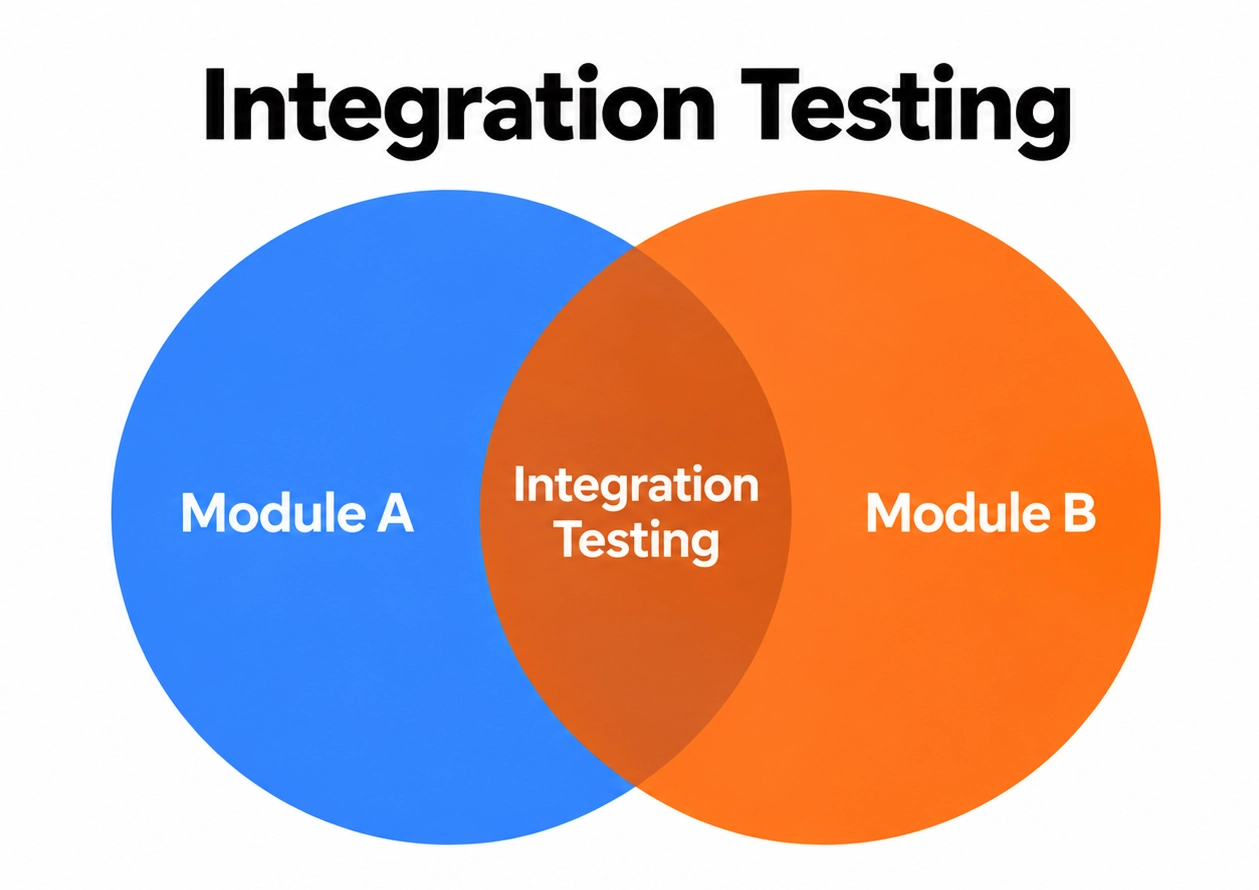
Integration testing is a software testing method that verifies that modules, databases, and APIs work together as expected once combined. It uses real dependencies instead of mocks, so each test exercises a genuine interaction.
Why it matters: Unit tests cannot see the gaps between components. It typically targets:
- API calls between services.
- Database interactions, including queries and migrations.
- Backend processes such as queues and scheduled jobs.
- User authentication, where one service must accept another's token.
When to perform it: Run it after unit tests pass, in a stable test environment. Many teams treat it as black box testing: Call the HTTP API and check the response. Software integration testing then picks a wiring order: Big bang (everything at once), top-down or bottom-up.
Integration Testing Tools
Integration testing tools differ by what they exercise, and API testing tools sit at the centre:
- Test containers for throwaway databases in Docker.
- REST Assured for HTTP checks from Java.
- Supertest for Node services.
- Postman for readable API collections.
Skip generic lists of the top test automation tools, which blend every layer. So what is test automation in software? Running checks like these without a person driving them.
Unit Testing vs. Integration Testing: Key Differences
Integration testing vs. unit testing comes down to scope: One isolated unit versus components working together. The table puts the two side by side, one row per question teams actually ask, so you can scan for the trade-off that matters to you.
When to Use Each Approach
A team inherits a billing module with no tests and unit tests for every class. Three hundred green tests later, nobody knows whether invoices still generate. You need both approaches: Unit tests prove each component works alone, and integration tests prove the components work together. Your current work decides which one comes first.
When Unit Testing Fits Best
Unit testing fits best when you are developing a single component, such as a function, class, or module. Write the tests alongside the code and run them on every commit in CI/CD, because they finish in seconds and point straight at the broken function. Three situations stand out:
- Complex business logic and algorithms, such as pricing rules.
- Early-stage projects on tight budgets, where cheap feedback wins.
- TDD workflows, which need second-long red-green cycles.
When Integration Testing Fits Best
Integration testing fits best when your work involves components that talk to each other, such as services, databases, or third-party APIs. Run it in CI/CD on merge or nightly against real dependencies, since it is slower. Four situations stand out:
- Microservices architecture, where contracts drift between services.
- Data-heavy applications, with complex queries and schema migrations.
- AI-backed features: AI model management makes the model version a boundary, and AI agents call endpoints in odd sequences.
- Frequent releases, since integration tests anchor your regression suites.
Which one fits your team?
- Is the risk in calculations and branching logic? Start with unit tests.
- Is the risk in service boundaries, queries, or third-party APIs? Start with integration tests.
- Inherited code with nothing covered? Integration tests around critical paths first.
How to Balance Both in Your Test Strategy
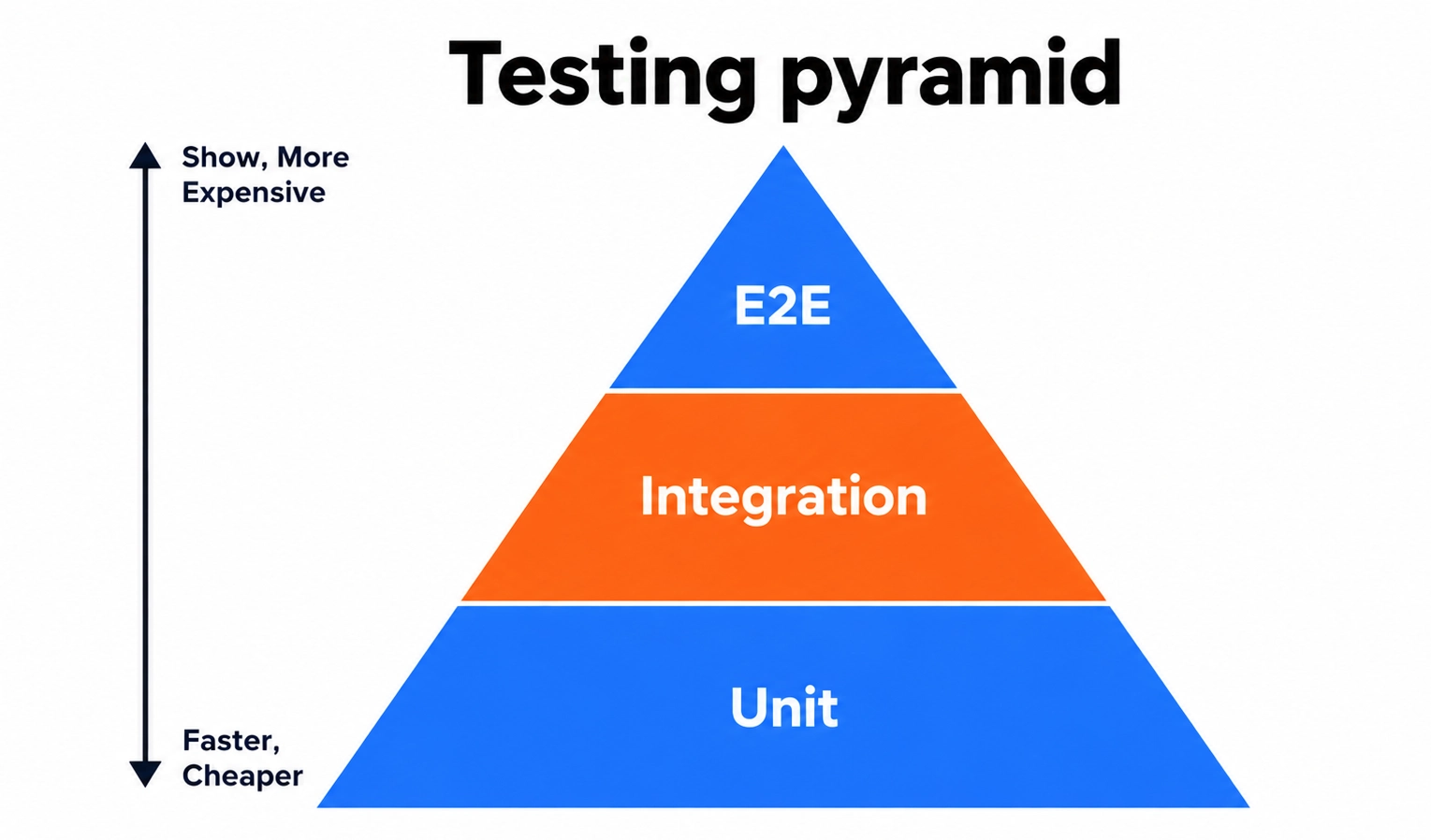
Most projects match both lists above, so the real decision is the split. The test pyramid gives you a shape for that split, and your CI/CD schedule decides when each layer runs. The two sections below show both with concrete examples.
Using the Test Pyramid to Split Effort
Most projects match both lists above, so the real decision is the split. The test pyramid gives you a shape for that split, and your CI/CD schedule decides when each layer runs. Examples of what sits where:
- Base: Pricing rules, date maths, input validation.
- Middle: Basket-to-payment calls, order API to database, login tokens across services.
- Top: End-to-end (E2E) testing drives the user interface through a full user journey, covering user interactions and user workflows that shape user experience.
Treat code coverage as a signal, not a target, because a covered line is not a verified behaviour. A/B testing and API security testing sit outside the pyramid, so hand the latter to a penetration testing company.
Our Take: If you can only write one test today, write the integration test at your most fragile boundary. A payment service that silently disagrees with your basket costs far more than a slow test.
Running Both Suites in CI/CD
Continuous integration should run unit tests on every commit and heavier integration suites on merge or on a schedule. Across CI/CD pipelines, duration decides whether developers trust the result; CircleCI's guidance suggests roughly 10-minute workflows and a 90% or higher success rate on the main branch. For example, a payment API suite can run against a Testcontainers database only on merge.
- Shard slow suites in parallel and cache dependencies for performance optimization, as our test automation in CI/CD guide shows.
- Keep pipeline configuration in version control.
- Schedule software regression testing nightly, and let automated regression testing on merge catch breakage sooner. The regression testing definition is simply re-running tests after every change.
- Tag each automation test with its layer so the pipeline knows when to run it.
unit:
  run: pytest tests/unit -q
integration:
  if: github.ref == 'refs/heads/main'
run: pytest tests/integration -qHow Frugal Testing Helps You Build a Balanced Test Strategy
Our software test automation services start with a review of your current suite. Our quality assurance engineers map each test to a layer, find boundary gaps, and recommend a split. In our experience, the most common finding is a suite heavy on one layer.
We work with whichever test automation platform and test automation frameworks you already run, including Selenium test automation services for browser-level checks. Our software QA services can also help you compare test automation solutions before you buy. Bring us in when the cost of guessing exceeds the cost of asking.
What Our Engagement Looks Like
- Week 1: Suite audit, mapping every test to a layer and a risk.
- Week 2: Gap analysis of untested boundaries.
- Week 3: Strategy write-up with the agreed split and CI/CD schedule.
- Week 4: Handover of the written strategy and a prioritised test backlog.
Conclusion
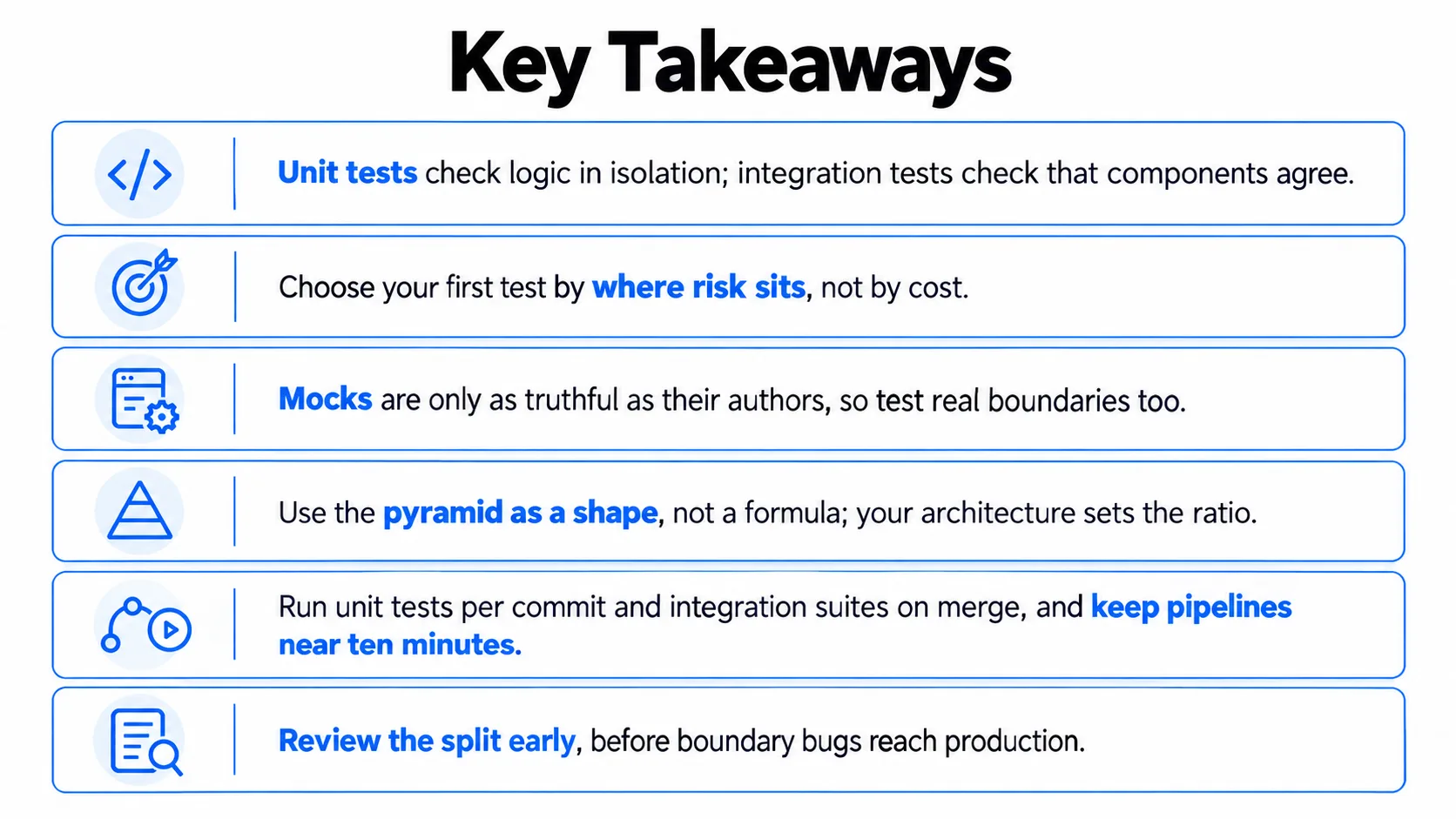
Unit testing and integration testing were never rivals. One gives you speed and precision; the other proves the pieces fit. The unit testing vs integration testing debate misleads because the real struggle is the ratio, which moves as your architecture does.
Start with one question: Where would a bug hurt most right now, and is anything watching that spot? Guard the logic with unit tests and the boundaries with integration tests, then rerun both after every change so today's fix never breaks yesterday's feature.
Frequently Asked Questions
Q1. What is the difference between mocks and stubs in unit testing?
Ans: A stub returns fixed answers so the code under test can run, whilst a mock also records how it was called, letting the test verify interactions.
Q2. What is API testing, and how does it fit alongside integration tests?
Ans: API testing sends requests to an endpoint and checks responses and data. With real dependencies behind it, it counts as integration testing; with stubs, it is narrower.
Q3. What is software test automation best suited for?
Ans: It suits repetitive, stable, high-risk checks such as regression suites and API contracts. Exploratory testing and usability judgements still need a person, so keep those manual.
Q4. What are codeless test automation tools, and who are they for?
Ans: They let testers build automated checks by recording or dragging steps instead of writing code. They suit simple browser journeys and non-developers, but reach unit and integration layers poorly.
Q5. How is API security testing different from integration testing?
Ans: Integration testing asks whether components cooperate correctly. API security testing asks whether an attacker could abuse them, probing authentication, authorisation, and data exposure with specialist tools.