


"Selenium is dead" gets repeated on LinkedIn and in QA Slack channels often enough that teams act on it without checking the numbers. It's a claim built on one narrow slice of usage data, and it rarely holds up once you look at how widely Selenium is still used across languages and industries.
For teams asking what software testing automation is in the first place, it's running scripted checks against a web application instead of clicking through it by hand. Selenium remains one of the most widely used browser automation tools for that job, and its WebDriver BiDi protocol has quietly closed the biggest technical gap that pushed teams toward newer automation testing tools.
Is Selenium Actually Dead? What the Data Says
Most "Selenium is dead" arguments start and stop at one number, and it's an incomplete one:
- The selenium-webdriver npm package pulls roughly 2.1 million weekly downloads, next to Playwright's 35 million. That looks damning until you remember Selenium was never a JavaScript-first tool.
- Selenium's Python package moves around 50 million downloads a month on PyPI, and Java and C# usage through Maven and NuGet adds a layer the npm figure never captures. (PyPI download statistics)
- Selenium IDE, the record-and-playback option for quick test scripts, still sees steady use among smaller qa automation testing services and internal teams who don't need a full test automation framework.
- Thousands of active US job postings list Selenium automation testing as a required skill for functional testing and regression testing roles, though hiring data is a lagging indicator of what companies run today, not what they're piloting next.
WebDriver BiDi: The Protocol That Changed the Conversation
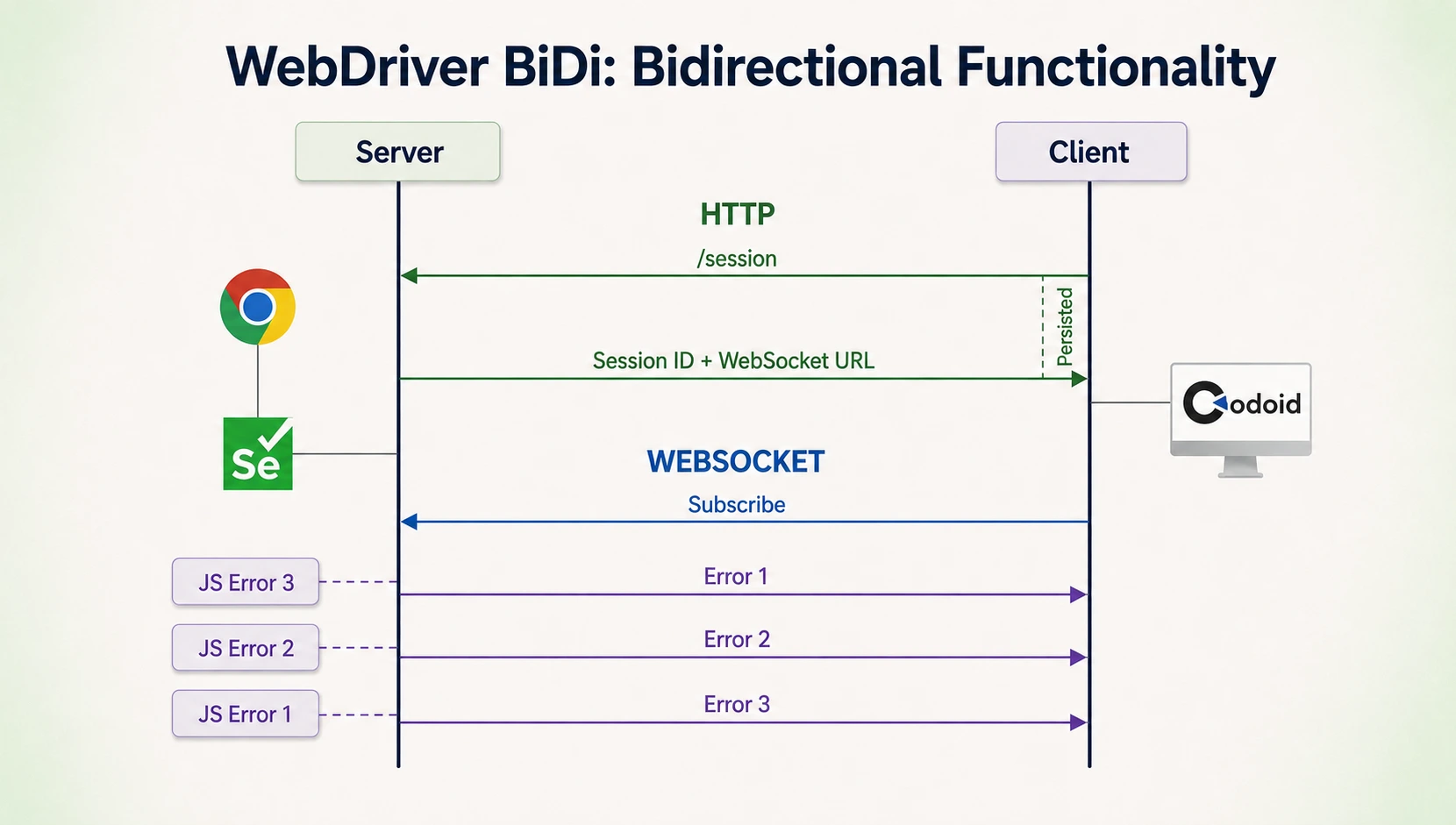
Selenium is built on the WebDriver protocol, a W3C WebDriver standard agreed on by every major browser vendor, part of why browser vendors kept investing in it as newer frameworks launched. WebDriver BiDi adds the piece that was missing: bidirectional functionality. Instead of the test polling the browser, the browser pushes events back over a WebSocket architecture, covering network requests, console logs, and JavaScript errors as they happen.
What this actually replaced:
- Network interception and API mocking, which used to require a Chrome-only Chrome DevTools Protocol (CDP) binding, version-pinned to whatever Chrome build was running.
- Logging features and browsing contexts, what the Browser Context model calls tabs, frames, and windows, now fire the same event stream across Chrome, Edge, and Firefox with no separate code path.
- Basic authentication and console capture, once bolted on through CDP workarounds that broke on every Chrome version bump.
Selenium was never going to win a speed contest against Playwright testing, and it doesn't need to. It needed to stop forcing Chrome-only workarounds onto a tool built around cross-browser testing, and BiDi fixes exactly that.
What Changed in Practice
A network listener that used to require a version-pinned CDP binding now looks like this in browser automation Python:
from selenium import webdriver
from selenium.webdriver.common.bidi.network import Network

driver = webdriver.Chrome()
network = Network(driver)

def log_request(event):
    print(f"Request: {event['request']['url']}")

network.add_listener(network.BEFORE_REQUEST_SENT, log_request)
driver.get("https://example.com")
Two more practical pieces round this out:
- Selenium Manager now handles driver binaries automatically, so teams stop hand-managing browser options and version mismatches, whether the suite runs through a Selenium Grid download or a Selenium Grid cloud setup.
- BiDi's browser context model makes parallel execution across multiple browsing contexts more predictable, which matters once a suite runs inside a CI pipeline rather than on someone's laptop.
Our Take: Adopt BiDi now for network interception and console capture, the two things most teams actually use CDP for. Hold off on heap profiling or performance testing workflows until BiDi's coverage catches up.
When Selenium Still Wins for Enterprise Teams
A few situations keep coming up in our engagements where ripping out a working test suite costs more than it saves:
- Polyglot organisations, with a Java test layer, Python validation scripts, and a C# desktop client all hitting the same Selenium grid, and Page Object Models already built across every language.
- Regulated industries, where compliance means running browser compatibility testing against older builds that modern automation testing tools have quietly stopped supporting.
- Large, stable test suites with heavy test coverage, where migration cost is rarely about writing new tests; it's about re-earning years of trust, and the hit a bad migration takes on defect escape rate.
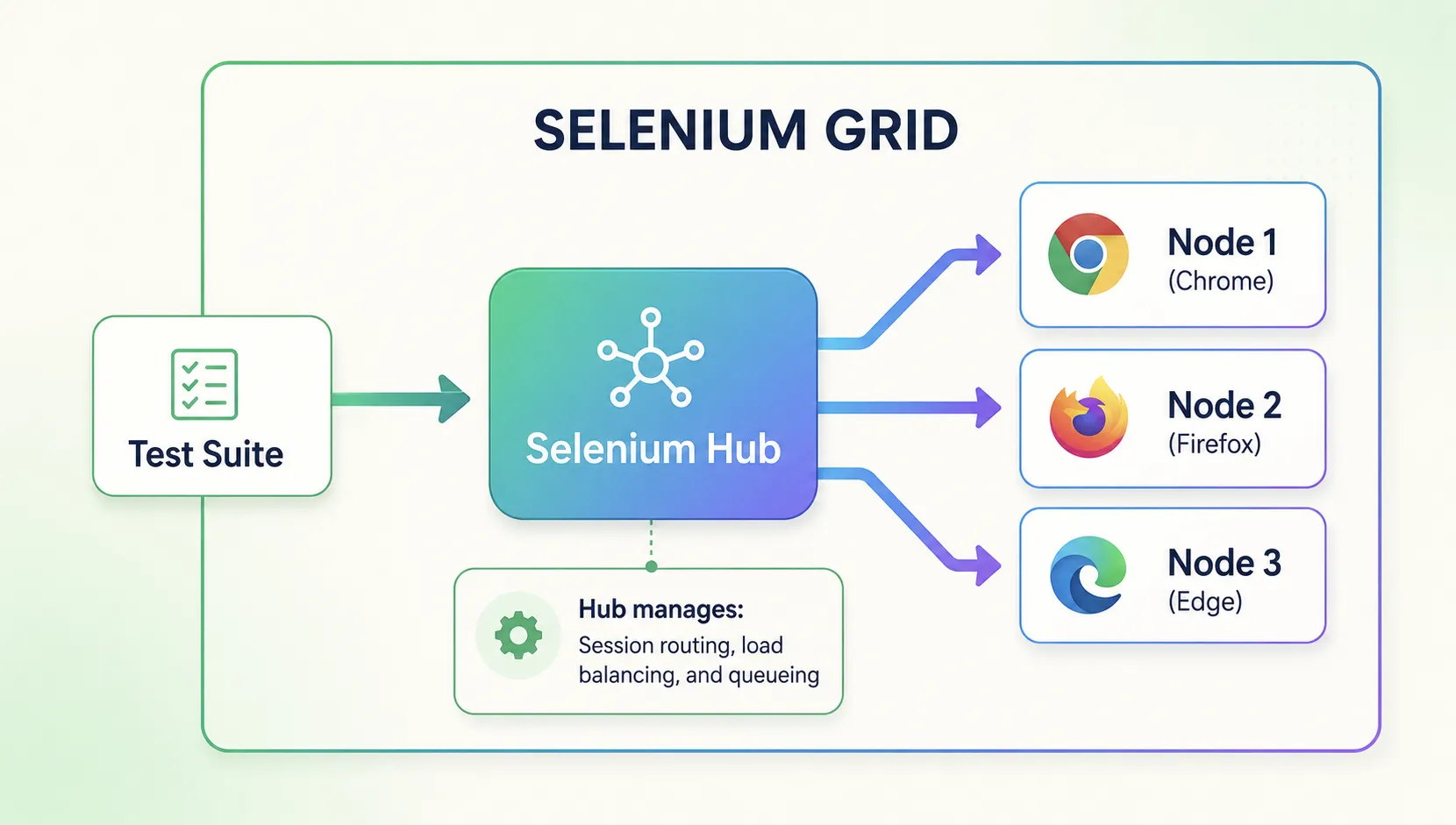
Grid-based parallel execution, self-hosted through a Selenium Grid download or run through a vendor like Sauce Labs for cross-browser testing cloud coverage, integrates cleanly into most CI/CD platforms and CI/CD infrastructure. Selenium sits inside a DevOps pipeline via GitHub Actions, an Azure DevOps pipeline, or other DevOps pipeline tools already wired in for performance testing and browser testing tools.
Across our engagements, the suites we're most cautious about touching are the ones already past 500 tests with three or more contributing languages. A client running exactly that setup asked us to estimate a full migration last quarter; the number came back at just under five months of engineering time for marginal flake improvement, so they kept Selenium and put the budget into BiDi adoption instead.
What Most "Is Selenium Dead" Articles Miss
A few gaps keep showing up across the pieces we read while researching this topic:
- BiDi mechanics get skipped. Most treat "a new protocol" as a footnote rather than the reason CDP workarounds are disappearing from web application testing.
- Tooling gets compared, not the pressure behind it. Cypress Cloud's dashboards versus Playwright's Trace Viewer misses that UI changes and faster release cycles, not brand preference, are what drive teams toward Cypress testing or Playwright testing.
- AI gets left out entirely. AI agents, AI-native agents, and AI-assisted debugging are showing up across the AI test automation tools market, layering onto existing Selenium and Appium suites rather than replacing them.
- Shift left testing rarely gets a real definition. What is shift left testing in practice: catching defects during development instead of after deployment. Shift left security testing extends that same idea to basic checks, catching malformed data or a stray SQL command before a site owner sees it in production, not as a substitute for a dedicated security solution.
- Visual regression testing gets ignored. Selenium doesn't handle pixel-level comparison natively the way some newer automation testing tools do.
According to the 2024 Stack Overflow Developer Survey, a majority of professional developers named technical debt their top on-the-job frustration. For a QA team, poorly planned test maintenance is exactly that kind of debt, and migrating just to follow a trend adds more of it.
How Frugal Testing Helps You Decide What Stays on Selenium
We start by mapping the actual footprint before recommending anything:
- Language mix across the test suite.
- Current flake rate and defect escape rate.
- Which specific tests are genuinely worth the migration cost, and which aren't.
That's the difference between a software test automation services engagement that actually saves money and one that just moves the same problems into a new framework.
Which tests are worth moving?
- Is it failing because of a protocol limitation BiDi already fixes? Leave it, just swap the CDP call.
- Is it in a single-language codebase that's still actively growing? Good migration candidate.
- Is it part of a stable, polyglot suite past 500 tests? Leave it on Selenium, revisit in a year.
Who This Is For
Enterprise QA teams running polyglot test suites who suspect they're either over-investing in a migration they don't need or under-investing in one they've put off. Whether you have a dedicated qa team in-house or lean on a quality engineering company for qa automation testing services and software testing consulting services, the assessment works the same way.
Conclusion
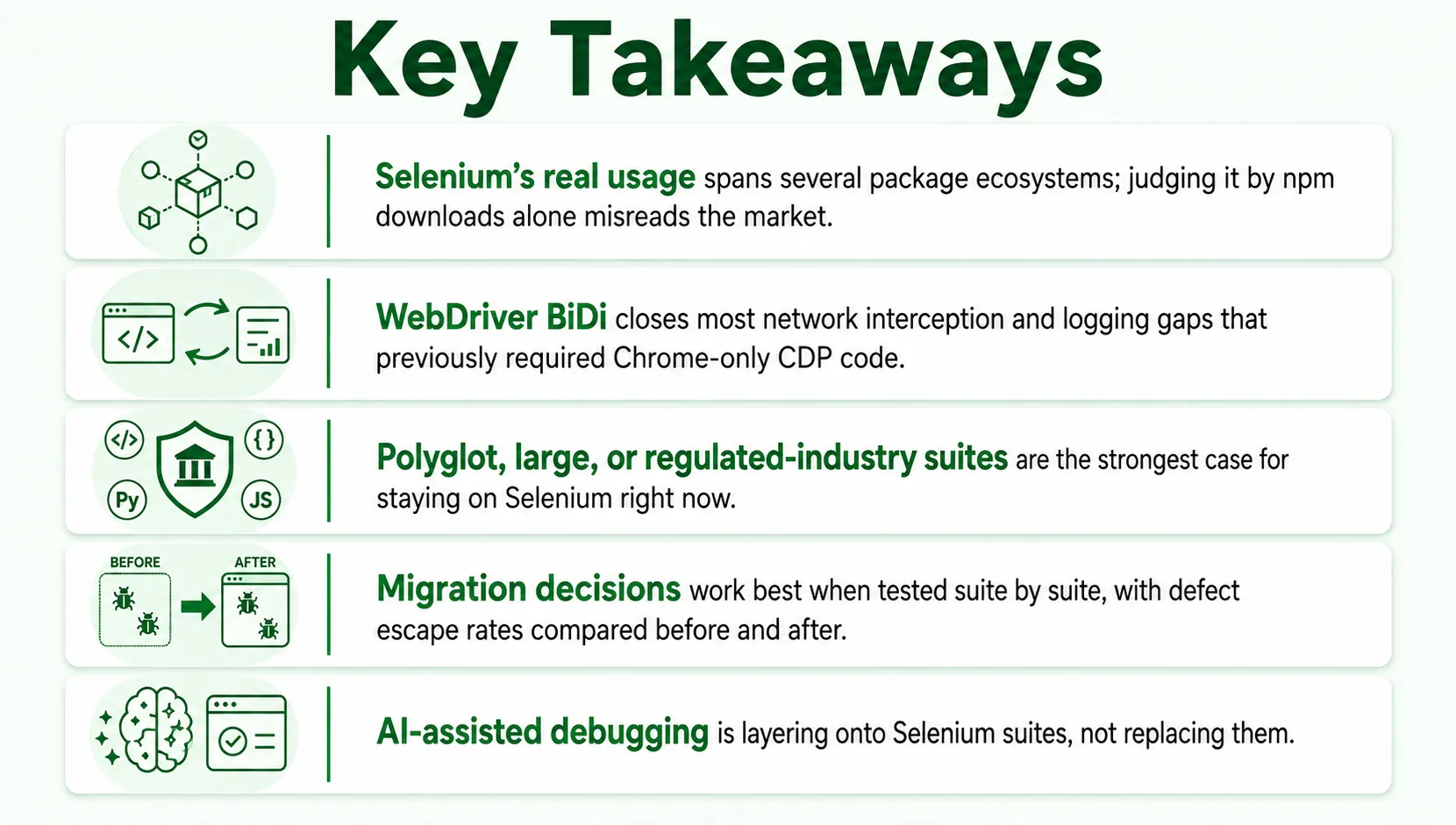
Selenium isn't dead, and it isn't standing still either. BiDi closes the technical gap that made CDP workarounds a maintenance headache, and the enterprise install base that never left isn't going anywhere soon. The real question was never Selenium versus whichever tool is trending; it's which tests actually benefit from moving. Most teams answer that on a hunch; the ones that use data spend their budget on the tests that matter.
People Also Ask (FAQs)
Q1. How does Selenium's cross-browser testing compare with Playwright testing for enterprise teams?
Ans: Selenium supports more browsers and language bindings, while Playwright testing offers faster setup and built-in auto-waiting. Most enterprise teams weigh existing suite investment against Playwright's smoother developer experience before switching anything.
Q2. Can Selenium handle headless browser testing for faster CI cycles?
Ans: Yes, Selenium supports headless browser testing across Chrome, Firefox, and Edge, letting suites run without a visible UI, which speeds up execution inside most ci cd pipeline setups considerably.
Q3. What programming languages does Selenium support for browser automation?
Ans: Selenium supports Java, Python, C#, Ruby, and JavaScript bindings, making browser automation in Python and other language-specific test scripts possible across nearly any development stack a team already uses today.
Q4. How does Selenium Grid differ from cloud-based cross-browser testing platforms?
Ans: Selenium Grid distributes tests across self-hosted browser and OS combinations, while cross-browser testing cloud platforms like Sauce Labs manage that infrastructure, letting teams skip maintaining physical or virtual machines.
Q5. Is Selenium suitable for visual regression testing out of the box?
Ans: Not natively. Selenium handles functional testing and regression testing well, but most teams pair it with a visual regression testing tool for pixel comparison that Selenium alone cannot do.



.webp)