


Most proposals for QA and software testing services look identical. Same assurances, same slide decks, same "agile-aligned" language. The difference shows up around Week 3, when release velocity slows, and your team starts absorbing coordination overhead the vendor never mentioned.
This guide gives CTOs, Engineering Managers, and Product Managers the 7 factors that actually matter when evaluating testing vendors, not a compliance checklist, and not a vendor pitch.
Factor 1: Do They Cover Your Entire Testing Scope?
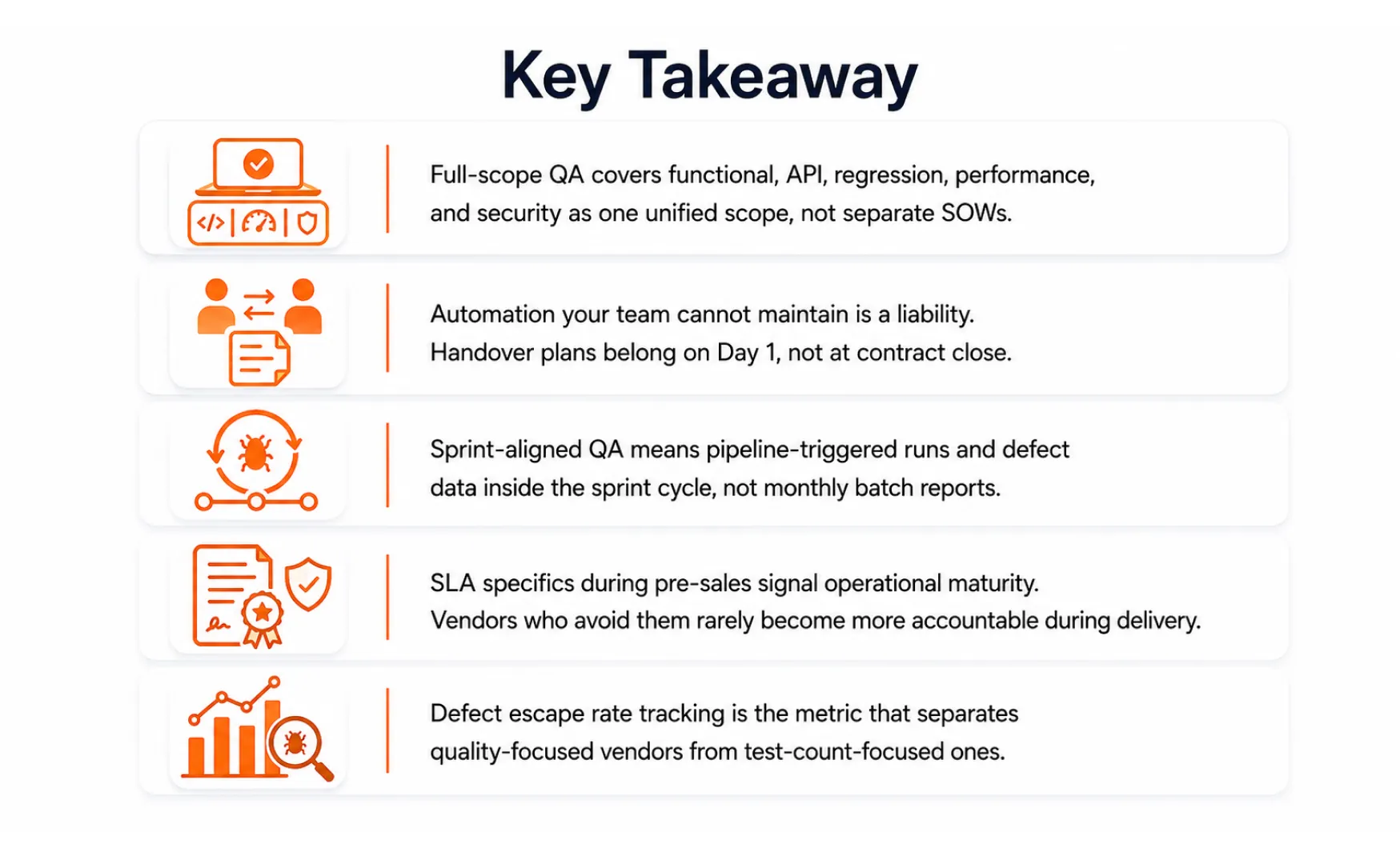
A SaaS platform team came to us after six months with a vendor who handled functional testing well. Performance testing was a separate SOW. Security was out of scope. By the time a regression hit production, no single party owned the failure.
Full-scope QA and software testing services cover:
- Functional testing and regression testing.
- API testing and API dependencies across microservices architecture.
- Performance testing services and load regression.
- Security testing, security audits, and security compliance.
- Non-functional testing requirements tied to release gates.
Quality assurance outsourcing structured this way reduces handoff failures. Fragmented coverage across multiple testing vendors means nobody owns product quality end to end.
Factor 2: Can They Build Automation Your Team Can Actually Maintain?
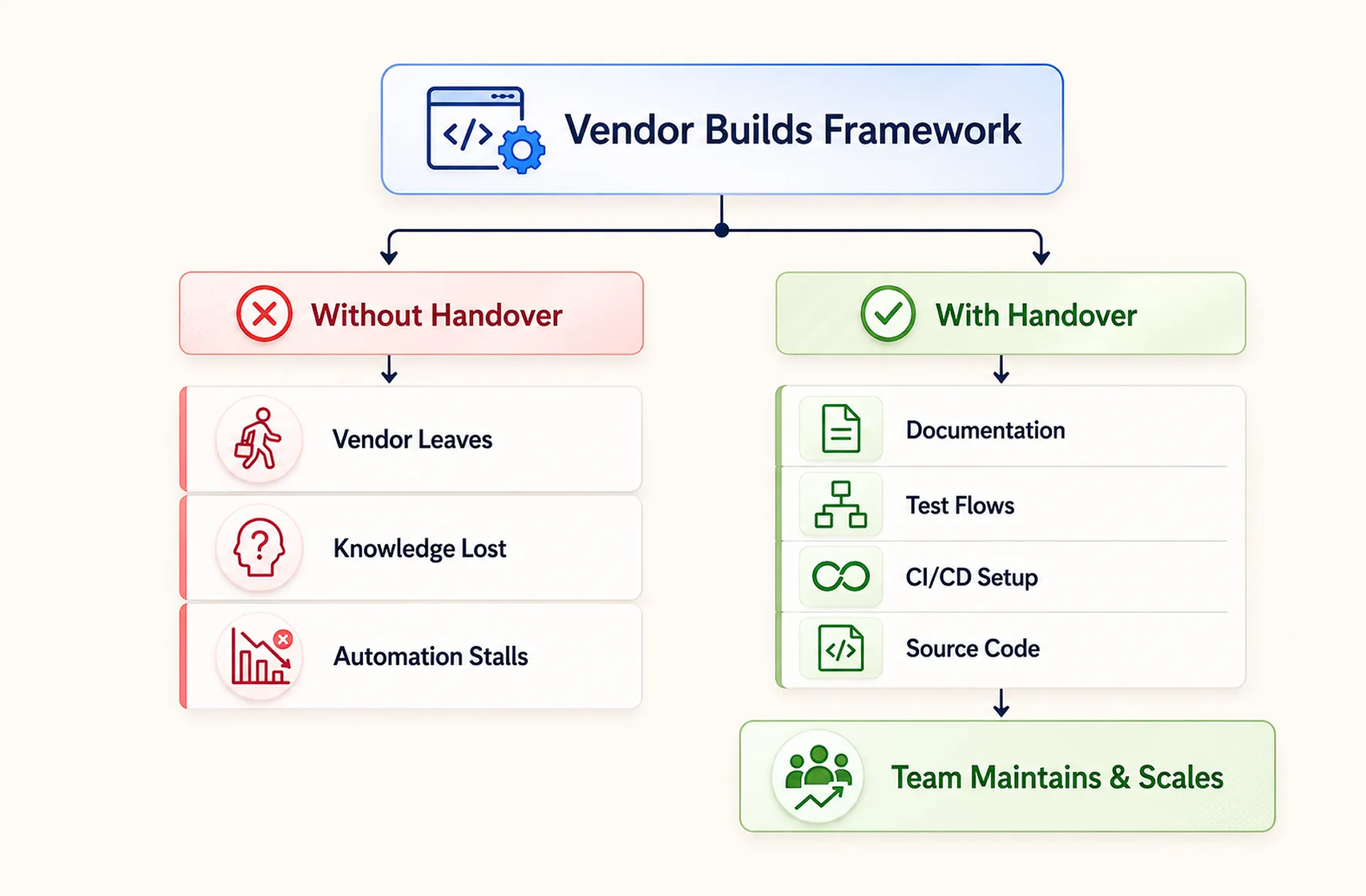
The hidden risk in most automation framework setup engagements is not poor coverage. It is knowledge lock-in.
The vendor builds automation frameworks using Playwright or Selenium that run perfectly while their engineers are on the account. When they leave, the institutional knowledge leaves with them.
What a QA partner should deliver at close:
- Documented architecture and test flows.
- CI/CD pipelines integrated with your existing toolchain.
- Regression suites your team can extend without vendor dependency.
- Full framework handover included by default, not as an add-on.
Test automation ROI only compounds if your team owns what gets built. Without a handover plan, the framework decays within a year.
Factor 3: Do They Understand How Your Application Actually Works?
Enterprise application testing is not the same as testing a three-page web app. Cloud-native infrastructures, microservices architecture, and multi-tenant data layers require testing practices that most generic QA agencies have never operated inside.
A capable QA partner asks about your stack in the first call:
- How services communicate across cloud infrastructure.
- Where API dependencies and third-party integrations sit.
- Whether CI/CD systems use GitHub Actions, Jenkins, or something else.
- What test management and defect tracking tooling is already in place.
If the discovery session has no technical questions, the vendor is scoping on assumptions. That mismatch surfaces the moment QA testing begins.
Factor 4: Are They Set Up for How Fast You Ship?
When release speed accelerates, QA becomes the bottleneck first. Not deployment. Not code review. QA, because the vendor's delivery model was built for monthly batch cycles, not continuous testing inside two-week sprints.
Sprint-aligned QA looks like:
- Pipeline-triggered test case generation and execution on every pull request
- Concurrent test flows running without holding up deployment pipelines
- Defect tracking and defect escape rate reporting within the sprint, not after it
- Risk-based testing prioritisation that maps to release velocity targets
Shift left testing is a selling point every vendor uses. Ask what it means operationally: specific CI/CD pipeline triggers, specific escalation when a test gate fails, and specific sprint-exit criteria.
Factor 5: How Do They Handle Security and Performance, and When?
Treating security checks and performance testing as pre-launch audits is a planning failure. By the time a separate security SOW gets signed and scheduled, the codebase has already moved.
Embedded delivery looks like:
- SAST and DAST gates inside the same CI/CD pipelines as functional testing.
- OWASP Top 10 coverage per sprint, not as a pre-launch checkbox.
- Load regression wired into the pipeline, not a one-off test before go-live.
- Security compliance coverage for SOC 2, HIPAA, or FedRAMP requirements built into the engagement from Day 1.
Products running on cloud adoption-heavy stacks cannot treat non-functional testing as a bolt-on. Security and performance issues introduced in a sprint should surface in that sprint, not in a post-release incident.
Factor 6: What Does Their Engagement Model Actually Look Like?
Three delivery methods dominate quality assurance outsourcing. Each signals different accountability.
The model matters less than what is committed to in the proposal. Look for:
- Defined SLAs with response times by defect severity.
- Named escalation contacts, not generic support queues.
- Sprint-exit criteria and scope-change protocols written in advance.
- A real example of how they handled a missed deliverable.
Most teams end up in managed QA but sign for staff augmentation because it appears cheaper. The quality gap surfaces when a release-blocker needs an owner at 11 pm and no one from the vendor is accountable.
Factor 7: What Happens When Something Goes Wrong?
This is the most under-evaluated factor in QA agency selection. Behaviour under pressure.
A failed test gate on a go-live morning is not a hypothetical. What matters is the SLA structure governing the response:
- Defect response times mapped to severity levels.
- Release-blocker escalation paths, with names attached.
- Communication protocols when CI/CD systems flag a failure the night before deployment.
- Defect escape rate accountability between sprints, not just test counts.
Vendors who avoid SLA specifics in pre-sales typically avoid accountability in delivery. Any software testing company can run a lot of tests. Fewer can show a defect escape rate trending down over a quarter.
How Frugal Testing Fits Into This Decision
Frugal Testing is built to own outcomes, not just run tests.
Our delivery model covers all seven factors above:
- Embedded QA team working inside your sprint cadence from day one.
- Automation-first approach using automation frameworks matched to your stack.
- Full regression suites built for your CI/CD systems, with framework handover included.
- Security testing, performance testing services, and API testing scoped as one unified engagement.
- AI testing and AI-assisted tools where test generation and test case generation can be accelerated.
Across 50+ engineering teams, test suites have gone operational in under two weeks. Regression cycles that ran at 8 hours have come down to under 2. Defect escape rates that had teams firefighting post-release have dropped to single digits within a quarter.
We arrive with a structured scoping conversation and technical questions about your stack, not a discovery quarter.
Conclusion
The vendors that pass all seven of these factors are built for the way software teams actually ship in 2026: fast, continuously, with production defects carrying real development costs and customer trust on the line. Most QA vendors pass three or four comfortably. The seven-factor filter finds the ones worth talking to.
People Also Ask (FAQs)
Q1. What should be included in a full-service QA and software testing engagement?
Ans: Functional, API, regression, performance, and security testing scoped to your release cadence, delivered as one unified engagement, not separate SOWs stitched together across multiple vendors.
Q2. How do we evaluate a QA vendor's automation maturity before committing?
Ans: Ask for the framework handover plan and a walk-through of their CI/CD integration approach before the demo. A mature vendor has both ready at scoping, not after you sign.
Q3. What is the difference between managed QA outsourcing and staff augmentation?
Ans: Ownership. Staff augmentation means your team manages the work. Managed QA means the vendor owns delivery, outcomes, and accountability for defects that escape to production.
Q4. How quickly can a QA partner integrate with our existing pipeline?
Ans: A mature vendor integrates without replacing your toolchain. Tool compatibility, CI/CD pipeline triggers, and reporting format should all be defined at scoping, not discovered during onboarding.
Q5. How much does quality assurance outsourcing typically cost?
Ans: Pricing depends on scope and delivery model. The right frame is ROI: cost of a QA engagement versus the development costs and customer trust impact of a production defect.




.webp)