


Software testing is one of the most commonly outsourced functions in software development, and one of the most commonly mishandled.
Not because vendors are bad. Because most buyers compare prices before understanding what they're buying, sign contracts before knowing what success looks like, and spend the first two months fixing the relationship instead of shipping software.
If you're evaluating software testing outsourcing, this isn't a guide on why to outsource. You've already made that call. This is what to sort out before you sign anything.
1. Know Why
Before speaking to any vendor, get internal clarity first. Most outsourcing decisions go wrong because the buying team skips this step. Answer these three questions honestly:
- What does your in-house QA function look like right now?
- What triggered this decision?
- What does a good 90-day outcome for product quality actually look like?
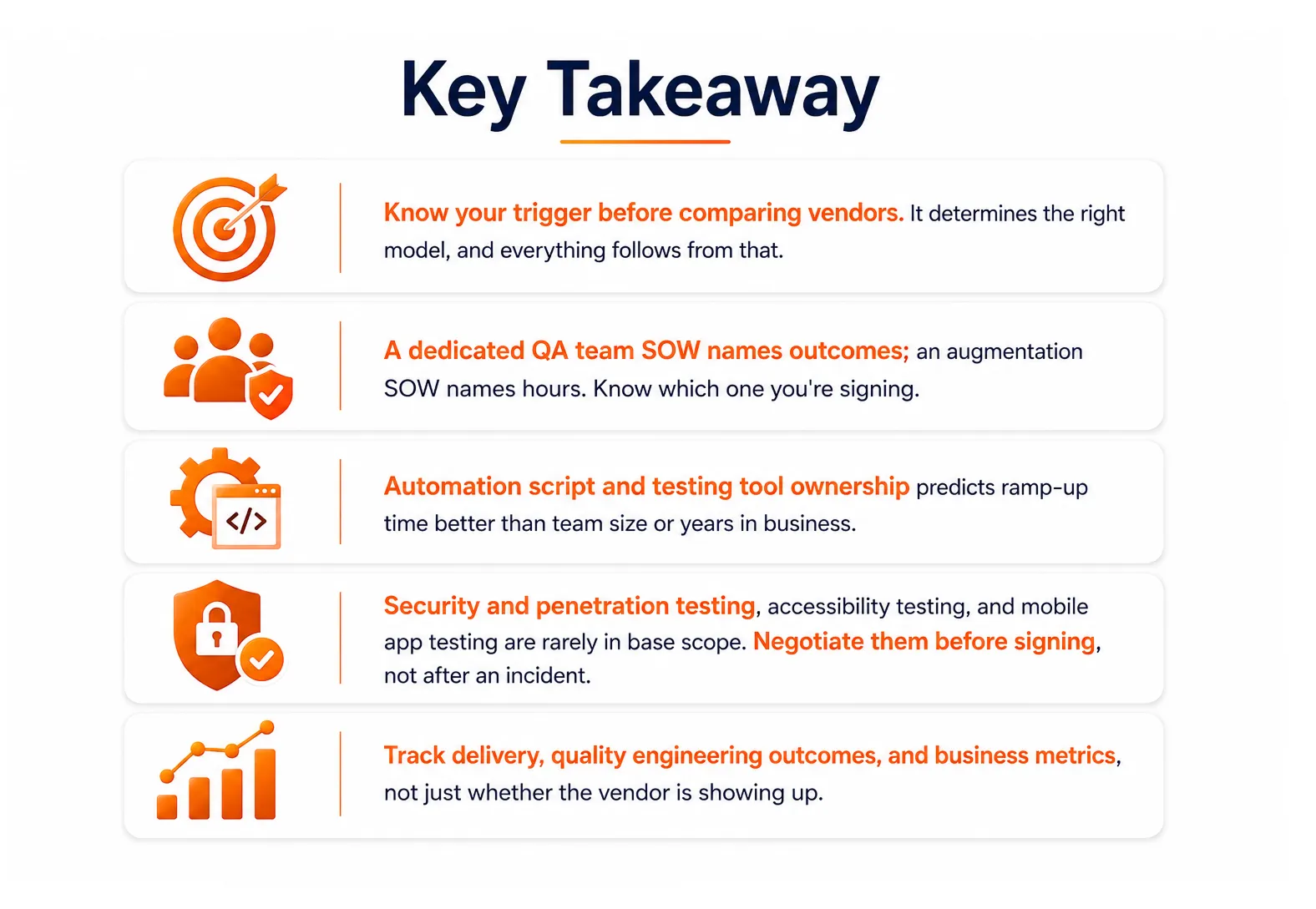
The trigger matters most. It determines the engagement model, and everything follows from that.
No QA testing function at all? The vendor needs to build the testing processes, not just run test scripts. Dev cycle outpacing your team? You need capacity, not a process overhaul. A specific gap like performance evaluation or security checks? You need specialized expertise, not a general QA role.
2. Pick a Model
Three models exist in India's software testing services market. Every vendor offers all three regardless of which one fits your situation.
With augmentation, you direct the work daily. With a dedicated team, the vendor owns service delivery and the outcome. If you have no testing processes to hand over, augmentation breaks fast. Your engineers end up managing software testers daily, which defeats the purpose.
Watch the contract closely. A managed testing services contract names outcomes: test coverage targets, defect turnaround, report cadence. An augmentation contract names headcount and hours. If a vendor can't show outcome-based terms, they're offering augmentation regardless of what they call it.
3. Check Process
A long client list shows a vendor wins deals. It says nothing about whether they have repeatable testing disciplines or documented quality engineering practices. Ask four questions before shortlisting:
- Can you share testing process documentation from a past engagement?
- How do you handle requirement gaps, including edge case coverage, during testing?
- What's your defect response protocol for critical issues?
- Do you own your automation scripts and testing tools, or build them from client specs each time?
That last one predicts ramp-up time better than anything else. A vendor with pre-built automation scripts and testing tools starts useful work in Week 1. A vendor building from scratch adds three to four weeks of setup before a single meaningful defect is caught, all on your budget. Ask for a live example: Framework structure, CI integrations, a real sample report.
4. Define Scope
Most QA outsourcing contracts cover functional testing and regression only. Performance evaluation, security and penetration testing, API testing, accessibility testing, usability testing, mobile app testing, and IoT testing are excluded unless explicitly requested. This is the most common source of post-signing disputes.
Before signing, confirm which testing disciplines are in and which aren't, who maintains the regression suite as the product evolves, and whether security protocols and performance evaluation are deliverables you receive or services run internally.
The most overlooked gap? Regression suite maintenance. Most contracts cover building it, not maintaining it. That causes billing disputes within two or three sprints.
5. Fix SLAs
Most buyers agree on price first and SLAs second. That's the wrong order. Vendors price based on what they're willing to commit to. Lock pricing first, and you get weaker Service Level Agreement terms in return.
Before pricing, get written agreement on P1 defect acknowledgement time (same business day), test automation execution rate per sprint, who owns the test environment, and when reports land.
Three red flags to watch in vendor proposals:
- "Business days" without a timezone. Without IST specified, a 24-hour Service Level Agreement quietly becomes 48, creating gaps in feedback loops.
- No severity tiers. Without P1/P2/P3 classification, a release pipeline blocker waits in the same queue as a cosmetic issue, hurting customer satisfaction.
- No breach consequences. An SLA without a penalty is just a target, and security risks go unresolved.
6. Validate Tooling
A vendor needing three weeks to integrate with your tools burns sprint capacity before a single test runs. In your first call, confirm source control experience, a live CI/CD integration example from a past project, whether they adapt to your Jira workflow, and whether they test against cloud infrastructure (AWS, GCP, or Azure).
Most Indian SaaS and fintech products run on cloud infrastructure. A vendor testing only against local environments misses auto-scaling issues and load behaviour that affects user experience and only surfaces in production: bugs that damage customer experience before anyone catches them.
If a vendor pitches artificial intelligence-powered test automation, push for a specific, demonstrable answer about how their automation engineering team tests AI product features. Generic claims about risk-based testing don't count without evidence.
7. Measure Success
Without agreed performance metrics, every review becomes a conversation about effort rather than outcomes. Before signing, agree on three layers:
- Delivery: Test automation execution rate, defect turnaround, reports on schedule.
- Quality: Defect detection rate, regression pass rate, test coverage growth.
- Business: Dev cycle time, production incidents, customer service overhead freed.
Most buyers only track delivery. They know the vendor is active. They have no idea whether software testing is actually improving product quality or customer satisfaction.
A simple 30-60-90 day cadence keeps things honest:
- Day 30: Did testing start on schedule? Any scope gaps to resolve?
- Day 60: Is test coverage growing? Are SLAs being met?
- Day 90: Is defect detection improving? Has release velocity increased? Renew, expand, or restructure based on what the numbers say.
How Frugal Testing Works
Run every check in this guide on us. We are specialized QA providers offering a dedicated QA team, managed testing services, and QA staff augmentation. Scope includes functional testing, regression, API, performance evaluation, security and penetration testing, accessibility testing, and mobile app testing, all defined before signing. SLAs are agreed before rates. Tooling confirmed in the first call.
Across 40+ engagements, the most common failure is ownership that was never agreed in writing. We fix that in the first call. At close, you own the test suite, automation scripts, and documented testing processes.
Conclusion
Poor QA outsourcing is expensive supervision. A vendor waiting for daily direction isn't a quality engineering partner.
Each of these seven steps removes a failure mode before the next decision. Most teams frustrated with outsourced software testing missed at least one before signing. The teams that get it right already knew what they needed before they started looking.
People Also Ask (FAQs)
Q1. What is the typical cost structure for software testing outsourcing in India?
Ans: Cost depends on the model: dedicated team engagements are retainer-based, managed testing is milestone-based, and augmentation is time-and-materials. Total cost including ramp-up matters more than the headline rate.
Q2. How do we decide between a dedicated QA team and managed testing services?
Ans: If you have no documented testing processes, choose a dedicated team so the vendor owns process design and quality engineering. If processes already exist, managed testing services give you sprint-level execution with measurable outcomes.
Q3. What testing disciplines are usually excluded from a base contract?
Ans: Security and penetration testing, accessibility testing, usability testing, mobile app testing, IoT testing, and UAT support are almost always excluded. Confirm all testing disciplines before signing.
Q4. How long before an outsourced QA engagement becomes productive?
Ans: Vendors with owned automation scripts and testing tools start meaningful test execution within one to two weeks. Vendors building from scratch add four to six weeks of setup first.
Q5. What should a 90-day QA outsourcing review include?
Ans: Three layers: delivery metrics (Service Level Agreement adherence, test automation execution rate); quality metrics (defect detection, test coverage, regression pass rate); and business metrics (dev cycle time, production incidents, customer satisfaction).


.webp)

.webp)