

Most software teams aren't short on ambition. They want faster releases, broader test coverage, and fewer 2 a.m. production alerts. What they're actually short on is QA engineers who can write automation scripts without breaking everything else in the process.
That's the real reason no code testing tools started growing. Not because the tools became trendy, but because the alternative - hiring three automation engineers and praying your Selenium suite survives the next redesign - just stopped making sense for most teams.
This guide covers what codeless automation actually is, where it falls flat, which tools are worth your time in 2026, and how to pick one without regret.
.webp)
What Are Codeless Automation Testing Tools?
Ask ten people this question and you'll get ten slightly different answers. The short version: these are testing platforms where you build, run, and fix automated tests without writing code. You click through a recorder, drag steps into a builder, or describe what you want in plain language. The tool handles the script underneath.
What this actually looks like day to day:
- A QA analyst records a checkout flow by clicking through the app. The tool captures every step and turns it into a repeatable test.
- The app gets redesigned. The button the test was clicking has moved. Instead of hunting down an XPath, the tool's AI detects the change and updates the step itself.
- The test runs on every pull request through a GitHub Actions integration. Nobody had to write a pipeline config.
The integration setup alone used to eat entire sprints
Why Codeless Test Automation Is Growing in 2026
Here's an honest take: the early versions of these tools were not good. Record-and-playback broke the moment a developer changed a class name. AI "self-healing" was mostly a marketing copy. Teams tried them, got frustrated, and went back to Cypress.
What changed is that the AI actually caught up. Modern platforms - Testim, Mabl, Katalon's newer versions - have self-healing logic that genuinely works in production environments, not just controlled demos. That wasn't true in 2021.
A few other things drove adoption:
- CI/CD became the norm, not the exception. Daily deployments meant manual regression was mathematically impossible for most teams.
- QA headcount stayed flat even as release velocity doubled. You can't hire your way out of that problem. You automate.
Codeless Testing Adoption Over Time Sogeti/Capgemini World Quality Report 2025
Who Should Use No Code Testing Tools?
The obvious answer is "QA teams without coders." That's true, but it misses a bigger group.
The teams that get the most out of these tools tend to be:
- Product squads running weekly sprints where nobody owns end-to-end automation. Developers write unit tests, manual QA writes test cases in Jira, and regression coverage is a spreadsheet that nobody updates.
- Enterprise QA teams with hundreds of regression tests. They have engineers, but maintenance overhead on coded suites is killing velocity. They want less of that.
- Startups under 20 people where the "QA team" is one person who also does product. They need coverage without a 3-month ramp.
- Business analysts and product managers in regulated industries who need to own acceptance tests themselves, not file tickets and wait.
Who probably doesn't need them: teams where developers already own automation and are happy with their Playwright or Cypress setup. If it's working, don't fix it.
Codeless vs Traditional Automation - Key Differences
The comparison most vendor sites give you is unfair in both directions. Coded frameworks get framed as "too complex," no code tools get framed as "limited." Teams with a stable Playwright or Cypress setup is usually better off improving their existing framework than adding a parallel tool.
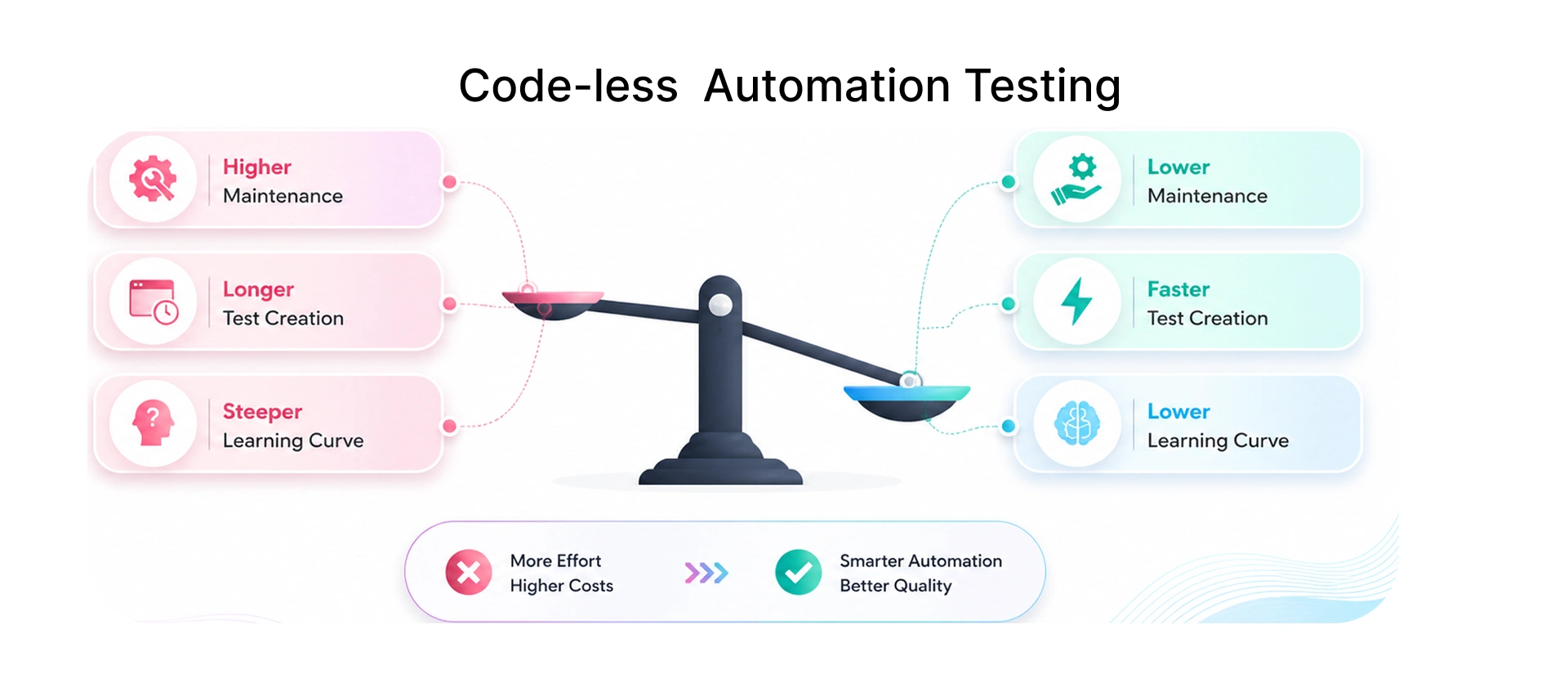
Traditional automation gives you control. You write exactly what gets tested. Edge cases, dynamic data, and complex state require careful planning—just as any experienced deck builder seattle professional carefully plans every stage of a custom project. The problem isn't capability; it's cost. Every UI change that breaks a test is time spent debugging selectors instead of building features. Teams with fast-shipping products often find the maintenance burden quietly eats most of the productivity gains.
No code tools flip the tradeoff. Faster setup, lower maintenance, more contributors who can write tests. The ceiling is lower on complex scenarios, but for 80% of what most apps need - regression coverage on core flows - it's usually enough.
The table below summarises where each approach wins and where it falls short across the five factors that matter most during tool selection.
Coded vs Codeless Comparison:
Low-Code vs. No-Code Testing – What's the Difference?
This trips up a lot of teams during vendor evaluations. "Low code" and "no code" show up in the same breath constantly, but buying the wrong one wastes real money.
Low Code Test Automation Explained
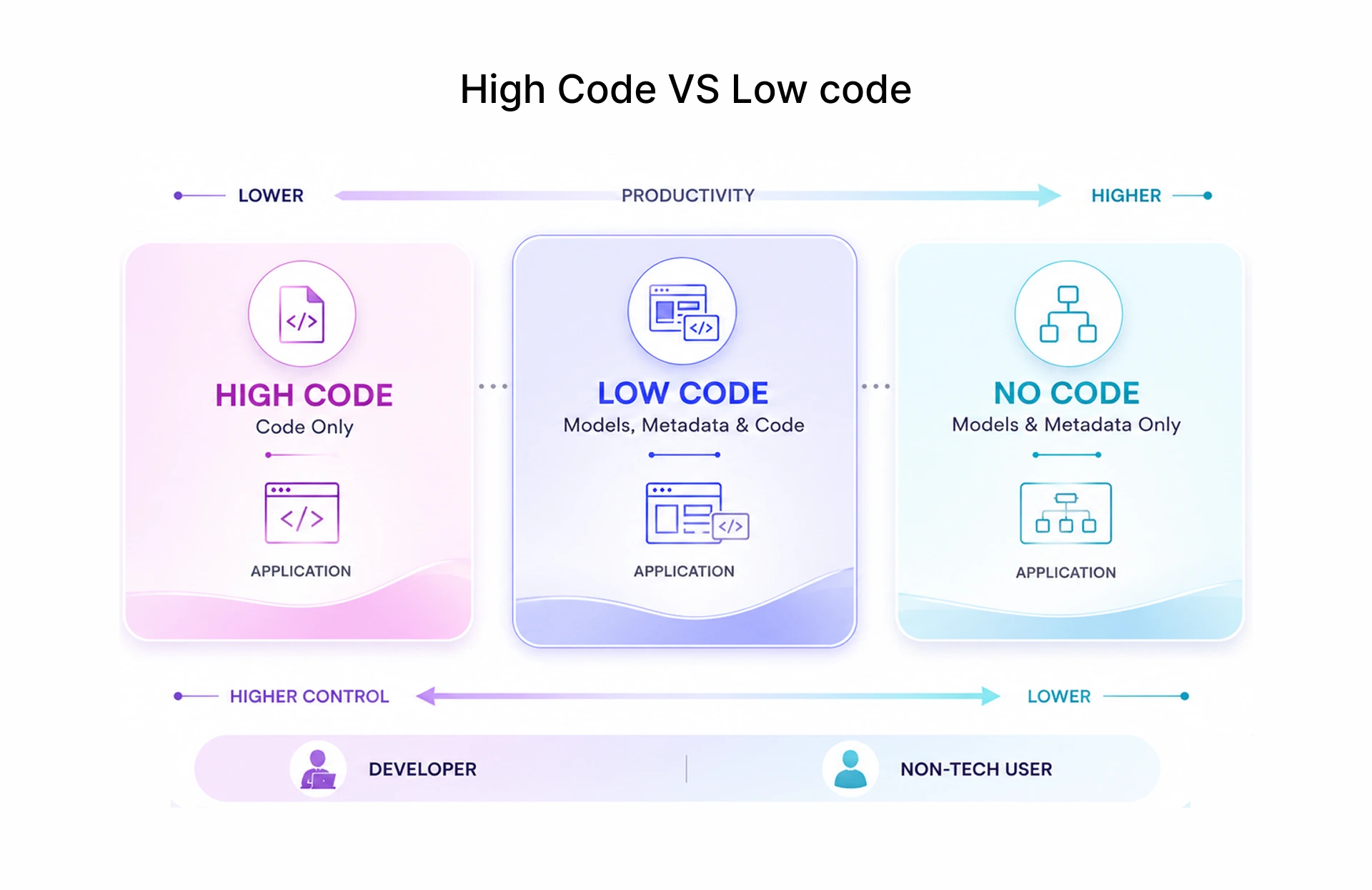
Low code tools give you a visual interface for most work and drop you into a code editor for the complicated stuff. Custom assertions, dynamic data handling, weird edge cases - you'll write some script for those. Usually JavaScript or Python, depending on the platform.
Ranorex, Tricentis Tosca, and Katalon (at its deeper layers) fall here. The QA analyst uses the visual builder daily. The engineer jumps in twice a sprint for something the builder can't handle. Both work independently on the same platform without getting in each other's way.
No Code Automation Explained
No code means no script. Ever. You click through a recorder, write steps in plain English, or build tests from a template library. Testim and Mabl are the clearest examples.
These tools are faster to adopt. A QA analyst who joined last week can run a regression suite by the end of day. The tradeoff is that if your app does something unusual - heavy JavaScript interactions, complex modal chains, third-party iframes - you'll hit the ceiling faster than you want to.
Low Code vs No Code Testing: Which Fits Your Team?
My honest take: if your QA team has even one person who can write Python, go low code. You'll get more flexibility when you need it without giving up the visual interface for everyday work.
If nobody in your QA org writes code at all, no code is the right call. Just be realistic about the scenarios your app has that might push you past the tool's limits before you sign a year contract.
Top 10 Codeless Automation Testing Tools Compared (2026)
Katalon Studio - Best for Enterprises
Katalon covers web, API, mobile, and desktop from one platform. It has a visual builder that non-engineers can use on day one and full Groovy scripting for engineers who need to go deeper. The two layers stay out of each other's way, which is harder to pull off than it sounds.
What keeps Katalon competitive in 2026 is range. Most platforms do web or mobile well. Katalon handles both without needing two separate tools and two separate test suites.
- Free tier with no expiration date, covers core web/API/mobile testing
- TestCloud add-on for parallel cross-browser execution
- Native Jira integration with defect auto-linking
- Community of 300,000+ with active forums and shared test libraries
The free tier is genuinely usable for small teams, not just a demo.
BugBug - Best for Fast Regression Testing
BugBug is a low-code test automation tool for SaaS teams that need reliable end-to-end web testing without the overhead of Selenium, Playwright, or enterprise platforms. Its AI-assisted Chrome recorder lets QA, product, and engineering teams create tests by clicking through real user flows.
BugBug focuses on speed and maintainability. Adaptive locators, smart waiting, smart click-and-scroll, and Edit & Rewind help teams create, update, and debug Chromium-based web tests faster.
- AI-assisted test recorder with adaptive locators and smart waiting
- Edit & Rewind for faster test debugging and maintenance
- Unlimited users, unlimited local runs, and unlimited cloud runs on paid plans
- Built-in inbox for testing signup, login, and email verification flows
- CI/CD, CLI, API, Slack, Zapier, GitHub, GitLab, Jenkins, and Bitbucket integrations
- Custom JavaScript steps for advanced scenarios when no-code is not enough
BugBug works especially well for SaaS teams with limited QA capacity that want to automate critical web app flows quickly, keep tests stable between releases, and avoid per-seat pricing.
BrowserStackLow-Code Automation - Best for Real-Device Scale
BrowserStack Low-Code Automation is an AI-assisted web testing platform that helps QA teams build and maintain testsvia a visual interface. It blends low-code simplicity with the flexibility ofcustom logic, enabling faster automation without relying solely on coded frameworks. By focusing on reducing overall effort, teams can author tests 10× faster and cut build failures by 40%, all while validating applications across 30,000+ real devices and 3,500+ browser-OS combinations.
- AI-powered recorder that generates automated test steps from user interactions
- Self-healing locators that automatically recover from common UI changes
- AI failure analysis with logs,screenshots, videos, and root-cause insights
- Integrates with Jira, GitHub,Jenkins, Slack, and popular CI/CD pipelines
BrowserStack works especially well forteams that have outgrown manual testing and need a low-code platform that canscale from simple regression suites to enterprise-grade automation.
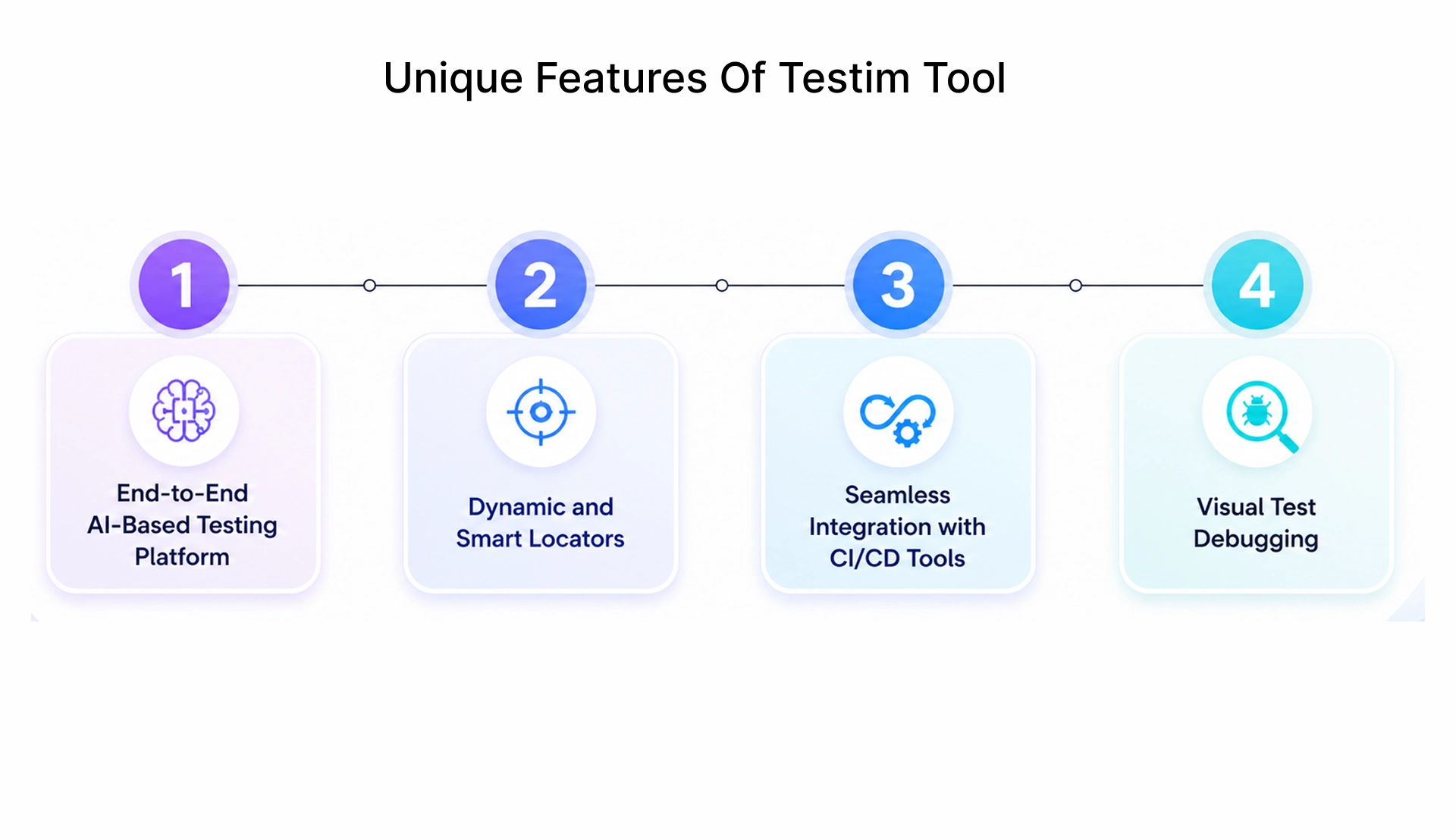
Testim - Best AI-Powered No Code Testing
Testim uses machine learning to lock onto UI elements and adjust when they move. When a developer renames a class or restructures a component, Testim's AI figures out what you were clicking before and finds the equivalent element without failing the test.
That sounds like a small thing. It isn't. In Frugal Testing's QA engagements, broken locators are consistently the leading reason test suites get abandoned — cited in post-mortems more than flaky tests or maintenance overhead combined.
- AI-driven element stabilization with multi-locator fallback
- Visual test editor with step-by-step recording
- Native Salesforce testing support - rare in this space
- Integrates with GitHub, Jenkins, and CircleCI out of the box
Testim works well for product teams without dedicated automation engineers who need tests that actually stay working between sprints.
Mabl - Best for Agile Teams
Mabl is the tool I'd point an agile team toward first if budget allows. It plugs into your CI/CD pipeline, runs tests on every deployment automatically, and surfaces results in Slack within minutes often before PR review is complete.The AI maintenance is solid. Self-healing catches most locator breaks, and the platform learns your application's patterns over time, which genuinely reduces the false-positive rate.
- Auto-healing tests with ML-driven element detection
- Built-in performance and accessibility testing (not an add-on)
- Slack integration with per-test pass/fail notifications
- Supports Chrome, Firefox, and Safari across web apps
If your team deploys more than twice a week, the tight CI/CD integration alone makes Mabl worth a serious look.
Leapwork: Best Visual Test Automation Tool
Leapwork uses a flowchart interface where tests look like process diagrams. Blocks connect with logic flows. There's no scripting at all, and the result looks less like a test file and more like a business process map.
This makes it popular in industries with compliance requirements, finance, healthcare, and insurance, where subject matter experts who aren't engineers need to own and audit test cases directly.
- Fully codeless with flowchart-style test design
- Strong SAP testing support, better than most tools
- Audit trail features for regulated industry compliance
- Available cloud or on-premise
Not the right tool if you need deep API or mobile coverage. For enterprise UI apps with compliance overhead, it's one of the cleaner options available.
Ranorex Studio - Best Record and Playback Testing
Ranorex has been around since 2007. The record-and-playback engine is mature, the object repository handles large test suites without falling apart, and the C#/VB.NET scripting layer gives engineers real power when they need it.
The catch: the authoring environment runs on Windows only. Test execution can be remote, but if your QA team uses Macs, that's a problem to plan around.
- Mature record-and-playback with accurate element recognition
- Full C# and VB.NET scripting for engineers who need it
- Built-in reporting with screenshots and execution timelines
- Strong desktop app testing (Win32, WPF, .NET apps)
Ranorex fits enterprises with Windows-heavy environments and teams that already have .NET expertise.
Testsigma - Best for Beginners
Testsigma lets you write test steps in plain English. Literally: "Click the Login button. Type 'admin' in the username field." The platform handles everything underneath. It's the lowest barrier to entry on this list.
It's cloud-based, so there's no local installation, no environment setup, and no "it works on my machine" problems. You open a browser and start building.
- NLP-based test authoring – no code syntax to learn
- Cloud execution across web, Android, iOS, and REST APIs
- Free tier for small teams and open-source projects
- Integrates with Jira, Slack, Jenkins, and GitHub Actions
For a QA analyst who has never touched automation before, Testsigma has the shortest realistic path from day one to running tests.
Tricentis Tosca - Best Low Code Automation Framework
Tosca works differently from everything else on this list. Instead of recording test steps or building flows, you model your application and generate test cases from that model. It's a model-based approach, and for large enterprise applications with dozens of interconnected modules, it scales in a way that script-based tools simply don't.
Its ERP integrations are best-in-class. SAP, Salesforce, Oracle - Tosca handles these better than any other platform.
- Model-based design reduces individual test scripting significantly
- Best SAP and ERP testing support in the market
- Risk-based test optimization for prioritizing coverage
- Enterprise pricing with dedicated implementation support
Tosca requires real onboarding time. Teams that invest in the setup properly tend to stick with it for years. Teams that skip the onboarding phase usually struggle.
Micro Focus UFT One - Best for Enterprise Web Apps
UFT One (the platform formerly known as QTP) has been enterprise QA's standard for over two decades. The AI object recognition handles dynamic web apps that break other tools' locators. If your organization has a large legacy test suite and is weighing a migration, UFT One is the most common destination.
- AI object recognition for complex, dynamic web UIs
- OCR-based testing for scanned documents and PDFs
- API, UI, and service virtualization in one platform
- Deep integration with the Micro Focus ALM ecosystem
The licensing is expensive. For teams already running Micro Focus ALM, the integration value is often enough to justify it.
The table below compares all eight platforms across key criteria including free tier availability, supported test types, AI self-healing capability, and starting price.
Prices verified April 2026 confirm directly with vendor before purchase
Key Features to Look For in No Code Automation Testing Software
The five features that most differentiate no code testing platforms and where vendor marketing is least reliable are visual regression coverage, API testing depth, mobile execution quality, AI visual testing accuracy, and regression speed. Here's what to actually verify during a trial.
Codeless Automation Testing Tools - Free vs Paid Options
Budget is a real constraint, especially for teams evaluating tools without executive buy-in yet. The good news is that a few platforms offer free tiers that are genuinely usable - not stripped-down trials designed to frustrate you into upgrading.
Best Codeless Automation Testing Tools Free Tier Breakdown
- Katalon Studio - Free tier with no time limit. Core web, API, and mobile testing included. Cloud parallel execution requires an upgrade, but for sequential testing, the free tier covers a lot.
- Testsigma - Free plan for up to 5 users with limited monthly test executions. Good enough for a team building their first automation suite.
- Selenium/Playwright - Free and open source, but these are coded frameworks. Worth knowing if your team has even one engineer who can run them.
Automated Testing Tools Pricing 2026 - Full Comparison
📊 TABLE - Pricing Breakdown:
Prices change. Always verify directly with vendors before making a budget decision.
Prices verified April 2026 confirm directly with vendor before purchase.
Best Codeless Automation Testing Tools by Use Case
For Non-Developers and QA Beginners
Testsigma. Plain English test steps, cloud execution, free to start, no local setup. Mabl is worth looking at if your budget runs to $500/month and you want built-in AI maintenance from day one.
For Agile and CI/CD Teams
Mabl is the strongest fit here. CI/CD integration is tight, self-healing keeps maintenance overhead low, and results surface in Slack before the sprint retro. Testim is worth comparing if your app depends heavily on Salesforce.
For Web App Testing Teams
No Code Web Testing Platform Recommendations
Katalon Studio gives the best value for web testing teams that want broad coverage without enterprise pricing. Testim's AI stability features are worth the premium if your web app ships changes weekly. For teams already in the Micro Focus ecosystem, UFT One handles complex dynamic web apps at a scale the others don't quite match.
Final Verdict: Best Codeless Automation Testing Tools (2026)
In Frugal Testing's QA engagements with SaaS teams migrating off Selenium, teams using Katalon or Testim reduced test maintenance time by 40–60% in the first quarter. After working through these platforms across real client projects, here's where things actually land.
Quick-Pick Summary Table by Team Size and Budget
TABLE “Final Recommendations”
Our Top Recommendation for Each Use Case
Best overall value: Katalon Studio. Free to start, no expiration on the free tier, covers web, mobile, and API without switching platforms. The ceiling is high enough for most teams.
Best for AI-driven stability: Testim. If broken tests from UI changes are the reason your last test suite died, Testim's self-healing logic is the most direct fix.
Best for absolute beginners: Testsigma. Plain English, cloud-based, no local setup. A new QA analyst can be running real tests within a day.
Best for enterprise complexity: Tricentis Tosca. Model-based design handles large, interdependent enterprise apps in a way script-based tools genuinely can't.
Best for real-device scale: BrowserStack Low-Code Automation. BrowserStack Low-Code Automation removes the infrastructure headache by allowing teams to run AI-generated tests directly on a massive cloud of over 30,000 real devices and browser combinations.
The teams that get this wrong usually do so by buying for their aspirational team - the one with four automation engineers and a full-time DevOps person - instead of their actual team. Pick the tool your QA team can use independently tomorrow, not the one that looks good in a vendor deck, just as a deck builder san diego professional would recommend choosing solutions based on the actual needs of a project.
Start Your Free Trial Today
If you're still unsure after reading all of this, the practical move is to trial two tools back-to-back on the same test scenario from your actual app. Not the vendor's demo. Your app, your flows, your edge cases.
Frugal Testing helps QA teams evaluate, implement, and scale test automation - including no code and low code platforms. Whether you're migrating off a coded framework that's costing you 20 hours of maintenance per sprint or building test automation from scratch, we've done this before.
Frequently Asked Questions
What are the best codeless automation testing tools in 2026?
The best codeless automation testing tools in 2026 are Katalon Studio (best overall value), Testim (best AI-driven stability), Mabl (best for agile/CI-CD teams), and Testsigma (best for beginners), with the right choice depending on team size and budget.
What is the difference between low code and no code test automation?
Low code tools use visual builders for most work but expect some scripting for advanced scenarios. No code tools require zero scripting - everything goes through a visual or AI-driven interface. If your team has even one person who writes code, low code will give you more room to grow without giving up the visual interface for day-to-day use.
Are there any free codeless automation testing tools available?
Yes. Katalon Studio and Testsigma both have free tiers that are usable, not just demos. Katalon's free tier has no time limit and covers web, API, and mobile testing.
Can no code testing tools handle API and mobile testing?
Katalon, Testsigma, and Mabl support both web and API testing.Mobile support is solid on Katalon and Testsigma. Leapwork and Ranorex are stronger on UI testing and weaker on API.
Which codeless testing tool is best for agile teams?
Mabl. Its CI/CD integration is the tightest on this list, maintenance overhead is low, and results surface automatically in Slack or Jira. Testim is worth comparing if your application has heavy Salesforce dependencies.