

.webp)
A SaaS company came to us convinced their QA process was airtight. Then they failed a vendor security review, twice, over a question nobody on the team could answer: What's actually in your build? Their test coverage was strong, their pipelines were fast, their releases were clean. None of it touched software supply chain security. Nobody could say which open-source dependencies were running in production, whether build pipelines were tamper-checked, or whether deployment infrastructure had ever been audited for security vulnerabilities.
The gap wasn't ignorance; it was ownership. Most teams track this only through scattered software supply chain security news rather than a real test plan; security assumed QA owned it, and QA assumed security did. That gap is where software supply chain attacks and malicious packages slip through. This guide covers SBOM generation, dependency scanning, and CI/CD checks as testable controls, plus the software supply chain security best practices enterprise buyers expect.
What Is Software Supply Chain Security, and What Does It Actually Cover?
Software supply chain security is the practice of protecting every component, tool, and process- source code, dependencies, build pipelines, deployment infrastructure - that touches a software product before it ships. A trusted software supply chain spans source repositories, every open-source component or third-party component, and the infrastructure that carries code from commit to production.
Here is how it works, in points:
- Source repositories and open-source dependencies feed code in, following the NIST Secure Software Development Framework's development life cycle.
- Build scripts and CI/CD tools compile everything into artifacts, and this is where most security threats surface.
- Artifact repositories store finished builds before deployment.
- Deployment infrastructure, including infrastructure as code, pushes builds into runtime environments where software finally executes.
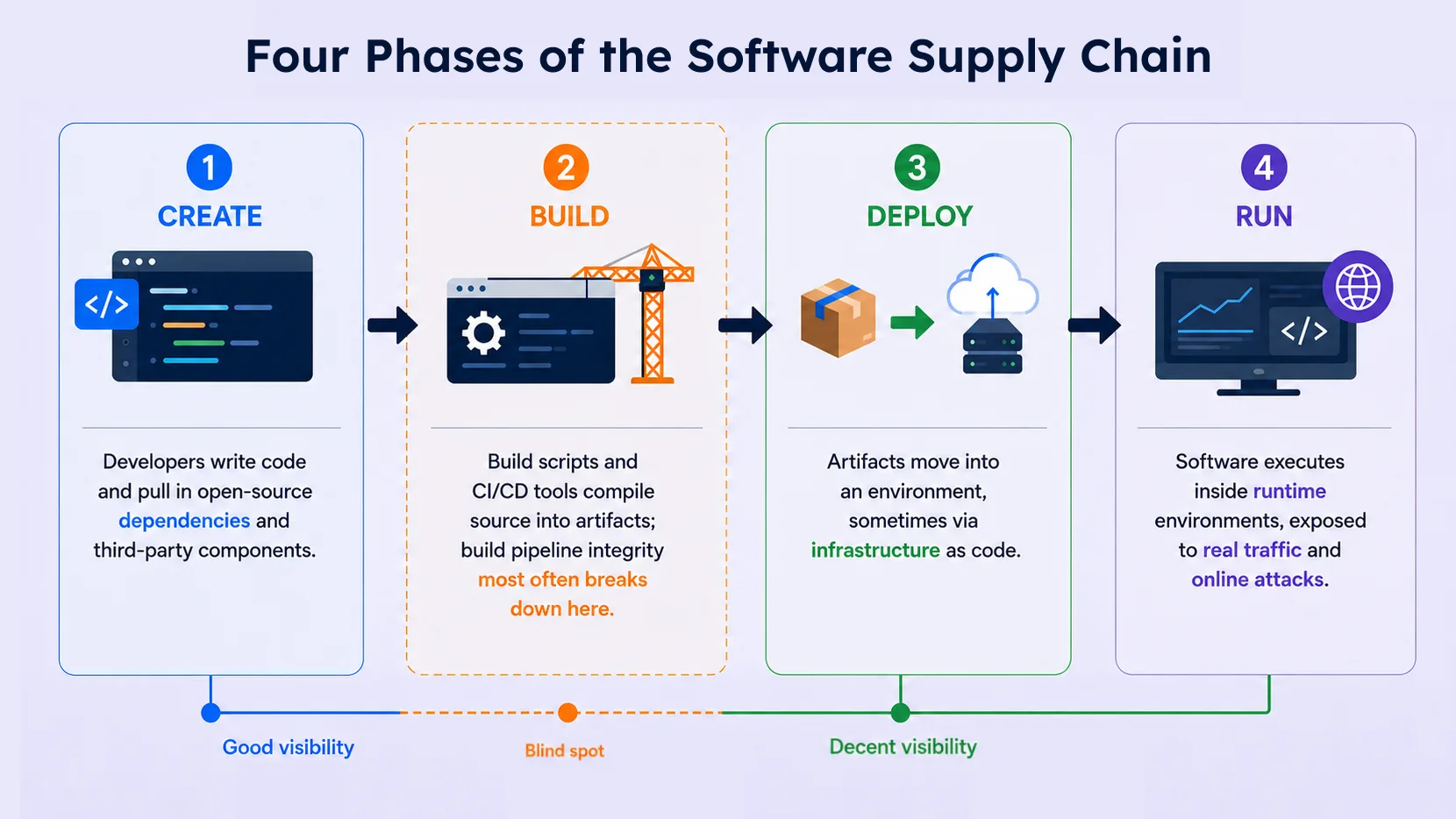
The Four Phases: Create, Build, Deploy, Run
Build is usually the weakest link: Solid visibility into what teams wrote, decent visibility into what is running, and a blind spot in between.
- Create: Developers write code and pull in open-source dependencies and third-party components.
- Build: Build scripts and CI/CD tools compile source into artifacts; build pipeline integrity most often breaks down here.
- Deploy: Artifacts move into an environment, sometimes via infrastructure as code.
- Run: Software executes inside runtime environments, exposed to real traffic and online attacks.
Supply Chain Security vs. Application Security: Where the Line Sits
A scanner flagging a SQL command injection bug does appsec work: It's checking your own code for a vulnerability you can fix directly, in your own repository. A tool flagging a hijacked maintainer account behind an open-source component does supply chain work: The fix isn't a code change but a decision about whether to trust, pin, or replace that dependency entirely.
Most QA test plans lean heavily toward the first category and treat the second as optional. That gap matters, because attackers increasingly target the path of least resistance, and a dependency nobody is watching is far easier to compromise than code under active review.
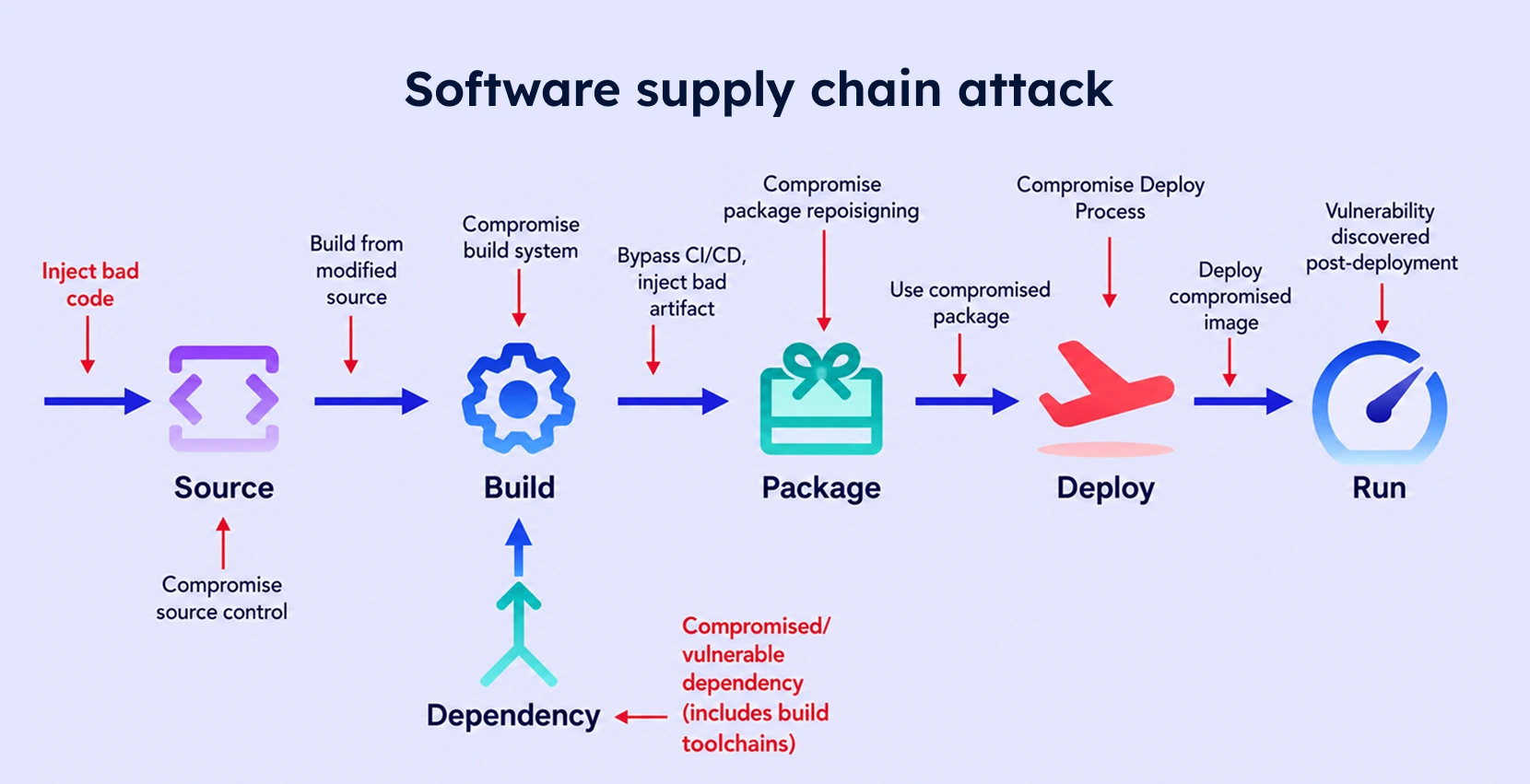
What Supply Chain Attacks Look Like, and the Standards Built to Stop Them
The attacker's playbook behind most software supply chain attacks is consistent, and the stakes keep climbing: IBM's Cost of a Data Breach Report 2025 puts the global average breach cost at $4.99 million, with supply chain breaches landing on the pricier end since the blast radius is harder to contain.
- Gain access to a repository, build platform, or artifact repository.
- Inject unauthorised behaviour, from dependency hijacking to Dependency Confusion, tricking a build into pulling a malicious package from a public registry instead of an internal one.
- Wait for the target to deploy the tainted build.
- Ride that access past perimeter defences already trusted.
QA test plans should cover:
- Malicious packages entering through a compromised dependency, often published under a trusted maintainer's name.
- Unauthorised source changes slipped into a repository without proper review.
- Build pipeline integrity failures, where a compromised runner quietly alters the artifact mid-build.
- Artifact substitution, swapping a signed build for a tampered one before deployment.
- Digital certificates hijacked for code signing, letting malicious code pass off as legitimate.
Why These Attacks Bypass Traditional Security Controls
Firewalls and endpoint tools catch online attacks and unauthorised access. A software supply chain attack needs neither: The code arrives from a source already trusted, already deployed through its own CI/CD pipelines, so perimeter tools have nothing to flag. Apache Log4j and the SolarWinds breach made this concrete: one a compromised update channel, the other a buried dependency nobody had audited. Regulatory requirements are tightening in response: a Software Bill of Materials, the SLSA framework, and attestation exist as a direct answer to these vectors, not abstract compliance boxes.
SBOMs, SLSA Build Levels and Attestation: Reading the Standards
Three standards make software supply chain security concretely testable rather than an abstract goal:
- A Software Bill of Materials has three parts: Manifest (every component and open-source dependency), pedigree (how each was built or modified), and provenance (where it originated, checked first when triaging a new CVE)
- The SLSA framework defines four build levels, how verifiable the build is versus trusted on faith: level 1 requires a documented process, level 4 runs on hardened, isolated infrastructure with two-person review, and higher levels cost more time, so treat this as a staged rollout.
- Attestation is the security metadata that lets a consumer verify a producer's claims: subject, statement, and a signature backed by digital certificates.
Testing and Tooling: CI/CD Gates, SCA and Vendor Vetting
A mature pipeline enforces four security guardrails: Dependency scanning (Snyk, Dependabot, OWASP Dependency-Check) covering open source dependencies and third-party components, Software Bill of Materials generation (Syft, CycloneDX), provenance verification before promotion, and digital certificate checks (Sigstore, Notary) before deployment.
What is software composition analysis? It is the layer of CI/CD security testing that checks dependencies against known vulnerability databases, using tools like Snyk, Mend, or Black Duck, usually the first supply chain security software teams buy before a fuller platform of software composition analysis tools.
Vetting a dependency means checking artifact provenance, reviewing security metadata, confirming active maintenance, and running it through an SCA tool, while third-party risk management software such as OneTrust or Prevalent assesses Security Posture in parallel. A fuller Security Posture draws on:
- Static Application Security Testing (SAST), using Semgrep or SonarQube, for flaws in your own code.
- Dynamic Application Security Testing (DAST), using OWASP ZAP or Burp Suite, for malformed data handling in the running software product.
- Threat modeling, using OWASP Threat Dragon, early in the development life cycle, mapping security policies to real exposure.
- Container Security using container image scanning tools like Trivy or Grype, plus runtime detection once deployed.
Dependency Scanning as a Pipeline Gate, Not a Report
Most teams already have a dependency scanner running somewhere in CI. The problem is rarely the tool itself; it's what happens after the scan finishes: A scan that produces a report nobody reads, and a scan wired to actually fail the build are two different projects, even though both run the same underlying tool. Teams that leave this unconfigured end up with scanning that looks active on paper but changes nothing in practice. The difference comes down to a few decisions:
- Does a critical finding block the merge, or does it just log a warning and let the pipeline continue anyway?
- Is the scan wired into every pull request, or only run manually before a release?
- Does anyone own triaging the findings, or does the output sit unread in a dashboard, with nobody forced to act before the code ships?
Comparing SCA, Container Scanning and Vulnerability Scanners
SCA does not test code behaviour, only whether known-vulnerable open-source components are present, unlike the categories below:
Signals a Dependency Is Poorly Maintained
No commits in twelve months or more, unpatched disclosed CVEs left open, and a single maintainer with no succession plan. Two together should stop a dependency from entering production until someone looks at it.
What Most Software Supply Chain Security Guides Get Wrong
Nearly every guide we reviewed treats software supply chain attacks as a security-team topic exclusively, and never says what a QA engineer should change in a test plan. The people best placed to gate a release are usually QA. Three gaps show up again and again:
- A Software Bill of Materials and SCA get used almost interchangeably, when they answer different questions: An SBOM tells you what is in an artifact; SCA tells you whether any of it currently carries security vulnerabilities
- Treating one SBOM export as equivalent to ongoing testing, especially as regulatory requirements around a trusted software supply chain tighten
- Running a scanning tool once and building a gated, repeatable control around its output get treated as the same project, though vendor pitches describe them identically.
How Frugal Testing Helps You Build Supply Chain Security Into Your Test Strategy
This sits at the end deliberately. You now have the technical picture; here is where we fit in. Our test automation and CI/CD integration security service maps directly onto this problem: we assess where dependency scanning and Software Bill of Materials generation sit, then wire the missing guardrails into CI/CD tools and hand off a test plan treating supply chain checks as a release criterion.
In engagements where a scanning tool was already installed, the gap was rarely the tool itself. Nobody had wired its output into anything that stopped a bad build from shipping, the first thing we check when assessing Security Posture. Enterprises tend to choose a specialised security solution over a DIY rollout for one reason: wiring security testing into an existing CI/CD pipeline, whether on infrastructure as code or a platform like Red Hat OpenShift with multicluster security requirements, without slowing release velocity is a narrower skill than it sounds.
What Our Supply Chain Security Testing Engagement Looks Like
Here's what the engagement actually involves:
- We audit the pipeline first: What's gated versus logged and ignored.
- We wire dependency scanning and Software Bill of Materials generation into enforced gates, not advisory reports.
- We validate every gate against a real release before handoff.
Who This Is For
Teams shipping to regulated buyers now ask for a Software Bill of Materials, and teams with a scanning tool installed but nothing enforced are the clearest fit. So are engineering teams moving upmarket into enterprise or government contracts, where a vendor security questionnaire can stall a deal for weeks if nobody can produce basic dependency evidence on request. If QA still treats supply chain checks as something the security team will get to eventually, that gap is exactly what this closes.
Conclusion
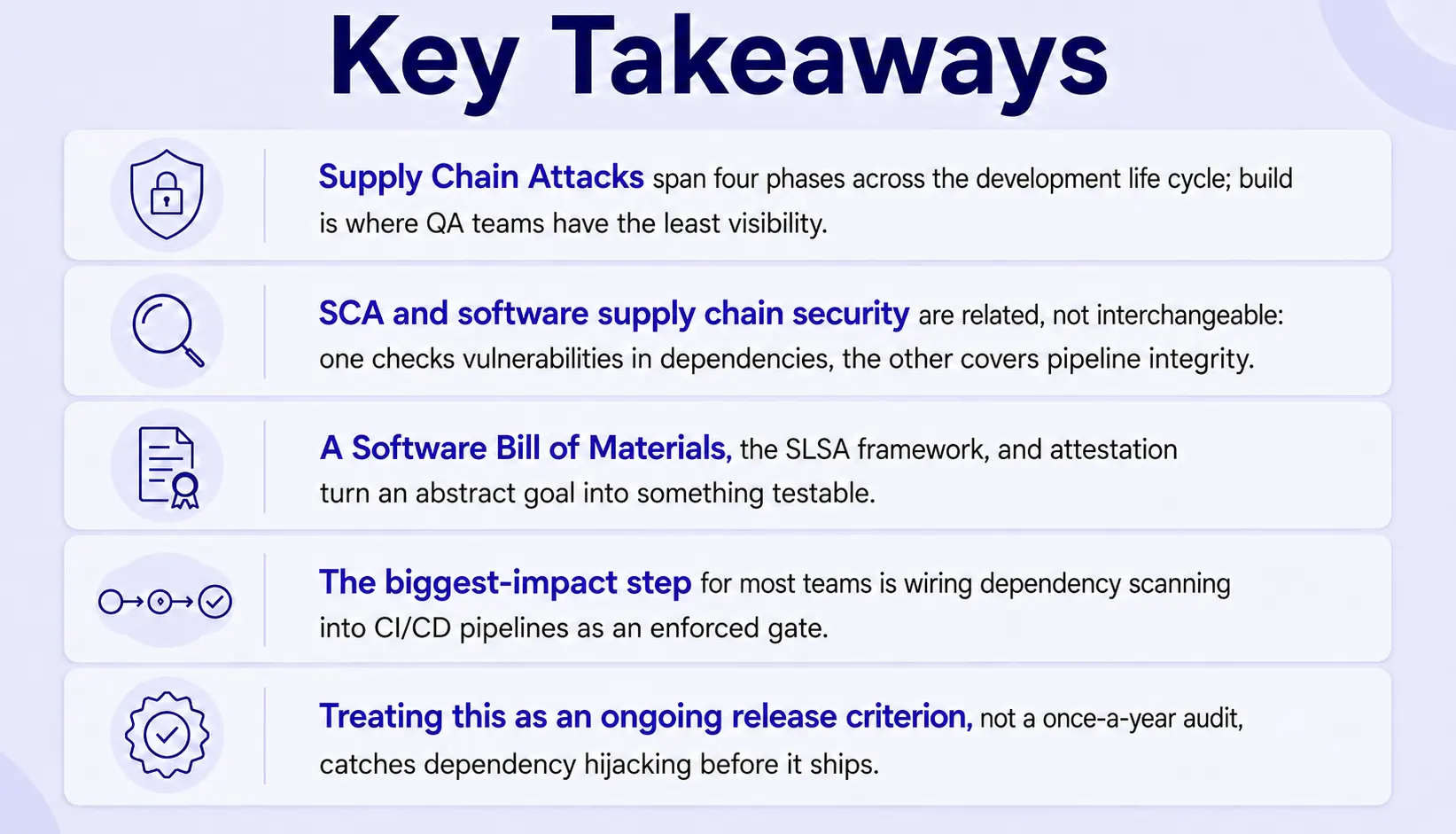
Software supply chain security is broader than SCA. Standards like a Software Bill of Materials and the SLSA framework give teams a concrete target instead of a vague compliance goal. The biggest-impact step stays simple: Turn dependency scanning into an enforced CI/CD pipeline gate. Next quarter's release pipeline either checks for software supply chain attacks or it does not.
People Also Ask (FAQs)
Q1. How often should QA teams re-run supply chain security scans?
Ans: Ideally, on every pull request and build, not on a quarterly schedule. Software supply chain attacks emerge between review cycles, so a one-off open-source vulnerability scanner check quickly goes stale.
Q2. Does adding supply chain security testing slow down release velocity?
Ans: Not when gates are automated and wired into CI/CD pipelines. Teams that hand-check dependencies manually lose far more time than teams running the right software supply chain security tools automatically.
Q3. Is supply chain security only a concern for large enterprises?
Ans: No. Smaller vendors are frequent targets precisely because attackers assume weaker controls. Any team publishing software that other businesses depend on needs baseline dependency checks and a vetting process.
Q4. How long does it take to stand up basic supply chain security gates?
Ans: Most teams get dependency scanning enforced within a week. Full SBOM generation and SLSA-aligned provenance checks typically take months, depending on how many services and pipelines need coverage.
Q5. Do open source maintainers need to think about supply chain security too?
Ans: Yes. A maintainer's compromised account or build script can poison every downstream project depending on it, which is why supply chain security software increasingly targets publishers, not just consumers.

.webp)