



Testing is usually the last thing engineering teams think about. Code is written, reviewed, and merged; the next thing you know, QA gets pinged one day before release. Sound familiar? That pattern is why bugs slip into production, why sprints feel chaotic near the end, and why "we'll fix it in the next release" becomes a running joke.
Most people asking what software testing is expect a textbook definition. The real answer is simpler: it's how you stop users from finding your bugs before you do. The software testing life cycle (STLC) is the process that makes that happen consistently, with six phases running alongside development from day one.
TLDR: Most teams already do testing. What they skip are the six phases of the software testing life cycle that make it actually reliable. Rush them, and it shows up in production.
What the Software Testing Life Cycle (STLC) Actually Is and Why It's Not the Same as SDLC
Before getting into what the stages of software testing are, it helps to clear up a confusion that trips up a lot of teams. SDLC, also called the software development lifecycle, covers how a product gets built, from the first requirement through to deployment. STLC (Software Testing Life Cycle) is a separate track running within QA. Different phases, different deliverables, different ownership.
Why does this matter? Because teams that treat STLC as just one box inside the SDLC, across all SDLC models, whether Agile, Waterfall, or hybrid, compress all their quality assurance work into the final sprint. That's when defect escape rates spike and regression costs pile up.
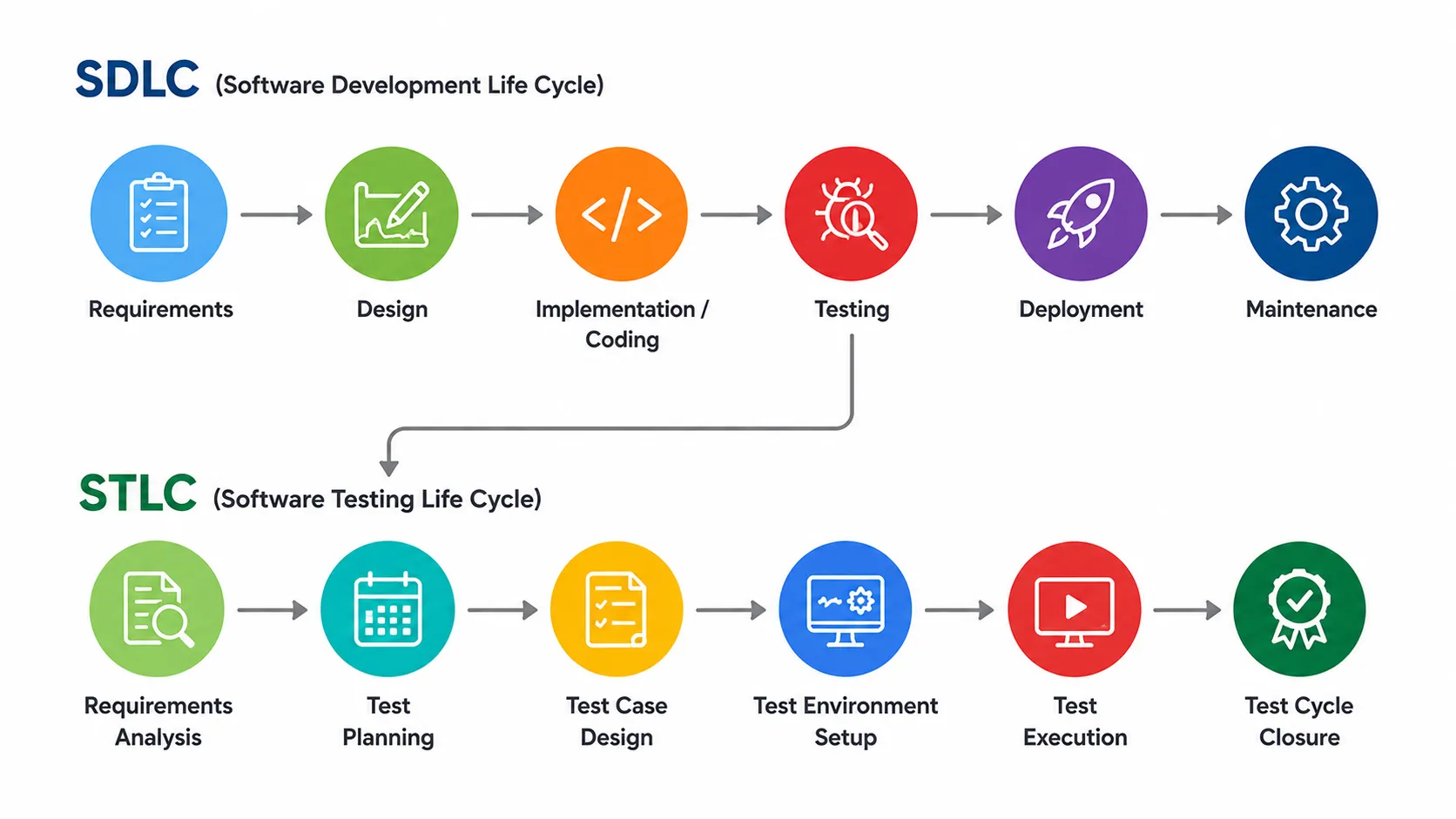
Phase 1: Requirements Analysis: Where QA Should Start, Not Finish
What it is: QA reads through everything before dev writes a line. Business requirements, user stories, acceptance criteria: all of it gets reviewed to check whether what's been asked for can actually be tested.
Why it's needed: Here's what happens when this phase gets skipped: the requirement says "validate user input," dev interprets it one way, QA assumes another, and a payment edge case slips through four sprints before a customer finds it. That's a requirements problem nobody caught early enough.
What we do:
- Go through business requirements and user stories, looking for gaps, contradictions, and things that can't be verified.
- Make the requirements traceability matrix such that each requirement links to one or more test conditions.
- Start test documentation early rather than scrambling to backfill it after execution.
- Flag automation candidates now, before the test plan locks in.
For teams working under IEC 62304, ISO 14971, or ISO 13485, this phase also sets up the software validation and software verification trail that regulators will ask for.
Phase 2: Test Planning: The Decisions That Determine Everything Downstream
What it is: Before anyone writes a test case, the team agrees on the strategy: what gets tested, how, by whom, and in what order. That's test planning.
Why it's needed: In the absence of an action plan, everyone does what feels right. Someone covers the login flow repeatedly. Nobody touches the payment integration. The release goes out with unknown coverage. That's not a testing problem. That's a planning problem.
What we do:
- Nail down the software testing strategies, scope, and a shared definition of what "done" actually means.
- Pick test tools and Test Automation Frameworks that fit the team's stack, not just what's popular.
- Use a Gantt chart to map timelines and catch scheduling conflicts before they cause delays.
- Apply risk management and risk-based prioritisation so the highest-stakes areas get covered first.
- Set clear criteria for moving between phases so nothing quietly drops when sprint pressure builds.
In agile methodologies, this compresses into sprint planning. It makes sense, provided that the criteria have been established instead of being presumed.
Phase 3: Test Case Design and Development: Building What You'll Actually Execute
What it is: This is where QA engineers write the actual test cases. Not rough notes. Cases that can be followed properly, repeatedly, and reviewed by someone else to do it themselves.
Why it's needed: Bad test case design is expensive and quiet. You get 300 test scenarios covering the same happy path, zero edge case coverage, and results that tell you nothing useful about what will break in production.
What we do:
- Write test cases using equivalence partitioning, boundary value analysis, and decision table testing to maximise coverage without bloating the suite.
- Structure coverage around the test pyramid and the main types of software testing: Unit Testing at the base, integration testing in the middle, functional testing and system testing at the top.
- Bring in a User Acceptance Tester to check cases against what the business actually needs.
- Have the Software Developer in Test own unit tests and integration test coverage.
- Lock in Test Automation Frameworks and identify which test automation scripts belong in automation vs. which should stay manual.
Phase 4: Test Environment Setup: The Phase Most Teams Get Wrong
What it is: Getting the infrastructure, data, and integrations ready so that test results reflect what real users will experience across the software system, not just what works on a dev laptop.
Why it's needed: We've seen every test pass in QA and half fail on release day. Code unchanged. The environment had drifted. User trust takes the hit, and user experience suffers for it.
What we do:
- Mirror production as closely as possible: same data shapes, same integrations, same infrastructure config.
- Set up performance testing software and load testing software with the infrastructure they actually need to simulate real load.
- Run visual testing and UI tests, so User interface regressions don't slip through unnoticed.
- Keep test data isolated per tester so one run doesn't corrupt the next.
Phase 5: Test Execution: Running the Suite, Managing Defects, Tracking Progress
What it is: The tests run. Results get logged. Defects get triaged, fixed, and verified. Then you do it again. Execution is a cycle.
Why it's needed: A lot of teams treat execution like a single event: run everything, collect results, mark it done. That works until a P1 gets logged on day three with no clear owner. Sign-off slips, the release date moves, and everyone's firefighting instead of testing.
What we do:
- Run manual testing and automated testing, covering every layer of qa testing, in the agreed sequence rather than whatever feels urgent.
- Log every software bug with severity and priority separated, because they mean different things, and mixing them up wastes dev time.
- Move each issue through the full defect life cycle: new, assigned, fixed, verified, closed. No shortcuts.
- Watch the metrics that matter: pass rates, defect density, blocked test count, first-pass yield.
- Use AI in software testing and machine learning to catch anomalies early and flag parts of the codebase most likely to fail.
Most engineering teams running Agile today treat the CI/CD pipeline as the default execution environment, meaning test runs happen continuously rather than as a sprint-end event. For teams that want testing embedded across every stage of delivery rather than bolted on at the end, working with a partner that offers full-cycle software development ensures quality assurance is built into the architecture from day one rather than treated as a final checkpoint.
Phase 6: Test Closure: The Phase That Turns Results Into Institutional Knowledge
What it is: Once execution wraps, someone needs to write down what actually happened: what passed, what failed, what was deferred, and what the next team inherits. That's test closure.
Why it's needed: Most teams jump from "release approved" straight to the next sprint. Nobody documents the decisions. Six months later, the same gaps appear, and nobody remembers why that area was skipped or which defects were deferred. QA keeps starting from zero.
What we do:
- Produce the test closure report and pull together all test documentation in one place.
- Run a proper defect analysis: what broke, why it broke, how it was resolved.
- Record every deferred defect with a clear reason: not just "won't fix" but the actual rationale and risk acceptance behind it.
- Lock in a coverage baseline so the next release has something real to build from, not just a blank slate.
STLC in Agile and CI/CD Environments: How the Phases Adapt Without Disappearing
A lot of Agile teams push back on this. "We move too fast for a formal STLC." Fair point on the surface. But Agile teams run all six phases of the testing lifecycle already, just compressed and without always naming them. Pair programming and shift-left testing spread quality work across the sprint. The phases don't disappear; they fold into ceremonies that already exist.
In a two-week sprint, the STLC phases tend to map like this:
According to Gartner, teams that explicitly map QA activity to Agile ceremonies report noticeably fewer defect escapes than teams treating testing as one undifferentiated block at the end.

How Frugal Testing Builds and Manages the Full STLC for Your Engineering Team
Most QA vendors get called in at Phase 5. By then, the test strategy was never written, and the environment was set up by whoever had spare time. We come in at Phase 1.
Frugal Testing has worked with 50+ engineering teams across SaaS, fintech, and healthcare in the US. We own the full lifecycle: software testing strategies, test tools selection, test creation, environment setup, regression testing, and the test closure report, all structured to fit Agile sprint cadences.
What Our STLC Engagement Looks Like
- Weeks 1 to 2: We start with discovery. We audit what test assets already exist, find the coverage gaps, and agree on the scope before writing a single test case.
- Weeks 2 to 3: Strategy and test creation. We write the test plan, choose Test Automation Frameworks, identify what to automate, and get the environment ready.
- Weeks 3 to 6: Execution and defect management. We run the suite inside continuous integration pipelines, manage the defect life cycle, and report progress daily.
- Week 6 onwards: Closure and handover. You get a test summary, a coverage baseline, and a suite your team owns and can maintain without us.
Who This Is For
Best fit for product teams of 20 to 200 engineers shipping weekly, where QA is missing, stretched thin, or pulled in too late. Three signs it's time to call us:
- Regression tests are spilling into the next sprint.
- Nobody knows the real test coverage before a release.
- A bug reached a customer that QA should have caught.
If any of that rings true, let's have a conversation.

Conclusion
The software testing life cycle doesn't exist to create a process for the sake of it. It exists because quality doesn't survive without structure, and most teams find that out the hard way.
Six phases. None of them optional. Get through all of them properly, and releases stop feeling like a gamble. Skip one, and it tends to show up in the next one. Understanding the STLC life cycle isn't the hard part. Actually running it, every release, is where most teams fall short.
People Also Ask (FAQs)
Q1. Who is responsible for the STLC in a software team?
Ans: The QA lead typically owns the STLC, but it's a shared effort. Developers, business analysts, and product managers all play a role, especially in the early phases like requirements analysis.
Q2. What happens if you skip a phase in the STLC?
Ans: Skipping a phase doesn't save time. It moves the problem forward. A missed planning phase means chaotic execution. Skipped closure means the next release starts without knowing what went wrong.
Q3. Is STLC only for large teams or enterprise projects?
Ans: No. Teams of any size follow the STLC, though smaller teams compress the phases and lean more on automation. The structure scales down; the phases themselves don't disappear.
Q4. How is STLC different from manual testing?
Ans: Manual testing is one activity within the STLC, specifically in the execution phase. STLC is the full process surrounding it, from planning what to test through documenting the results.
Q5. What is the most commonly skipped phase in the STLC?
Ans: Test closure is skipped most often. Teams finish execution, declare the release done, and move on. Without closure, there's no record of what was covered, what was missed, or why.



.webp)