


Every security team eventually hits the same wall: Hundreds of open findings, a handful of engineers, and no clear order to fix them in. Vulnerability management tools exist to solve exactly that problem. They find, rank, and track security weak spots across cloud systems, containers, endpoints, and network devices, then push each one to a verified fix.
Published CVEs crossed 48,000 in 2025, per the CVE Program, and no team can patch everything. The best vulnerability management platforms in 2026 pair steady vulnerability scanning with EPSS and CISA KEV signals, so teams know which findings need attention this sprint instead of guessing from a severity number alone.
What Is Vulnerability Management, and How Is a Tool Different From a Scanner?
What is vulnerability management? It is the ongoing work of finding, checking, and fixing security weak spots before attackers do. What is vulnerability assessment? It is the exercise of identifying and rating those weak spots at one point in time. What is vulnerability scanning? It is the automated process that locates them across servers, apps, and cloud assets. A vulnerability management tool ties all three into one continuous program, and that is what separates a real vulnerability management platform from a plain scanner.
The VM Lifecycle: Discover, Assess, Prioritise, Remediate, Verify
Every vulnerability management process runs through five steps:
- Discover every asset across the estate.
- Assess and scan them for known weak spots.
- Prioritise findings by real risk, not just severity.
- Remediate the confirmed issue.
- Verify the fix actually held.
Most teams handle discovery and scanning fine, since that part is largely automated. Programs break down at prioritisation and verification: A raw CVSS-sorted list does not say what to fix first, and closing a ticket does not prove the flaw is gone.
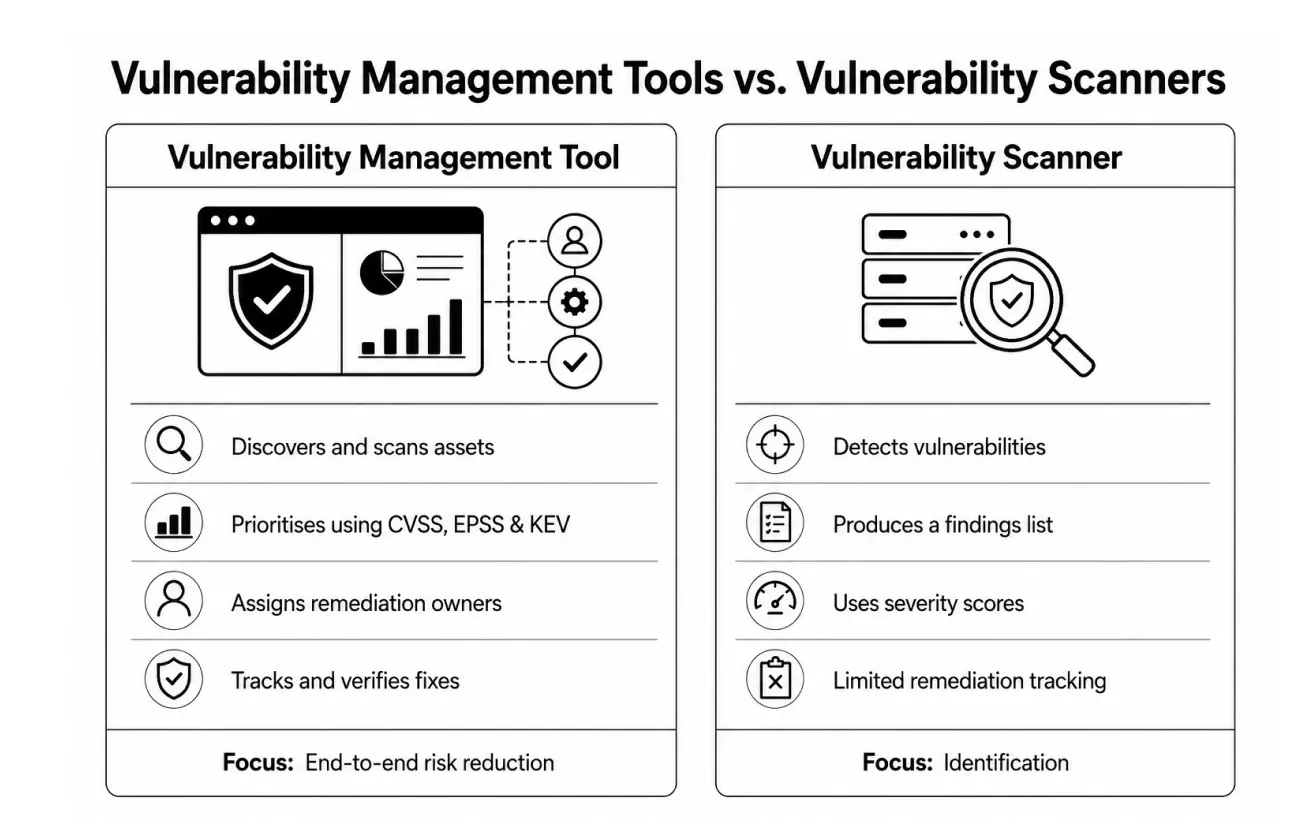
VM Tools vs. Vulnerability Scanners: Where the Line Is
Standalone vulnerability scanning tools such as Nessus, OpenVAS, and Trivy tell you what is wrong. Full vulnerability management platforms such as Tenable One, Qualys VMDR, and Rapid7 InsightVM go further: They say what to fix first, who owns it, and whether the fix held. Buying vulnerability scanning software when you actually need a vulnerability management solution with remediation tracking is a common, costly mix-up.
What to Look for in a Vulnerability Management Tool in 2026
A strong vulnerability management program in 2026 rests on six checks:
- Coverage breadth and deployment model.
- Prioritisation that names EPSS and CISA KEV, not just CVSS scoring.
- Two-way ITSM integration.
- False-positive control.
- Remediation tracking speed.
- Audit-ready compliance reporting.
These same six checks apply whether you want a full platform or a smaller set of vulnerability assessment tools for one gap.
EPSS, CISA KEV, and Why CVSS Alone Is No Longer Enough
CVSS scoring is a fixed, theoretical severity rating from 0 to 10. It does not change even if nobody is exploiting the flaw. EPSS, the Exploit Prediction Scoring System from FIRST.org, is a daily probability score for how likely a CVE will be exploited in the next 30 days. CISA KEV is a live catalogue of vulnerabilities with confirmed real-world exploitation. A CVSS 9.8 vulnerability nobody is exploiting can be lower priority than a CVSS 6.5 sitting in the KEV catalogue with active exploitation behind it. Any vulnerability management best practices guide worth following in 2026 says the same.
Our Take: CVSS-only prioritisation is not a small gap this year. It is a sign the tool has not kept pace with how attackers work. A demo that cannot show live EPSS and KEV data is a scanner wearing a platform's marketing.
Agent-Based vs. Agentless Scanning, and Where CSPM Tools Fit
- Agent-based scanning gives deep runtime data once installed, but misses anything without an agent. This matters for enterprise vulnerability management across thousands of endpoints.
- Agentless vulnerability scanning reads the environment through APIs and snapshots, enabling fast cloud vulnerability scanning with no install step, though with less runtime depth.
- Many cloud security posture management tools, such as Wiz and Prisma Cloud, fold scanning in as one module inside a wider CNAPP rather than a standalone product.
Most enterprise teams run both models: Agentless for cloud and container vulnerability scanning tools, agent-based for stable endpoints. Risk-based vulnerability management, in practice, means weighing CVSS, EPSS, and KEV together against asset value, not picking one signal alone.
The 10 Best Vulnerability Management Tools in 2026
This vulnerability management tools comparison maps ten leading vulnerability management products to where each is strongest, since no single tool wins in every setup.
Tool-by-Tool Breakdown: Features, Strengths, and Where Each Falls Short
Tenable One and Nessus: Broad Enterprise Coverage and Compliance Depth
Tenable One carries the broadest plugin and CVE coverage among vulnerability management vendors, with compliance mapped to NIST, SOC 2, PCI DSS, and FedRAMP, common for enterprise vulnerability management. Nessus began as vulnerability assessment software before Tenable One grew around it. The trade-off: Cloud-native coverage sits inside a wider portfolio, and configuration takes real time.
Qualys VMDR: Scan-to-Patch Compliance for Regulated Enterprises
Qualys VMDR blends TruRisk scoring, threat intelligence plus CVSS, with Cloud Agent deployment and built-in patch management tools that close the loop from finding to fix. Regulated teams tend to like the tight scan-to-patch workflow once it is set up. The trade-off: licensing complexity and module sprawl can slow smaller teams during evaluation.
Rapid7 InsightVM: Action-Oriented Remediation Tracking
Rapid7 InsightVM stands out for Remediation Projects, which assign and track fixes with the teams that own them, plus Active Risk scoring for real-world exploitability. It is one of the stronger vulnerability remediation tools for reporting mean time to remediation to leadership. The trade-off: Cloud depth is thinner than a cloud-native platform, and value assumes broad agent rollout.
Wiz: Attack-Path Context for Cloud-Native Teams
Wiz uses an agentless security graph to map vulnerabilities onto attack paths, useful for container vulnerability scanning and Kubernetes work, and that attack path analysis changes triage decisions. The trade-off: it is built only for cloud; on-premises endpoints need a different tool, and pricing sits at the premium end.
Microsoft Defender Vulnerability Management: The Native Choice for Microsoft Estates
Microsoft Defender Vulnerability Management integrates natively with Defender for Endpoint and Intune, which is close to free incremental value for teams already on E5 licensing. The trade-off: Non-Windows and multi-cloud coverage needs supplementing elsewhere, so it rarely stands alone in a mixed estate.
CrowdStrike Falcon Exposure Management: Threat-Intel-Driven Prioritisation
CrowdStrike Falcon Exposure Management ranks findings using ExPRT.AI, its own threat intelligence on real-world weaponisation and attacker activity, not just CVE severity. The trade-off: value depends heavily on existing Falcon agent coverage, so teams not already running Falcon get less from this module alone.
Palo Alto Prisma Cloud: Multi-Cloud Platform Consolidation
Palo Alto Prisma Cloud folds vulnerability management into a broader CNAPP across hybrid and multi-cloud environments, useful for teams consolidating several security vulnerability tools onto one vendor. The trade-off: Full value needs multiple modules, and credit-based pricing is hard to forecast.
SentinelOne Singularity Cloud Security: Runtime Protection With Verified Exploit Paths
SentinelOne pairs Verified Exploit Paths and runtime protection with vulnerability tracking software, tying findings to endpoint forensics in one console. The trade-off: Teams with heavy network-scanning needs will still want a dedicated scanner alongside it.
Intruder: Continuous External and Internal Scanning for Lean Teams
Intruder is one of the simpler automated vulnerability scanning tools on this list: Continuous external and internal scanning that a generalist admin can run, on tiered SMB pricing. The trade-off: it is not built for the compliance depth large regulated enterprises need, and it is not trying to be.
OpenVAS, Trivy, and DefectDojo: When Open Source Is the Right Starting Point
OpenVAS covers network and host scanning, Trivy is one of the more approachable code vulnerability scanning tools for container images, and DefectDojo builds an open source vulnerability management dashboard from multiple scanners. These are solid open source security testing tools and a fair open source software vulnerability scanner tier, but none replace the prioritisation logic a commercial platform gives out of the box.
How Frugal Testing Helps Close the Application Security Gap
A vulnerability management platform scans OS-level CVEs, cloud misconfigurations, and known library flaws. It does not reach custom code, API logic, or login flows- the OWASP Top 10 issues that need web application security testing, mobile application security testing, and manual review. Closing that gap means static application security testing (SAST), dynamic application security testing tools (DAST), and API security testing working together, since SAST, DAST tools, and infrastructure VM platforms pair up rather than substitute for each other. Mature security vulnerability management solutions run side by side.
What a Frugal Testing Application Security Engagement Looks Like
We ran a vulnerability assessment for an Abu Dhabi-based e-wallet provider before a production launch. Testing found 3 critical, 3 high, and 1 medium-severity issue, including a backend remote code execution flaw and a chainable CSRF-plus-XSS pair that could take over the admin panel. None were infrastructure CVEs a scanner would catch; they sat in the payment gateway and merchant logic, exactly where a VM platform does not reach. A typical engagement scopes the apps and APIs in play, runs SAST and DAST plus manual testing, and delivers a prioritised report mapped into the team's workflow.
Who This Application Security Layer Is Right For
- Teams in regulated industries needing third-party validation for SOC 2, HIPAA, or FedRAMP.
- Security leads with a vulnerability management platform for infrastructure but no application-layer coverage.
- Growth-stage companies facing enterprise security reviews or vendor risk checks.
Frugal Testing is a software testing services company offering security work as part of a wider practice: Mobile app security testing, API security testing, and managed vulnerability scanning delivered as vulnerability scanning services or vulnerability assessment services.
How to Choose the Right Tool for Your Environment
Start by mapping your real environment-cloud, endpoints, containers, network devices, and custom apps-against a vendor's demo.
Which one fits your team?
- Cloud-first, ephemeral infrastructure? Start agentless (Wiz, Prisma Cloud, Intruder).
- Stable, large endpoint estate? Agent-based (Tenable, Rapid7, CrowdStrike) earns its overhead.
- Already on Microsoft or Falcon? The native module usually beats a parallel platform.
- No internal program capacity? A managed vulnerability scanning service can run this for you.
Before signing anything, run a proof of concept on your own assets, usually two to four weeks. Confirm EPSS and CISA KEV are wired into the logic, count false positives in the first 100 findings, and check that findings auto-create tickets.
"A tool that ranks a theoretical CVSS 9.8 above a confirmed, actively exploited CVSS 6.5 in CISA KEV isn't protecting you. It's giving you a false sense of order."
Conclusion
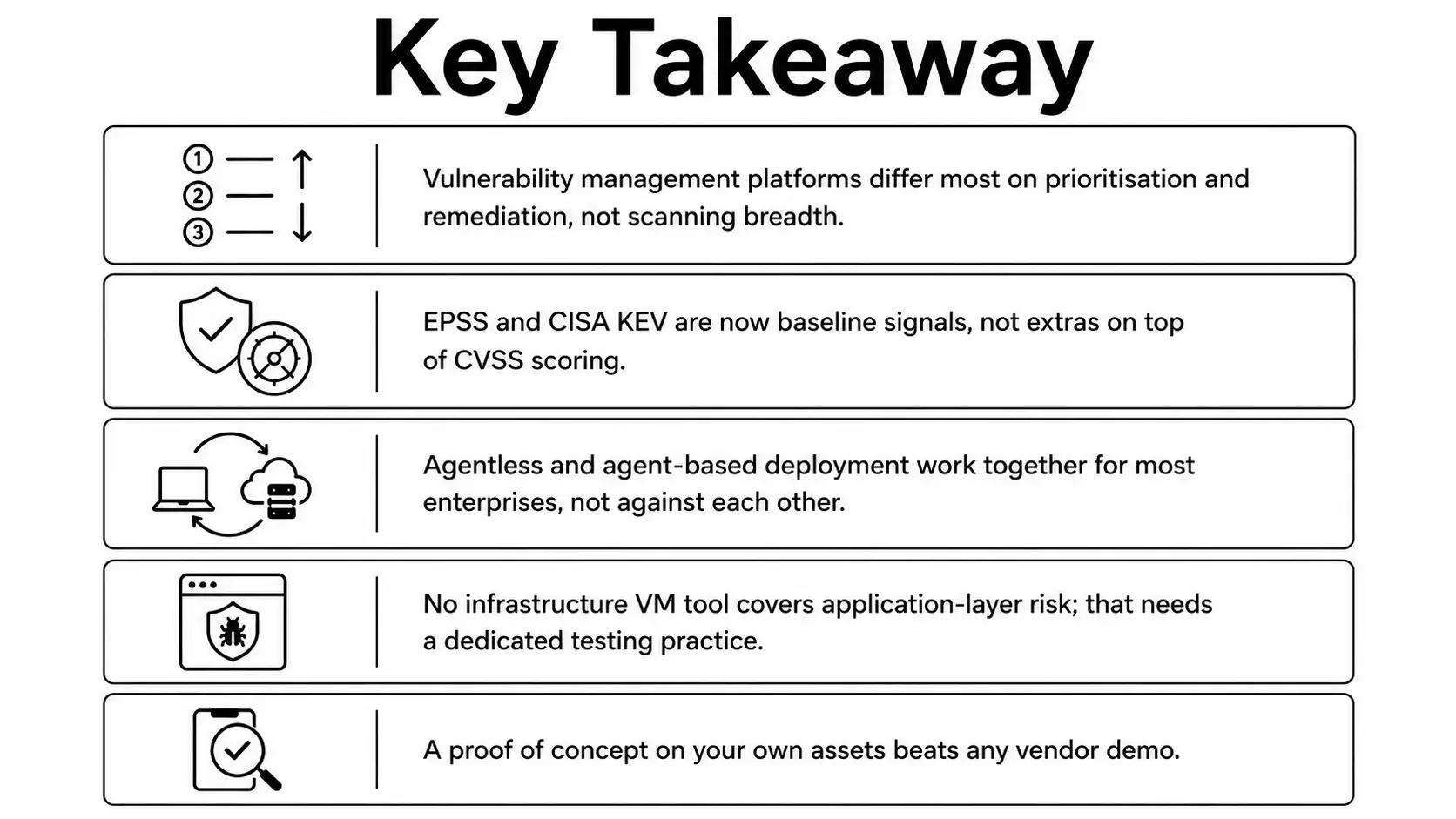
Ranking tools by CVSS alone was fine five years ago, not anymore. The best vulnerability management software in 2026 treats EPSS and KEV as core signals, closes findings instead of just listing them, and admits that infrastructure coverage and application security are two different jobs. No piece of security vulnerability software is exempt from that standard. Beyond security, Frugal Testing is also one of the software testing companies covering quality assurance services and qa testing services more broadly, including automation testing services, performance testing tools and performance testing services, usability testing services, and generative AI in software testing.
People Also Ask (FAQs)
Q1. How much does a vulnerability management platform typically cost for an enterprise team?
Ans: Enterprise platforms usually run from a few thousand to well over six figures a year, based on asset count, modules, and whether agent-based or agentless licensing applies.
Q2. How often should a vulnerability management program run scans?
Ans: Continuous or daily scanning is standard for cloud and internet-facing assets in 2026, while internal network scans often run weekly, backed by real-time EPSS and CISA KEV alerts.
Q3. Do vulnerability management tools integrate with cloud security posture management tools?
Ans: Yes, most modern platforms include or connect to CSPM features, since cloud misconfigurations and vulnerable software need joint review to see true exposure.
Q4. How long does it typically take to deploy a new vulnerability management platform?
Ans: Agentless setups can cover cloud assets within days. Agent-based rollout across a large enterprise estate usually takes four to eight weeks, depending on change management.
Q5. Are vulnerability management tools suitable for mobile application security testing?
Ans: Not alone. Vulnerability management tools cover infrastructure and device-level risk, while mobile app security testing needs dedicated static and dynamic analysis of the app itself.


%201.png)