

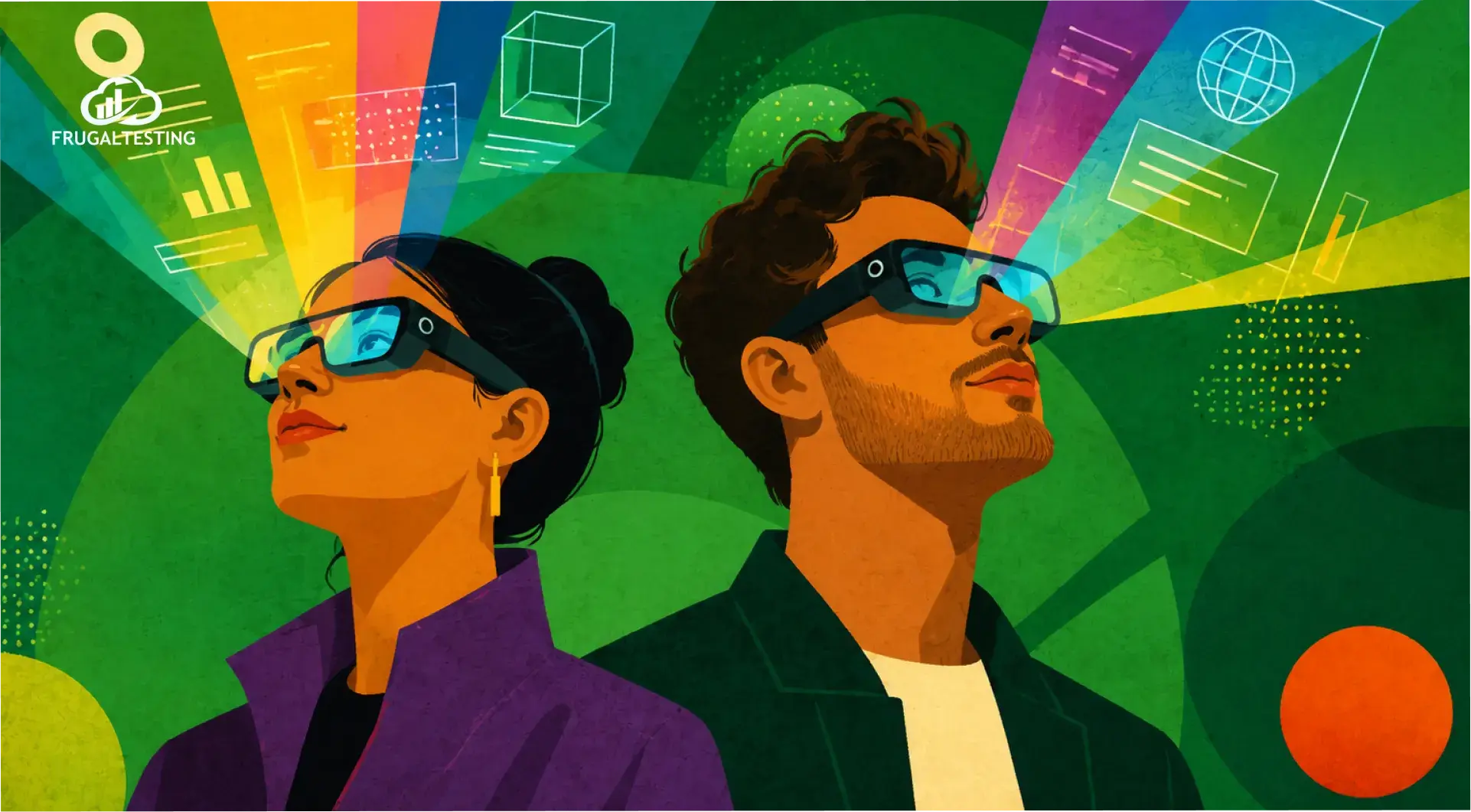
Your Meta glasses look like ordinary frames until you realize the complexity hiding inside. Dual RGB cameras track your surroundings. Neural Band sensors read your intent. Generative AI processes commands with capabilities that make Google Translate look primitive. Computer vision, augmented reality rendering, mixed reality anchors-all running simultaneously on a battery that lasts 8 hours. That technological density is why testing Meta glasses matters. Skip rigorous QA, and you launch a product that fails in the real world. Get it right, and you ship confidence.
This is the untold story of how Ray-Ban Meta Display Glasses, Meta Scriber Optics, and generative AI features survive months of rigorous validation before reaching your hands.
What Makes Meta AI Glasses More Than Just Eyewear
A smartphone crashes? Restart it. Smart glasses lag or overheat? You get motion sickness, eye strain, or thermal burns.
That's the difference. Meta glasses and display glasses aren't phone replacements. They're a new category with new failure modes. The hardware is dense with dual RGB cameras for computer vision, eye-tracking cameras, an IMU capturing head motion, microphones integrating with Bluetooth headphones, and a proximity sensor. Each is a data source. Each can fail independently. Before this tech works reliably, every component gets validated in isolation, then together as a system.
Real-World Impact: When Testing Matters
Picture this: A content creator explores an unfamiliar historical site for a TikTok video wearing Ray-Ban Meta Display Glasses with Meta Blayzer Optics. They point at a monument and ask, "What is this?" The generative AI instantly identifies it and pulls historical context through the Meta View app-delivering capabilities far beyond what a simple Google Translate tool could provide. They hit record, and the built-in video recording system applies colour grading in real-time to match challenging outdoor lighting.
Four hours later, they've shot 200 minutes of content. Battery sits at 15% remaining. Video quality is flawless. Colour grading adapted flawlessly to every lighting change. The generative AI never halted. If QA had been rushed, the device would overheat after two hours, colour grading would introduce artefacts, and battery would die at three hours. That's the real cost of skipping rigorous testing.
The Core Testing Process: What Actually Happens
Hardware Stress Testing
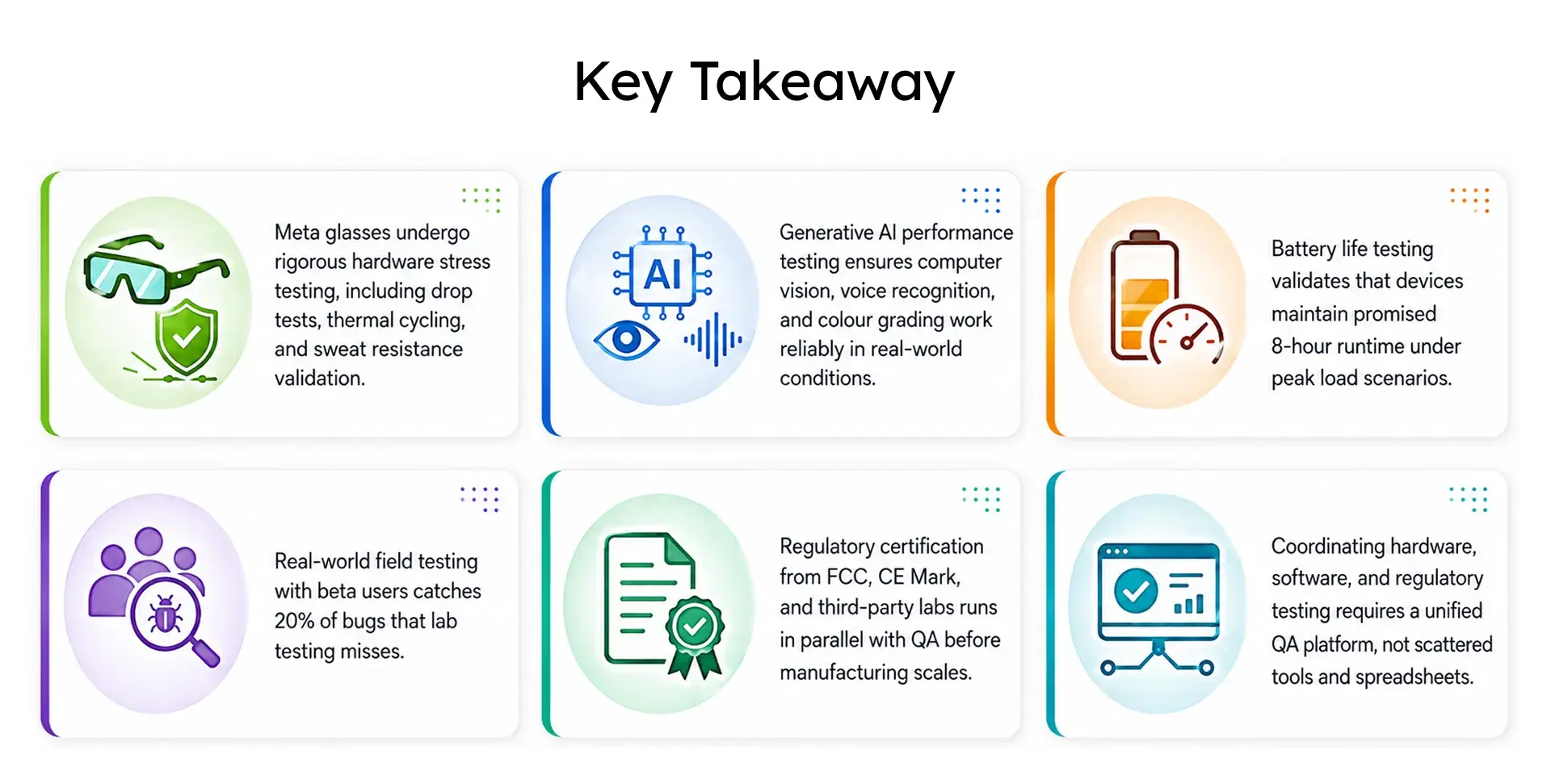
- Drop tests follow IEC 60068 standards; devices drop repeatedly from one meter onto concrete, steel, or carpet.
- Sweat and salt-spray resistance testing simulates six months of daily wear in 72 hours.
- Thermal cycling stresses frames between -10°C and +60°C to catch solder joint cracks and battery degradation impacting battery life.
- Hinge durability testing runs 10,000+ open-close cycles representing five years of wear.
- Thermal safety validation ensures surface temperature stays below 45°C per IEC 60950-1 standards.
- Battery life testing validates the device maintains promised 8-hour runtime under peak load scenarios.
AI and Software Performance Testing
- Computer vision accuracy gets tested against thousands of real-world images with varied lighting, motion blur, and video recording scenarios.
- Model latency under thermal load must guarantee sub-80ms end-to-end latency even when thermally throttled.
- Voice command accuracy testing happens in noisy environments with Bluetooth headphones requiring seamless audio handoff.
- Colour grading and video processing capabilities using generative AI must work flawlessly across lighting conditions, adapting in real-time without introducing latency or battery drain.
- Edge-case handling validation covers camera tracking failure, voice processing failure, or GPS drops; the device must gracefully degrade without crashing.
Privacy and Security Audits
- Data leak checks validate that recordings aren't stored on the device or transmitted without authorisation.
- Unauthorised recording prevention gets red-team tested to ensure users maintain full control over their content.
- All data in transit and at rest must be encrypted per FCC and GDPR standards for maximum protection.
- Third-party library audits catch vulnerabilities before they become security risks.
- Colour grading and video recording data must be isolated from non-essential system processes.
- Generative AI model weights and processed data remain locally on-device without cloud synchronisation without explicit consent.
Real-World Testing Beyond the Lab
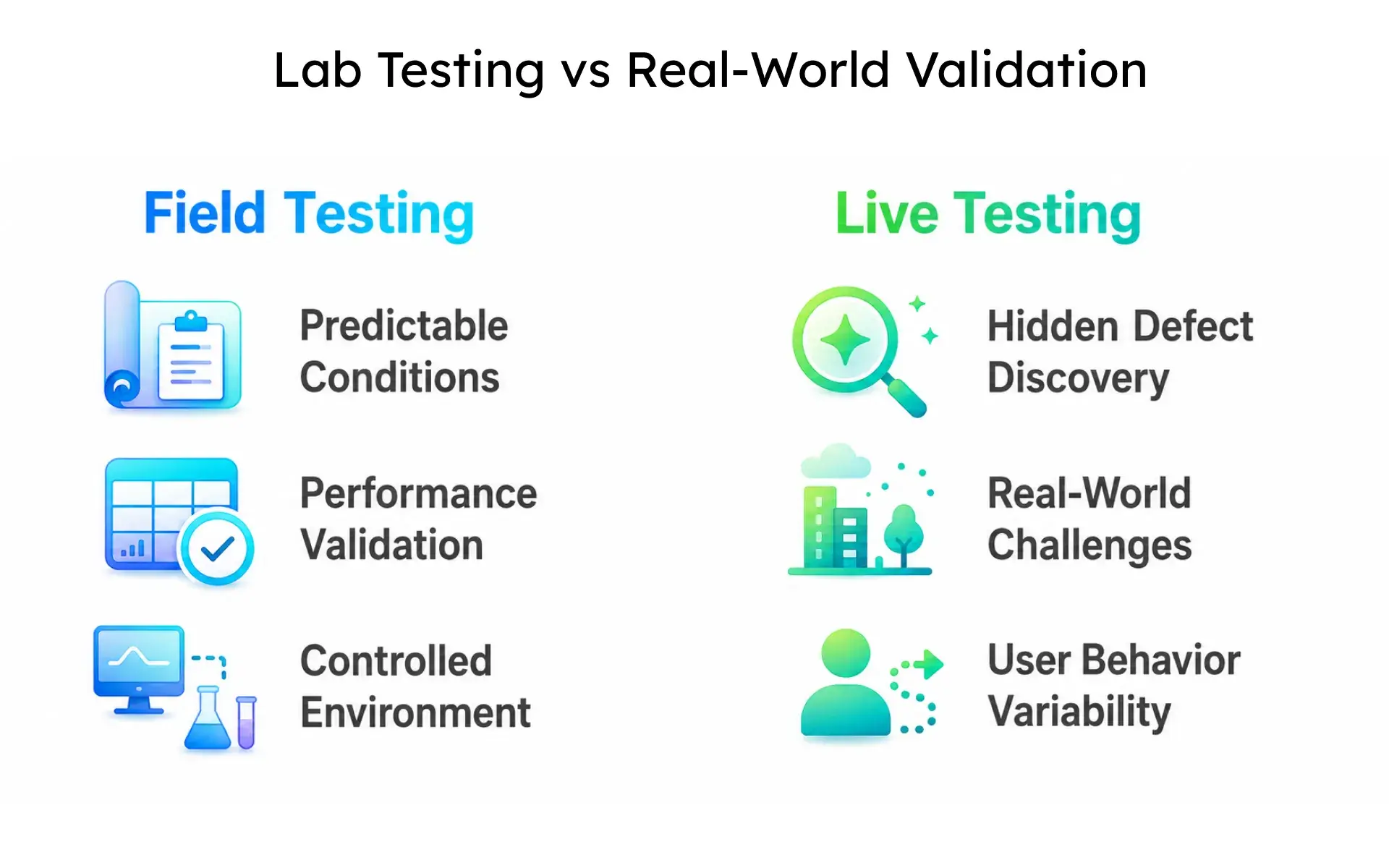
Lab testing catches 80% of bugs. Real-world testing catches the other 20%, and that 20% is what kills products.
Beta Users and Internal Testers
How real people surface bugs that lab conditions miss. Beta testers use Ray-Ban Meta Display Glasses and models paired with Meta Blayzer Optics in actual situations. Walking through offices with the Meta View app active. Navigating in cars with colour grading applied to video recording. Outdoor use with Bluetooth headphones. Social scenarios requiring augmented reality anchors and voice commands.
They report comfort issues, latency hiccups, colour grading failures, and media import problems with mixed reality anchors. The feedback loop iterates rapidly. Firmware updates validate fixes.
Regulatory and Safety Certifications
FCC, CE marking, and eye/ear safety standards before the product ships. Regulatory certification runs in parallel with functional testing. The FCC audits electromagnetic interference and radio frequency safety. The CE Mark audits optical and thermal safety. Eye and ear safety standards cap blue-light exposure and audio levels. Third-party labs verify compliance before manufacturing scales.
Orchestrate Wearable Device QA with Frugal Testing Software
Testing Meta glasses touches seven disciplines: hardware validation, computer vision benchmarking, augmented reality experience evaluation, thermal stress, regulatory compliance, field validation, and security audits. These are rarely managed in one place.
Frugal Testing software provides the test management framework and automation backbone for coordinating this complexity. The platform tracks hardware test results from partner labs, integrates software testing pipelines, correlates failures across disciplines, and maps results to regulatory requirements. You set the test gate criteria, and the software tracks whether you've passed compliance for Meta Blayzer Optics specifications, colour grading robustness, generative AI performance, and battery life benchmarks. No spreadsheets. No manual handoffs. Automatic compliance documentation for FCC and CE Mark submissions.
Your team owns testing execution. Frugal Testing software owns the orchestration, visibility, and compliance workflow.
Why This Testing Process Matters to You
Rigorously tested Ray-Band Meta Display Glasses keep augmented reality anchors locked in place. Voice commands work consistently. Video recording captures flawless content with accurate colour grading. Battery life holds up through real-world use. That reliability builds trust because the device delivers on its promises.
Conclusion
Meta glasses don't just ship. They survive a testing gauntlet most consumers never see. Hardware stress. Generative AI validation. Real-world field testing. Regulatory sign-off. Battery life validation. That rigour is exactly why smart glasses work when it reaches your hands.
As augmented reality and mixed reality become mainstream, this level of testing rigour is table-stakes. Companies shipping confidence aren't just building hardware. They're testing it systematically, tracking it meticulously, and proving it thoroughly.
People Also Ask (FAQs)
Q1. How often do Meta AI Glasses get tested before they ship?
Ans: Testing is continuous from design through release phases. Firmware updates trigger re-validation of 80% of the test suite. Major hardware refreshes require 16-24 weeks of full testing.
Q2. Can a consumer tell if smart glasses were rigorously tested?
Ans: Absolutely. Rigorous testing shows up in stable anchors, consistent voice commands, accurate colour grading, and reliable battery life. Under-tested devices drift, lag, overheat, and fail unpredictably.
Q3. Why do some augmented reality glasses feel sluggish?
Ans: Latency testing reveals performance bottlenecks. Snappy devices pass aggressive latency gates below 80ms end-to-end. Sluggish devices often skipped latency optimisation or ship with thermal throttling that testing missed.
Q4. What happens if regulatory testing finds safety issues right before launch?
Ans: It's catastrophic. Smart companies run regulatory testing in parallel with QA. Finding thermal safety issues at month 20 is manageable. Finding them at month 24 derails shipping schedules.
Q5. Can you outsource wearable device QA with a small team?
Ans: Yes. Most teams outsource 60-80% of wearable QA and keep 1-2 in-house engineers for liaison and regression testing. It's faster and more cost-effective than hiring specialists.

.webp)